Five Giants Devour Nearly 60% of Global Ad Spend? AI Has No 'Equal Rights,' Only 'Centralization of Power'
On June 16th, WPP Media released the global mid - year advertising forecast report "This Year Next Year 2026", raising the growth rate expectation of global advertising revenue after excluding the impact of political advertising from 7.1% predicted in December last year to 8.9%. More thought - provoking than the data itself is a metaphor put forward in the report.
The report compares the current AI development boom to the "Manifest Destiny" in 19th - century America - an ideological trend of the era that believed expansion was inevitable and that one must keep moving forward, even if it would come at a huge cost.
Kate Scott - Dawkins, the head of WPP's business intelligence, said bluntly at the press conference that under the rhythm of "must win, must be fast", the technology industry is caught in a new gold rush of "seizing the opportunity at all costs". If the industry was still discussing what AI could do last year, the core topic this year has become how fast AI will eat up traditional traffic entrances and grow into new trading channels. The deep - seated connection between the advertising industry and the technology industry also determines that this round of growth will be led by AI.
The most alarming implication of this report lies here: When AI changes from an efficiency tool to the industry itself, on one side of the rapid progress is the incremental dividend, and on the other side is the accelerated concentration of power.
It's not just the growth rate that's being raised: From cyclical rebound to structural increment
Let's first look at the incremental side of this rapid expansion.
In just half a year, WPP raised its annual growth rate expectation by nearly 2 percentage points. What caused this change?
The most direct trigger is that the market performance in the first quarter exceeded expectations. Kate Scott - Dawkins said that despite the continuous economic pressures such as the situation in Iran, tariff policies, and supply - chain issues driving up consumer goods costs, the global advertising market still showed strong resilience.
The financial reports of leading platforms also confirmed this judgment: In the first quarter of 2026, Meta's advertising revenue increased by 33% year - on - year, Google's search advertising revenue increased by 19% year - on - year, and Amazon's advertising business revenue increased by 24% year - on - year. All three outperformed market expectations.
However, the better - than - expected performance in the first quarter is just a surface signal. The core ballast stone supporting the annual expectation is the clear and definite incremental growth in the second half of the year.
The top one is the US market. As the largest single market contributing about 40% of the global advertising revenue, the US will experience both the World Cup marketing cycle and the mid - term elections in 2026. WPP expects that the advertising revenue in the North American market will grow by 11.6% this year. Just the mid - term elections alone will bring $12.4 billion in political advertising investment. This level of concentrated investment is enough to directly boost the global growth rate.
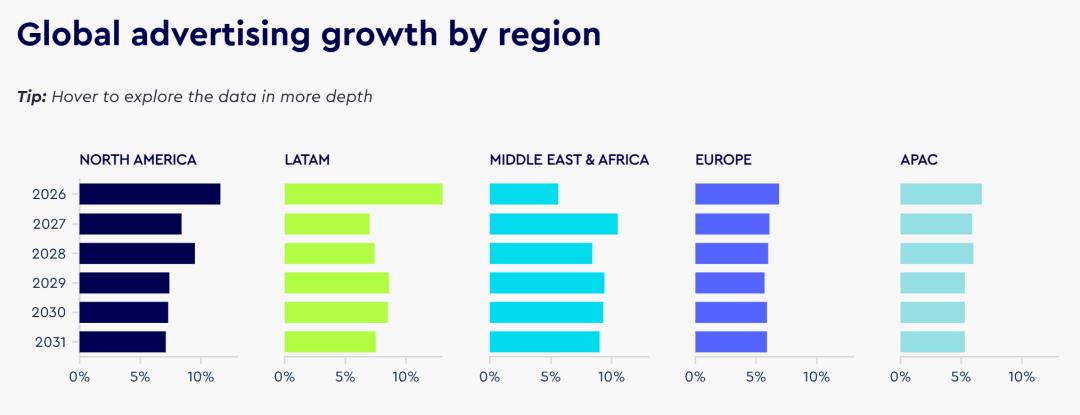
Meanwhile, Latin America is another explosive point. The annual advertising revenue in this region is expected to grow by 13%, making it the fastest - growing region in 2026. The growth momentum comes from the explosion of the retail media track and the popularity of World Cup marketing.
However, this kind of growth driven by sports events and election cycles still belongs to the traditional cyclical dividends of the advertising industry. What truly breaks out of historical patterns and rewrites the underlying logic of growth is the structural increment from AI.
AI drives growth through three parallel logics:
Expansion on the demand side: AI - native enterprises have become a brand - new group of advertisers. Enterprises competing around large - scale models, AI infrastructure, and intelligent agent applications are continuously increasing their investment in brand and performance advertising to compete for C - end users, developers, and corporate customers. This is a new budget pool that has never existed before.
Release on the efficiency side: AI has lowered the threshold for content production and advertising placement optimization. Brands use AI to complete material generation, placement optimization, and effect attribution. With the same budget, they can cover more marketing scenarios, which indirectly boosts the overall advertising investment scale.
Closed - loop on the supply side: Leading platforms have formed a positive cycle of "advertising revenue - AI R & D - product upgrade - revenue growth". Platforms continuously invest advertising revenue in AI technology iteration, and then use AI to improve the conversion efficiency and commercialization ability of advertising products. This cycle itself strengthens the growth resilience of the market.
Scott - Dawkins once clearly summarized: "Advertising is crucial to the economy and is also the key to funding the AI revolution." Technology companies use advertising revenue to support AI R & D, and then use AI to feed back advertising monetization. The two empower each other, allowing growth to break free from the constraints of traditional macro - cycles.
The report also mentioned that the proportion of global advertising revenue to GDP is expected to rise to the highest level since 1999, even exceeding the peak during the 2000 Internet bubble. However, different from the concept hype back then, the core support for this round of growth is measurable performance advertising, and the growth foundation is more solid.
AI has not weakened the platform's advantages; instead, it is accelerating industry concentration
Now that we've talked about the incremental story, let's look at the other side.
In the past few years, AI has often been described as a technology that lowers the threshold and promotes industry democratization. However, the reality is the opposite. In this AI - driven expansion, the distribution of dividends is not equal - it is putting more power in the hands of fewer people.

WPP data shows that excluding the Chinese market, the world's top three advertising sales platforms, Alphabet, Meta, and Amazon, are expected to account for 57.6% of the global advertising market share. Five years ago, this proportion was 43.8%. These three companies are also among the technology enterprises with the largest investment in AI, especially in continuously introducing generative AI capabilities into advertising products.
If Chinese Internet companies are included in the statistics, the top five global platforms, Google, Meta, ByteDance, Amazon, and Alibaba, together account for 58% of the market share.
Meanwhile, the speed of pattern change far exceeds industry expectations. In 2026, all the top ten platforms in global advertising revenue are digital - native enterprises. Traditional media companies are completely absent for the first time. The highest - ranked Disney only ranks 11th. Even if Paramount and Warner Bros. Discovery complete their merger, the new company is only expected to rise to the 9th place.
Overall, the top 25 global advertising platforms together take 75% of the market share. Power change is taking place. AI has not subverted the giants; instead, it is accelerating the "digital colonization" of the advertising industry. The barriers for the strong to remain strong are becoming more and more difficult to break.
So, why has AI not dispersed power but instead strengthened concentration? WPP's "Advertising Intelligence Framework" released in February 2026 provides an observation perspective.
This framework breaks down the capabilities of advertising platforms in the AI era into five dimensions: data assets, technology/AI capabilities, distribution capabilities, business/transaction capabilities, and content/media capabilities. The report points out that to remain competitive in the advertising market in 2030, platforms need to achieve "synchronous excellence" in all five dimensions. Currently, no company can achieve top - level performance in all dimensions. Those that can achieve "partial excellence" are precisely those technology giants that already hold an absolute market share.
The reason is simple. The construction of AI capabilities depends on three core elements: data, computing power, and engineering talents, and the thresholds for these three things are linear - the more data, the more accurate the model; the stronger the computing power, the faster the iteration; the more concentrated the talents, the better the product. Leading platforms have overwhelming advantages in these three dimensions.
Data flywheel: Google processes more than 8.5 billion search requests every day, Meta covers more than 3 billion monthly active users globally, and Amazon has the full - link shopping and payment data of hundreds of millions of consumers. The high - quality labeled data required for AI model training is itself deposited in the ecosystems of the giants, which is difficult for external players to reach.
Computing power barrier: From data center construction to GPU cluster procurement, from power supply to cooling systems, the investment threshold for AI infrastructure is keeping most potential competitors out. This is an arms race that only trillion - dollar - market - value enterprises can participate in. Small and medium - sized platforms do not even have the entry qualification.
Technical accumulation: For leading platforms, AI is not a new business but an underlying capability that has been deeply developed for many years. Google's DeepMind, Meta's PyTorch ecosystem, and Amazon's AWS AI services have long been deeply embedded in the advertising system.
Scott - Dawkins also pointed out at the press conference that large platforms have been using AI to optimize advertising systems "for more than a year or two", and this first - mover advantage will continue to expand with AI iteration.
Coupled with the risk - hedging ability of diversified business lines, when economic uncertainties impact one business segment, other segments can fill in. This anti - cyclical attribute itself is a competitive barrier.
Morketing observed that WPP also implicitly reminded advertisers in the report to be aware of the dependency risk: When core technologies and traffic entrances are concentrated in the hands of a very small number of platforms, the bargaining power and rule - making power will also shift synchronously. In the past few years, Apple's privacy policy adjustment directly impacted the industry's targeted advertising logic, and Google's third - party Cookie elimination plan repeatedly changed industry rules... Every time the rules change, advertisers can only passively adapt and have little space to participate in rule - making.
AI is accelerating this process. When new forms of traffic entrances such as generative search and AI Agents are also in the hands of a few platforms, advertisers will have fewer rather than more optional channels. The deeper the AI decision - making black box that platforms hold, the weaker the advertisers' control over the advertising placement logic. Eventually, they can only survive by relying on the platform's rule system.
Generative search advertising is becoming a new growth market
In addition to affecting the platforms themselves, AI has also given birth to a brand - new digital advertising channel - Generative Search.
WPP made a landmark statistical adjustment in this mid - year report: For the first time, it merged traditional search advertising and generative search advertising and included them in the new " Intelligence (Intelligent Search)" category for calculation. It is expected that in 2026, the entire intelligent search channel will contribute 21.8% of the global advertising revenue.
This is not a simple merger of statistical calibers but a confirmation of the independent channel status of generative search at the classification level.
WPP uniformly defines advertising forms in scenarios such as AI Overview and chatbots as generative search advertising. For example, the self - service advertising product launched by ChatGPT in May this year belongs to this category.
At present, its scale is still small: The global market size in 2026 is about $5.1 billion, accounting for only 0.4% of the total global advertising revenue. However, its growth rate is the fastest among all channels.
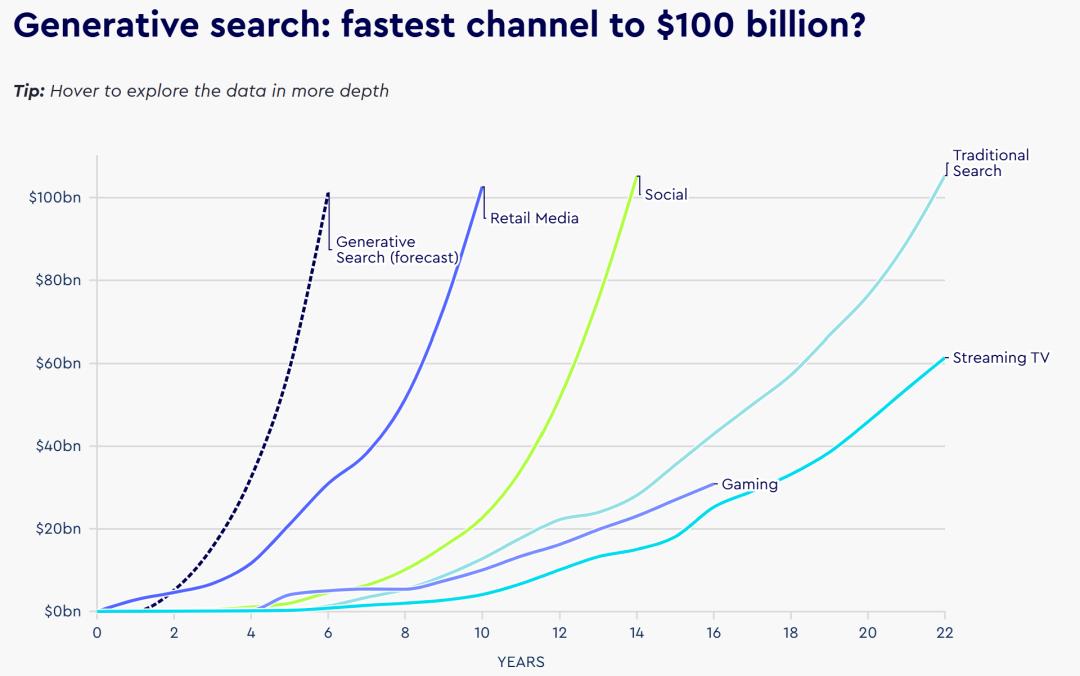
WPP predicts that generative search will become the fastest - growing advertising channel in history to reach a scale of $100 billion. This milestone is expected to be achieved in 2030, and it may only take 6 years to reach the $100 - billion mark. In contrast, it took 22 years for traditional search to reach the $100 - billion scale, 14 years for social media, and about 10 years for retail media.
Consistent with the overall growth logic of the global advertising industry, the growth of generative search is also dominated by the US market. Thanks to the first - mover advantages of products such as OpenAI's ChatGPT Ads pilot and Google's AI Overviews, the US currently accounts for about 60% of the global generative search advertising revenue, with an expected scale of about $3 billion in 2026. As ChatGPT Ads expands to new markets such as the UK, Brazil, and Japan in the form of a self - service platform, and Google promotes its AI search experience to more regions, investment is expected to accelerate further.
It is worth noting that the advertising revenue of generative search does not all come from the internal transfer of traditional search.
Scott - Dawkins pointed out that part of the budget will be transferred from traditional search, another part may be diverted from e - commerce marketing budgets, and some are purely new budgets. The combination of these three supports this track to reach the $100 - billion scale.
But for brands, what really needs attention is not the numbers themselves but the change in the rules of the game.
WPP clearly pointed out in the report that in a world increasingly intermediated by AI, the most valuable brand awareness will be the "salience" that determines whether a brand can be mentioned in a chatbot's answer, recommended by an AI Agent, or recalled at the moment of decision - making.
Scott - Dawkins has a precise summary: Traditional search is about displaying information, while generative search is about performing tasks. This directly rewrites the starting point of the marketing funnel. When users are used to letting AI directly give answers and complete bookings, the starting point of the marketing funnel changes from "attracting clicks" to "striving to be cited and recommended by AI".
However, WPP also reminds that this kind of salience is unlikely to be established in a few - second short video or a brief chatbot conversation. It needs to be built in an environment that can win in - depth participation, provide context, and build trust, including streaming TV, live sports events, high - quality publications, outdoor advertising, and cinemas. Meanwhile, new content interfaces such as connected cars, augmented reality, environmental screens, and even physical robots are emerging, and the brand's contact map is still expanding.
In other words, the rise of generative search has not immediately killed traditional brand building; instead, it has made "building brand awareness in the right place" more important than ever.
Conclusion
WPP believes that AI search is just the beginning. The real watershed will be the day when consumers gradually get used to letting AI Agents complete product searches, price comparisons, and even purchase decisions on their behalf.
By then, the advertising placement logic will also shift accordingly: In addition to continuing to compete for people's emotions and attention, it also needs to adapt to the decision - making mechanism of AI. The focus of marketing may shift from polishing a beautiful copywriting to building a set of brand data that AI can understand, trust, and be willing to call first