Zhongke Wenge surged 81% at opening, marking another new hard-tech IPO in Beijing.
This article is about 900 words, estimated to take 2 minutes to read
Author | Peng Xiaoqiu, ZHANG WEIYAO, ZHANG XIAOQIAN
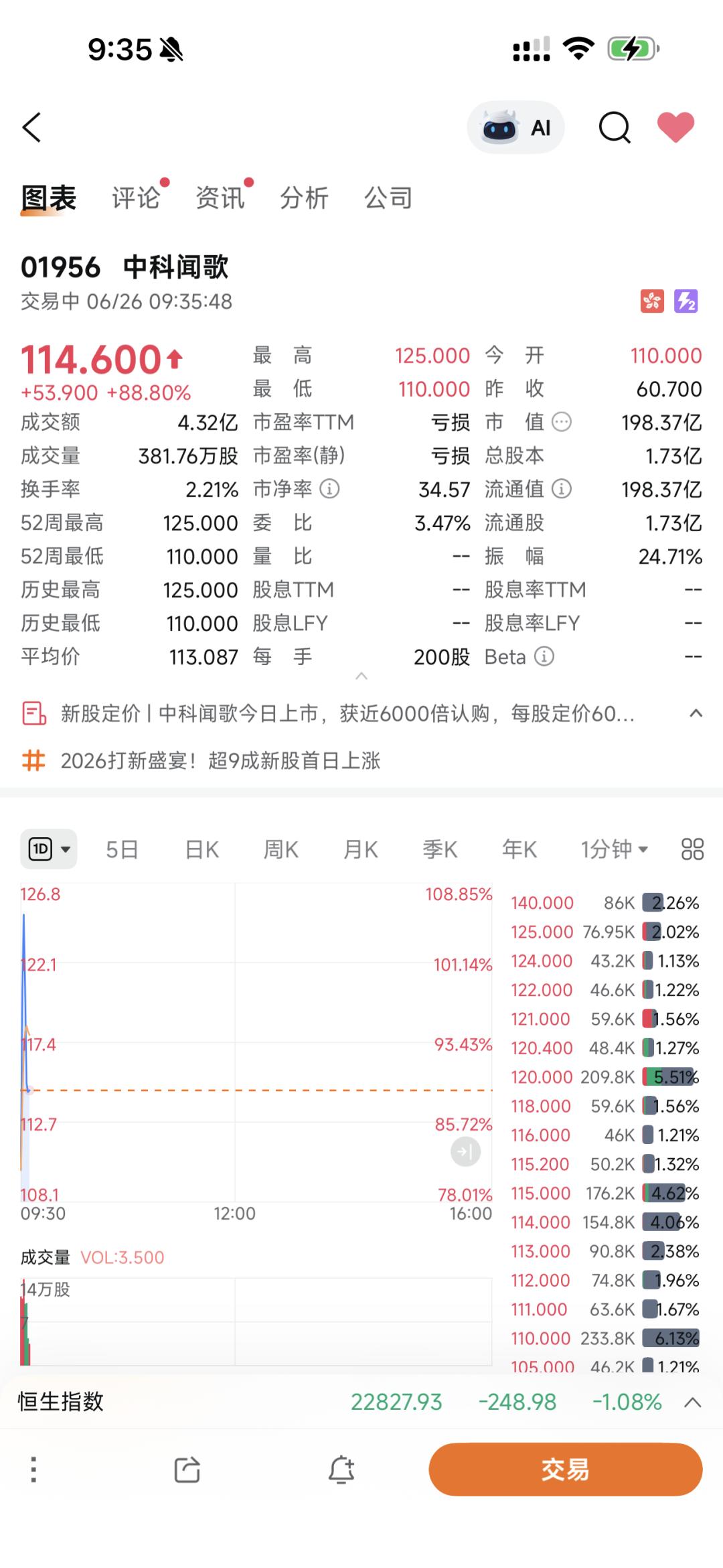
On June 26, Zhongke Wenge (01956.HK) was officially listed on the Main Board of the Hong Kong Stock Exchange with a gong-striking ceremony. Its share price rose 81.2% at opening, reported at HK$110, with a market capitalization of HK$19 billion. As of press time, the intraday peak hit HK$125 and the trough stood at HK$110, with the amplitude narrowing to 24.71% and the turnover rate reaching 2.21%. At the current price, the paper profit for one board lot is HK$10,800, and the company's market capitalization stands at HK$19.837 billion.
For in-depth coverage of Zhongke Wenge, you can refer to our previous report: CAS PhD team pushes for IPO, with market capitalization exceeding HK$10.5 billion.
In the pre-listing dark trading session yesterday afternoon, it closed at HK$115.40, surging 90.12% compared with the issue price of HK$60.70, corresponding to a market capitalization of HK$19.976 billion (about RMB 17.5 billion). Calculated on the basis of 200 shares per board lot, the paper profit per lot is about HK$10,900; the intraday peak hit HK$128, up 110.9%, while the trough stood at HK$85, up 40%, with an amplitude as high as 70.84%. The total trading volume of the whole dark trading session was HK$250 million, with a turnover rate of 1.32%.
The sharp rise of Zhongke Wenge is driven by the resonance of three forces:
First, the overall market environment of new share subscription in Hong Kong stock market is booming. The 2026 Hong Kong stock new share subscription market can be described as a grand feast, with the first-day rise ratio of new shares exceeding 90%, high market risk appetite, and new shares generally enjoying sentiment premium.
Second, it is empowered by the AI concept. As the first stock of general-purpose decision-making large model with a state-backed shareholder lineup, including China Development Bank, China Internet Investment Fund, CCTV Media Convergence, Zhongguancun Science City, Beijing AI Fund, Shenzhen Venture Capital Group and more. It is exactly at the intersection of AI narrative and state-owned capital-backed technology concept, which is the most popular story favored by capital at the moment.
Third, the tradable share size is small. The publicly offered share size of Zhongke Wenge in this IPO is not large in the first place. In addition, 6 cornerstone investors have locked their shares for 6 months, so the actual tradable chips in the dark trading session and on the first listing day are limited — a small amount of buying orders can push up the price easily, which is also the reason why the amplitude in dark trading reached 70.84% while the turnover rate was only 1.32%.
Warren Buffett once said that the stock market is a voting machine in the short term, but a weighing machine in the long term. Eventually, the market will return to fundamentals.
In terms of valuation, calculated at the issue price, the static price-to-sales ratio of Zhongke Wenge is about 22.7 times, which is already at the relatively expensive level among similar companies in the Hong Kong stock market; calculated at the dark trading price of HK$115.40, the price-to-sales ratio directly rises to about 43 times, and the valuation has nearly doubled.
However, Zhongke Wenge still lost about a quarter of its revenue after adjustment, with an adjusted loss rate of -24.8% in 2025; its net cash outflow from operating activities has remained large for three consecutive years; 70% of its revenue comes from labor-intensive project-based local deployment.
Looking ahead, two events are worth paying attention to: first, the 6-month lock-up period for cornerstone investors expires. The total fundraising subscribed by its 6 cornerstone investors accounts for about 27%, which will be a key node when the lock-up period ends. Second, the exit of pre-IPO investors. Among the 10 rounds of financing of Zhongke Wenge, the institutions that entered in the Series B round in 2019 had a cost of only HK$18 per share, a discount of about 66% to the issue price, with a paper profit of nearly 3 times. Generally speaking, the earlier the institutions enter the market, the higher their paper profit, and the stronger their willingness to cash out after listing. However, the lock-up period for these shares will not expire until one year after listing.