China's smart cleaning industry is heading into the next decade amid differentiation
In 2025, Chinese brands occupied the top five positions in global floor-cleaning robot shipments, collectively capturing over 50% of the market share. iRobot, the industry pioneer that once held 80% of the global market, entered bankruptcy protection, while Roborock topped both global sales volume and revenue for two consecutive years. At this point, Chinese domestic enterprises have fully taken over the discourse power in the intelligent cleaning field.
However, beneath the glory, there are also undercurrents. Ecovacs's profit declined again after a recovery. Roborock was temporarily overtaken at the top. Dreame's radical cross - border expansion sparked public controversy. According to media reports, its car - making business has scaled back from independent operation to technology pre - research in the industrial research institute, with the person - in - charge leaving and the team significantly reduced. Yunjing is experiencing growth anxiety while carefully deepening its market. Companies in the same track are experiencing the same pressure in different ways.
The consumer electronics industry generally follows the evolution trajectory of "technological singularity - market prosperity - efficiency competition - value transfer", which is an inevitable stage for the industry to mature. Currently, the intelligent cleaning industry is at a turning point: The adjustment after global dominance is not unexpected but a collective precipitation before the industry moves on to the next stage. This precipitation is precisely the starting point of a new cycle.
Looking back at the past decade, Chinese brands have made the leap from "following" to "leading". In the next decade, the competition logic is being rewritten - From a single category to multi - curve synergy, from parameter competition to user insight, and from "making a good product" to "building a good system". Whoever can make this leap first may define the industry rankings in the next decade.
1. Short - term rankings are hard to define the pattern,
The industry is heading towards the second growth curve
In June 2026, IDC data showed that Dreame ranked first in both volume and revenue globally for the first time in the first quarter of 2026. Roborock, Ecovacs, Xiaomi, and Yunjing ranked second to fifth respectively.
However, it's hard to interpret a single - quarter shipment fluctuation as a reshaping of the industry pattern. Quarterly rankings are significantly affected by short - term factors such as channel inventory and new product launch schedules. The industry focus is shifting from "who is temporarily leading" to "who can lead continuously", and annual data is a more stable yardstick.
Looking at a longer time frame, iRobot, the industry's pioneer, dominated the global market for nearly two decades. Roborock, which succeeded it, topped global sales revenue in 2023, and its shipments reached the top for the first time in 2024, and it ranked first in both volume and revenue globally in 2024 and 2025. In the whole year of 2025, Roborock shipped 5.8 million units, with a share of 17.7%. Ecovacs and Dreame ranked second and third respectively.
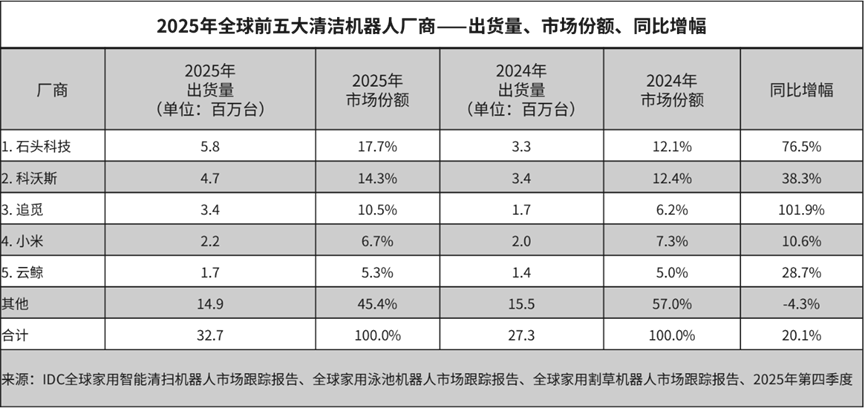
Chinese brands have won the global market, but not easily.
According to Aoweiyun data monitoring, in 2025, the online average price decreased by 6% year - on - year to 3,535 yuan. On the technology side, laser navigation and all - in - one charging stations have become standard, narrowing the technology premium. On the marketing side, costs are high. The industry's sales expense ratio is approaching 30%, and customer acquisition costs are continuously rising. The online CR5 (the sum of the market shares of the top five brands in the online market of a specific category) has reached 90.3%, indicating that the industry concentration has reached its peak. Cross - border players such as DJI are still entering the market, making the track more crowded.
However, the industry is far from reaching its ceiling.
According to third - party report data, in 2025, the market size of floor - cleaning robots grew by 34.4%, ranking alongside floor scrubbers as the two major pillars of the growth of cleaning appliances. The penetration rate of floor - cleaning robots in domestic households is less than 10%. In mature markets such as the United States, it exceeds 15%, and in first - tier domestic cities, it is close to 25%. There is vast potential in lower - tier cities.
In addition, two external forces are also accelerating the transformation.
On the demand side, users are no longer satisfied with the single function of "cleaning", but expect the machine to actively detect dirt and cooperate with household devices to complete a whole set of cleaning tasks.
On the supply side, underlying technologies such as SLAM algorithms, AI vision, and motion control are naturally transferable. The integration of AI and embodied intelligence has evolved robots from single - function terminals to systems with a closed - loop of perception, decision - making, and action.
The upgrade of terminal consumer demand and the spill - over of underlying technologies drive enterprises to extend their capabilities outward, which has become an inevitable trend for the industry to break through the growth bottleneck.

Therefore, breaking out of the floor - cleaning robot market and seeking new growth curves has become the common choice of the industry. Ecovacs incubated Tineco. In 2025, Tineco's revenue was 8.117 billion yuan, almost on par with the main brand. Roborock is focusing on floor scrubbers, lawn mowing robots, etc. Dreame previously expanded into cross - border fields such as large home appliances, drones, and auto parts. According to multiple media reports, in June 2026, Dreame completed a major strategic adjustment, consolidating more than 200 business units into four major sectors: whole - house intelligent cleaning, smart home appliances, intelligent mobility, and AI embodied intelligence. Businesses such as cars and mobile phones were transferred to the industrial research institute for technology reserves. Yunjing is deeply involved in niche categories such as window - cleaning robots and floor scrubbers.
Although the surface actions vary, the underlying logic is highly consistent: migrating the technical capabilities accumulated in floor - cleaning robots to new scenarios to redefine the growth curve. The intelligent cleaning industry is in a transformation period from "dominated by a single category" to "multi - curve synergy".
2. Expansion vs. Rooting,
A strategic calibration around the circle of competence
With the industry's growth slowing down, price wars intensifying, and profit margins narrowing, single - category enterprises are like walking on one leg. It has become a consensus to layout new growth curves, but there are obvious differences in path selection.
The strategic divergence among the five leading enterprises essentially lies in their understanding of their core capabilities: Is it "digging deep within the circle of competence" or "betting on new tracks with the circle of competence".
Ecovacs and Roborock choose to expand comprehensively and deeply within the boundary of their circle of competence. Dreame, which once used its circle of competence as a fulcrum to leverage a borderless ecosystem, is now shrinking back into its circle of competence. Yunjing is betting on the end - game of intelligent cleaning and household service robots in a leap - frog manner. Xiaomi follows the "ecosystem - first" route, using "ecosystem to cover categories" - with a large user base and channel network as the foundation, it builds a platform first and then fills in products. Floor - cleaning robots are just one part of Xiaomi's ecosystem, not the origin.
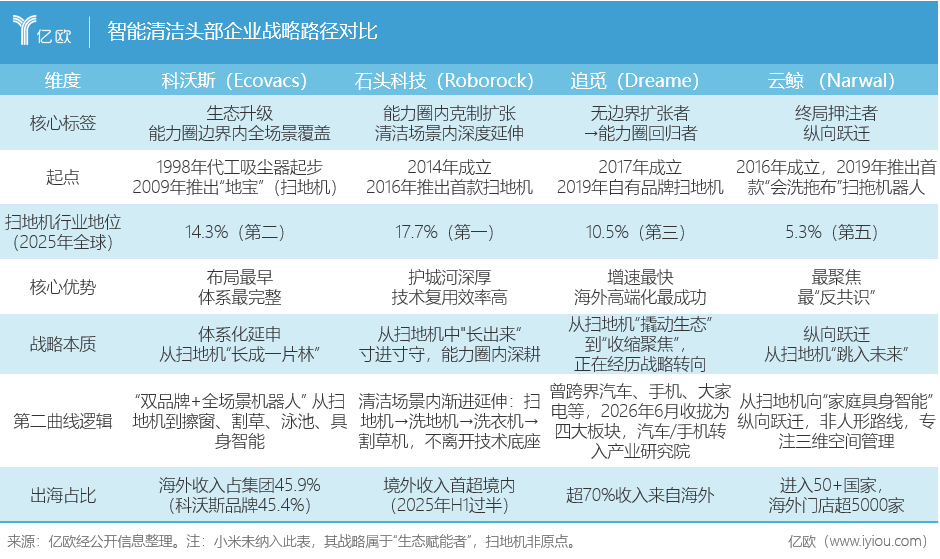
What's most worthy of attention is that Roborock and Dreame, both starting from floor - cleaning robots, have taken completely opposite directions.
Dreame once regarded the high - speed digital motor developed in floor - cleaning robots as a "universal fulcrum" and tried to radiate into fields such as cars, mobile phones, large home appliances, and drones. Instead of using the ecosystem to cover categories, it tried to nurture an ecosystem with individual sub - categories. However, according to multiple media reports, in June 2026, Dreame completed a major strategic adjustment. Businesses such as cars and mobile phones are no longer independently promoted for mass production and are uniformly transferred to the industrial research institute, only retaining the technology R & D function. More than 200 previous business units have been consolidated into four core sectors. The narrative of borderless expansion is shrinking back into the circle of competence.
Roborock has always chosen to deepen its development internally, anchoring the core field of "cleaning". From floor - cleaning robots to floor scrubbers, and from floor scrubbers to lawn mowers, each step is a gradual extension within the boundary of its circle of competence. This expansion rhythm tests strategic determination.
Three sets of data support the rationality of this choice: In 2025, R & D investment was 1.42 billion yuan, a year - on - year increase of 46.13%. The number of R & D personnel increased to 1,481, accounting for nearly 43% of the total number of employees. These investments have yielded results. The sales volume of other intelligent appliances centered around floor scrubbers increased by 250.45% year - on - year, and the gross profit margin increased by 5.45 percentage points. Roborock's floor - cleaning robot business has ranked first in the global market share for two consecutive years.
In terms of regional layout, in 2025, Roborock's overseas revenue accounted for more than its domestic revenue for the first time. Li Ping, the sales director of the Asia - Pacific region, said that the domestic market is the engine of innovation and technology, and the overseas market is the engine of in - depth operation. The two together drive the company's development.
From the statements of the company's senior management, we can see a determination that does not fluctuate with market sentiment: Expand within the circle of competence in a restrained manner, do not touch fields you don't understand, and do not engage in categories without a technical foundation. Continuously deepen your development in each high - certainty niche category. When Dreame's borderless narrative starts to shrink back into the circle of competence, Roborock's path of internal deepening reveals a more certain long - term value - these categories strung together form an ecological network that is difficult to break down.
3. Understand users,
Understand the next decade
The family scenario is full of randomness and complexity. Enduring competitiveness does not depend on the short - term market share game but on whether the in - depth understanding of users' real pain points can be built into a solid competitive barrier.
Yang Dongwen, the chairman of Aoweiyun Network, pointed out at the "2026 China AI Robot Industry Leaders Summit" that the cleaning appliance industry is moving from "function substitution" to "intelligent evolution". The key to breaking through the industry lies in "three - dimensional synergy and two - way expansion": Strengthen the supply chain foundation and tackle key components such as motors and sensors. Promote cross - category integration and intelligent evolution. Deeply cultivate the global channel and build a full - domain growth engine with in - depth domestic offline experience and multi - point breakthroughs in overseas markets.
This framework points to only one end - Respond to the real cleaning pain points that have been long covered by parameter competition with more reliable technology, products that understand users better, and more complete scenario coverage.
On the issue of solving users' pain points, each brand has a different approach.
Ecovacs tends to use the "family of household service robots" to meet the demand for "whole - scenario peace of mind", addressing the breadth of users' pain points. Dreame makes single - point breakthroughs around specific pain points and at the same time expands across borders with the high - speed digital motor as the fulcrum. However, according to multiple media reports, its cross - border business has shifted from expansion to contraction, and the sustainability of single - point innovation and the feasibility of cross - category migration are facing real - world tests. Yunjing excels in the single point of "mopping the floor". Xiaomi uses the Mi Home ecosystem as the foundation, attracting users with extreme cost - effectiveness and cross - scenario linkage capabilities.
The paths of these brands have different focuses, and Roborock competes on a different dimension from the previous four. It neither relies on ecosystem coverage nor category stacking. Instead, it defines products from the "scenario" perspective, and each technological breakthrough has a clear scenario orientation: The wheel - foot climbing scheme covers the "blind area of stairs" in the cleaning area. The five - axis bionic manipulator reduces the "manual pre - arrangement" burden before the floor - cleaning robot starts working. The 180°C steam hot - water floor - scrubbing technology addresses the problems of heavy oil stains and bacteria. Each technological breakthrough corresponds to a specific problem that has been long discussed in the industry but not fully solved, rather than simply chasing higher parameter indicators.
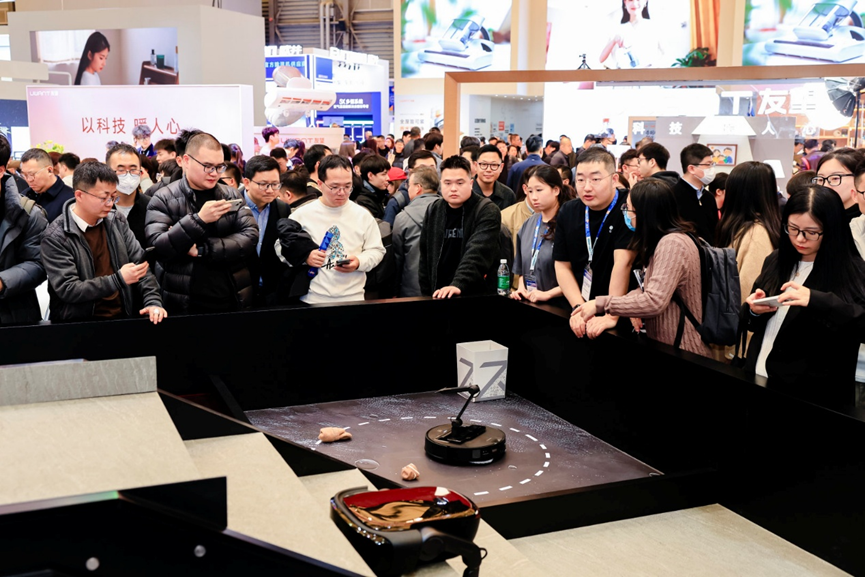
In the short term, the restrained expansion rhythm may seem to lack market popularity. But in the long run, a solid technical foundation, an expanding category matrix, and a coordinated market layout at home and abroad together build an unshakable competitive barrier.
The market is the most real test.
According to Aoweiyun Network data, during the 618 promotion in 2026, Roborock's sales revenue increased by 23% year - on - year, ranking first among cleaning appliance brands. Its market share in the floor - cleaning robot category was 35.73%, firmly ranking first in the industry. The market share of its floor - scrubber category rapidly increased to 27.22%, ranking second in the industry, only 1.02 percentage points behind Tineco, the first - ranked brand.
In addition, according to data released by mainstream e - commerce platforms, the total sales volume of Roborock's floor - cleaning robot P20 Max across all platforms reached 320,000 units, firmly ranking first among new floor - cleaning robot products on JD.com and first on Tmall's hot - selling list. In terms of floor scrubbers, Roborock's A30 Pro 2.0 won the first place among new floor - scrubber products on JD.com, and the Roborock A30 series won the first place on Tmall's hot - selling list and the first place on the positive - review list.