Three Consecutive Drops in Inventory!
The national effort to "reduce inventory" has achieved initial results.
The latest industry data released by the National Bureau of Statistics shows that the floor area of commercial housing for sale has declined year-on-year for three consecutive months.
Meanwhile, data from the Puruishu Intelligence Research Center shows that the total area of stock residential land in typical cities decreased from 62,300 hectares at the beginning of 2025 to 59,900 hectares at the beginning of 2026, a year-on-year decrease of 4%.
With local governments strictly implementing the top - level policy guidance, on the one hand, they strictly control the supply of new residential land, simultaneously promote new policies for the disposal of idle land, strengthen the cleaning up of inefficient stock land, and push a number of idle and inefficient projects out of the market; on the other hand, they precisely supplement high - quality residential land. With the continuous improvement of land use efficiency, the inventory scale has finally started to decline.
In the future, the total inventory of commercial housing for sale at the national level may enter a slow - decline channel.
01
The latest data from the National Bureau of Statistics shows that as of the end of May 2026, the floor area of commercial housing for sale was 771 million square meters, a year - on - year decrease of 0.4%, and it has declined year - on - year for three consecutive months.
Among them, the area of housing for sale for less than three years was 570 million square meters, a decrease of 2.8%. The decline was 0.2 percentage points larger than that at the end of April, indicating that the short - term inventory is decreasing at a faster pace.
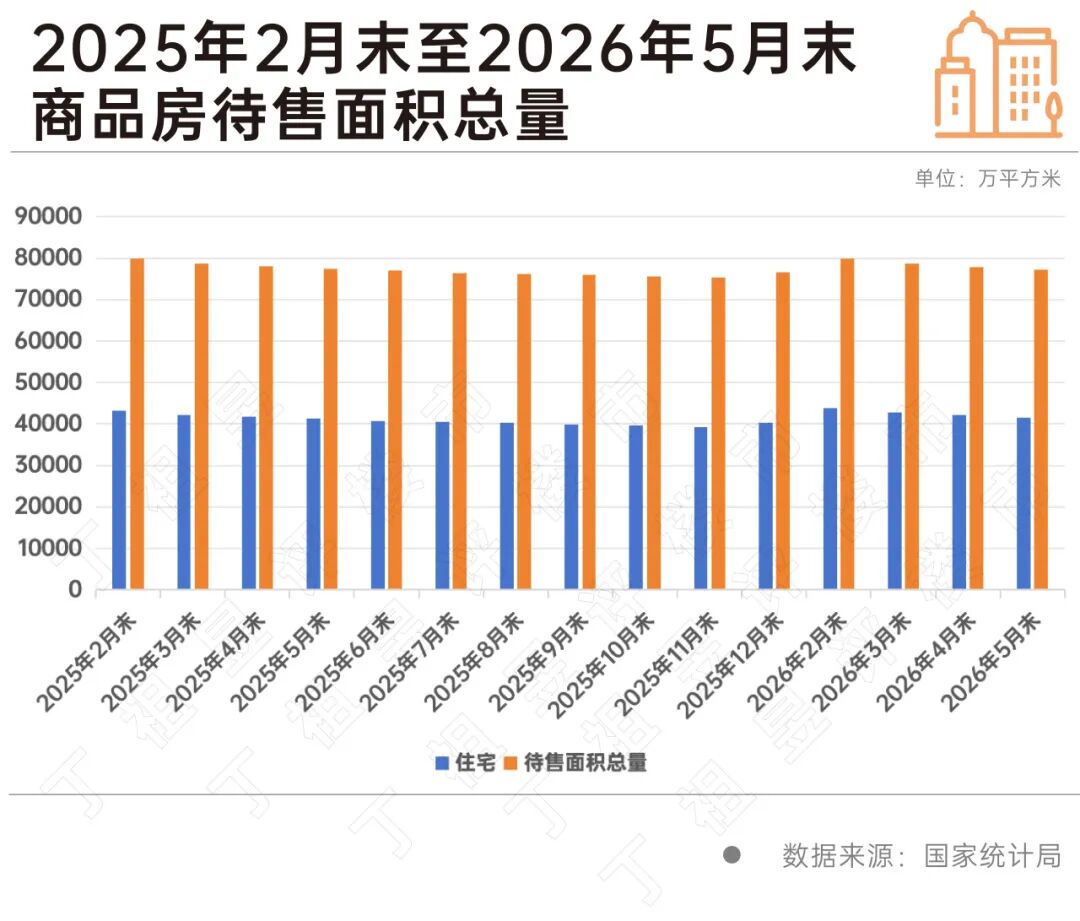
The main reason is that the industry is implementing the policy guidance of "strictly controlling the increment and optimizing the stock".
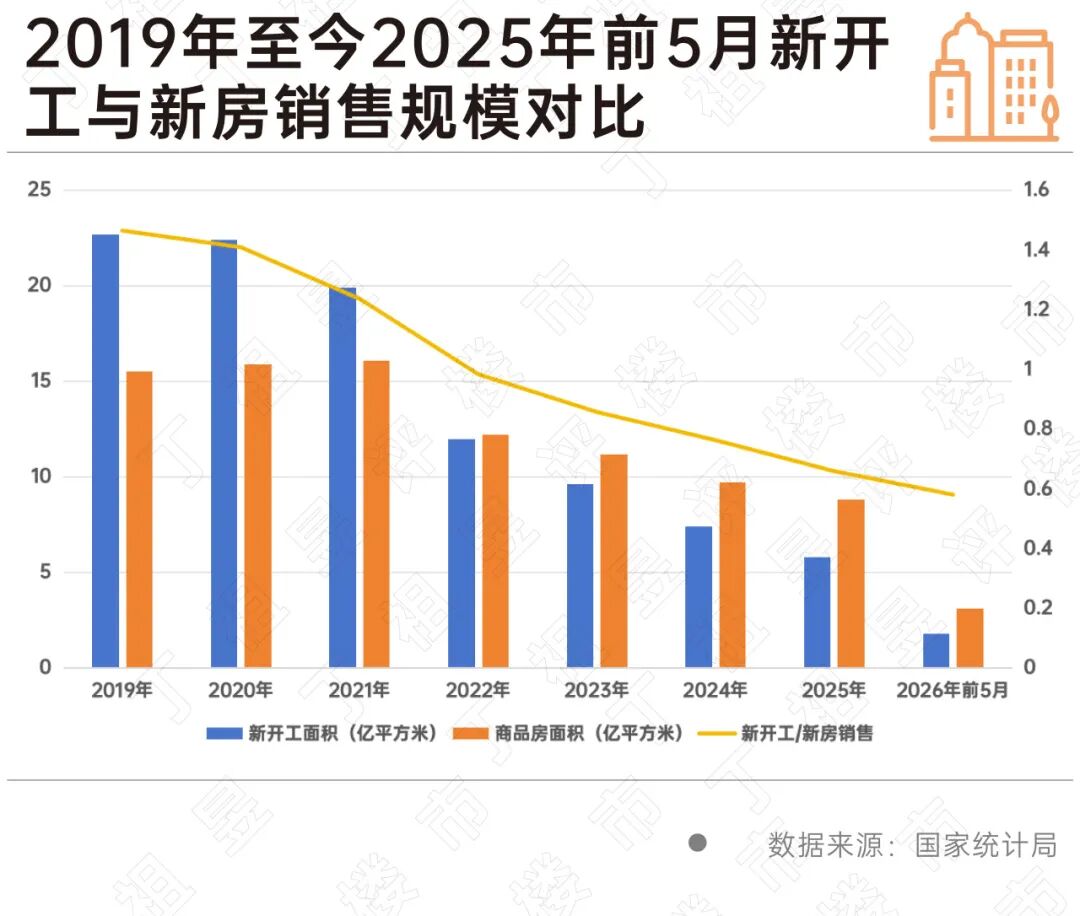
The latest data from the National Bureau of Statistics shows that from January to May 2026, the newly started floor area of buildings was 180 million square meters, a decrease of 22.6%. Among them, the newly started floor area of residential buildings was 130 million square meters, a decrease of 23.4%. In the first five months of 2026, the newly started scale of buildings was 57% of the sales scale of new houses, still remaining at a historical low.
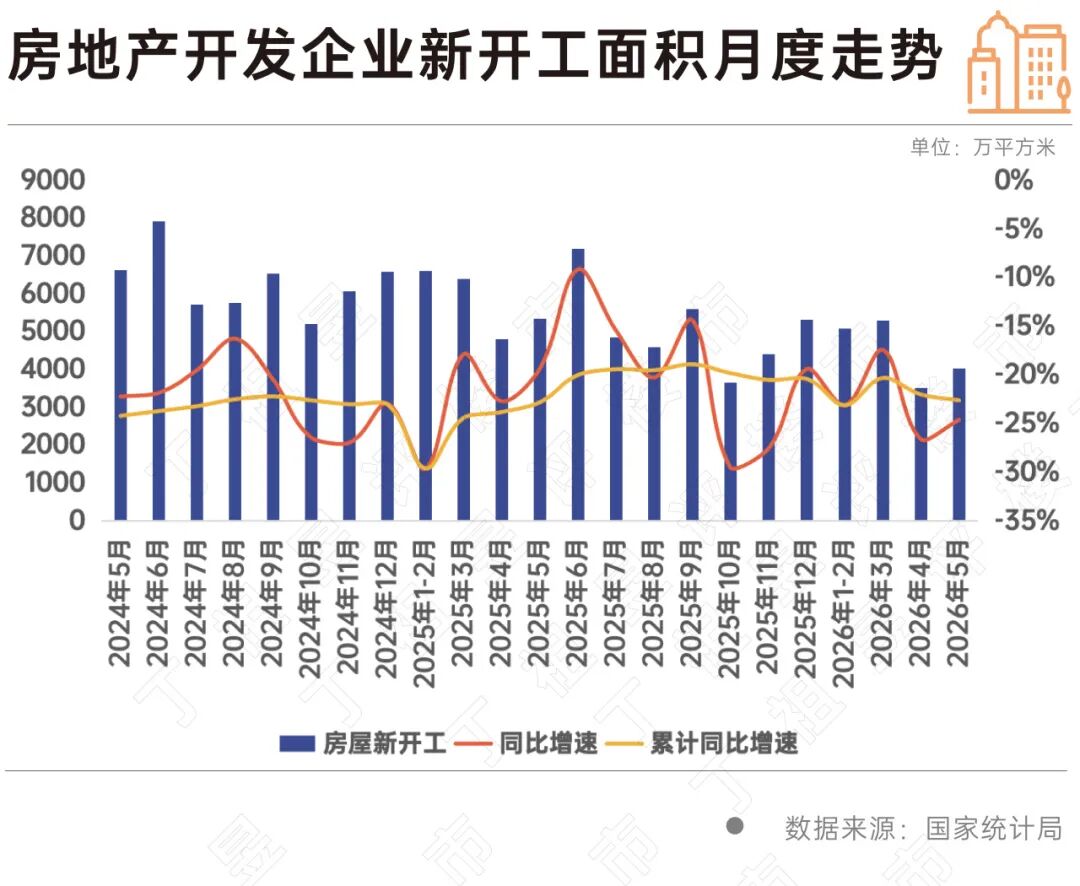
Comparing the newly started scale with the sales scale of new houses, since 2022, the newly started floor area has been lower than the sales scale of new houses for more than four consecutive years. The contraction of new starts helps to relieve the market supply pressure. The fact that the sales scale of new houses has been continuously higher than the newly started floor area means that the market has shifted to "stock digestion".
It is against this background that as of the end of May 2026, the floor area of commercial housing for sale has decreased for three consecutive months.
In the future, with the further reduction of land supply, it is expected that the newly started scale will also remain at a reasonable low level, and the total inventory of commercial housing for sale at the national level will enter a slow - decline channel.
02
Looking at the scale of stock residential land in typical cities, since 2025, thanks to the continuous implementation of the national policy of "controlling the increment, reducing the inventory, and optimizing the supply", the total area of stock residential land in the sample cities decreased from 62,300 hectares at the beginning of 2025 to 59,900 hectares at the beginning of 2026, a year - on - year decrease of 4%.
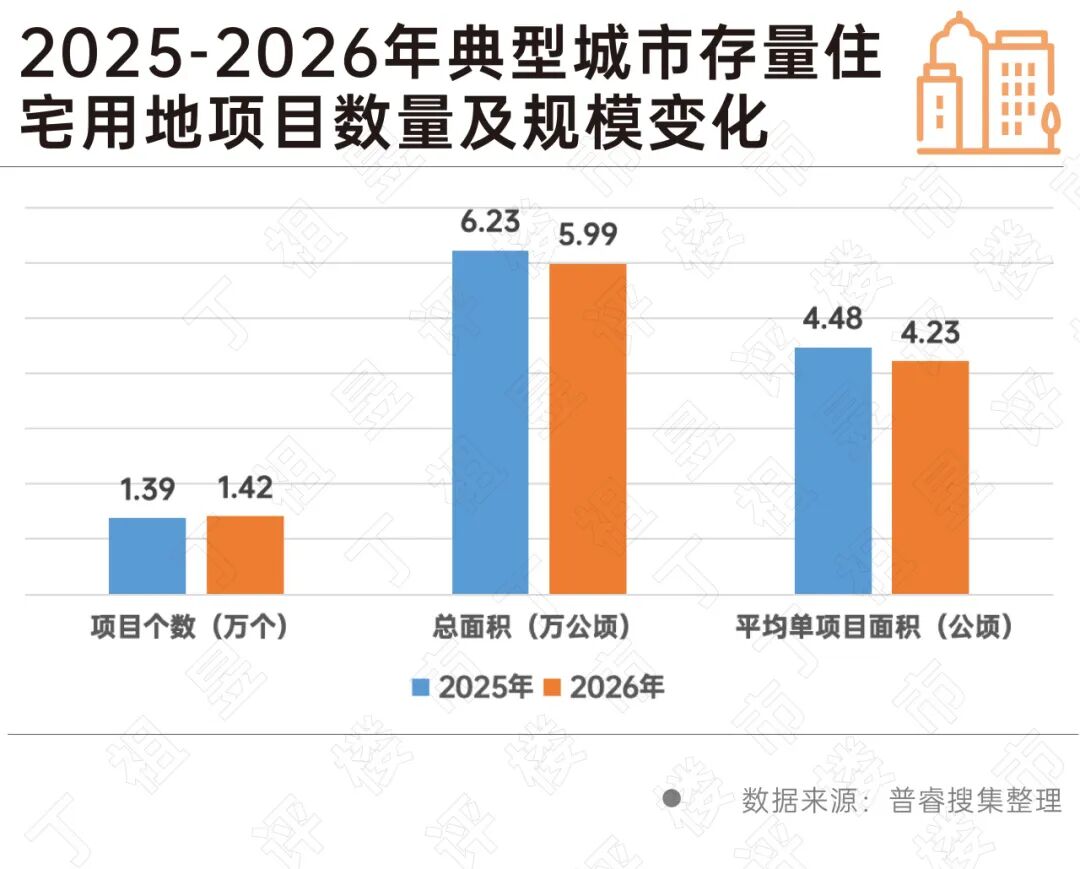
Specifically, the inventory scale of more than 60% of the cities has declined or remained flat year - on - year. Among them, the inventory reduction in 11 cities such as Maoming and Chongqing exceeded 100 hectares. The reduction in Maoming reached 215 hectares, and the intensity of stock digestion was particularly prominent. Among the first - tier cities, the inventory in Shanghai decreased by 6% year - on - year, and the absolute inventory scale still decreased by 91 hectares despite the high base.
In addition, the inventory scale of 19 sample cities increased by no more than 10 hectares, including Suzhou, Xiamen, Haikou, and Dalian. The inventory changes are normal market fluctuations. Taking Suzhou as an example, the land for unstarted projects decreased by 18.8 hectares, and the land for unsold projects increased by 20 hectares, with a net increase of 1.2 hectares, reflecting the normal rotation and development of residential land, and the inventory pressure has not increased significantly.
Only a few core first - and second - tier cities have seen a significant increase in inventory scale: Beijing had the largest increase of 434 hectares. The increases in Guangzhou, Changchun, Hefei, Nanjing, and Hangzhou all exceeded 200 hectares. The inventory growth in such cities is mainly due to the concentrated transfer of key residential land in the past year. As the core and certain investment areas for real - estate enterprises since 2025, the increase in the inventory of stock residential land in Beijing, Guangzhou, and Hangzhou also conforms to the overall logic of current market supply restoration and investment focus.
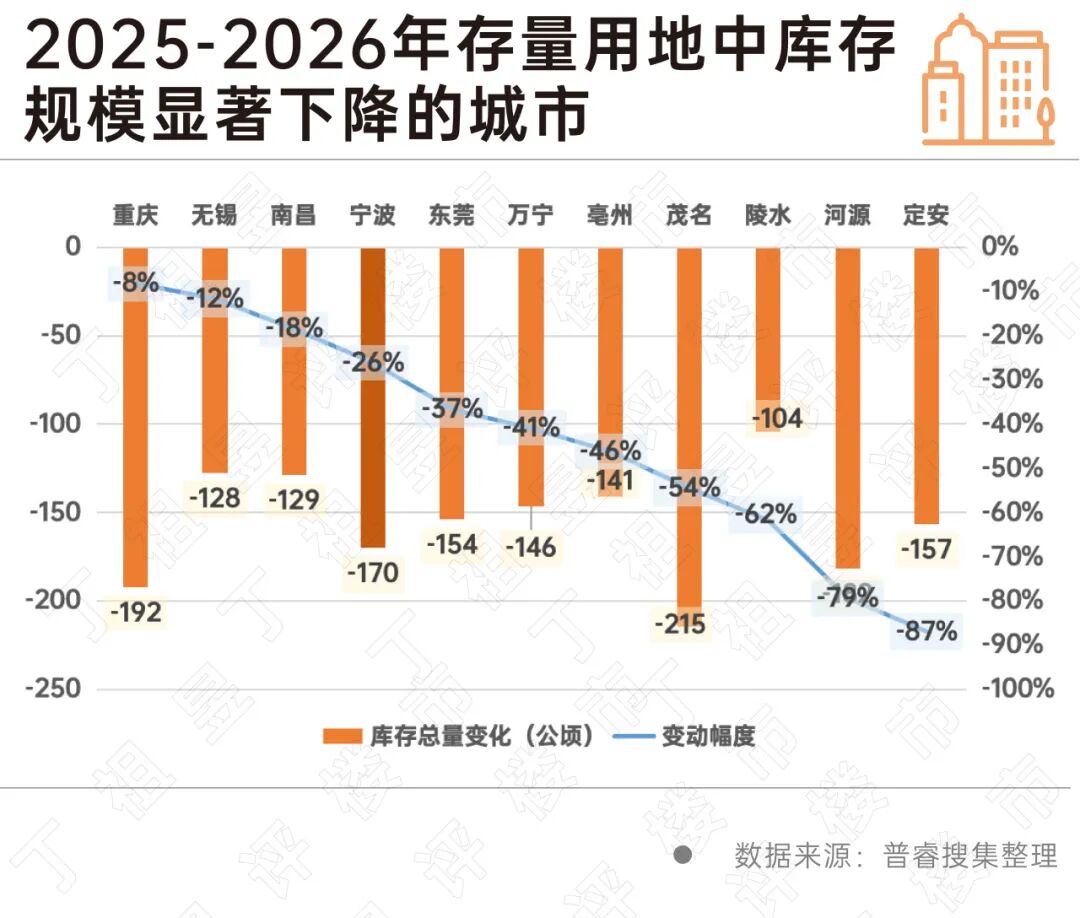
The decrease in the scale of stock residential land in these cities is, on the one hand, due to the strict control of the supply of new residential land to curb the inventory increment from the source. For example, according to the detailed list of stock land released, Maoming and Ding'an had zero new stock residential land in 2025. Lingshui only signed 8 new residential land projects in 2025, with a total area of only 18.2 hectares, indicating remarkable results in the control of new supply.
On the other hand, local governments are actively using special bonds to acquire idle land. According to incomplete statistics, more than 300 billion yuan of special bonds have been issued nationwide in 2025 for this purpose, providing strong financial support for the revitalization of idle land.
It is worth noting that Chongqing has still achieved a steady decline in inventory despite the efforts in new supply. In 2025, there were 50 new residential projects with a total area of 200 hectares. At the beginning of 2026, the inventory scale of stock residential land in Chongqing decreased by 192 hectares year - on - year, a decrease of 8% compared with the beginning of 2025.
This is mainly because the newly added residential land in Chongqing has significant location advantages: most of the plots in the core area are close to subway stations, mature residential areas, and urban core roads, while the plots in the new areas rely on backbone transportation such as Science Avenue and Jinkai Avenue, and are combined with ecological and industrial supporting facilities; at the same time, many projects are within the scope of urban village renovation and old - area renewal, having both the dual attributes of residential supply and urban function improvement, which not only improves the urban supporting facilities but also helps to rejuvenate the stock areas.
Under the policy guidance of "strictly controlling the increment and optimizing the stock", the floor area of commercial housing for sale at the national level has declined year - on - year for three consecutive months, and the inventory indicators have been continuously optimized.
It should be noted that although the inventory scale has shown a downward trend due to the reduction of land supply and the decrease in newly started floor area, the de - stocking cycle has not shortened because of the slowdown in market sales speed. The de - stocking cycles of most cities are still at a high level. In the future, it is still necessary to take multiple measures such as policy optimization, state - owned asset acquisition, and sales promotion to further shorten the de - stocking cycle and achieve market stability.
This article is from the WeChat official account "Ding Zuyu's Review of the Real Estate Market". Author: Editorial Department. Republished by 36Kr with permission.