The regulatory crackdown is not over yet. Is there one final plunge ahead for Trip.com?
Under the shadow of regulatory scrutiny, Ctrip finally released its long - awaited first - quarter financial report on June 25th. Overall, it can be summarized as follows: a. The quarter was not bad; b. The regulatory situation is still uncertain; c. The guidance is quite poor: the expected revenue growth rate is only 3% - 8%, and the profit outlook is bleak. Specifically:
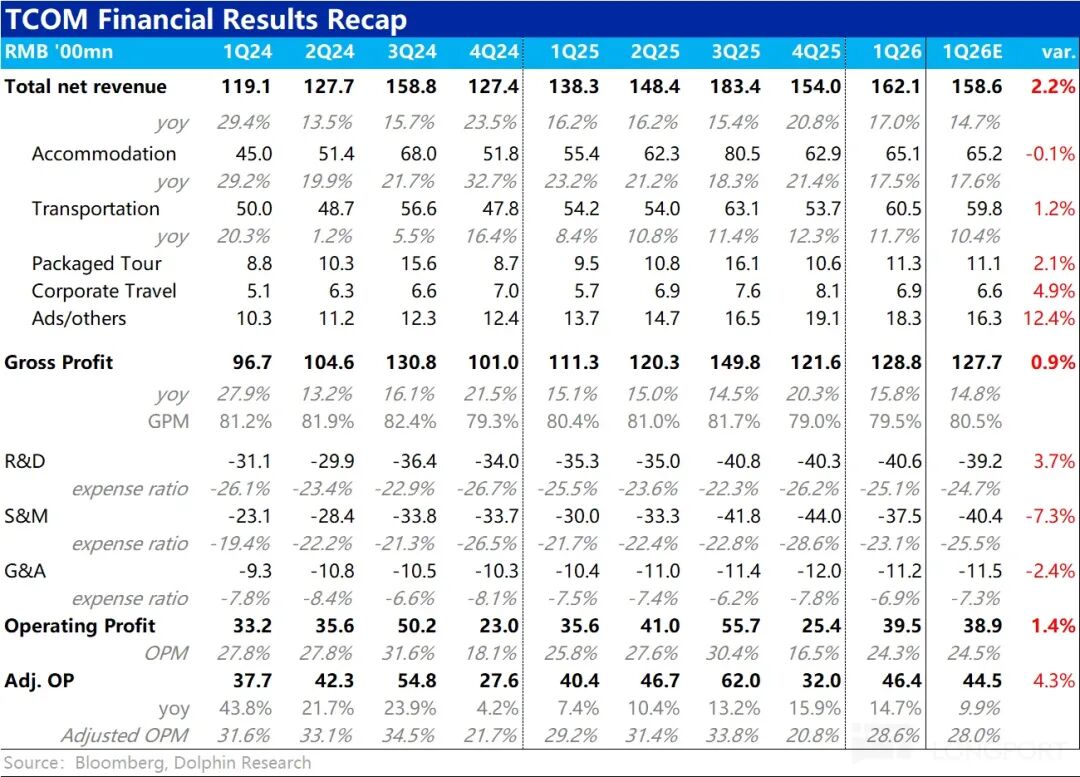
1. Revenue growth has slowed down: This quarter, Ctrip Group's overall net revenue was approximately 16.2 billion yuan, with a year - on - year growth of about 17%. Although it has declined from the peak of the previous quarter, it still exceeded the market expectation of about 15%.
Looking at the revenue types, the revenue from hotels and ticketing, which account for the majority, had a generally stable or slightly slower growth rate this quarter compared to the previous quarter. What exceeded expectations were the business travel and other businesses mainly based on advertising.
In terms of regional performance, the order volume of pure overseas business increased by 65% year - on - year, slightly accelerating from 60% in the previous quarter. The inbound tourism orders also had a 90% year - on - year growth despite the high base.
It can be seen that the growth in these two new directions, overseas and inbound, remains good. Therefore, the sequential slowdown in revenue growth this quarter is most likely due to the domestic business, which may be an initial manifestation of regulatory impact.
2. The growth of hotel and ticketing business has slowed down: Among the two pillar businesses, the revenue from hotel bookings increased by about 17.5% year - on - year, with a slower growth rate compared to the previous quarter, but it was basically in line with the company's guidance.
However, the performance of Atour and Huazhu, which previously announced their results, showed that the hotel revenue and average room rate in the first quarter actually improved sequentially. This implies that the monetization rate of the company's hotel business may have declined due to regulatory impact.
The ticketing revenue increased by 12% year - on - year this quarter, and the sequential growth rate was generally stable. The regulatory measures on issues such as "bundled sales" of train tickets that started in recent months do not seem to have had much impact yet.
3. Business travel and advertising still exceeded expectations: The revenue from business travel was 690 million yuan, with a year - on - year growth of 20%. It was the only business that accelerated its growth compared to the previous quarter (15% in the previous quarter), significantly better than the market expectation. According to the company's explanation, it was mainly driven by domestic enterprises going global, which boosted the company's overseas and cross - border business travel revenue.
As for other revenues mainly based on advertising, it increased by 33% year - on - year this quarter. Although the sequential growth rate slowed down significantly from over 50% in the previous quarter, it was still strong and outperformed the market expectation by more than 10 percentage points. According to the company's explanation last quarter, the slowdown this quarter was mainly because the advertising revenue entered a high - base period starting from 2025.
4. The decline in gross profit margin has widened: The gross profit margin this quarter was 79.5%, and the year - on - year decline widened to 0.9 percentage points. Dolphin Research believes that this is due to the combined effects of the increasing proportion of overseas business with lower gross profit margin and the possible decline in the monetization rate of the tourism business and the reduction in the sales of ticketing additional services caused by domestic regulatory measures mentioned above.
5. The company is still in the investment phase for expenses: Ctrip's total operating expenses increased by 18% year - on - year this quarter, slowing down from 23% in the previous quarter, but it was still higher than the revenue growth rate, thus putting pressure on the profit. Fortunately, the actual expenditure was about 2% lower than the market expectation.
Specifically, the growth rates of all three types of expenses slowed down compared to the previous quarter. Among them, the growth rate of marketing expenses was still the highest, approaching 25%. Due to the need for overseas expansion and the increasing domestic competition pressure, Ctrip is still in the investment phase.
The R & D expenses increased by about 15% year - on - year this quarter (due to the need to develop AI capabilities), and the management expenses increased by less than 7% year - on - year (the main area for squeezing profit) .
6. Although the profit exceeded expectations, there was "revenue growth without profit growth": Since the gross profit margin still declined slightly and the growth rate of expense expenditure was slightly higher than the revenue growth, the GAAP operating profit margin narrowed by 1.5 percentage points year - on - year. The profit amount was 3.95 billion yuan, with a year - on - year growth of about 11%, lagging behind the revenue growth.
Dolphin Research's view:
1. As can be seen from the above, Ctrip's performance in the first quarter was neither outstanding nor poor. On the one hand, although the revenue growth rate declined, the decline was not significant and was in line with the company's previous guidance. On the other hand, although the operating profit margin declined year - on - year due to the decline in gross profit margin and the investment in expenses, and the profit growth lagged behind the revenue growth, this situation has persisted for nearly a year, and the actual profit was better than the market expectation.
Therefore, the decline in Ctrip's stock price after this quarter's results, similar to the previous declines, was mainly due to the uncertainty brought about by the regulatory investigation - what impact will the company's adjustment according to regulatory requirements have on its competitive position and profitability?
For Ctrip's stock price to have a real turning point, the above question must be fully resolved and clearly answered. Even if the result is negative, at least the negative factors can be fully digested.
2. First, regarding the regulatory issue, since the release of this first - quarter report was significantly delayed, the market definitely expected that the release of the results would mean the final resolution of the regulatory issue.
However, in fact, the company still has not given any positive response to key questions such as how much more time the regulatory inspection will take, what the possible regulatory results are, and how much the fine might be. In other words, the regulatory uncertainty still looms large.
3. Looking forward to the future performance trend, the company's revenue growth guidance of 3% - 8% this time is the lowest since the end of the pandemic in 2022. The company's explanation in the announcement and conference call is as follows:
a. First, the increase in oil prices caused by the conflict between the United States and Iran has pushed up the prices of domestic and international air tickets, leading to a decline in the demand for domestic and international air travel and also affecting the travel structure (presumably, long - distance travel has decreased).
b. The conflict between the United States and Iran will obviously also lead to a decrease in tourism demand in the Middle East and other related regions.
c. The recent regulatory measures on additional services such as "acceleration packages" in train ticket sales will also lead to a partial loss of such high - margin revenues.
d. The company has made some adjustments in its business operations to comply with regulatory requirements and new industry norms.
Dolphin Research believes that although the conflict between the United States and Iran and the increase in oil prices are factors, on the one hand, these are short - term impacts, and on the other hand, Ctrip's overseas business is mainly concentrated in East Asia and Southeast Asia, so the impact of the Middle East region on Ctrip should not be significant. Therefore, the key issue lies in the previous regulatory measures on the domestic tourism business and the recent regulatory measures on the train ticket business.
4. Although the specific regulatory results for Ctrip have not been announced yet, we can get a preliminary idea of the possible impact from the recently released "Rules for Price Behavior of Internet Platforms" and the regulatory authorities' interviews with relevant platforms together with the railway administration.
a. First, let's look at the regulatory issue of train tickets, which is not very complicated. It is actually similar to the previous restrictions on default and induced bundling of insurance for air tickets. The recent rounds of interviews mainly restrict platforms from promoting or inducing the purchase of additional services such as "ticket - grabbing acceleration packages", "waiting - list ticket - grabbing assistance", "online seat selection", and "buying short and traveling long".
Since domestic OTA platforms basically do not generate any net revenue or profit from pure agency sales of train tickets and instead have to bear corresponding operating costs, it is a "flow - earning but non - profitable" business. These additional services are the only way for OTA platforms to earn profits (or cover costs) from train ticket sales.
Therefore, restricting such bundling sales should have a relatively large impact on the profit of the train ticket business, basically meaning that the train ticket business will return to the "losing - money - to - earn - traffic" model.
b. The "Rules for Price Behavior of Internet Platforms" related to Ctrip mainly include the following points - Platforms are not allowed to force merchants to automatically follow prices or provide the lowest prices across the network, which harms the merchants' independent pricing rights; they are not allowed to implement different pricing rules for different consumers; they are not allowed to bundle or induce the sale of additional services such as insurance, ticket refunds, and services of other cooperative platforms.
It can be said that the above requirements precisely target the following problems of Ctrip (and many other platforms). Requiring hotels to provide the lowest prices across the network or not to enter other platforms through methods such as "special brand contracts" or "withholding traffic"; dynamically pricing consumers through big data to earn more price differences; increasing revenue and profit by bundling additional services when booking hotels, air tickets, train tickets, and other services.
Generally speaking, as we previously judged, this regulatory action is unlikely to have a significant impact on Ctrip's market competitive barriers and market share. The core impact is the restriction on the incremental/additional revenue that platforms like Ctrip can earn from each transaction, and these incremental revenues are an important source of profit.
Therefore, behind the revenue growth guidance of 3% - 8% in the next quarter, the profit performance may be even worse and deserves more attention.
5. On the one hand, Dolphin Research believes that Ctrip's competitive landscape is far better than that of e - commerce, and currently Ctrip's revenue growth center is significantly higher than that of e - commerce companies. The profit from its overseas business has not been fully realized yet. Therefore, Ctrip "does not deserve such a harsh situation", and its valuation is unlikely to truly fall to the single - digit PE level of e - commerce companies.
However, as mentioned above, this regulatory action may have a more serious impact on Ctrip's short - to - medium - term profit. Even without considering one - time impacts such as fines, there is a risk of negative growth in Ctrip's operating profit. Therefore, before the final regulatory resolution, Ctrip may experience one last wave of profit - squeezing decline.
The following is a detailed review
I. Slight slowdown in revenue growth, regulatory impact unclear
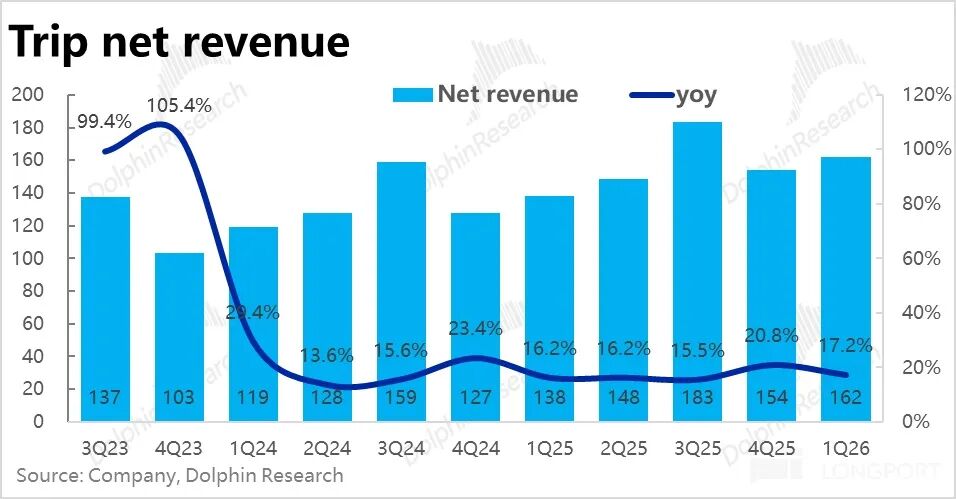
This quarter, Ctrip Group's overall net revenue was approximately 16.2 billion yuan, with a year - on - year growth of about 17%. Although it declined from the growth peak of the previous quarter, it was better than the company's guidance and the previous market expectation of about 15%. It can be said that the performance was still good, and the impact of the regulatory issue on the company's performance in the first quarter was not very obvious.
Specifically, the performance of the hotel and ticketing revenues, which account for the majority, had a generally stable or slightly slower growth rate this quarter compared to the previous quarter. And the businesses that exceeded expectations were mainly business travel and other businesses mainly based on advertising.
In terms of regional performance, the order volume of pure overseas business increased by 65% year - on - year this quarter, slightly accelerating from 60% in the previous quarter. At the same time, the inbound tourism orders still had a 90% year - on - year growth even though they had entered a high - base period. It can be seen that the momentum in these two new growth directions remains good.
1. Stable but slightly declining growth in core business
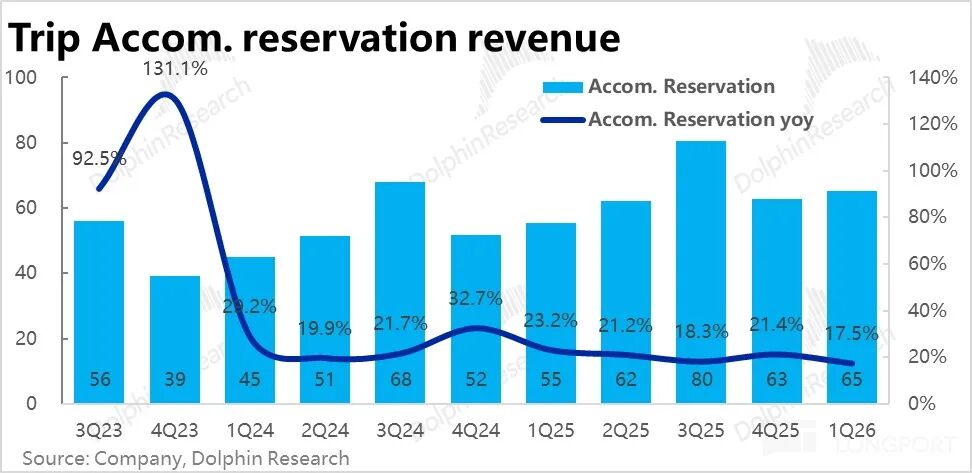
This quarter, the revenue from hotel bookings increased by about 17.5% year - on - year, with a slower growth rate compared to the peak of the previous quarter, and it was basically in line with the company's guidance and market expectation. However, the performance of Atour and Huazhu, which were announced earlier, showed that the revenue and average room rate of domestic hotels improved sequentially in the first quarter of this year. Ctrip's performance was the opposite. Dolphin Research suspects that it may be affected by the decline in the monetization rate of the company's hotel bookings under regulatory pressure.
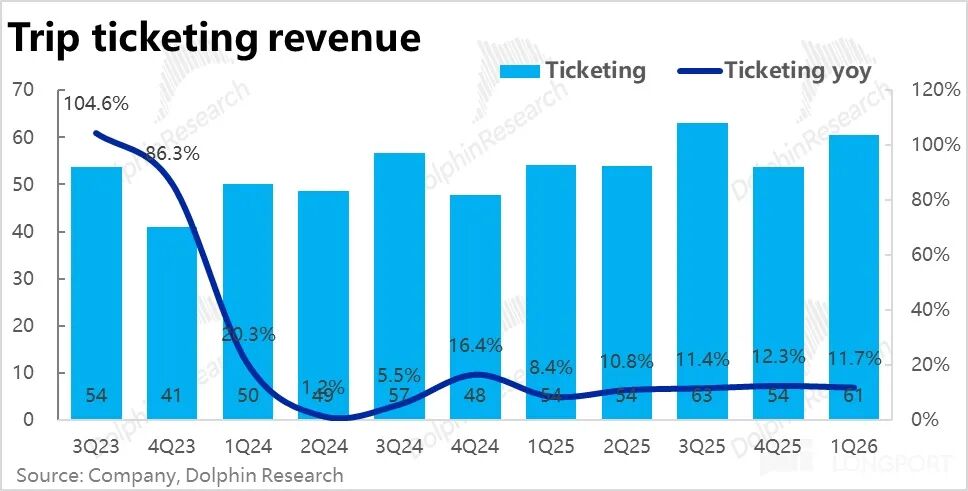
As for the ticketing revenue, it increased by 12% this quarter, and the sequential growth rate was generally stable, slightly higher than the market expectation. The regulatory measures on the bundling of train tickets in the first quarter do not seem to have had an impact yet.
2. Better - than - expected growth in advertising and business travel
Among the other three smaller - scale businesses that exceeded expectations:
The growth of packaged tour products met expectations. The revenue was 1.13 billion yuan, with a year - on - year growth of about 19%. The growth rate slowed down slightly compared to the previous quarter, but it was generally in line with the market expectation .
The revenue from business travel was 690 million yuan, with a year - on - year growth of 20%. It was the only business that accelerated its growth compared to the previous quarter (15% in the previous quarter), significantly better than the market expectation. According to the company's explanation, it was mainly driven by domestic enterprises going global, which boosted the company's overseas business travel revenue.
As for other revenues mainly based on advertising, it increased by 33% year - on - year this quarter. Although the sequential growth rate slowed down significantly, it still outperformed the market expectation by more than 10 percentage points. According to the company's explanation last quarter, the slowdown this quarter was mainly because the advertising revenue entered a high - base period starting from 2025.