Micron's Strong Earnings, Gold's Bad News
On June 24, Eastern Time, Micron Technology, a storage giant, released its financial report for the third fiscal quarter of fiscal year 2026. The data shows that in the third quarter of fiscal year 2026, the company achieved revenues of $41.5 billion, a 74% increase from the previous quarter and a 346% increase from the same period last year, setting a new historical record for the fifth consecutive quarter. During the same period, the company's consolidated gross profit margin reached 84.9%, a 10-percentage-point increase from the previous quarter; the operating cash flow reached $25.4 billion, and the free cash flow was $18.3 billion, both hitting quarterly highs.
While the performance far exceeded market expectations, Micron also disclosed details of 16 SCAs in the financial report and the subsequent conference call, stating that even when calculated at the lower price limit, the cumulative value of the existing signed orders within the remaining contract period is still as high as $100 billion. At the same time, the relevant agreements can lock in $22 billion in cash deposits and financial commitments for the company.
Benefiting from the resonance of the better-than-expected performance and the favorable long-term contracts worth hundreds of billions, as of press time, Micron's after-hours stock price soared, approaching 16% at one point, and finally stabilized in the high range of 14% - 16%. Catalyzed by Micron's better-than-expected performance, the sub - sectors of the AI chain such as computing power and semiconductors in the A - share market all rose across the board on the same day; the South Korean market also strengthened synchronously. Samsung Electronics and SK Hynix, the two leading storage chip companies, closed up 5% and 13% respectively on a single day.
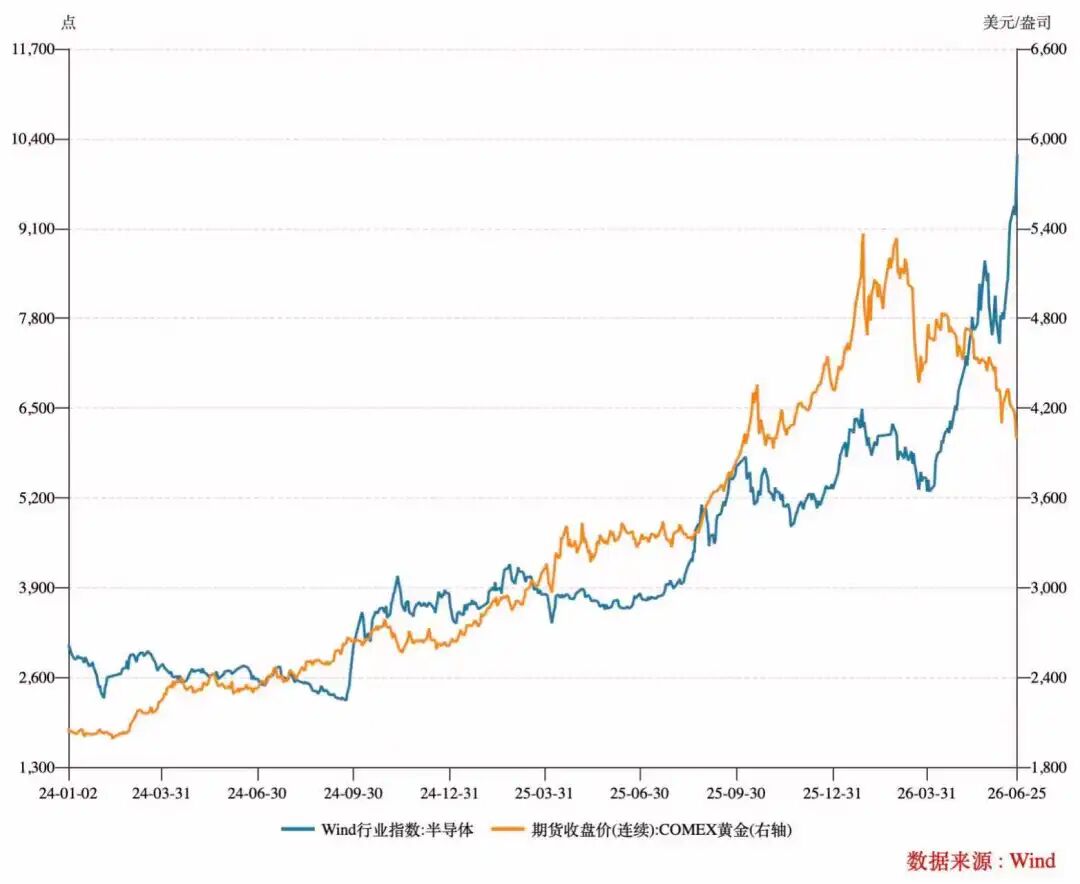
Chart: Trends of the Wind Semiconductor Index in the A - share market and COMEX gold futures; Source: Wind, 36Kr
It is worth noting that while the global AI chain is in a bull market, gold, which has provided investors with considerable returns in recent years, has started to weaken this year. COMEX gold futures once reached a high of $5,600 per ounce in intraday trading at the end of January this year, and then entered a volatile adjustment channel. After a period of continuous decline, as of press time, the gold price fell below the $4,000 - per - ounce mark.
On the surface, the AI chain market and the gold price have shown completely opposite trends recently. So, is the AI chain bull market a core factor suppressing the gold price? And how will the main line of the AI chain develop in the future?
01
The Structural Bull Market of the AI Chain: The "Siphon Effect" of Funds is Prominent
While the AI chain is in a bull market, the capital market is experiencing a "liquidity reconstruction."
From the trading style of the A - share market, funds are gradually migrating from large - cap value stocks to small - and medium - cap growth stocks. Trading data shows that the Science and Technology Innovation Board and the Growth Enterprise Market have experienced a bull market in the past two years. In particular, technology/growth - oriented indexes such as the Kechuang Chuangye 50, Kechuang 50, and Chuangchengzhang have significantly outperformed the broad - based large - cap indexes. Driven by the bull market, the proportion of the combined trading volume of the two boards in the total market trading volume (excluding the Beijing Stock Exchange and in - market ETFs) has continued to rise.
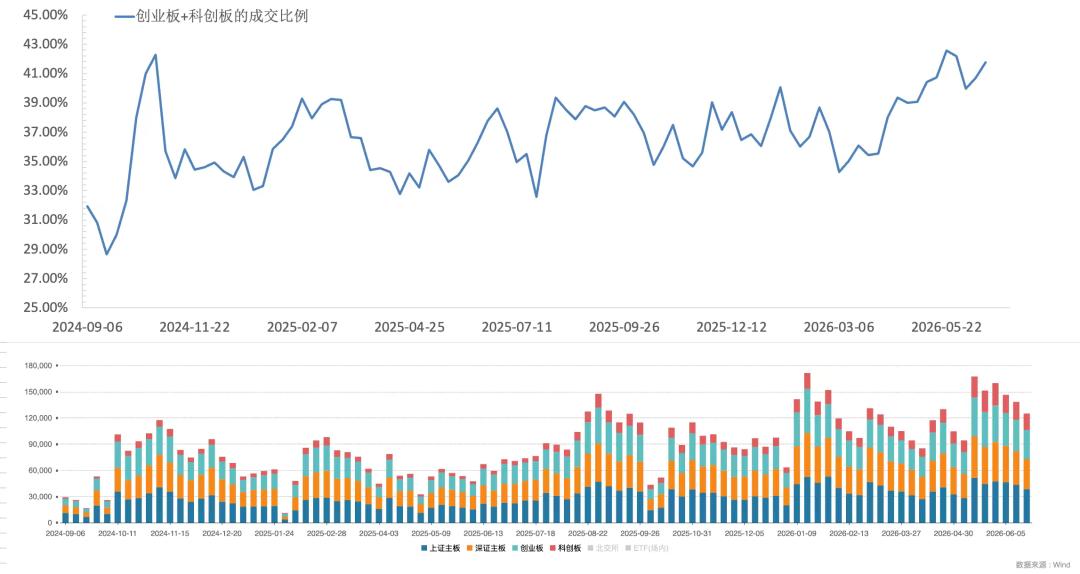
Chart: Proportion of trading volume of the Science and Technology Innovation Board and the Growth Enterprise Market; Source: Wind, 36Kr
At the theme level, the bull market of the Science and Technology Innovation Board and the Growth Enterprise Market mainly stems from the continuous high prosperity of sub - sectors such as computing power and semiconductors in the AI chain. Of course, popular pan - technology themes such as new energy and high - end manufacturing also contribute. The market trading structure also clearly reflects that current trading is mainly concentrated in the above - mentioned popular themes, that is, the information technology sector with AI as the core main line. The proportion of its trading volume in the total market trading volume has been continuously rising, and has remained above 40% in the past two months, even approaching 50% at the peak.
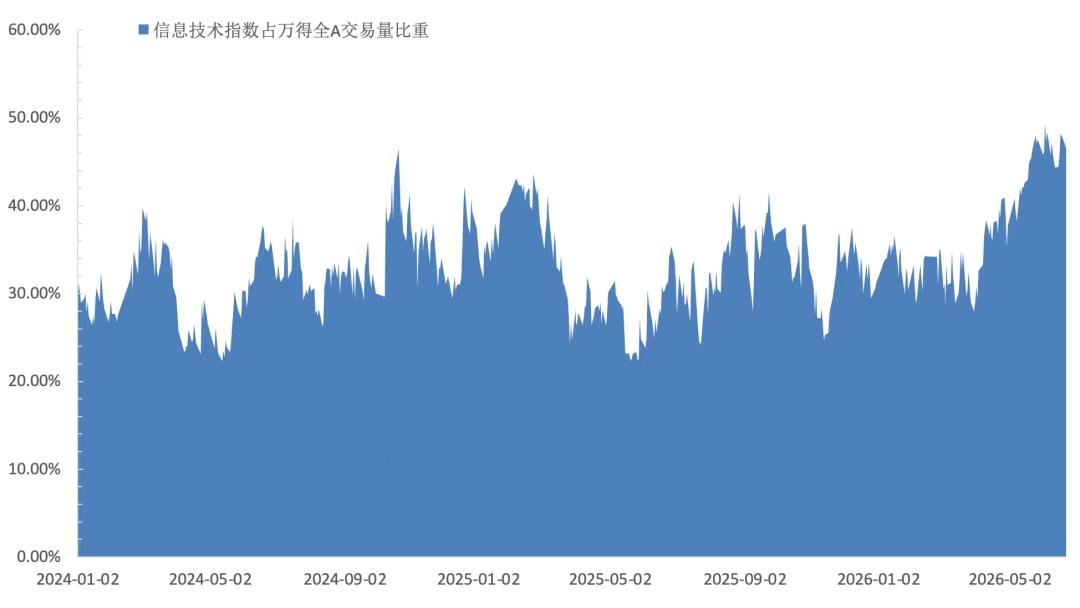
Chart: Proportion of trading volume of the Wind Information Technology Index; Source: Wind, 36Kr
This means that nearly half of the funds in the entire market are concentrated in AI - related sectors.
Meanwhile, the high - density trading has led to extreme differentiation among sectors. As of June 24, among the 31 first - level industries of Shenwan, only 11 have recorded positive returns since the beginning of the year. Among most of the sectors with negative returns during the same period, sectors such as commerce and retail, agriculture, forestry, animal husbandry and fishery, beauty care, and food and beverage have continued to decline and adjust, and have now approached or fallen below the levels when the Shanghai Composite Index was at 2,600 points in February 2024.
This differentiation among sectors is also reflected in valuations: on the one hand, the valuation quantiles (PE - TTM) of AI - related industry indexes such as the Kechuang 50, semiconductors, and communication equipment have rapidly climbed to above 80% of the historical level in just a few months; on the other hand, the index valuations of poorly performing industry sectors are mostly below 40% of the historical quantiles. In particular, the food and beverage sector, which was once popular due to the strong performance of liquor, has even been below 10% for a long time.
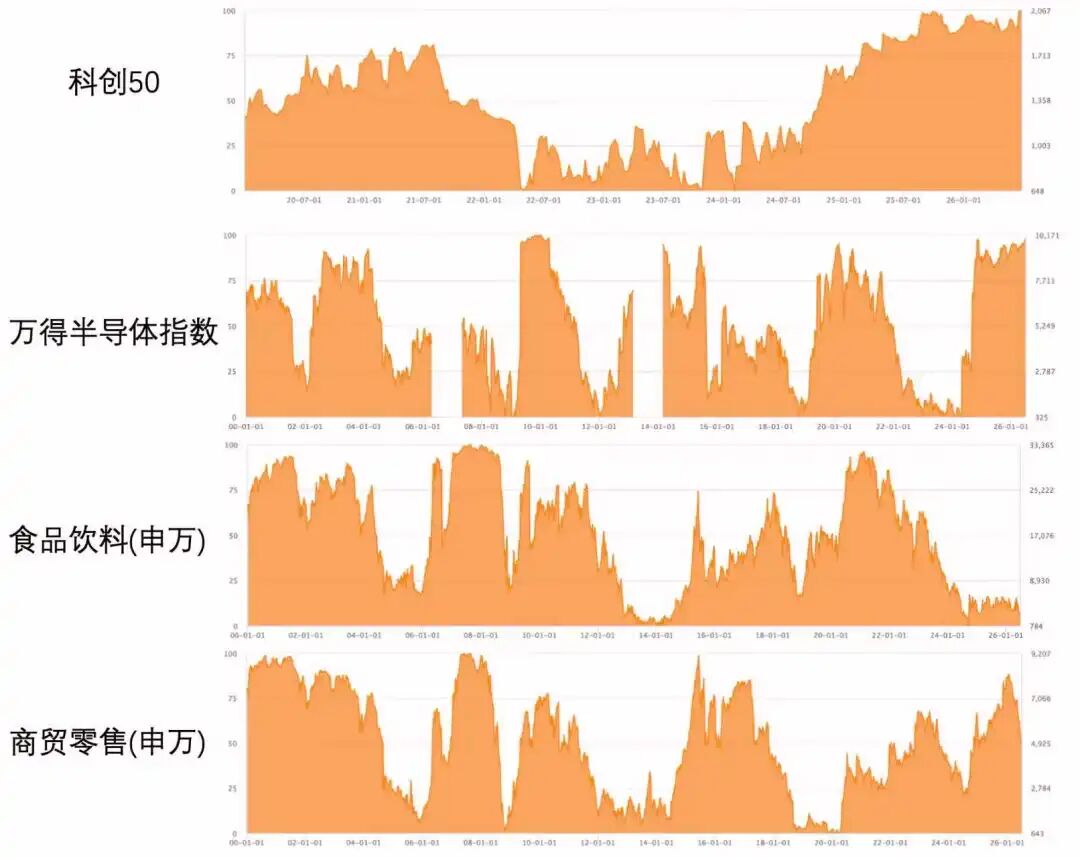
Chart: Historical quantiles of valuations of some indexes; Source: Wind, 36Kr
The degree of valuation differentiation among sectors does not seem as extreme as the market performance. The main reason is that for those sectors abandoned by the market, such as consumption and medicine, while the numerator (earnings) decreases, the deterioration of the fundamentals leads to a simultaneous decrease in the denominator (book value), so the valuation quantile does not decline much or remains at a relatively high level. For those sky - rocketing AI - related sectors, under the joint guidance of high industry prosperity and the realization of expectations (expectation of an increase in the numerator), as a large amount of funds pour in, the valuation is passively pushed up. The continuous record - breaking market of some sectors has even pushed their valuation quantiles to 100%.
The current liquidity reconstruction in the A - share market is a microcosm of the global capital market. In the U.S. stock market, the trend of fund migration is quite clear: recently, funds have mainly flowed out of sectors such as energy, healthcare, food and beverage, tobacco, software and services, and have poured into the two sub - sectors of semiconductors and technology hardware in the information technology sector. Reflected in the market, the Philadelphia Semiconductor Index has accumulated a 90% increase since the beginning of the year, and the corresponding valuation quantile has also climbed to 80%.
Another characteristic of this fund migration is that iconic leading companies have become the reservoirs of funds. In the U.S. stock market, NVIDIA's total market value once exceeded the $5 - trillion mark, and the currently popular Micron Technology also entered the trillion - dollar market - value club this year. The bull market in the South Korean market is highly tied to Samsung Electronics and SK Hynix, the two leading semiconductor companies, and their combined weight accounts for more than half of the total market value of South Korean stocks. In China, the total market value of core leading companies in the AI chain such as Zhongji Xuchuang and Foxconn Industrial Internet has also exceeded the one - trillion - yuan scale.
It is worth noting that the siphon effect of the AI chain bull market on funds is no longer limited to the stock market but has spread to the cross - asset level. Data from the World Gold Council shows that in May this year, global technology - related ETFs recorded the highest single - month inflow since 2024. At the same time, global gold ETFs have witnessed another large - scale outflow of funds.
For investors, the stable realization of excess returns in the AI chain bull market, with a much stronger money - making effect than the weakening and volatile gold market, has led to the continuous shift of funds originally allocated to gold for portfolio risk hedging to the technology growth track in pursuit of higher returns. Global gold ETFs have seen net outflows for consecutive months, further increasing the downward pressure on the gold price.
Therefore, although the continuous decline of the gold price is mainly suppressed by macro factors such as rising interest rates and increasing inflation expectations, the continuous inflow of global funds into the AI chain is also an important factor that cannot be ignored in dragging down the gold price.
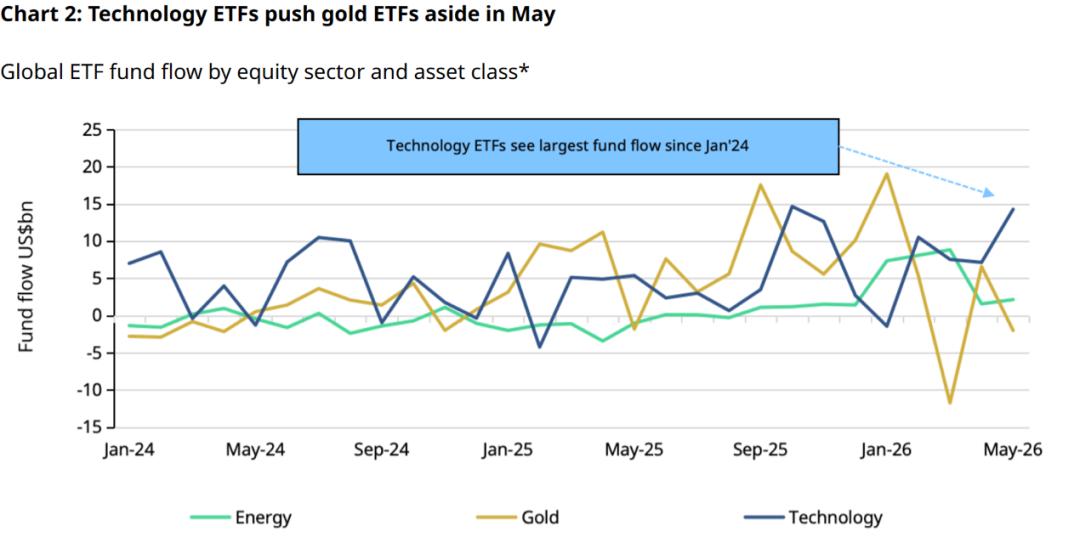
Chart: Fund flows of gold ETFs and technology ETFs; Source: World Gold Council, 36Kr
02
Why are Global Funds Betting on the AI Chain?
Global funds are unanimously giving a higher valuation premium to the AI chain. In particular, relevant hardware such as computing power and semiconductors is in a structural bull market. This is not simply investment speculation but a medium - and long - term industrial trend catalyzed by the resonance of multi - dimensional and multi - level logics.
First of all, the overall strong fundamentals of the AI chain and the related industries being in a prosperous cycle are the core support for this round of structural bull market. Taking the U.S. stock market as an example, among the constituent stocks of the Nasdaq and the S&P 500, the proportions of AI - related enterprises that achieved profitability in Q1 2026 were 48% and 25% respectively, far exceeding the high of about 3% during the Internet bubble in 2000. The continuous better - than - expected performance of leading enterprises such as NVIDIA and Micron is the key to dispelling investors' concerns that AI - chain - related enterprises "only burn money without making profits."
In contrast, sectors such as food and beverage, agriculture, forestry, animal husbandry and fishery, and commerce and retail, which are impacted by the strong siphon effect of the AI chain, generally face the dilemmas of slow demand recovery and intensified competition, and have relatively insufficient long - term growth potential. Therefore, the high valuation given by the current market to the AI chain is not only a bet on a new round of technological revolution but also, under the comparative advantage of fundamentals, investors have a stronger willingness to allocate to high - prosperity sectors.
Secondly, the money - making effect brought by the rising stock prices is also the core factor driving fund migration and liquidity reconstruction. The continuous sky - rocketing of the AI chain has stably realized excess returns, triggering investors' widespread and strong fear of missing out. In order to avoid missing the technological main - line market, while reducing their holdings in traditional industries, existing funds have turned to increasing their positions in core assets of the AI industry chain such as computing power and semiconductors; incremental funds are also continuously entering the market to layout the technological main line. A typical example is that many newly issued overseas funds in recent times are all related to SpaceX.
From the perspective of macro - interest rates, the rising long - term U.S. Treasury yields have generally suppressed various types of assets. Among them, the AI chain and gold have shown opposite trends, which essentially reflects that under the influence of the money - making effect, the expectation of excess returns has, to a certain extent, overwhelmed the interest - rate risk. The logic behind this is as follows:
Interest - rate fluctuations lead to changes in the financing environment. In particular, rising interest rates are an obvious negative factor for the technology sector, which is highly dependent on financing. Moreover, since this year, AI - chain - related enterprises have started to raise funds through bond issuance, further strengthening the sensitivity of technology enterprises to interest - rate changes. Although the tightening expectation has been reflected in the prices of various types of assets to a certain extent, under the continuous high prosperity of the AI chain, investors' sentiment is relatively optimistic. The current mainstream view in the market is that once the AI industry explodes, the huge excess returns it brings will far exceed the marginal cost increase caused by rising interest rates.
03
Outlook: The AI Chain Bull Market Will Continue, and Gold is Expected to Enter a Bear Market
The strong positive feedback in the capital market after Micron's financial report is essentially a public vote for the valuation - reshaping logic of the storage industry shifting from "cyclical game" to "long - term locking." Judging from the performance of AI - chain enterprises in the first quarter of this year, the profit growth rate and profit quality are both improving. The strong signal released by Micron's latest financial report provides key evidence for the verification of the AI chain's prosperity in the second - quarter window.
This once again shows that the realization of performance is one of the underlying logics supporting this round of structural bull market of the AI chain, and it is also the essential difference from the Internet bubble in 2000.
From the perspective of the industry narrative, driven by the super - cycle of AI, in the past two years, core computing - power links represented by storage, optical modules, and PCBs have continuously refreshed the market's inherent perception. Due to the significant hard bottlenecks on the supply side, the performance visibility of the industry has been significantly improved. These sectors are collectively crossing the traditional cycle positioning and entering a new growth spiral of "full - blown expectations - performance verification - valuation reshaping," and the span of the industry prosperity cycle has also been extended.
Therefore, the core focus of the market has completely shifted from whether the demand is sufficient and sustainable to how long the supply bottleneck of storage can last. Moreover, the "supply - demand mismatch" in the above - mentioned core links is reshaping the access threshold of the entire AI hardware industry chain. Leading enterprises have obtained higher growth certainty through a series of in - depth binding measures such as long - term contracts, payment in advance, and joint R & D. This also means that industry dividends are accelerating to concentrate on the leading echelon with scale and technological barriers, which is the fundamental reason why relevant leading enterprises have become the reservoirs of funds in the equity market.
The tight supply - demand balance at the industry level provides solid support for the continuation of the prosperity cycle. Against the background of the overall increase in capital expenditure and continuous expansion of production capacity in the global AI chain, the supply shortage will continue until after 2027. After 2028, when the supply improves marginally, the long - term strong demand for AI will also provide a certain bottom - support for the entire industry. Therefore, the prosperity cycle of the AI industry will be extended, and the bull market of the AI chain under the growth logic will also continue.
Although the medium - and long - term prosperity of the