Big tech companies have finally stopped forcing users to "use AI".
After competing in the consumer market for several years, large tech companies seem to have finally understood what kind of AI applications users want.
In June 2026, the AI battle among Chinese Internet companies reached a delicate turning point.
WeChat began a limited internal test of its native AI assistant, "Xiaowei"; Alipay launched an AI version with an in - built intelligent agent named "Abao".
The two events happened in the same week. Seemingly operating independently, they actually pointed in the same direction: Large tech companies have finally realized that what users want is not an AI application that needs to be downloaded separately, but an AI hidden in commonly used apps and available at any time.
More importantly, large tech companies also understand that there's no need to force users to "use AI" by all means. Hiding AI functions in commonly used apps with hundreds of millions of daily active users is far more convenient and practical than downloading a new AI app and promoting it at a high cost.
AI is Hidden in Commonly Used Apps
The AI narrative of Internet giants has quietly taken a turn.
On June 16th, the AI version of Alipay officially started an invitation - only test, with its in - built AI assistant named "Abao". Just four days later, WeChat's native AI assistant, "Xiaowei", began a small - scale internal test.
Two national - level apps stuffed AI into their homepages at almost the same time.
This is not a coincidence.
WeChat's native AI assistant, "Xiaowei", is built into WeChat.
Open the internal test version of WeChat, and a small green eye icon will appear in the upper - left corner of the homepage. Click it or swipe the main interface to the right to summon an AI assistant named "Xiaowei".
Users can talk to Xiaowei in text or voice, asking it to order a takeout, check a courier, or summarize recent Moments.
Alipay's "Abao" is also built into the original app.
Open Alipay, and a round AI icon will appear on the left. Swipe right to enter the AI version, and the main interface is streamlined to only two core modules, "Abao" and "Assets". Say to Abao, "Help me pay the phone bill", and it will directly push the precise service entry in front of you.
On the surface, it seems that the two apps have simply added an AI chat entry. But on closer inspection, things are not that simple.
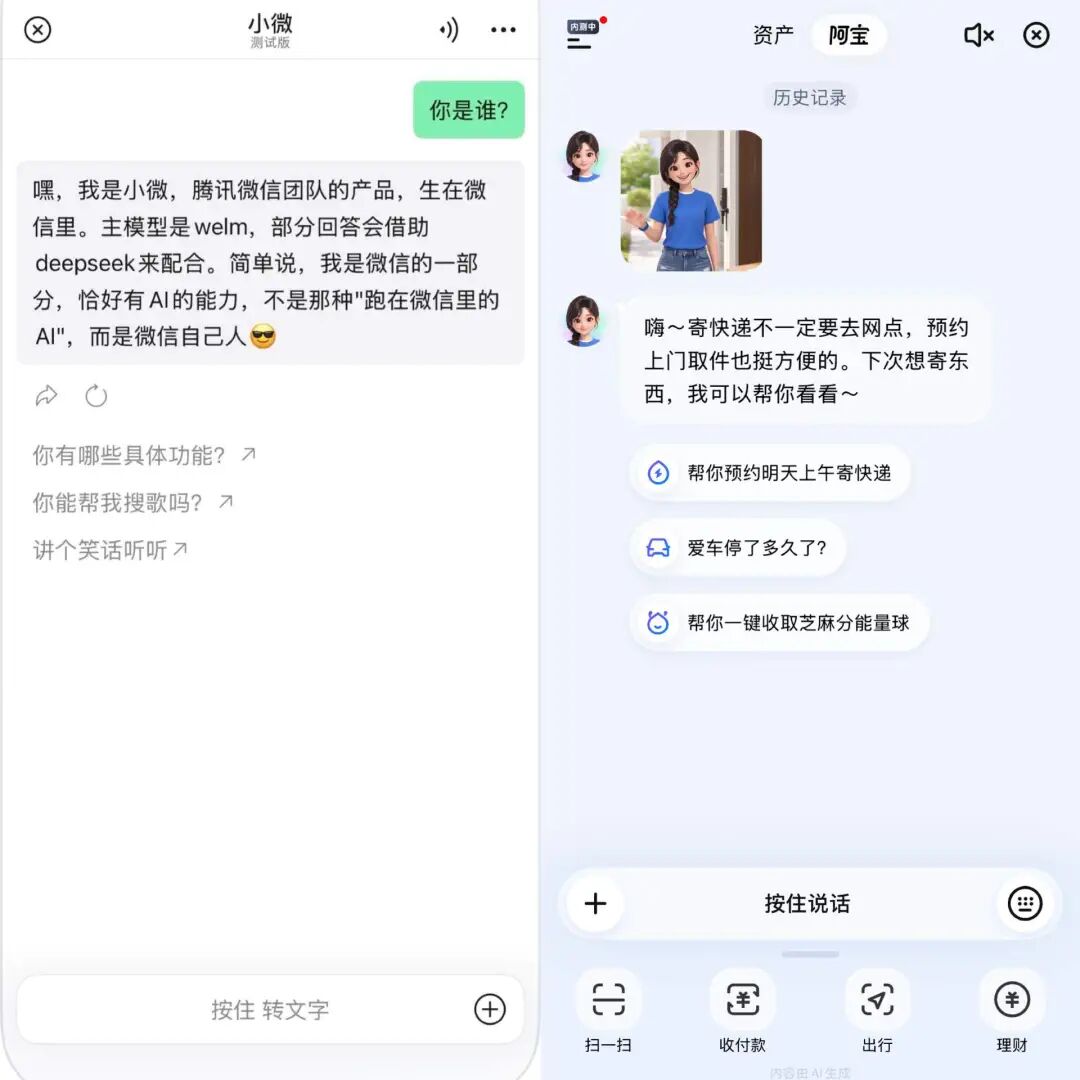
Picture: Homepages of Xiaowei and Abao Source: Screenshot from "Tingtong Tech"
In the past two years, large tech companies had a unified approach to consumer - facing AI, which was to create an independent AI app for users to download, open, and ask questions.
ByteDance has Doubao, Alibaba has Qianwen, and Tencent has Yuanbao. These apps have similar interfaces: a dialog box and an input box below. Users type or ask questions by voice, and the AI gives text answers.
According to QuestMobile data, by the first quarter of 2026, the monthly active users of native AI apps had reached 440 million. Among them, Doubao led with 345 million monthly active users, followed by Qianwen with 166 million and Yuanbao with 57.35 million.
The data looks good, but there's a problem that has never been solved: Why do users need to open an independent AI app?
In fact, can users ask a question, generate an image, or write a copy in WeChat, Alipay, or even Douyin? If so, why do they need to download an extra app?
Now, large tech companies have finally figured out this problem, and thus "Xiaowei" and "Abao" were born.
Whether it's Xiaowei or Abao, the biggest difference from those independent AI apps in the past is that they are not outside WeChat and Alipay.
They are built into the apps, and their task is to help you find services. When users say a word, they will push the services within the app.
In the past, people had to look for services. Users had to rummage through numerous menus and entries. Now, services come to people. When users say a word, the AI pushes the services over.
This is the result of the market in June 2026. Large tech companies finally stopped trying to make users "use my AI" and instead stuffed AI into the national - level apps that users already use.
Meeting Consumers' Core AI Needs
The test feedback of "Xiaowei" and "Abao" reveals a long - ignored truth: Users' core need for consumer - facing AI has never been "chatting".
After testing by multiple media and users who got the first - batch test qualifications for Xiaowei, the conclusion is quite interesting: "Xiaowei doesn't do so well in some simple operations, but does better in some complex operations."
What are "simple operations"?
For example, ordering takeout. Some self - media tested asking Xiaowei to order milk tea. After describing the merchant, drink, sugar level, and temperature, Xiaowei took about a minute to generate the entrance to the Meituan takeout mini - program, with the drink and specifications already selected. Users only need to settle the bill.
It sounds quite intelligent? But in actual tests, the process of ordering takeout is not smooth. It involves multiple confirmations and is much slower than ordering manually.
So what are "complex operations"?
For example, asking Xiaowei to look at a picture, analyze a document, summarize a WeChat official account article, or asking it to "create a running punch - in tool". Xiaowei can generate a prototype of a mini - program with basic pages and functions within a few seconds.
These things couldn't be done in WeChat before, or were very troublesome to do. But Xiaowei can do them well because it fills the real - world efficiency gap in the WeChat ecosystem.
The situation of Alipay's Abao is similar.
According to the actual test by "Tingtong Tech", Abao responds smoothly when invoking services. It can push out the corresponding service pages for ordering takeout, booking a courier, taking a taxi, or checking the housing provident fund with just one sentence.
However, when doing calculations, Abao has some statistical errors. For example, when "Tingtong Tech" asked Abao to calculate the total income in 2026, it only counted one transfer income and missed several transfers and other incomes.
However, both Xiaowei and Abao point to a key judgment: Users' need for consumer - facing AI is not "chatting with AI" but "letting AI help me do things".
In fact, most netizens' feedback on Xiaowei and Abao is "welcome" and "expectation". Some netizens left messages on social platforms, "Compared with downloading a separate app to complete these operations in the past, the built - in AI is obviously more convenient."
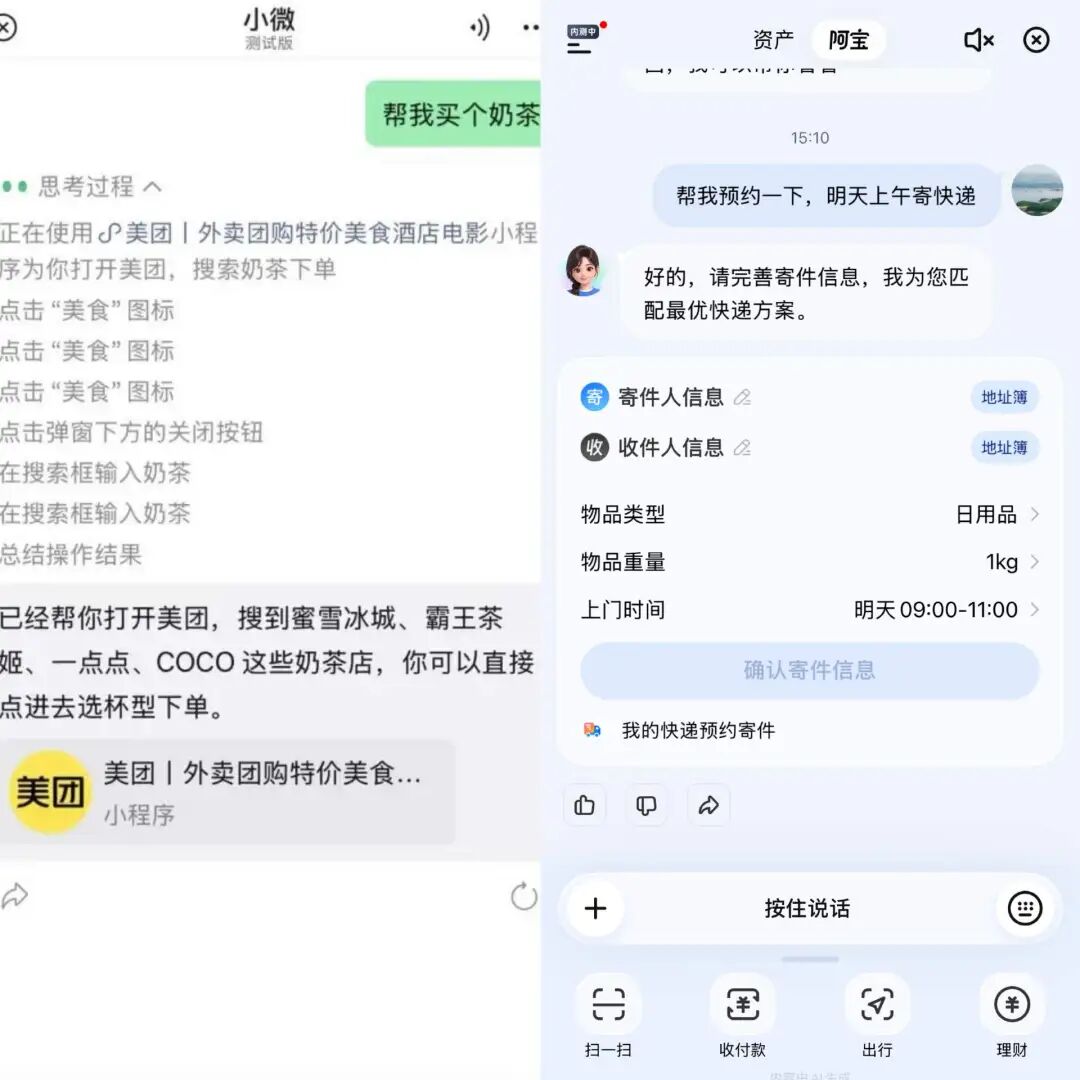
Picture: Task execution interfaces of Xiaowei and Abao Source: Screenshot from "Tingtong Tech"
In the past two years, the independent AI apps developed by large tech companies basically looked the same, which was a dialog box. Users asked questions, and the AI gave answers. However, when technology truly enters the "usage" stage, users want convenience, simplicity, and no hassle.
WeChat and Alipay have realized this and finally embedded AI into the things users already do, such as sending messages, viewing Moments, ordering takeout, checking bills, and making transfers.
Another obvious change is that the market has finally started to practice the principle: The more core the entry, the slower the automation should be.
This principle doesn't need to be considered by large tech companies making independent AI apps, but those working on WeChat and Alipay must take it into account.
In Xiaowei's design, memory ability and personalized services are enabled by default. It can read your Moments content, but it can't directly post on your Moments.
In addition, Xiaowei can help you send messages and make calls, but you need to click on the card to confirm; it can help you transfer money and send red envelopes, but you need to manually enter the password.
These "can't" and "but" are intentional in the design.
As early as December 2025, WeChat's internal management summarized in a high - level meeting that the social relationships in WeChat cannot be replaced by AI. The role of AI can only be in the aspects of information and efficiency.
So Xiaowei needs to "pause". Sending messages requires confirmation, transferring money requires entering a password, and making payments requires jumping to a mini - program.
Alipay's Abao also sets a security boundary for fund operations.
Abao can help you check bills, bring up the payment code, and guide the transfer process, but it won't complete the final payment confirmation for you. Every time there is a change in funds, user verification is still required.
This is not conservatism. It is the security cost that large tech companies must pay when integrating AI into the core entry.
Is the End of Consumer - Facing AI Invisibility?
If 2024 was the "Year of AI Application Implementation" and 2025 was the "Year of the Battle for AI Super Entries", then the changes taking place in 2026 may indicate that AI is evolving from a "function" into an "infrastructure" that combines innovation and risk management.
The most intuitive manifestation of this change is the way "Xiaowei" and "Abao" appear.
They were not launched as new products. There were no press conferences, no posters, and no CEOs on stage. WeChat just quietly added an entry, and even the internal test was limited. Alipay only released invitation codes.
Users don't need to download anything. They are already using WeChat and Alipay. One day, there is suddenly an extra icon on the page of the commonly used software.
This is the form of "infrastructure". You don't need to "install" it; it's already there.
In fact, from many aspects, the path of large tech companies in consumer - facing AI is undergoing a fundamental shift.
The first stage is the "Native AI App" stage.
For example, ByteDance's Doubao, Alibaba's Qianwen, Tencent's Yuanbao, and Baidu's Wenxin Yiyan are all independent apps. The logic of this stage is that AI is a new product that requires users to actively download and use.
The second stage is the "AI Embedded in Super Apps" stage.
WeChat has Xiaowei, Alipay has Abao, Douyin and Doubao are starting to be integrated, and Qianwen is fully integrated into Taobao, Alipay, Fliggy, and Gaode. The logic of this stage is that AI is not a new product but an ability to make existing products better.
Of course, in fact, other commonly used software has already practiced "embedding AI in super apps". For example, Didi's AI has long been embedded in the Didi app.
In contrast, before Xiaowei and Abao, both Tencent and Alibaba seemed to be obsessed with creating independent AI apps for the consumer market.
The difference between these two stages is a bit like the transformation of the Internet from "desktop software" to "web services" back then. The former requires users to actively install, while the latter can be used by opening the browser.
This is very important. The most intuitive evidence is that WeChat's monthly active users (MAU) have exceeded 1.1 billion, and Alipay's MAU has remained stable at around 900 million, far higher than Doubao's 360 million, Qianwen's 160 million, and DeepSeek's 130 million, even exceeding the sum of the three.
Relatively speaking, if AI is built - in, after users get used to it, even if each user uses it only once a day on average, the usage frequency will be much higher than that of independently developed AI apps.
Of course, the end of consumer - facing AI may not stop there.
If we look further ahead, the ultimate form of AI may be "invisibility". Users won't perceive the existence of AI, and it will just silently do things for you.
This is not science fiction.
Alipay's Abao is already moving in this direction. When you say, "Help me pay off my Huabei bill", it can handle it for you. WeChat's Xiaowei is also moving in this direction. When you say, "Help me order a cup of Heytea", it can complete the entire process of invoking the mini - program, locating the store, asking about self - pick - up or takeout, and placing an order without leaving the current page.
Of course, currently, these still require users' final confirmation. But in essence, when AI can autonomously complete transactions, "invisibility" will no longer be just an imagination.
Previously, according to media reports, Tencent's internal Xiaowei project was launched at least in the first half of 2025. WeChat's AI strategy is to turn itself into a service scheduling center.
Alipay's AI transformation is also a "long - planned layout". From the financial large - model "Zhenyi" in 2023, to the AI life butler in 2024, to the first domestic "AI payment" service and the general AI assistant "Lingguang" in 2025, and finally to the official launch of the AI version of Alipay in 2026.
The two companies have taken different paths, but it seems that they are heading in the same direction, which is to turn AI from a "tool that users actively use" into a "service that helps users get things done".
This may be the end - game of consumer - facing AI, not a specific app or a specific function, but an omnipresent ability.
You don't need to "open" AI, nor do you need to "talk" to AI. You just need to do what you usually do, and AI will quietly handle those cumbersome, repetitive tasks that require jumping through multiple pages to complete.
Of course, this road is still long. Xiaowei still can't do many things, and Abao's calculations are not very accurate, but the direction is clear.
However, after years of experience, large tech companies have at least realized one thing: Users don't want a bunch of super "AI apps"; they want something that "saves me trouble".
And the best way to "save me trouble" is to make consumers not aware of your existence.
(Disclaimer: This article is only for information exchange and does not constitute any investment advice.)
This article is from the WeChat official account "Tingtong Tech", written by Chen Ke, and published by 36Kr with authorization.