Abandoning the "10-Billion-Yuan Target", Its Share Price Falls Back to the Level of a Decade Ago, Kouzujiao Failed to Be Saved by McKinsey
1
50 Billion Yuan in Market Value Vanishes
After a decade, the stock price of Kouzijiao once again fell below the integer mark of 20 yuan.
On June 19th, the last trading day before the Dragon Boat Festival, the stock price of Kouzijiao dropped to 19.59 yuan, hitting the lowest closing price since 2017. Its total market value fell below 12 billion yuan, shrinking by nearly 50 billion yuan compared to its historical high. As of the most recent trading day, its stock price further declined to 18.77 yuan, with a market value of only 1.1215 billion yuan.
Poor financial report performance is obviously a major reason for investors to "vote with their feet" on Kouzijiao's stock. Data shows that in the whole year of 2025, Kouzijiao achieved an operating revenue of 3.991 billion yuan, a year-on-year decrease of 33.65%, setting the lowest revenue record since 2017. During the same period, the company achieved a net profit attributable to the parent company of 673 million yuan, a year-on-year plunge of 59.32%. This figure is significantly lower than the net profit level of Kouzijiao in the same period of 2016 (783 million yuan).
Against the backdrop of the continuous slump in domestic consumer demand and the oversupply in the liquor industry, the operating performance of listed liquor companies is generally poor. However, the decline in Kouzijiao's performance is still among the most severe in the industry. Specifically, the decline in Kouzijiao's operating revenue ranks fourth among 20 listed liquor companies, and the decline in net profit ranks seventh in the industry.
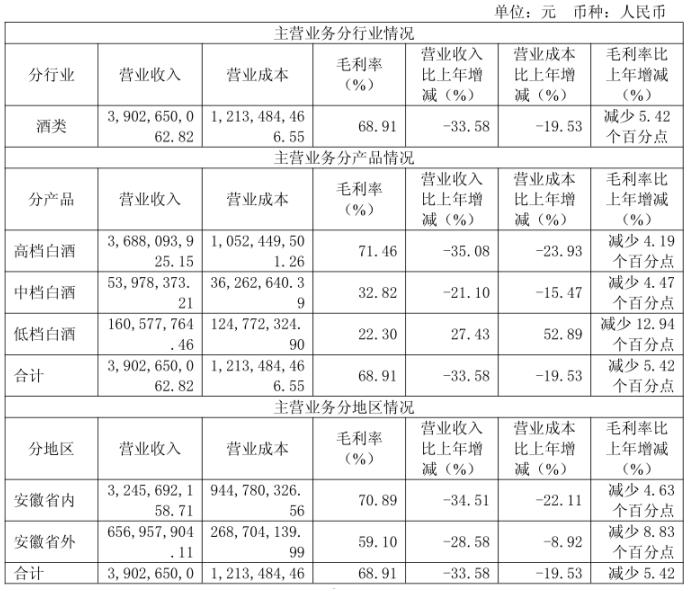
In terms of revenue composition, Kouzijiao's main revenue comes from high - end liquor, accounting for more than 90% of the revenue. It is reported that Kouzijiao's high - end liquor mainly includes products such as Five - year Cellar, Six - year Cellar, Imperial Respect, Xiaochi Cellar, Precious Storage, Founding Anniversary Edition, and the Blended Series. The product prices range from 100 to 1000 yuan, and the vast majority are concentrated between 100 and 300 yuan. In addition, the company's mid - end liquor mainly includes products such as Laokouzi and Kouzifang. The low - end liquor is represented by the Kouzijiu series, and the revenue of both accounts for less than 5%.
In the whole year of 2025, the sales revenue of Kouzijiao's high - end liquor reached 3.688 billion yuan, a year - on - year decrease of 35.08%; the revenue of mid - end liquor was 54 million yuan, a year - on - year decrease of 21.1%; the operating revenue of low - end liquor represented by the Kouzijiu series was 161 million yuan, a year - on - year increase of 27.43%. However, due to the small volume of low - end liquor, it failed to offset the impact brought by the significant shrinkage of the company's high - end liquor revenue.
In fact, high - end liquor has always been the main source of revenue for Kouzijiao. However, in recent years, it has been deeply trapped in the embarrassing situation of weak growth, which also poses a severe challenge to its so - called strategy of "the No. 1 brand of high - end blended - flavor liquor in China".
Public information shows that in 2022, Kouzijiao put forward the strategic goal of "accelerating the realization of a 10 - billion - yuan Kouzijiao and entering the first echelon of the national liquor industry". Among them, the upgrading of the product structure and the creation of high - end blended - flavor single products have become the main direction for the company to break into the 10 - billion - yuan revenue camp. For this reason, Kouzijiao cooperated with the well - known consulting firm McKinsey. Under the strategic framework of "10 - billion - yuan Kouzijiao", McKinsey assisted Kouzijiao in completing the upgrading and adjustment of strategy, brand, products, and organization, and jointly formulated the strategic goals for the next five years, striving to become the "leading brand of Anhui liquor" in terms of sales volume, brand influence, and channel popularity.
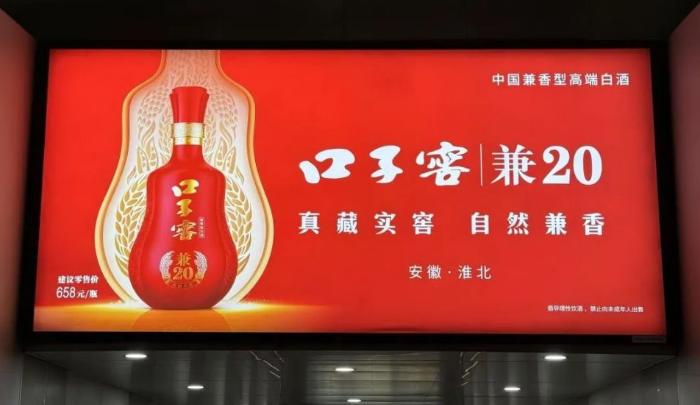
In line with the new strategy, in February 2023, Kouzijiao held a grand new product launch conference in Hefei, Anhui, with the theme of "Natural Blended Flavor, Extraordinary Enjoyment", and officially launched the "Blended 10, Blended 20, Blended 30" series of new products, precisely targeting the three mid - to - high - end price ranges of 300 yuan, 500 yuan, and 1000 yuan respectively. This marks that Kouzijiao has officially established the strategic positioning of creating "the No. 1 brand of high - end blended - flavor liquor in China".
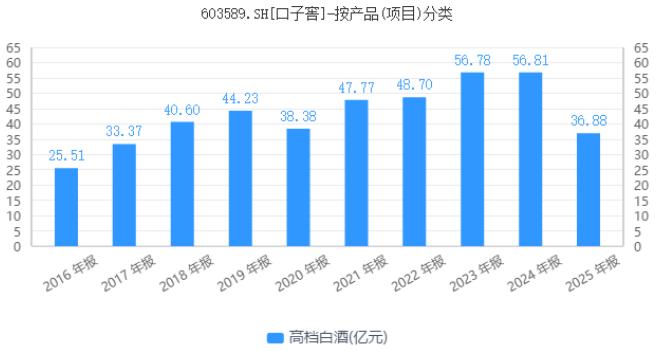
However, judging from the subsequent market performance, this strategy of Kouzijiao did not achieve the expected results. Data shows that from 2023 to 2024, the scale of Kouzijiao's high - end products hovered below 5.7 billion yuan for two consecutive years, which was largely due to the contribution of channel inventory pressure. By 2025, the high - end liquor showed a year - on - year decline of more than 30%, indicating that the growth of its high - end products has completely stalled.
In 2026, Kouzijiao's operating performance is still in a state of significant decline. The latest financial report shows that in the first quarter of 2026, Kouzijiao achieved an operating revenue of 1.375 billion yuan, a year - on - year decrease of 24.02%; and a net profit of 329 million yuan, a year - on - year decline of 46.16%. Looking at each quarter, Kouzijiao has experienced a double - decline in operating revenue and net profit for four consecutive quarters.
There is nothing more sorrowful than a dead heart. Facing the continuous decline in operating performance, Kouzijiao's management has resolutely stopped mentioning the previous "10 - billion - yuan goal". On the contrary, according to the company's 2026 financial budget plan, Kouzijiao has only set this year's revenue target at 4.3 billion yuan, with a year - on - year growth rate of about 8%.
However, judging from the "reservoir" indicator of contract liabilities, the achievement of Kouzijiao's annual report target still faces great pressure. As of the end of March 2026, the latest scale of Kouzijiao's contract liabilities was only 201 million yuan, a 40% decline compared with the end of 2025, indicating that dealers' confidence in purchasing goods is still at a freezing point.
In addition to the significant decline in operating performance, the continuous reduction of shares by the actual controller is also an important reason for the low stock price of Kouzijiao. Since 2019, Liu Ansheng, the co - founder of Kouzijiao, has cashed out more than 1 billion yuan through multiple share reductions and transfers. Among them, in August 2025, Liu Ansheng reduced 10 million shares of the company's stock through block trading, cashing out about 329 million yuan, which further exacerbated the breakdown of Kouzijiao's stock price.
In the late 1990s, on the basis of inheriting traditional craftsmanship, Kouzijiao launched the epoch - making "blended - flavor" liquor after several years of research and development, successfully breaking out of the traditional liquor competition pattern. After that, through more than 20 years of continuous exploration and process evolution, Kouzijiao gradually formed a "one - step blended - flavor" process system with the core of "more of three elements, one high, and two long". In 2003, Kouzijiao liquor was recognized as a "blended - flavor" liquor by the China Liquor Standardization Committee, becoming an outstanding representative of China's blended - flavor liquor and a formulator of national standards.
As the recognized "King of Blended - Flavor Liquor", Kouzijiao used to be firmly in the second place among Anhui liquor brands, and even once outperformed Gujinggong to top the scale of Anhui liquor. However, due to the strategic absence in the sub - high - end price range and the fault in the product matrix, Kouzijiao missed the sub - high - end dividend and was finally overtaken by Yingjiagongjiu. At the same time, the slow pace of channel reform further restricted the space for the upgrading of Kouzijiao's product structure. It only took five years for Kouzijiao to fall from the glory of being the "second largest Anhui liquor brand" to the altar.
2
The "King of Blended - Flavor" That Lost the Title of Famous Liquor
"Don't go east into Anhui, don't go west into Sichuan."
In terms of production volume, Anhui liquor is inferior to Sichuan liquor, and in terms of sales volume, it is difficult to compete with Shandong, Henan, Jiangsu, and Guangdong. However, the status of Anhui liquor in the Chinese liquor industry cannot be underestimated. Among them, Gujinggong, Kouzijiao, Yingjiagongjiu, and Jinzhongzi are collectively known as the "Four Golden Flowers" of Anhui liquor, becoming an important pole in the Chinese liquor map.
If we talk about the long history and profound heritage, Kouzijiao ranks first among Anhui liquors.
According to public reports, the brewing history of Kouzijiu can be traced back to the Spring and Autumn and Warring States periods. At that time, the confluence of the Sui River and the Xi River formed an alluvial plain, and the population gradually gathered to form "Kouzi Town", which is the predecessor of Suixi County, Huaibei City, Anhui Province today. It is reported that the local people have made a living by brewing liquor for generations, and the liquor produced is named "Kouzijiu" after the place.
In May 1949, the people's government established the state - owned Suixi People's Winery on the basis of redeeming private liquor - making workshops such as "Xiaotongju". This is the predecessor of today's Kouzijiao. In 1959, "Suixi Kouzijiu" was sent to Beijing as a major scientific and technological research achievement, becoming the liquor for the National Day 10th anniversary state banquet, and was presented as a gift to the King of Yemen by Premier Zhou Enlai, becoming a highlight in the history of Kouzijiao.
However, as an old - fashioned liquor brand with a brewing heritage of more than 2,700 years, Kouzijiao has never won the title of "Chinese Famous Liquor" in the five previous official national liquor evaluation meetings in China. Among them, the ambiguity of the participating entities caused by the separation of the "two companies" has become an important reason.
In 1970, Huaibei City was officially established. Due to the special financial system of the city and county at that time, the originally homologous "state - owned Suixi People's Winery" was split into two, forming a situation where "Huaibei Kouzi Winery" (city winery) and "Suixi Kouzi Winery" (county winery) coexisted, and they formed a competitive relationship with each other. After that, the two wineries broke out a fierce dispute over the ownership of the core trademark "Kouzi", which also led to what was later jokingly called the "battle between the two companies" in the industry.
Facts have proved that this long - lasting internal strife not only brought a heavy blow to the two wineries but also made Kouzijiao miss the historical window for the "Chinese Famous Liquor" selection for many times.
According to public information, in 1989, the fifth national - level famous liquor selection was held in Hefei, Anhui. This was also the last official "famous liquor" evaluation. Among them, Kouzijiu, which originally had a great chance, was still deeply involved in the trademark civil war of the "two companies". To avoid disputes, the liquor evaluation committee did not list either of them as a "famous liquor" but awarded them the title of "National High - Quality Liquor". Thus, Kouzijiao missed the last opportunity to be included in the "Seventeen Famous Chinese Liquors".
In 1997, with the strong promotion and coordination of the Anhui Provincial and Huaibei Municipal governments, the previously split Huaibei Kouzi Winery and Suixi Kouzi Winery were merged into Anhui Kouzi Group Co., Ltd. Thus, the more than 20 - year - long "battle between the two companies" came to an end.
In order to further integrate internal resources, Liu Ansheng, the then secretary of the Lieshan District Party Committee of Huaibei City, was transferred to Kouzi Group to serve as the general manager and later the chairman. At the same time, Xu Jin, the assistant to the district head, was also entrusted with an important task and was specifically responsible for the group's marketing work.
However, the simple equity merger did not really solve the problems of rigid system and chaotic management in Kouzijiao Group, and the enterprise development stagnated. In 2002, Anhui Kouzi Group Co., Ltd. announced a restructuring and initiated the establishment of Anhui Kouzi Liquor Co., Ltd., introducing external capital such as Jiangsu Tiandilong Industry and Shaanxi Tianju Commerce and natural person shareholders, realizing the transformation from a pure state - owned enterprise to a mixed - ownership enterprise.
After that, in the face of operational difficulties and capital shortages, Kouzi Group began to transfer its equity in Kouzijiao one after another, while Xu Jin and Liu Ansheng continuously increased their shareholding ratio in Kouzijiao. By 2008, state - owned capital completely withdrew, and Liu Ansheng and Xu Jin achieved the actual control of the ownership of Kouzi Liquor through shareholding, becoming the joint actual controllers of the company.
3
The Glory and Decline of the Big - Dealer System
Driven by Liu Ansheng and Xu Jin, Kouzijiao launched the blended - flavor Five - year - type Kouzijiao liquor and cooperated with the first - created "Plate - within - Plate" marketing model. Through the strong promotion of core hotel terminals, it quickly opened up the market, laying the leading position of Kouzijiao in the sub - high - end market and creating a new pattern of blended - flavor for Chinese liquor.
It is reported that the core of the "Plate - within - Plate" model is to start the "big plate" through the "small plate", that is, to concentrate resources on conquering Class A high - end catering hotels (small plate), and through the demonstration effect of political and business opinion leaders, radiate and drive the mass consumer market (big plate). Among them, attacking high - end hotels, especially those for political and business banquets, has become a key link, and it also requires extremely strong personal connections.
In order to promote the continuous implementation of the "Plate - within - Plate Model", Kouzijiao also launched the so - called "Big - Dealer Model", that is, all the heavy - asset and labor - intensive work such as capital advance, team building, and terminal public relations in the regional market was handed over to powerful big dealers to handle, while the manufacturer focused on production and brand promotion, thus achieving rapid expansion with light assets