The Death of Internet Business Models
Over the past two decades, the asset - light model has been the consensus optimal solution in the business world. From Nike's contract manufacturing and distribution to Marriott's management output, from SaaS subscription monetization to the supply - demand matching of Internet platforms, the lighter the asset structure, the higher the valuation premium, the faster the expansion speed, and the more substantial the shareholder returns tend to be.
The capital market believes that the top - notch business model is to use the least amount of fixed assets to leverage the maximum profit, and ideally, to use others' money to do one's own business. However, in the AI era, this decades - long business iron law is loosening.
On one hand, the stock price of Intuit, once a benchmark of SaaS in the US stock market, has plummeted. On the other hand, Internet giants such as Google and Meta have continuously set new highs in capital expenditures. Meanwhile, the HALO (Heavy Assets, Low Obsolescence) strategy proposed by Goldman Sachs has swept the world.
All the signals point to the same direction: The once - invincible Internet asset - light business model is coming to an end.
01
The Underlying Logic of the Dispute between Asset - light and Asset - heavy Business Models
1. Definitions and Financial Boundaries
From a basic definition perspective:
● The asset - light model integrates external resources through brand, technology, channels, organizational capabilities, etc., to achieve higher capital efficiency, faster replication speed, and a lighter asset burden;
● The asset - heavy model builds entry barriers, share stability, and a local winner - takes - all effect through asset scale, asset quality, production capacity control, and vertical integration.
From a financial perspective, the differences between the two are obvious:
● Asset - heavy models focus on capital expenditures (Capex). Fixed costs such as depreciation and amortization account for a higher proportion of revenue, and profits are greatly affected by production capacity utilization. Asset - light models mainly consist of variable costs (Opex) such as sales, management, and R & D. Performance elasticity mainly comes from revenue expansion.
● The cash - flow characteristics are very different: Asset - heavy companies need continuous capital expenditures to maintain equipment upgrades, while asset - light enterprises can optimize working capital through accounts payable in the industrial chain. Therefore, the latter has stronger free cash flow, which enables mature asset - light enterprises to achieve 100% dividend distribution. For asset - heavy enterprises, a dividend ratio of 40% - 50% is considered very excellent.
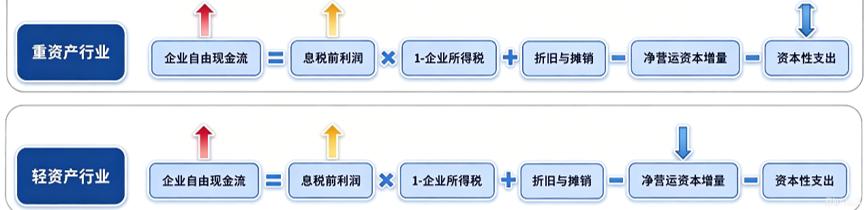
This is where the high growth potential of the asset - light model lies: The initial investment is low, and expansion does not require simultaneous matching of land, factories, and equipment; The marginal cost is lower, especially for platform - type businesses, which can be quickly replicated in new markets.
The hotel industry is a typical example. In the early stage, it used the asset - heavy model of self - operation and leased properties to establish standards, and then shifted to franchising and management output for lightweight expansion. For example, the proportion of fixed assets of Marriott International has decreased from 36% in 1998 to 7% recently.
For this reason, the secondary market has long been willing to give higher valuations to asset - light enterprises: Faster growth realization, clearer shareholder returns, and smaller fluctuations in financial statements.
2. The Internet is the Epitome of the Asset - light Model
If traditional asset - light models are only partial lightweight improvements - for example, Nike divested its production and hotels divested their properties, but still had to bear the implicit rigid investment in supply - chain coordination - then the Internet has taken the "removal of heavy assets" to the extreme.
Internet enterprises naturally take intangible assets such as algorithms, user data, and platform rules as their core values, almost completely eliminating large - scale fixed assets such as factories, offline stores, inventory, and logistics fleets. Meituan does not acquire restaurants, Didi does not purchase vehicles, and Pinduoduo does not build its own warehouses...
The core advantage is that the Internet has a marginal cost close to zero, perfectly realizing the ultimate goal of the asset - light model of "small investment, large - scale revenue". For each additional traditional physical product produced, raw materials and labor need to be invested, and the marginal cost is rigid. However, the incremental investment difference between WeChat serving tens of millions of users and one billion users is extremely small. For short - video platforms to increase the playback volume and e - commerce platforms to add new order matching, only a small amount of server computing power costs need to be added.
In addition, Internet enterprises further reduce the asset weight through two - layer design: First, they use platform rules to aggregate a large number of suppliers, allowing merchants, service providers, and individual workers to bring their own assets to operate. Second, they mostly use the cloud leasing model for computing power and servers, without having to build large - scale data centers. They convert fixed capital expenditures into variable operating costs paid by usage, avoiding the risks of fixed - asset depreciation and idle losses.
02
The Trap of the Smiling Curve: The Moat of the Asset - light Model is Being Broken through by AI
1. The Trap of the Smiling Curve
The most well - known summary model for asset - light and asset - heavy is the smiling curve. Manufacturing, assembly, and raw - material processing in the middle and on the left - hand side of the curve are naturally asset - heavy. The R & D, design, brand marketing, and management output at both ends of the curve are more likely to form an asset - light model.
Whether it is the high - end EMBA courses that corporate executives come into contact with in business schools or the social trend, they all point to the shift from the asset - heavy manufacturing and assembly at the bottom of the smiling curve to the asset - light ends, namely brand design and technology R & D.
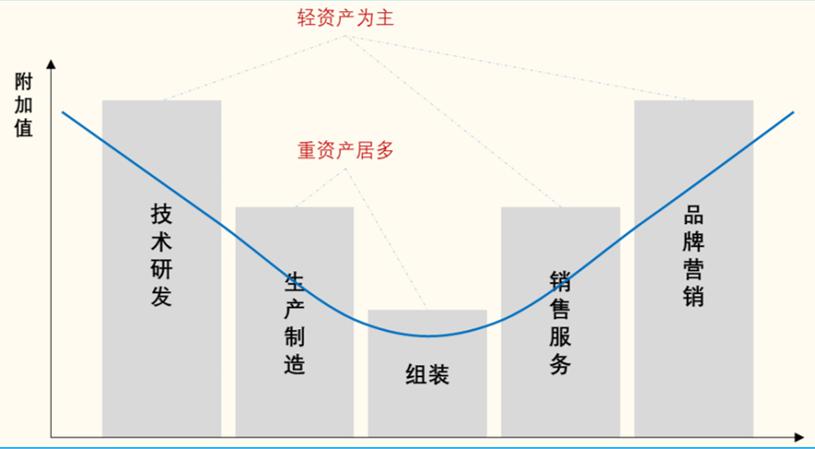
Figure: The Classic Smiling Curve and the Positioning of Asset - light and Asset - heavy. Source: Guojin Securities
For a long time, Internet enterprises have undoubtedly been the ones smiling the most brightly on the smiling curve: They focus on the network effect and traffic, outsource all infrastructure, turn their business into a money - printing machine, and then consolidate their traffic moat by investing in potential risk entry points.
Until the emergence of AI, which completely changed the rules of the game. The traffic logic has become the pipeline logic. When trying to quickly enter the AI field through investment, it is found that this track requires systematic capabilities rather than just financial power.
2. From SaaS to the Internet, AI is Devouring the Asset - light Model
The fact that large models are devouring software and the Internet is not a worry but a real occurrence. The first to be threatened are SaaS software with single functions, simple interaction logic, clear decision - trees, and low marginal costs.
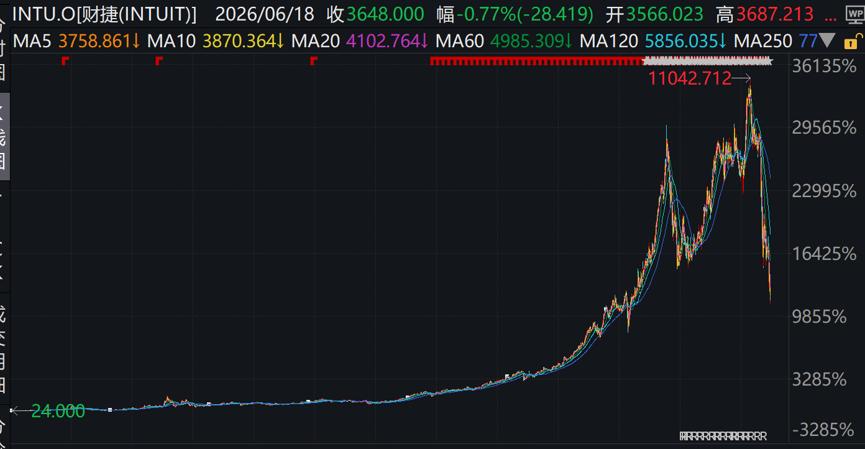
One of the most representative cases is Intuit, a SaaS giant with a market value of over $200 billion. Its fixed assets are less than $1 billion, making it a model of the extreme asset - light model.
Its business mainly serves the rigid - demand scenarios of US small and medium - sized enterprises' taxation, accounting, and finance, as well as individual tax filing. By migrating from traditional software to the SaaS subscription model, the market positions it as a "high - quality platform - type software leader". Its stock price has been on a bull run since the financial crisis, with a gain of up to 50 times.
Since the end of 2025, the biggest pressure on Intuit's stock price comes from the concern about the impact of generative AI on the value of traditional SaaS, because its core business is exactly one of the scenarios most likely to be replaced by large language models. The most direct trading catalyst for the sharp decline in May 2026 is that the TurboTax business has fallen short of expectations.
During the upward phase, the market trades on growth and quality improvement. During the downward phase, it trades on the discount of the moat. This is the common dilemma faced by all asset - light software enterprises.
The impact on the to - C Internet is also happening, but it is not so obvious yet. However, large models are becoming a new and efficient medium. They are not only information - retrieval tools but also intelligent agents capable of understanding semantics, logical reasoning, and independently performing tasks, and are gradually reconstructing the traffic entry points.
● According to industry research data, currently, less than 10% of Internet traffic has begun to shift to AI tools, and the impact is relatively mild. The core reason is that the core moat of Internet platforms is the network effect and user habits, and the change in behavior patterns is a gradual process.
● However, it is expected that in the next 3 - 5 years, the proportion of Internet traffic shifting to AI tools will increase to 30% - 40%. When users can complete operations that previously required opening multiple apps and switching countless pages through natural - language conversations, the C - end entry points will no longer be dominated by browsers or apps but will be reshaped by AI assistants that can directly complete tasks.
Intelligent terminals with system - level Agent capabilities can directly access core services without relying on application UI interaction. Even if traditional Internet platforms are not replaced, they will at least face the risk of being pipeline - ized.
03
The Essence of the Popularity of the HALO Strategy is that the Requirements of the Times for Enterprises have Changed
1. The HALO Strategy does not Involve the Debate on Business Models
Since the beginning of 2026, the hottest investment strategy globally has been the HALO trading promoted by foreign investment banks such as Goldman Sachs - Heavy Assets, Low Obsolescence, that is, "heavy assets, low obsolescence rate". This is a systematic re - evaluation of the value of basic assets with "scarcity" and "certainty" in the physical world in the AI era.
In terms of financial stability and cash - flow returns, the asset - heavy model is definitely far inferior to the asset - light model. However, the asset - light model is not always the better choice. The core change is that when the industry has extremely high requirements for process complexity, quality stability, and delivery consistency, the asset - heavy model often has more advantages, which is exactly the case in the AI era.
Actively becoming asset - heavy does not make the business model more excellent. In fact, the financial statements of asset - heavy models are more fragile, and it is more difficult to cope with cyclical fluctuations. However, there is no other way. This is an inevitable choice for enterprises to adapt to the complex era: The scarce production capacity and core infrastructure in the physical world have become new safety margins.
2. In the Era of Entropy Increase, the Business Paradigm is Shifting from Division of Labor to Systematization
We know that the iteration of business civilization is essentially the evolution of the way enterprises integrate resources and solve problems. The current environment is that the industry has entered the no - man's land of hard technology - such as general AI, controllable nuclear fusion, and space exploration. There are no mature solutions in the industrial chain and no ready - made suppliers.
The business model of extreme division of labor in the industrial chain will fall into the strange circle of high efficiency at a single point but system failure. Especially under the recent trend of anti - globalization, the international supply chain is more likely to be disrupted, and external dependence on key technologies/raw materials may also lead to "choke points".
The entropy - increase principle points directly to the crux of the problem: In an isolated system, the degree of disorder (entropy) always tends to increase and will not decrease automatically. Therefore, it is not that the market favors asset - heavy models. In the era of entropy increase, only by deeply controlling the industrial chain can we counter the uncertainty of the system.
We can see that in order to solve the problem of entropy increase in the entire chain, the fourth - generation business model - systematization - has emerged. Its core solution is to actively become asset - heavy, start from the end goal, work backward, and solve all the bottlenecks in the entire chain one by one.
Even NVIDIA, which has been relying on the asset - light model and making huge profits, has been forced to get involved in heavy - asset enterprises.
NVIDIA starts from GPUs, and its ultimate goal is to form a full - stack closed - loop of "chips - systems - data centers - services". Therefore, according to incomplete statistics, NVIDIA has invested more than $90 billion in large - scale projects from 2025 to 2026, covering more than 140 companies.
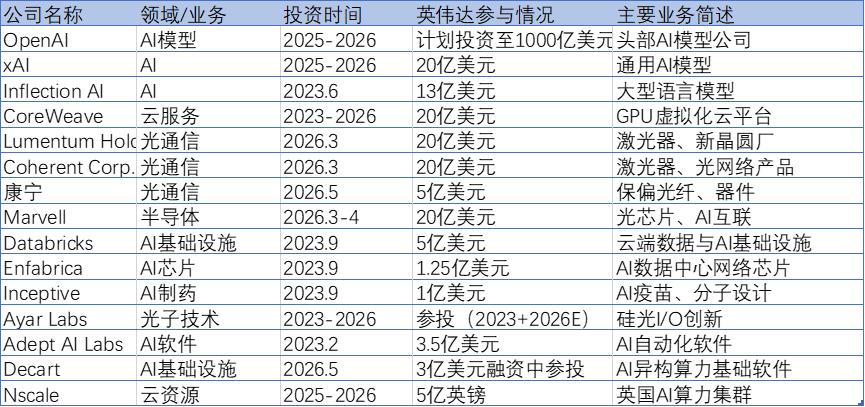
Figure: Representative Cases of NVIDIA's Investment in Core Infrastructure. Source: Jinduan Research Institute
04
The Only Way out for the Internet is to Actively Become Asset - heavy
AI will build an intelligent interaction entry point on top of the traditional Internet link. If Internet enterprises stick to the original asset - light traffic model, they will at least be pipeline - ized if not replaced, and their value - chain status and profitability will continue to decline. Becoming asset - heavy is the only way to increase user stickiness and maintain the core position in the value chain.
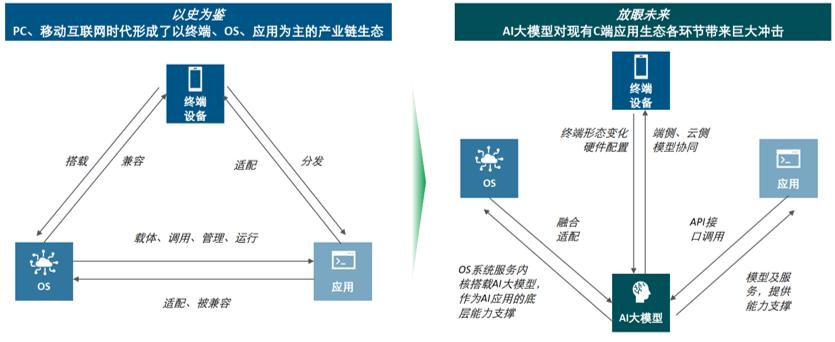
Figure: The C - end Link will be Reconstructed in the AI Era. Source: Deloitte
1. Becoming Asset - heavy on the Balance Sheet: Investing in Computing Power and Full - stack Closed - loop
Becoming asset - heavy on the balance sheet means that enterprises directly increase their capital expenditures and include heavy assets such as computing power, data centers, and core technologies in their balance sheets to build full - stack closed - loop capabilities. Google and Alibaba have a foundation in cloud services, so their transformation paths are relatively clear. Meta and Tencent are in a more entangled position.
● Google: A Four - layer Closed - loop Attempt to Reconstruct the Moat in the AI Era
Google's core AI strategy is to reconstruct the entire Internet empire with a four - layer closed - loop of "model - infrastructure - distribution entry point - commercialization scenario". It embeds AI into all main channels such as search, advertising, cloud, Workspace, Android, Chrome, YouTube, autonomous driving, and robots. It not only uses AI to defend the search moat but also builds it into a new growth engine for cloud and subscription services.
It can be summarized in one sentence: With Gemini as the cognitive core, TPU/data centers as the computing - power base, search/Android/Chrome/Workspace as the distribution system, advertising/cloud/subscription as the monetization engine, and