Cook's Departure: Apple's New AI Power Restructuring and the Balance of Values
On June 8, 2026, Apple held its annual Worldwide Developers Conference (WWDC) at Apple Park in Cupertino. This was Tim Cook's last time hosting WWDC as CEO. According to Apple's official announcement in April this year, he will step down on September 1st, and John Ternus, the senior vice president of hardware engineering, will succeed him as CEO. Cook himself will transition to the executive chairman of the board.
On that day at the venue, Cook received nearly a minute of applause and cheers from the entire audience.
The focus of the outside world's attention on this WWDC is how the new generation of Apple's leadership, with the new CEO John Ternus at the core, will lead the company to prove in the AI era that Apple is a "definer" rather than a "chaser."
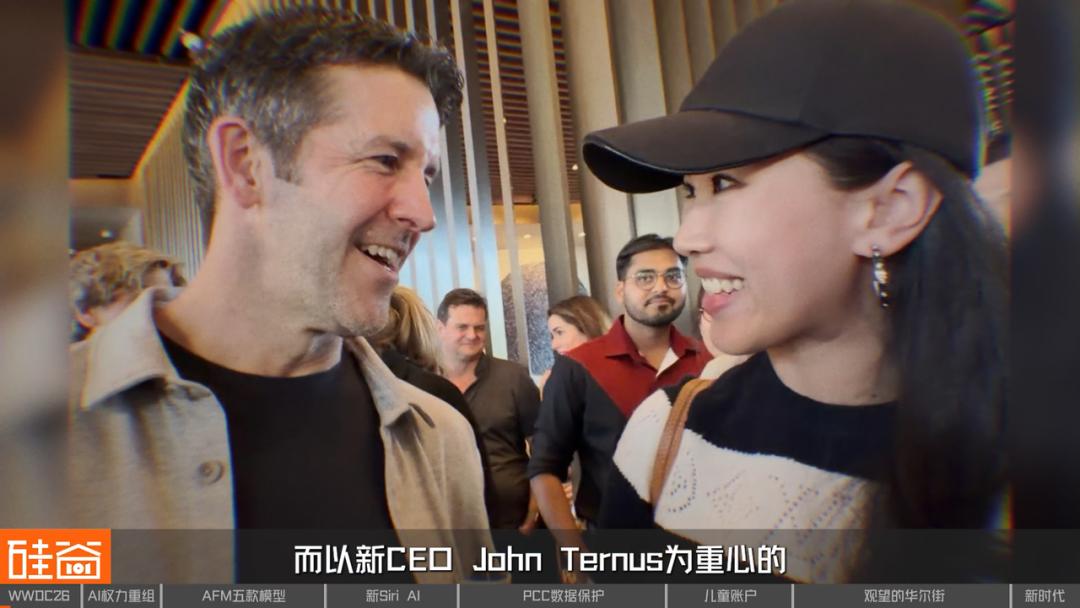
It's already 2026, and Apple has a new CEO. So, how is Apple's AI progress? We're very glad to be invited to the WWDC this year to closely observe Apple's AI strategy.
In this article, we'll focus on several questions: What adjustments have been made within Apple after the setback of Apple Intelligence's release two years ago? What changes have occurred in the restructured AI leadership team? What key strategic signals are released behind the announcements at this WWDC? What's the actual capability of Apple's self - developed models? And, if it's just the beginning now, when will the "iPhone Moment" in the consumer AI field finally come to us?
01 Organizational Power Restructuring: AI Enters Apple's Core Battlefield
First, let's look at the timing of Apple's press conference.
Two years ago, on June 10, 2024, Apple officially announced Apple Intelligence. However, Apple postponed the delivery of AI features several times, which not only made the industry question Apple's AI R & D capabilities but also triggered lawsuits from consumers against the company. Last year, the point that "Apple used the undelivered AI features as the core of its promotion" led to consumer false advertising lawsuits and shareholder securities fraud lawsuits.
Undoubtedly, Apple fell into an "AI crisis" in 2025. The crux of this crisis lies in: Apple, which always demands a perfect experience, is unable to balance the scales between "user experience" and "product innovation" in the face of the impact of the AI revolution. Apple's once - proud "perfection culture" has lost its balance.
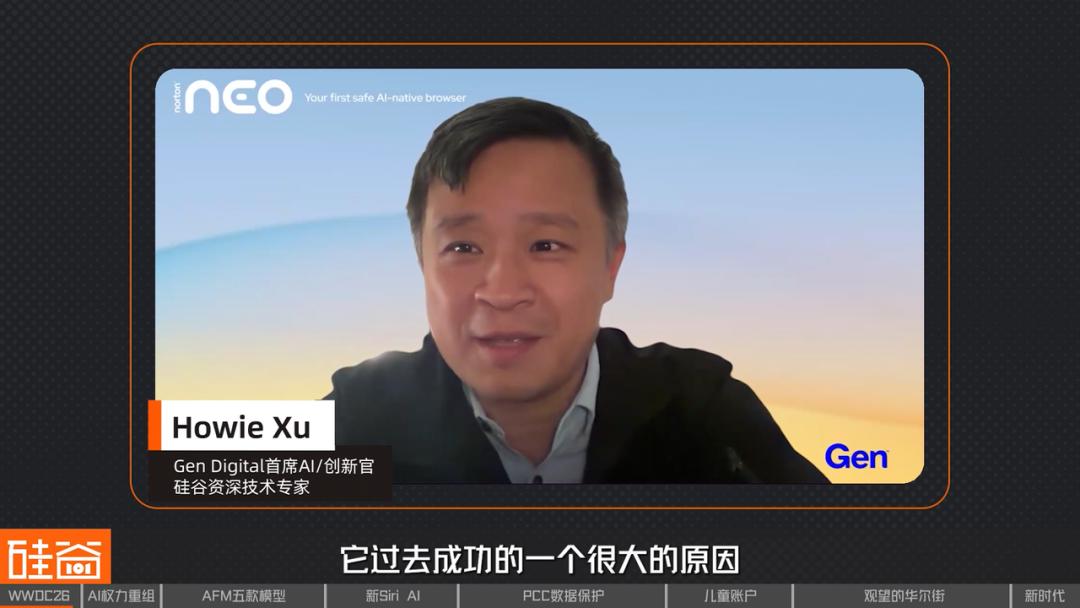
Howie Xu
Chief AI/Innovation Officer at Gen Digital, a senior technology expert in Silicon Valley
One of the main reasons for Apple's past success is that it can integrate the entire company's strength, take a year to come up with a big move, and make progress step by step. This was very effective in the past, but I think it may not be suitable in the AI era because in the AI era, there should probably be a release every week.
It has to be aggressive because there's no other choice. If it still takes a year to come up with a big move like before, by the time Apple has passed one year, the AI field may have advanced "several centuries," which would be a big problem.
Apple has also realized this. According to a recent Bloomberg report, Apple's top management had a personnel change in 2025, which also reshaped the power landscape of Apple's AI.
At the crucial secret meeting at the beginning of last year, Cook himself didn't attend, and it was chaired by Jeff Williams, the then COO. After the failed release of Apple Intelligence, Apple finally realized: This is not just a problem of product delay but an issue of organization, culture, and leadership.
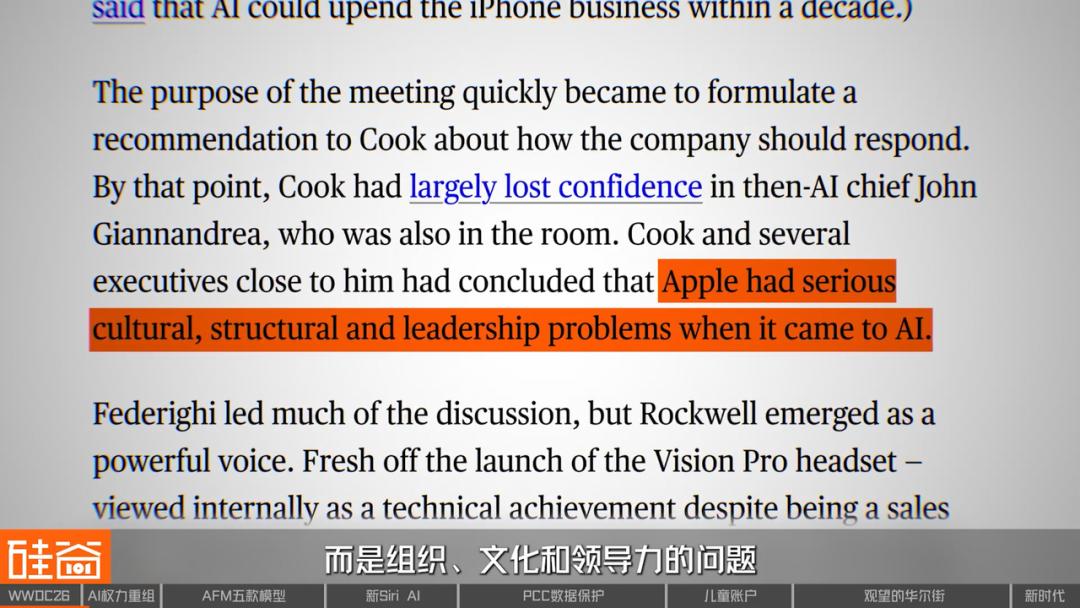
John Giannandrea, who was originally in charge of AI, was losing the trust of Cook and the top management. Apple needed a new person to turn around the mess of Siri and AI. And that person is Mike Rockwell - yes, the one who announced the AI products at the press conference.
Rockwell was previously in charge of Vision Pro and visionOS. Although Vision Pro wasn't very successful in terms of commercial sales, within Apple, it was regarded as an engineering achievement with extremely high technical difficulty. So, Rockwell has experience in tough battles, leading teams, and developing complex systems. More importantly, he believed early on that AI would become a key issue for Apple and also proposed a transformation plan for Siri, showing deep thinking about AI.
However, the Bloomberg report also revealed that since Apple is a large company, it's normal to have some internal "political" games at this time. Rockwell originally thought he might become the overall AI leader at Apple, replacing Giannandrea and reporting directly to Tim Cook, but Craig Federighi disagreed. Federighi is the head of Apple's software engineering. In his view, AI and Siri should ultimately belong to the software engineering system. So, Rockwell can take over Siri but has to report to Federighi instead of directly to Cook.
Behind this is actually a re - division of the ownership of AI within Apple: Is AI an independent new center or a part of the software system? In the end, Rockwell didn't become the top - level AI leader at Apple, but he took over Siri and reported to Federighi. And Giannandrea finally left Apple.
So, let's take a look at the new power landscape of Apple's AI.
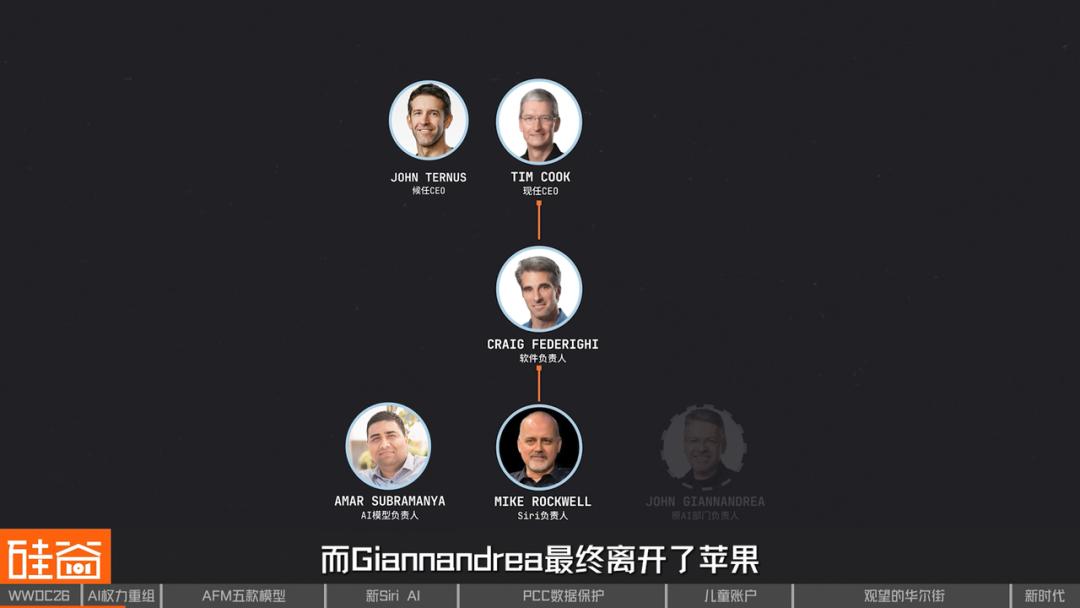
Tim Cook: From a CEO who observed products from the sidelines to someone who gets directly involved in the AI route.
Craig Federighi: Still the software leader, but AI is starting to become the center of Apple's operating system upgrades in the next few years.
Mike Rockwell: A hard - tech manager who used to work on Vision Pro starts to take over Siri and restructure the Siri team.
Amar Subramanya: Apple recruited an AI model leader from outside. This role is very crucial, proving that Apple has the ability to develop models independently. His resume shows that he worked at Google for 16 years and was the engineering vice - president of Gemini, Gemini App, and Bard. He was poached by Apple just five months after switching to Microsoft. Apple started collaborating with Gemini this year, and it's believed that Amar also has a lot of say in this.
John Giannandrea: Marginalized and finally left.
John Ternus: After September this year, he will succeed Cook as the new CEO. This helmsman will inherit an Apple that must prove its AI capabilities.
So, this year's WWDC is a test for Apple's new top - level team.
Next, let's specifically talk about Apple's AI products this time. Apple emphasizes that even in the AI era, the technology it brings must be "in line with Apple's values."
02 In - depth Analysis of Five AFM Models: Cooperation Architecture with Gemini
First, let's talk about the five models and the underlying architecture.
The new generation of Apple Foundation Models (AFM) includes two on - device models: AFM 3 Core with 3 billion parameters and AFM 3 Core Advanced, a Mixture of Experts (MoE) architecture model with 20 billion parameters.
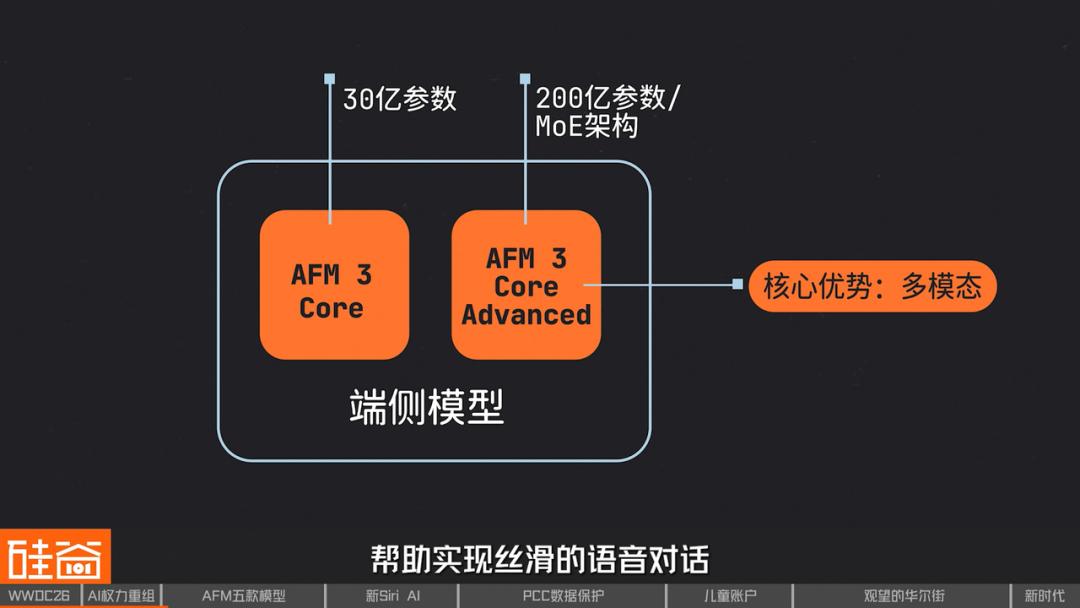
The core advantage of this more powerful on - device model lies in the improvement of multi - modal capabilities such as voice and dictation, which can support a smoother and more fluent voice - dialogue experience. However, whether it's a more "human - like" Siri, personalized and expressive voices, or the system - wide dictation function, all of these require powerful hardware to support - and this is exactly what some Apple users complain about:
This more powerful on - device model, AFM 3 Core Advanced, can currently only run on iPhone 17 Pro, iPhone 17 Pro Max, iPhone Air, iPads with M4 or higher chips and unified memory of no less than 12GB, and Macs with M3 or higher chips and unified memory of no less than 12GB.
But it seems there's no other way because on - device AI has extremely high requirements for hardware, including memory and chips.
Nathan Wang
Former Apple engineer/Senior AI Agent developer
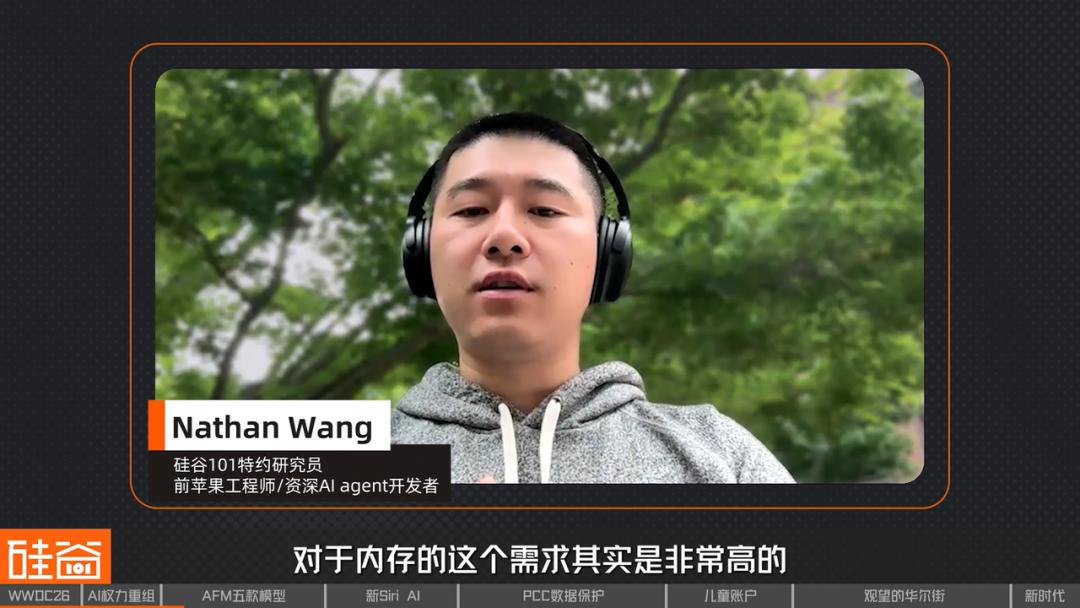
The models running on the device actually have very high memory requirements. So, if you want to run a very large model, the device side can't support it. The reason Apple can run a 20 - billion - parameter model this time is that it uses two relatively core technologies. One is the well - known sparse MoE (Mixture of Experts). It only activates about 1 to 4 billion parameters at a time, which is similar to a 3 - billion - parameter model and is basically the level that Apple's mobile devices can support.
The interesting part of this advanced model is that it's a multi - modal model. I carefully read the underlying technical paper, and I think the most interesting thing is that it integrates a technology that uses flash memory to store model parameters.
The larger the model, the higher the memory requirement. But Apple has done something: It puts some fixed parameters into the flash memory, that is, the flash storage device. Apple considered that the DRAM memory on the device is actually not very sufficient. If you load all the parameters at once, it will waste a lot of resources and consume a lot of power. So, Apple's idea is: Put some commonly used and basic parameters into the flash memory, and the memory dynamically loads different amounts of parameters according to user needs to achieve on - device inference. The advantage is that it takes up less memory and also helps a lot in saving power on the device.
From this point of view, Apple is gradually leveraging its advantages in large models. I think Apple's greatest advantage is the integration of hardware and software.
In addition to the two on - device models, Apple has deployed a "cloud trio" on the cloud, namely: AFM Cloud, AFM Cloud Pro, and ADM Cloud (Image) models.
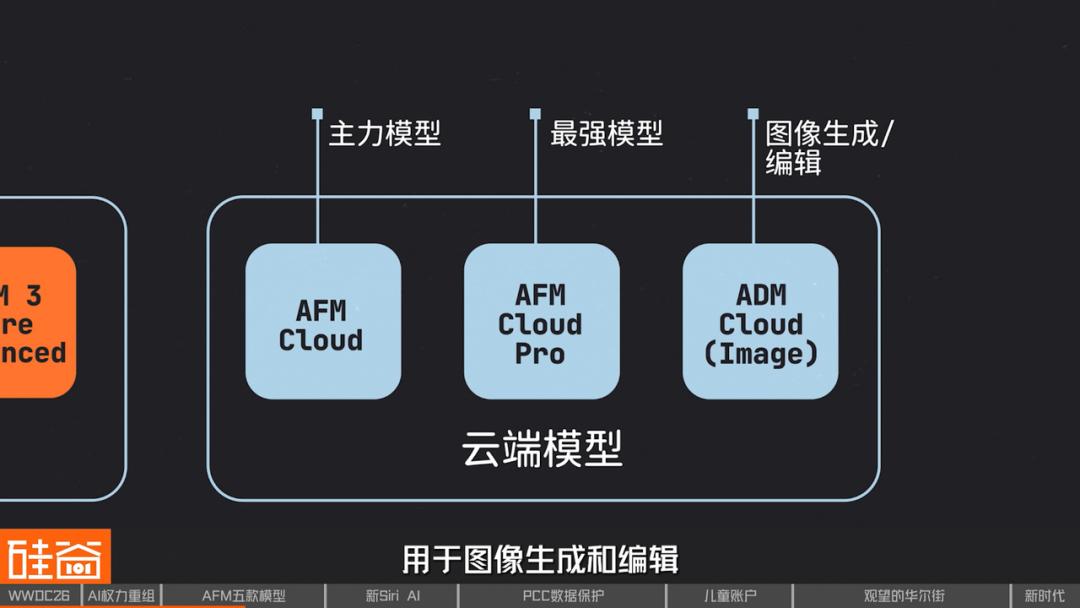
The parameters and details of these cloud models haven't been announced, but from a functional perspective:
AFM Cloud is Apple's main cloud model. When the on - device model's capabilities are insufficient, this model will handle most of the cloud tasks. Apple's official technical article calls this model the "server - side workhorse," which is optimized for speed, efficiency, and comprehensive performance.
AFM Cloud Pro is Apple's most powerful cloud model, responsible for complex reasoning and the agentic tool use of intelligent agents. It's used in the most computationally intensive and complex scenarios, and this model is optimized for NVIDIA GPUs on Google Cloud.
ADM Cloud (Image) is Apple's cloud image model, used for image generation and editing.
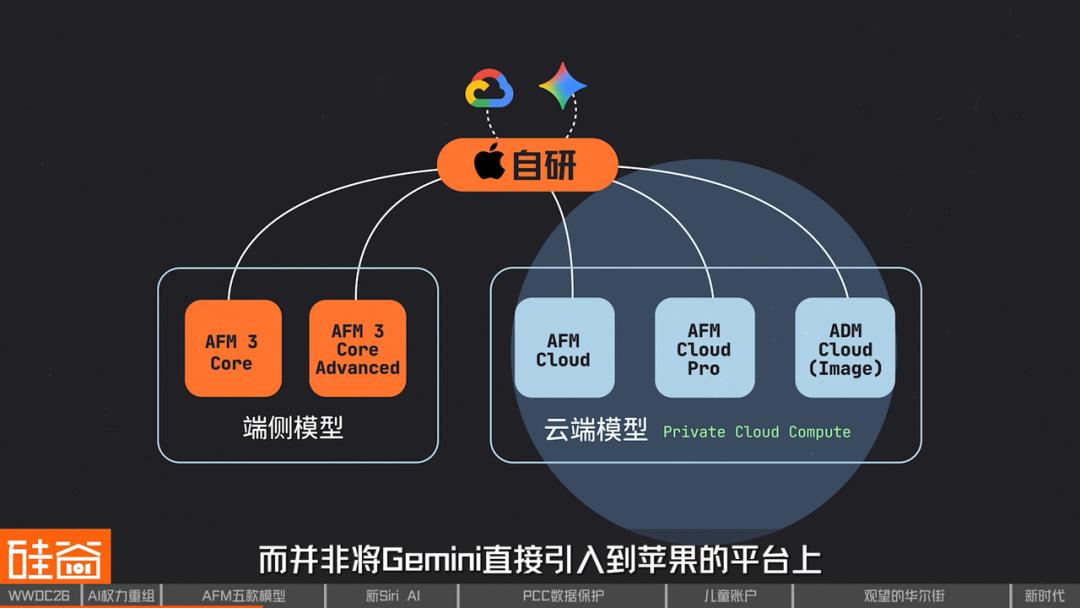
Here's an important question: Two years ago, when Apple cooperated with OpenAI, the strategy of "using Apple's on - device model locally and GPT model on the cloud" made Apple highly controversial, and it was considered to have insufficient capabilities in cutting - edge AI models. And this time, when it cooperates with Gemini, are Apple's models self - developed or Gemini's models?
I got an answer from an Apple insider, and the answer is straightforward: All five models are self - developed by Apple, but the underlying technology uses Gemini - related technologies and Google Cloud infrastructure; among them, the most important Cloud Pro is also extended to NVIDIA GPUs on Google Cloud and is wrapped by Apple's Private Cloud Compute (PCC) privacy architecture. So, simply put, Apple still leads the models instead of directly introducing Gemini to the Apple platform.
Apple's technical paper also states at the end that it will release a more detailed technical report later this summer, sharing more model details, evaluations, and benchmarks. By then, we may also have more information about Apple's self - developed models and the cooperation details with Gemini.
So, how does the entire Apple system schedule these five models? The keyword is the "System Orchestrator." As the name suggests, it's like the conductor of a concert, whose role is to schedule different models and organize different functions to complete tasks.
It has four functional architectures below: App Toolbox, Spotlight index, on - screen context, and the cloud's world knowledge.
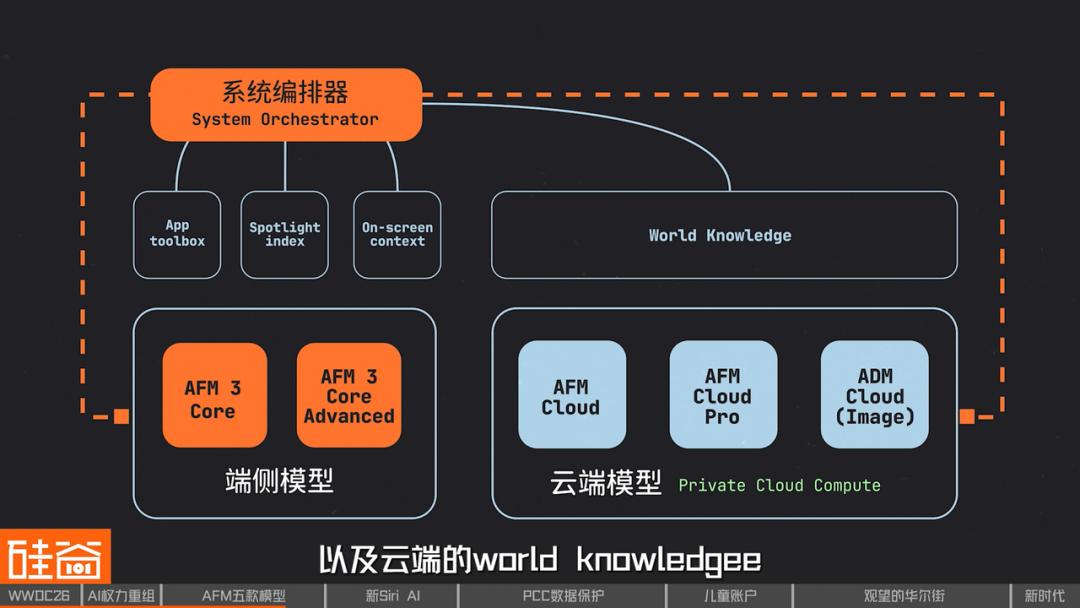
The first is the App Toolbox, which is the key for Siri to "take action" and complete tasks. The System Orchestrator knows what each app on your phone can do through the App Intents framework. For example, when you ask Siri to send a message or an email to a friend, it will call Messages or Email to execute. In theory