From mass deployment to co-creation: Three major shifts in KOL marketing in 2025
84 billion. This is the scale of the overall KOL placement market in 2025, showing a slight decline of about 4% compared to 2024.
With the market size declining for two consecutive years, some people can't help but wonder: Has KOL marketing entered a bottleneck period?
However, the data shows that the number of Douyin AI content creators increased by 191%, and their income grew by 440%. On Xiaohongshu, the number of users with dual identities of content creators and buyers exceeded 97,000, a year-on-year increase of 1.5 times. On Kuaishou, the proportion of placement spending on mid-tier KOLs jumped by 4 percentage points in a single year...
Behind the 84 billion, there is a profound transformation from "buying traffic" to "buying relationships."
Less money is spent, but the gameplay has changed. There is less traffic, but the conversion is more precise. There are fewer collaborations, but the relationships are deeper.
These three questions are worth serious consideration for every brand, MCN agency, and content creator.
Behind the 84 billion, where exactly is the budget flowing?
How is the value of mid and long-tail KOLs being re-evaluated?
In 2026, how should the money for KOL marketing be spent?
Based on data from platforms such as Douyin, Xiaohongshu, Weibo, Kuaishou, Bilibili, and Video Accounts, as well as data related to KOLs, TopKlout released the "Inventory and Outlook of the KOL Marketing Market for Advertisers from 2025 - 2026" after researching the KOL placement situation of advertisers on various platforms in the past year. This report analyzes the overall characteristics of the KOL placement market for advertisers in 2025. Let's take a first look.
Less money, and the budget is finding new directions
Let's first take a long - term view.
In 2023, the scale of the overall KOL placement market reached a peak of 90 billion. In 2024, it was 87.3 billion, and in 2025, it was 84 billion.
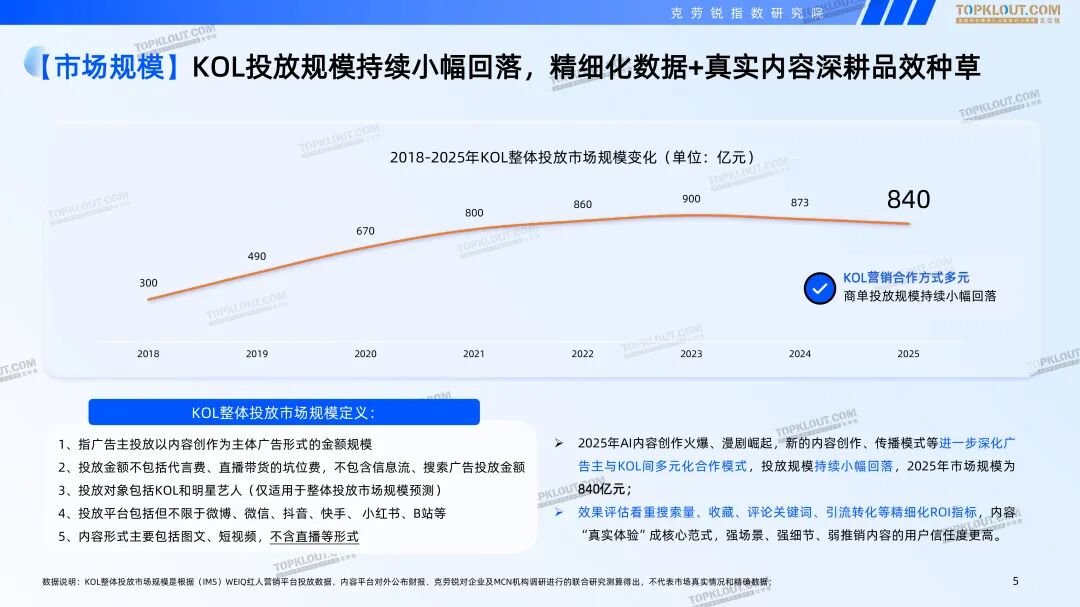
Judging from the absolute figures, there is indeed a decline. However, if we only focus on this number, it's easy to make a misjudgment.
Because the change in the flow of money is greater than the change in the placement amount.
In the past, when brands engaged in KOL marketing, they basically purchased a single video or a piece of graphic content. After the KOL published the content, the data collection ended. This was the most primitive content - purchasing logic, with the core being "buying exposure" and emphasizing the number of fans and instant traffic.
Now, this logic has been completely broken. The money hasn't disappeared; instead, the budget is flowing in more diverse directions.
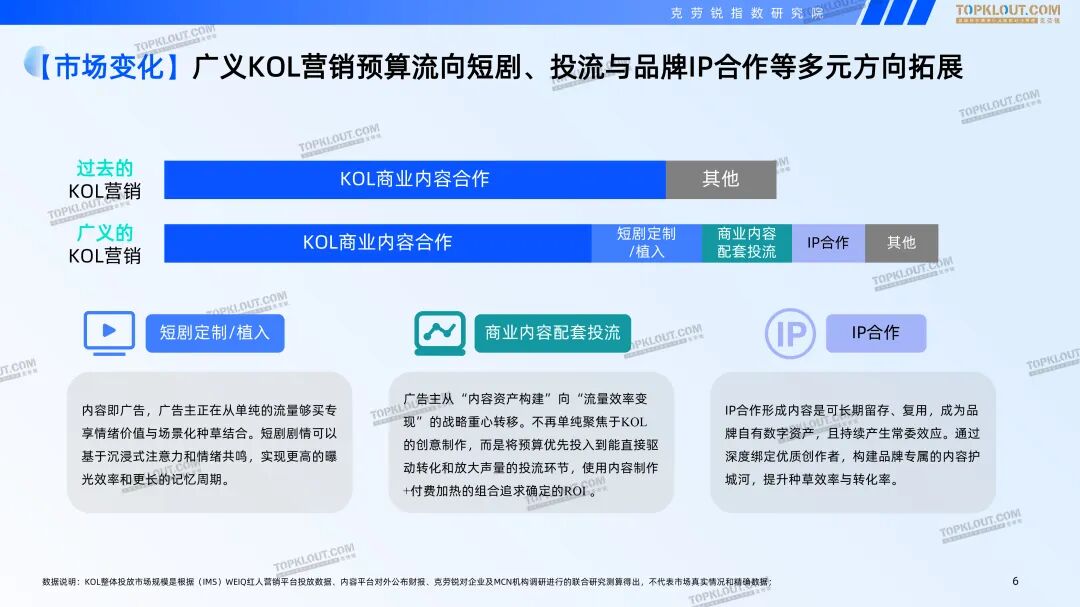
The flow of money has changed, shifting from a single commercial order purchase to diversified in - depth cooperation models such as short drama insertions and IP co - branding. The relationship between brands and KOLs is undergoing an upgrade from content exposure, to scenario binding, and then to joint co - creation.
For example, brands can achieve symbiosis between the brand and content through customized storylines, optimize the linkage between placement and search with the help of platform tools, and even jointly develop products with KOLs to deeply explore commercial value.
The evaluation criteria have changed, shifting from the sole focus on traffic to precise ROI. Brands are starting to value refined indicators such as search volume, number of collections, and comment keywords that can bring long - tail effects.
The content has changed, shifting from elaborate advertisements to real experiences. Those obviously fake hard - sell ads are being abandoned, and users are more willing to pay for real, scenario - based, detailed, and low - pressure grass - planting content.
Behind these changes is the transformation of KOL marketing from traffic operation to the accumulation of content assets. Brands are no longer just buying a single exposure; instead, they are building a sustainable content system.
In the past, money was spent on buying popularity; now, it's spent on buying trust and long - term conversion.
The traffic landscape is being reshaped, and the rise of mid and long - tail KOLs is supported by data
This is a set of data in the entire report that is worth looking at repeatedly.
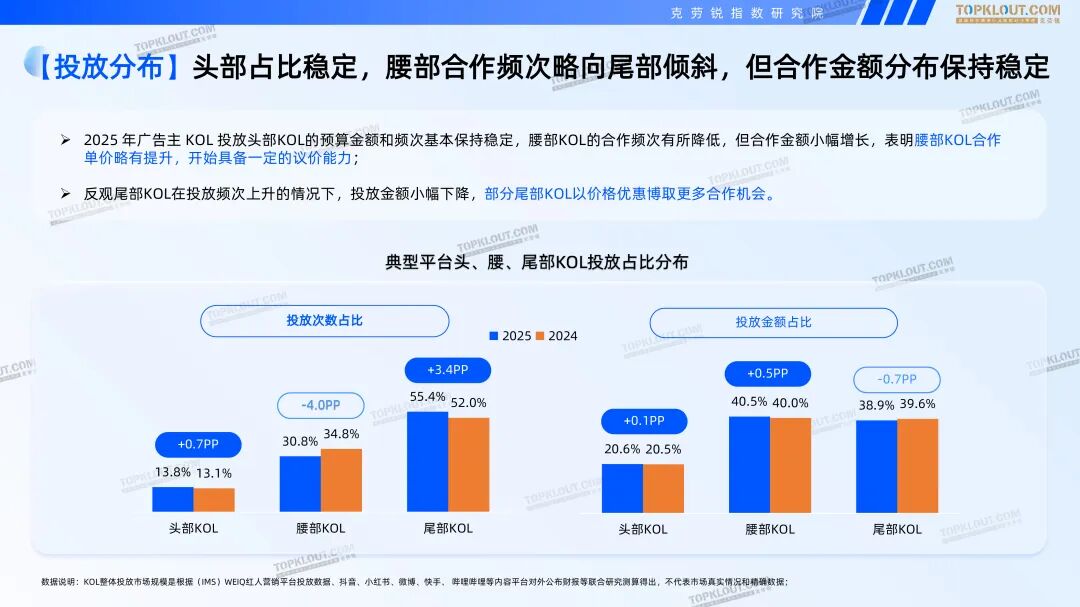
In 2025, in terms of the proportion of KOL placement times on typical platforms, top - tier KOLs only accounted for 13.1%, while mid and long - tail KOLs together accounted for as high as 86.8%. In terms of the proportion of placement spending, top - tier KOLs accounted for 20.5%, and mid and long - tail KOLs shared nearly 80% of the budget.
Compared with 2024, all indicators of top - tier KOLs showed a downward trend, while the share of mid and long - tail KOLs continued to rise. The market has bid farewell to the era of only focusing on top - tier KOLs and entered an era of "meticulous cultivation" centered on high cost - effectiveness and precise penetration.
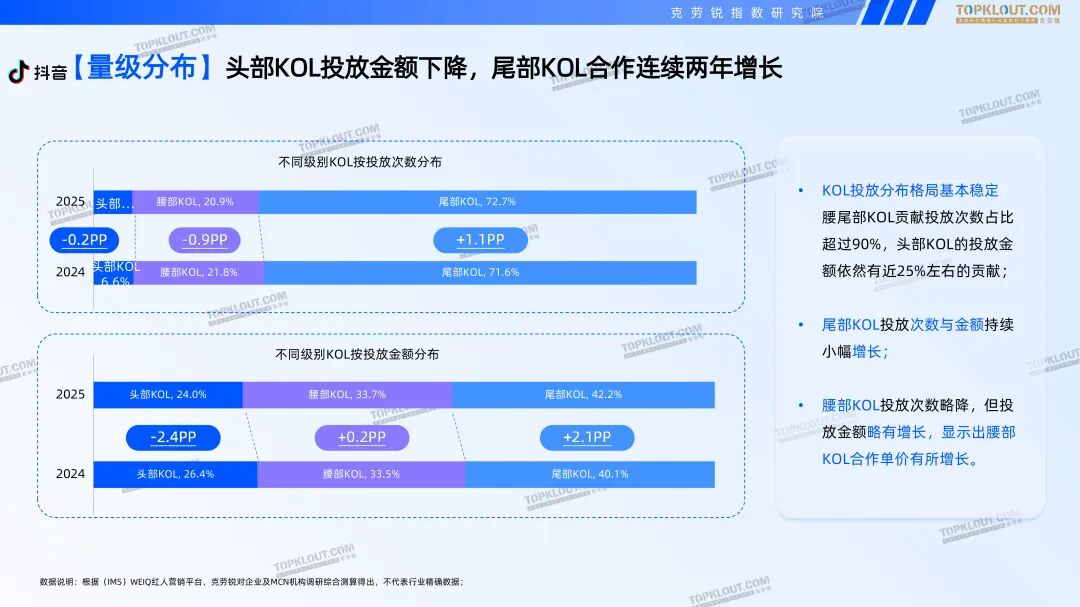
Looking at the specific situations of each platform, we can find that whether it's the long - tail KOLs on Douyin accounting for 72.7% of the placement times, or the long - tail KOLs on Xiaohongshu approaching 20% in terms of placement spending, or the mid - tier KOLs on Kuaishou achieving a "simultaneous increase in quantity and price"...
The common point is that brands are no longer blindly obsessed with top - tier content creators but are more pragmatically pursuing the coverage breadth of real content and the penetration power of vertical circles.
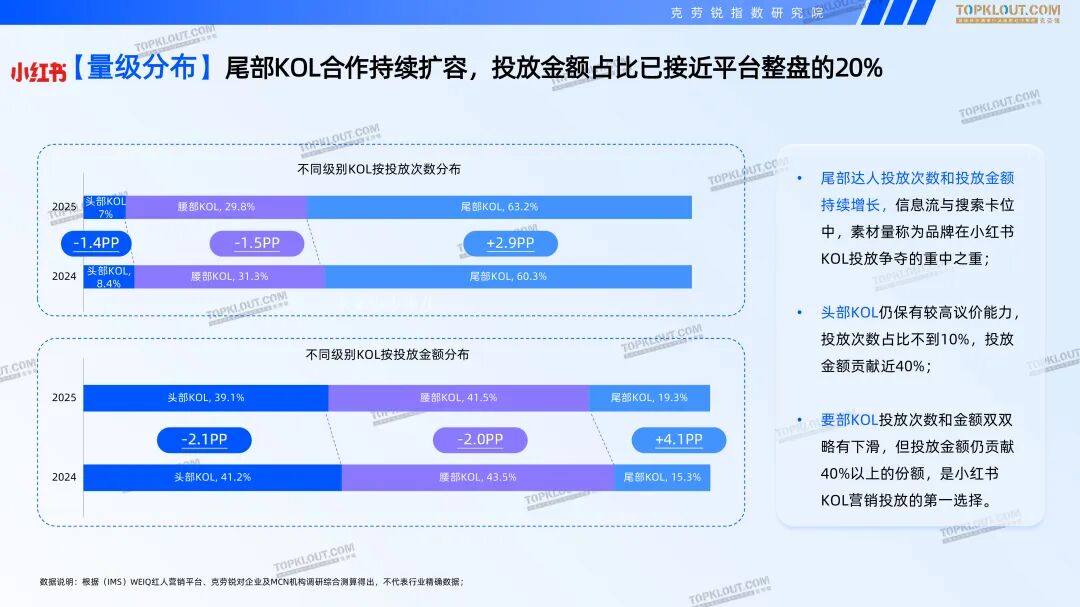
The importance of mid and long - tail KOLs is emerging. They are no longer alternatives to top - tier KOLs but have become the foundation of brand marketing.
Behind this set of data is a change in the underlying logic.
The increase in the proportion of placement spending on mid and long - tail KOLs on most platforms is also a profound transformation from "buying fame" to "buying practical results."
In the past, when brands evaluated KOLs, they often tended to use the number of fans and the top - tier effect as the core evaluation indicators.
This relatively single evaluation dimension, although able to bring basic exposure, has long underestimated the value of many mid and long - tail niche content creators with high conversion potential.
In 2025, the brand's logic for selecting KOLs has been upgraded. The core considerations have become three dimensions: the overlap between the brand's target audience and the KOL's fans, the compatibility between the KOL's content tone and the brand's products, and the long - term stability and compliance of the KOL's account.
Use data matching to replace intuitive judgment and systematic selection to replace experience - based selection.
The rise of mid and long - tail KOLs is not because top - tier KOLs are too expensive and brands have to make do; it's because they are really more suitable for precise penetration into specific circles.
Mid - tier KOLs have high fan stickiness, strong verticality, and moderate costs. Long - tail KOLs/KOCs spread real experiences and provide high - trust word - of - mouth endorsements in the user decision - making process, thus effectively driving long - tail conversion.
These two types of KOLs together account for nearly 80% of the placement share in the market. This is not a coincidence but the result of brands voting with real money.
The cooperation model is being upgraded, from the brand having the final say to two - way co - creation
If we use one sentence to describe the change in the KOL marketing cooperation relationship in 2025, it is this: The brand has changed from the client to a co - founder.
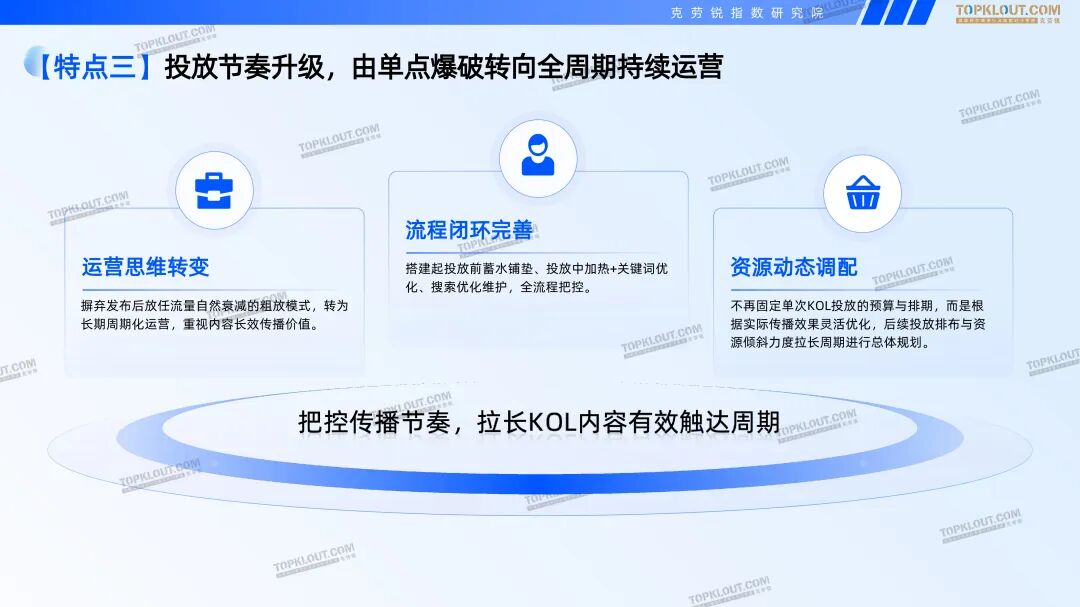
In the past cooperation logic, the brand issued requirements, and the KOL passively executed them. There were standardized insertions and templated replications. The overall communication form was brand - oriented, and users received the information passively.
The problems with this model are obvious: the content is rigid, the styles are similar, users can easily tell it's an ad at a glance, and the trust level is extremely low.
In 2025, this logic was overturned.
The new cooperation model is called native co - creation. The brand sets the boundaries, and the KOL determines the expression. The brand clarifies the core communication information and compliance bottom line without restricting the specific script, shots, and tone. The KOL creates native content independently based on their in - depth understanding of the vertical circle and the trust of their fans.
This change has brought about upgrades at three levels.
Upgrade of the cooperation logic: From one - way brief output and delivery to two - way co - creation of native content with both brand awareness and sales effectiveness. The content has more of the creator's personal style, and users have a higher acceptance level.
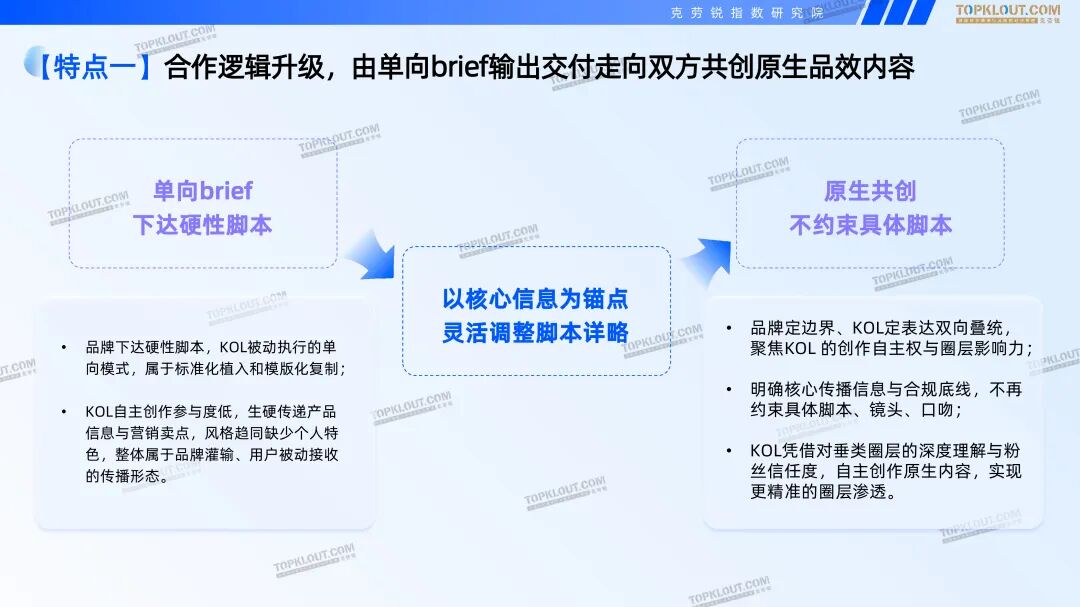
Upgrade of the recommendation logic: From selecting based on data effects to a multi - dimensional systematic selection. Brands are starting to build their own content creator resource pools, establish a tagging system, and deepen diversified cooperation with high - quality KOLs. The cooperation extends from single commercial orders to scenario customization and live - streaming conversion, and finally to in - depth brand endorsement and joint co - creation.
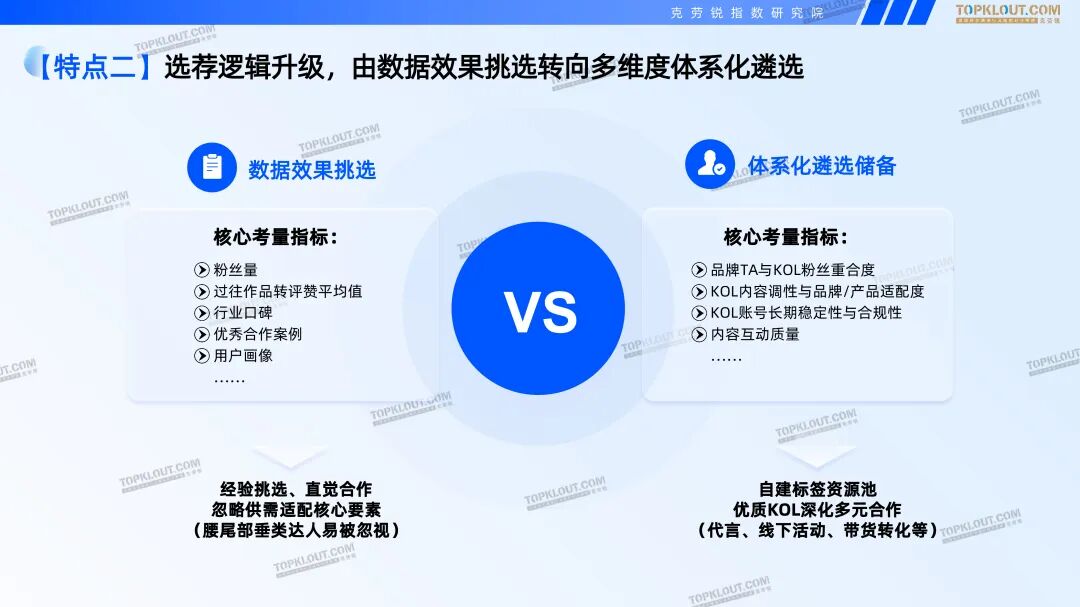
Upgrade of the placement rhythm: From single - point explosion to full - cycle continuous operation. Abandon the extensive model of letting the traffic decline naturally after publication and switch to refined long - term operation. Prolong the content popularity cycle through multi - node pulsed heating, use material and portrait authorization for secondary creation and traffic generation to amplify the long - tail effect, and continuously accumulate consumer trust during continuous exposure to maximize the communication value.
These three upgrades all point to one conclusion: KOL marketing has transformed from traditional content purchasing to a co - creation partnership based on circle value.
Brands and KOLs are no longer the client and the service provider but collaborative partners with the same goal.
Each platform has its own strategies, and Douyin and Xiaohongshu remain the two cores
In 2025, in the KOL placement spending of advertisers on different platforms, Douyin and Xiaohongshu together accounted for nearly 65%, still maintaining an absolute dual - core pattern.
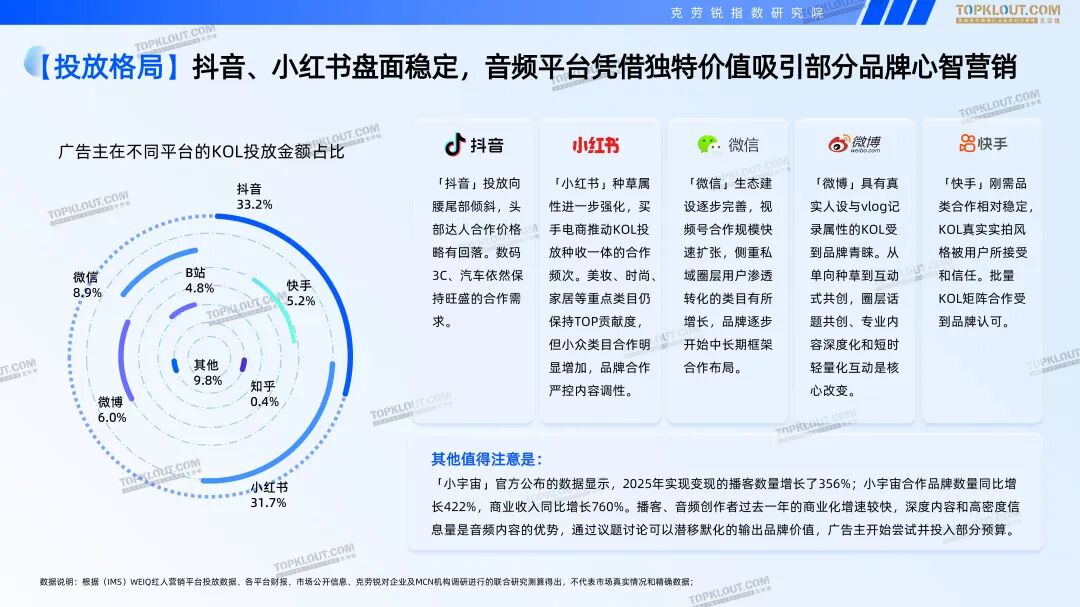
However, the gameplay on each platform has become quite different.
Douyin: Scenario - based content + AI tools, moving towards long - term operation
Douyin's placement logic is to use scenario - based content to precisely match user interests and then leverage AI and platform tools to amplify the effects.
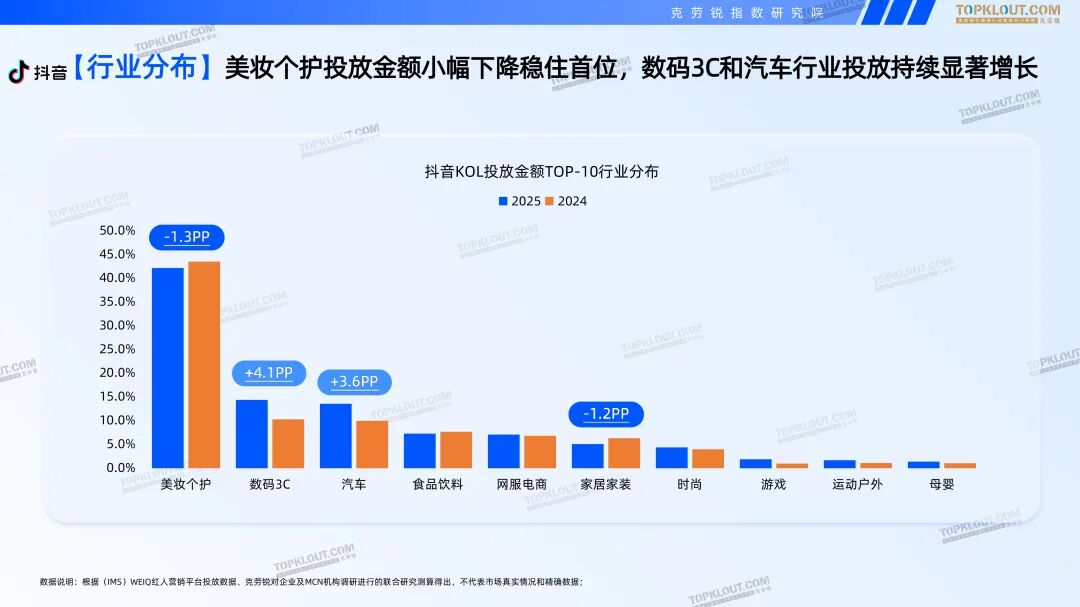
In 2025, the placement spending on digital 3C products on Douyin increased by 4.1 percentage points, and that on automobiles increased by 3.6 percentage points, making them the two industries with the largest growth rates. In terms of niche distribution, the placement spending on automobile KOLs ranked among the top three, and the cooperation in the technology and digital, and film and entertainment categories was significantly enhanced.
At the platform level, ByteDance's marketing platform launched a new star - wide joint placement service, which helps brands precisely utilize content resources around material operation and placement management. The selected content creator group traffic incentive plan allows high - quality long - term cooperation content to gain more exposure.