The rollercoaster ride of Shanghai SEER Intelligent: 7% below issue price on the grey market, surging 38% on the first trading day
This article is about 1,100 words long. It is recommended to read it in 3 minutes.
Author | Peng Xiaoqiu
On June 24, Seer Robotics (06106.HK) officially rang the bell for its listing on the Hong Kong Stock Exchange. It opened at the issue price of HK$101.6 and then soared all the way. It reached a peak of HK$140.50 (+38.3%). Subsequently, it pulled back. As of press time, it was reported at HK$115.70, still up 13.88%. The amplitude was 38.29%, the trading volume was HK$533 million, and the market value was HK$12.78 billion.
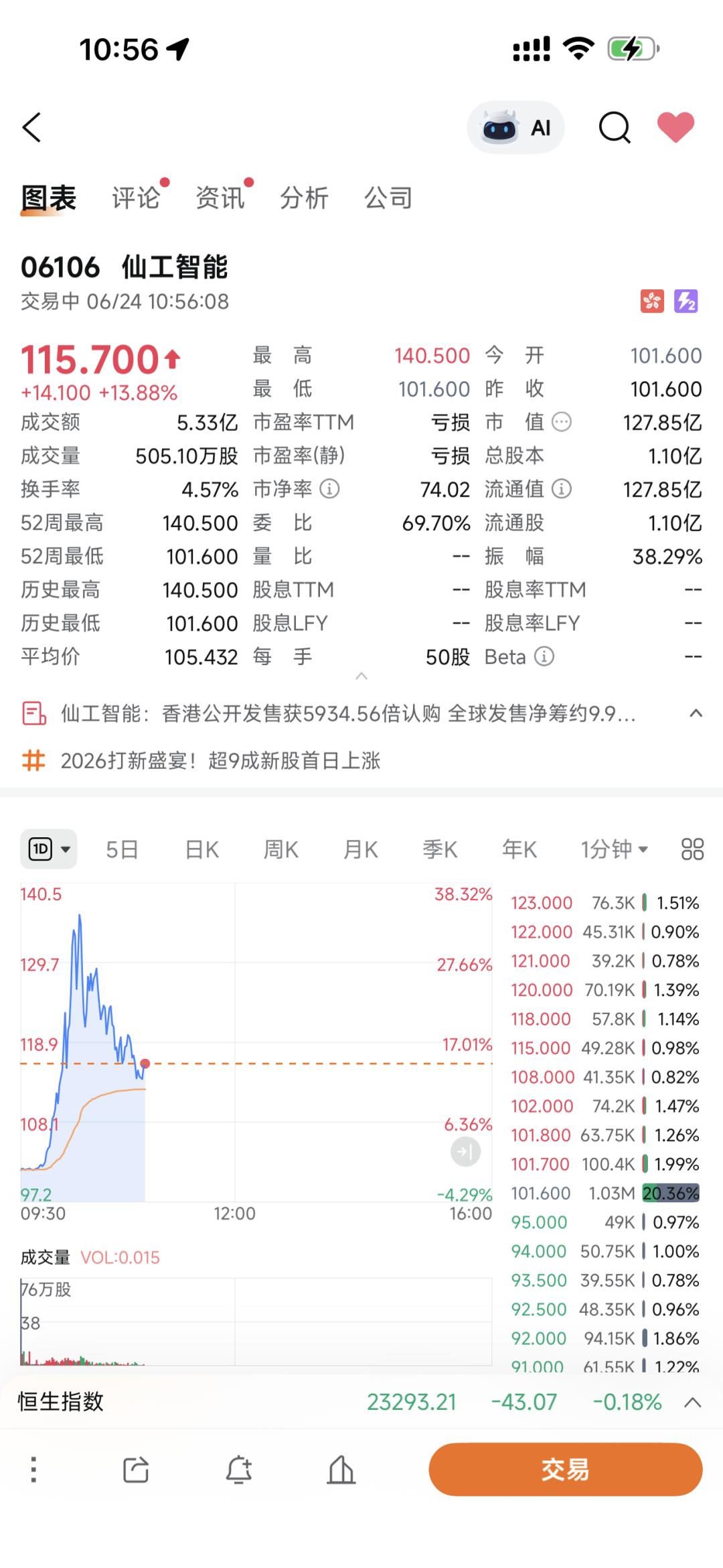
Based on this market value, with its revenue of RMB 442 million last year, the static price-to-sales ratio has risen to about 25 times, making it the most expensively valued new robotics stock in the Hong Kong stock market. Geek+ Robotics, the world's No. 1 in AMR, has a ratio of about 9 times, and Estun Automation, the No. 1 in industrial robotics in China, only has a ratio of 4 - 5 times. The issue price of HK$101.60 has already factored in the optimistic expectation of "sustainable high growth + high gross profit".
For an in-depth report on Seer Robotics, please click the link to view "Zhejiang University Entrepreneurs Rush for IPO in Hong Kong Stock Market: Five Highlights of Seer Robotics' Prospectus".
In fact, Seer Robotics experienced a roller-coaster ride within 24 hours. In the grey market trading yesterday afternoon, it opened slightly higher at HK$105 and once soared to HK$130 (+27.9% compared to the issue price) during the session, but then plunged all the way down to a low of HK$80 (-21.3%). The daily amplitude was 49.21%. It finally closed at a low of HK$94.20, down 7.28% compared to the issue price of HK$101.60. It traded below the issue price for most of the time, with an average trading price of HK$92.84, and the grey market market value was about HK$10.4 billion.
What's more eye-catching than the share price breaking below the issue price is the volatility. In other words, most of the investors who got on board are in the red; those who wanted to do short - term trading were swept back and forth by this nearly 50% up - and - down volatility.
From the perspective of tradable shares, the reason for such volatility lies in the small amount of tradable shares. The public offering only accounts for 9.5%, and the cornerstone investors have locked up 4.12%. A small number of tradable shares means that only a small trading volume is needed for the share price to rise or fall.
Eight cornerstone investors subscribed a total of 43.34% and locked up their shares for 6 months. The investors include Hillhouse HHLRA, GF Fund, etc. They also experienced an overall paper loss of about HK$33.67 million, which then turned into a paper profit of about HK$64.15 million.
Seer Robotics' robot controller holds the "world's No. 1" position with a 24.8% market share. However, if calculated by the revenue of industrial intelligent robots, as clearly stated in its prospectus, Seer Robotics ranks only seventh globally (1.1%) and third in China (2.5%).
Just being the sales champion does not mean being the revenue champion, let alone the leader in the industry. "The champion in controller sales" is a very narrow segment, which cannot support a market value of HK$12.8 billion. Therefore, Seer has to manufacture complete machines to increase sales volume - and the gross profit margin of complete machines is only 38.4%, which is the core reason for its "increasing revenue but not increasing profit".
A person in the industry frankly said: Large robotics companies rarely purchase controllers externally - because they can manufacture them by themselves, and external procurement will also indirectly cultivate competitors; so the real customers of Seer's controllers have never been large companies, but a group of integrators. The large - scale procurement of integrators "will only be activated when the industry penetration rate is higher". In other words, the story of high gross profit from pure controllers has not come to fruition yet.
Therefore, when a company's "No. 1" status is in a narrow scope, the complete machines are pulling down the gross profit, and its valuation is at the highest level among its peers, the market will not keep buying just because it is called "the first stock of the robot brain". In the short term, it depends on the sentiment of funds; in the medium and long term, it depends on whether the company can maintain its share in controllers and whether it can achieve profitability in complete machines. - These questions now need to be answered by each financial report after its listing.