The Divergence of Sino-US Autonomous Driving: Overseas Authoritative Indices Reveal the Real Gap in the Track
The latest four real - time indices of the Road to Autonomy are out. In the manned Robotaxi race, Waymo leads slightly, while in the unmanned delivery RoboVan race, Chinese companies have achieved a global counter - overtaking. Neolix tops the delivery robot list, and Meituan remains firmly in the forefront. Their commercialization and implementation capabilities have been recognized by overseas institutions. However, behind the impressive implementation data, the structural gaps in underlying technology, long - term R & D, and global rule - making power cannot be ignored.
The autonomous driving industry has long lacked a neutral, dynamic evaluation system based on real - world operation data. Most companies' external publicity focuses on test mileage and demonstration videos. There is little horizontal comparison of hard - core indicators such as commercial orders, cross - regional operations, and safety compliance. The industry comparison has always been plagued by information asymmetry.
In June 2026, the US industrial research institution Autnmy AI updated its full set of real - time indices of the Road to Autonomy. This set of indices was built by Grayson Brulte, the proposer of the "Autonomous Economy" theory, and the data is calculated by S&P Dow Jones. It is updated dynamically every 12 hours. All scores are based on regulatory disclosures of various countries, corporate financial reports, and compliance operation records, without relying on self - reported promotional materials from manufacturers. Overseas media such as Bloomberg and TechCrunch have long cited its list as a benchmark for industry observation.
The entire set of indices is divided into four major races: manned Robotaxi, last - mile unmanned delivery RoboVan, long - haul heavy trucks, and intelligent driving software licensing. The list shows a very clear differentiation pattern: the US maintains an advantage in the comprehensive scores of the Robotaxi and long - haul heavy - truck races; the last - mile unmanned delivery has become the only race where China has taken the global lead. Neolix and Meituan have both made it to the top; in the intelligent driving licensing race, Chinese and American manufacturers are on par.
On the one hand, Chinese companies have created large - scale commercialization samples based on the domestic market. On the other hand, American giants hold underlying general technologies and long - term R & D funds. The competition between the two routes has entered a substantial divergence stage.
Why does this index have industrial reference value?
Before analyzing the list data, it is necessary to clarify the uniqueness of this list, which is also the core reason for the objectivity of its conclusions. First, it is a rare global commercialization - oriented quantitative list for autonomous driving. Most industry rankings in the market focus on laboratory technical parameters, while the four indices of the Road to Autonomy mainly assess real - world implementation capabilities: fleet size, volume of paid orders, cross - city operation licenses, business cooperation ecosystem, and long - term safety accident records, which are more in line with the real competitiveness of the industry.
Second, it is endorsed by official financial institutions, with high data credibility. In 2023, this index reached a cooperation with S&P Dow Jones. S&P is responsible for unified verification and distribution of data. It is a core observation indicator for Wall Street institutions to track the autonomous driving industry chain, rather than a list self - made by niche self - media.
Third, it fully covers the entire autonomous driving field, in line with the theoretical framework of the Autonomy Economy. The founder, Grayson Brulte, proposed that autonomous driving is just the vanguard of the autonomous economy. Last - mile delivery, long - haul freight, and industrial autonomous equipment are the long - term mainstays of the industry. The four sub - lists fully cover the two core scenarios of travel and logistics, which can fully reflect the overall situation of the Chinese and American industries.
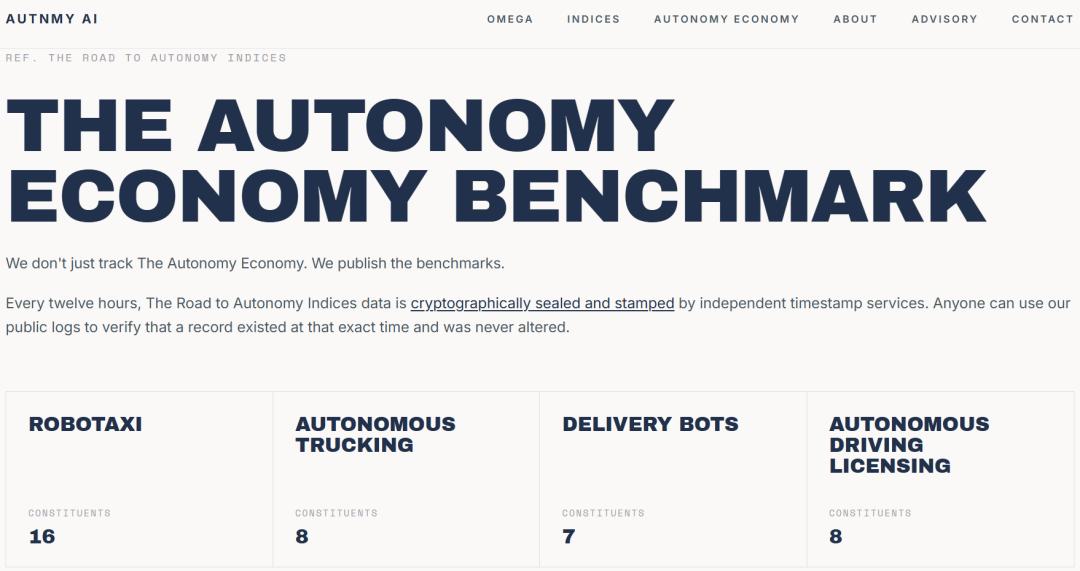
China's advantage lies in last - mile urban distribution, while it still lags slightly in Robotaxi
1. Robotaxi: Waymo ranks first in the comprehensive score, and Chinese manufacturers firmly hold the top position in the second echelon
The scores of the top five in the latest list are: Waymo with 81.2 points, Baidu Apollo Go with 78.1 points, Pony.ai with 61.8 points, WeRide with 54.3 points, and Tesla with 42.6 points. Among the 16 listed companies, 6 are Chinese manufacturers, including Baidu, Pony.ai, WeRide, Caocao Chuxing, Didi, and XPeng.
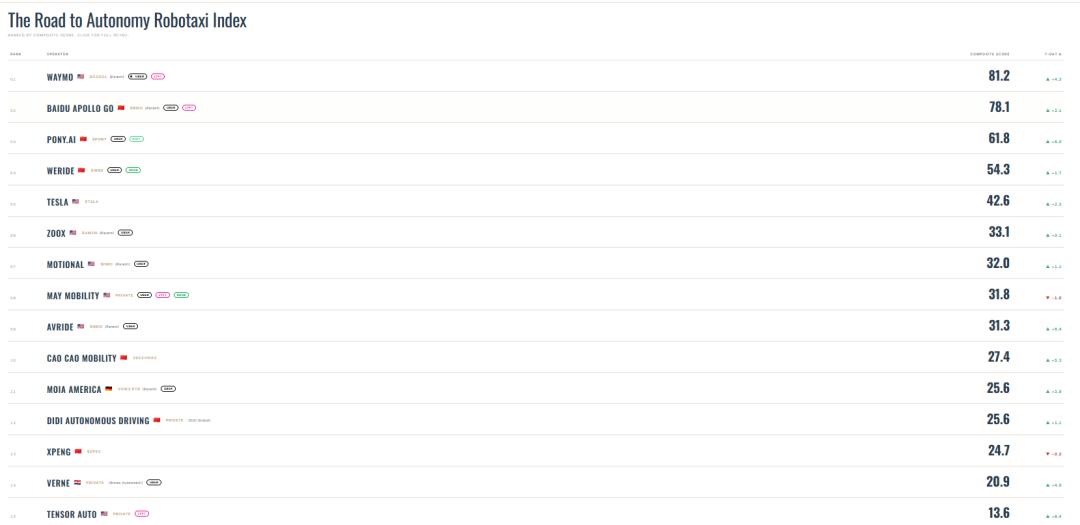
Waymo's slight lead mainly comes from more than a decade of original L4 technology accumulation. Its self - developed full - set of perception hardware, long - term global road safety database, and balanced commercial operations in multiple US cities give it a higher score in the unrestricted general autonomous driving dimension.
However, domestic leading manufacturers are catching up very rapidly. The score difference between Baidu and Waymo is only 3.1 points. With the real - time update of the list, there is always a possibility of the rankings alternating. Baidu Apollo Go had millions of fully unmanned travel orders in the first quarter of this year. In March, the peak weekly orders reached 350,000. Its fleet of 3,500 vehicles covers 11 domestic cities, with a cumulative driving distance of 300 million kilometers without major safety accidents. In the past six months, it has successively obtained L4 operation licenses in Abu Dhabi and Switzerland. It is the only L4 manufacturer in the industry that has achieved multi - regional commercialization in Asia, the Middle East, and Europe. Pony.ai has gone further in terms of commercial profitability. Its fleets in Guangzhou and Shenzhen have achieved positive cash flow per vehicle per day. The annual goal is to have a global fleet of over 3,000 vehicles. Regular Robotaxi services have been launched in Croatia in Europe and Qatar in the Middle East. WeRide has simultaneously deployed multiple scenarios including manned taxis and logistics. Its multi - line monetization model effectively hedges against the cyclical fluctuations of a single race.
Overall, the core advantages of domestic Robotaxi manufacturers are concentrated in large - scale implementation in high - density cities, supply - chain cost control, and the speed of entering emerging markets. The key to future global competition still lies in who can run a replicable profit - making cycle in the target market at the lowest compliance cost and the fastest speed, and quickly achieve large - scale implementation to build a risk - resistant global operation network.
2. Unmanned delivery: Two Chinese companies lead, and Neolix takes the global first place by a large margin
This is the race where China's industrial advantage is most prominent in the entire set of indices. The complete ranking of the top seven in the list is: Neolix with 74.7 points, Starship with 73.7 points, Serve Robotics with 60.4 points, Coco with 43.7 points, Avride Pod with 36.2 points, Meituan with 32.1 points, and DoorDash Dot with 32 points.
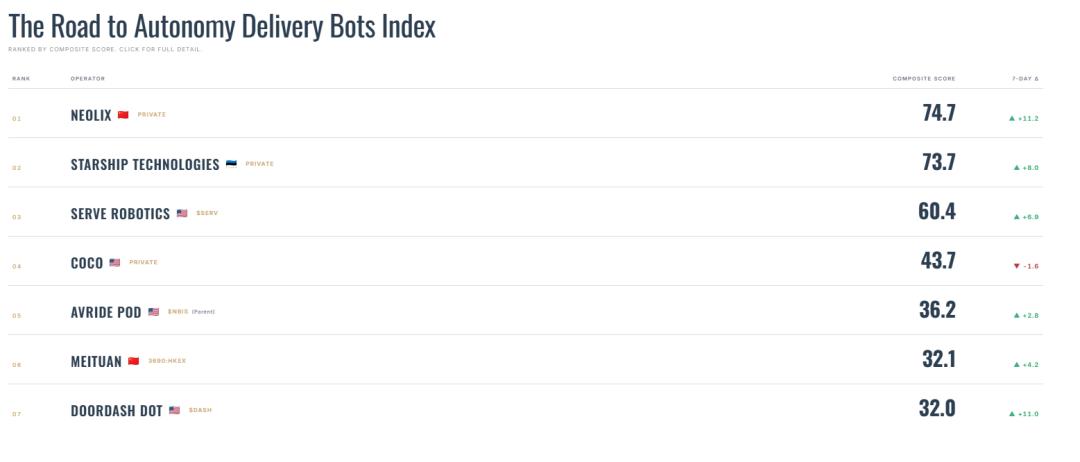
Neolix's score increased by 11.2 points in a single week, making it the company with the highest increase in the entire list. It has left the second - ranked Starship far behind, completely rewriting the global competition pattern of unmanned delivery. In terms of hard data, Neolix's L4 unmanned delivery vehicles have driven over 160 million kilometers, and its business has been implemented in nearly 20 countries and over 300 cities. In 2025, the total sales volume of domestic unmanned urban distribution vehicles was 22,000, and Neolix's market share exceeded 51%, leading by a large margin in the domestic market. In terms of business models, the industry generally adopts the one - time vehicle sales model, while Neolix has created an RaaS (Robots as a Service) subscription plan for unmanned vehicles, providing transportation capacity on demand, which significantly lowers the usage threshold for supermarkets and express delivery merchants. The stable and continuous transportation capacity income is also the key to its significant score increase. In the past six months, it has carried out intensive globalization activities: it obtained the first commercial license for unmanned delivery in the Middle East and plans to deploy 10,000 unmanned delivery vehicles in the UAE in 2026. In June, it reached a cooperation with QuikBot in Singapore to implement the world's first end - to - end delivery solution from "public roads to building entrances", filling the gap in last - mile delivery. During the process of going global, it has simultaneously coordinated the domestic cloud computing, in - vehicle mapping, and charging pile industrial chains for collective output, with a much higher localization adaptation efficiency than its European and American competitors.
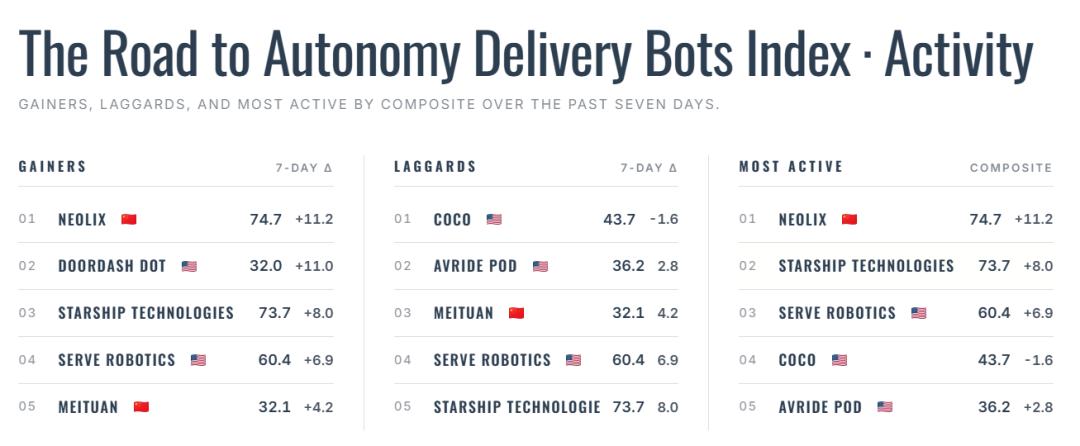
Meituan ranks sixth globally with 32.1 points. It is the only platform - type player in the list that has simultaneously deployed ground - based unmanned vehicles and low - altitude drones. Relying on the natural order pool of domestic instant retail, it has significantly reduced the empty - running rate of vehicles. It has regular operations in dozens of domestic cities, with 53 commercial drone routes opened. It has obtained the over - the - horizon operation qualification for drones in Dubai overseas, forming a multi - regional layout in the Chinese mainland, Hong Kong, and the Middle East. Different from pure hardware manufacturers, Meituan can achieve coordinated scheduling of unmanned transportation capacity and human riders, with better commercial operation efficiency than overseas delivery robot companies such as DoorDash.
In contrast, overseas players such as Starship are only limited to operations in closed campus areas. There is an obvious gap between Serve, Coco and Neolix in terms of fleet size and open - road operation mileage. Relying on the domestic trillion - level instant retail market and a low - cost complete supply chain, last - mile delivery has become a benchmark race for China's autonomous driving to expand overseas.
3. Long - haul unmanned heavy trucks: American companies maintain an absolute lead
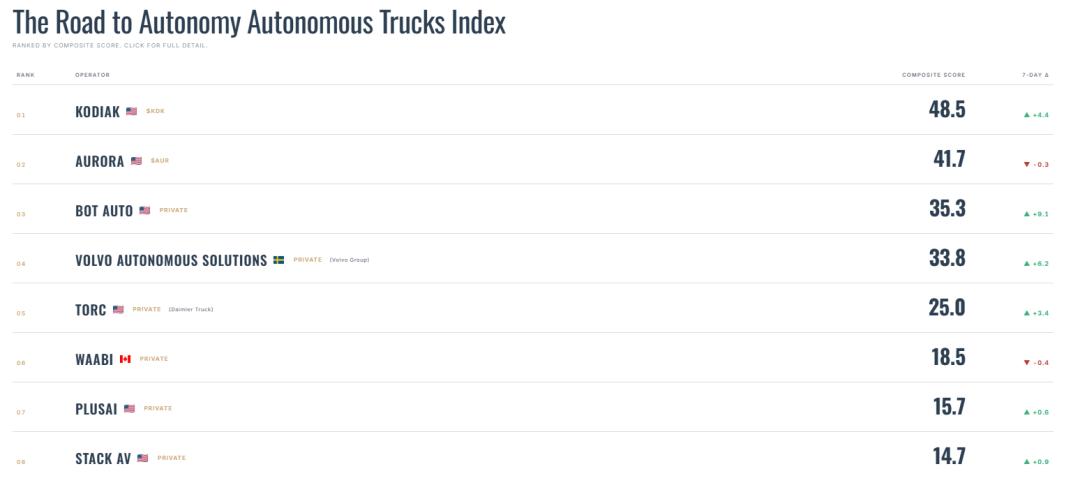
The top two in the long - haul heavy - truck index list are Kodiak and Aurora. The mature long - haul freight market in North America, standardized highway conditions, and long - term capital investment have enabled American companies to be the first to run a profitable long - haul freight cycle. This is also the sector with the most obvious gap between China and the US among the four races.
4. Intelligent driving software licensing race: China and the US are on par
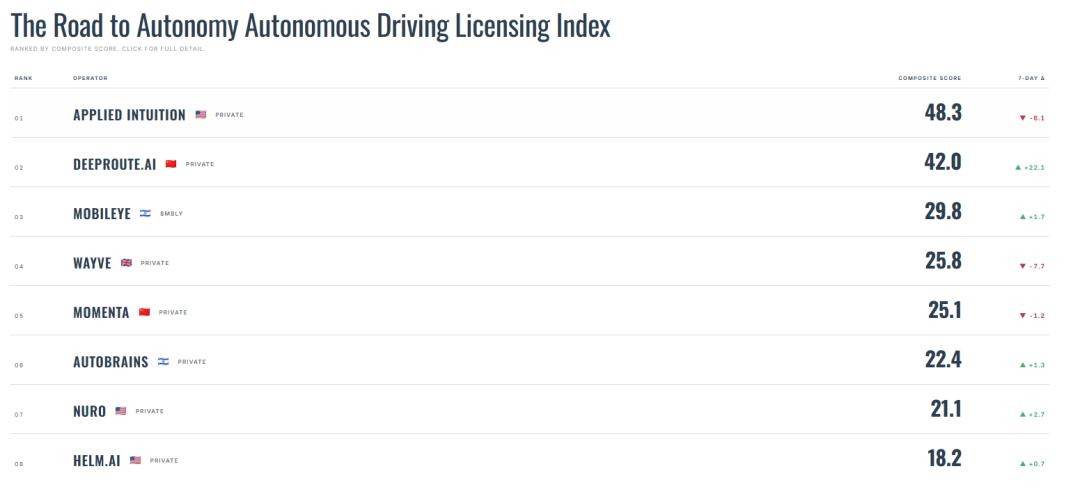
Applied Intuition from the US ranks first, while DeepRoute and Momenta from China rank second and fifth respectively. Domestic intelligent driving delivery solutions have formed a large - scale advantage in the mass production and implementation of passenger cars, competing differently from overseas manufacturers.
Don't just look at the scores. There are four deep - seated gaps between China and the US in autonomous driving
The commercialization scale in the list can only reflect short - term implementation results. Looking at the 5 - to 10 - year industry cycle, American leading companies still have a first - mover advantage in underlying general technologies, long - term R & D fund reserves, and global industry influence. However, Chinese companies have formed irreplaceable technical advantages in scenario - based implementation technologies, mass - production engineering, and multi - sensor fusion solutions based on a large number of real - world scenarios. Both sides have their own advantages and disadvantages.
Technical routes: General single - vehicle intelligence vs. scenario adaptation + map - less route
American companies generally follow the general single - vehicle intelligence route, where a single set of algorithms can adapt to various road conditions around the world without relying on external road infrastructure. Waymo adheres to the high - redundancy hardware original L4 solution, with a fully self - developed perception and computing power platform, and sufficient safety redundancy in extreme scenarios. Tesla's pure vision end - to - end route relies on tens of millions of mass - produced vehicles around the world to build a boundary - less data flywheel. The algorithm can simultaneously adapt to multiple scenarios such as manned, freight, and delivery, with a first - mover advantage in generalization ability.
On the other hand, Chinese manufacturers have explored a differentiated technical route suitable for high - density cities, with core technical advantages concentrated in complex - scenario adaptation and mass - production engineering. Domestic Robotaxi and unmanned delivery RoboVan companies are shifting from the multi - sensor fusion + high - precision map solution to the map - less technology route. Relying on a large number of real - world road conditions with mixed traffic of people and vehicles, narrow roads, and dense non - motor vehicles, they have developed globally leading complex - city perception and decision - making algorithms. The multi - modal autonomous driving large models self - developed by Baidu and Pony.ai can simultaneously identify pedestrians, electric vehicles, and irregular obstacles. Neolix and Meituan have developed lightweight fusion perception solutions for low - speed urban distribution, with lower hardware costs and faster mass - production implementation speed.
This localized technical solution has higher implementation efficiency and is a perfect fit for the high - density urban road networks in Asia, which is a technical barrier that overseas manufacturers find difficult to replicate.
There is a generation gap in long - term R & D fund reserves
Underlying technology iteration requires continuous huge capital investment, and there is a significant gap in the capital volume between Chinese and American companies. Waymo, backed by Alphabet, maintains an annual R & D investment of tens of billions of dollars in underlying technologies. Tesla's profits from the whole - vehicle business continuously support the R & D of FSD, with an annual investment in autonomous driving - related areas exceeding 5 billion dollars. The whole - vehicle sales form a complete self - financing cycle. Delivery robot companies such as Nuro and Starship have continuously received large - scale special financing.
In contrast, most domestic companies, whether in the Robotaxi or unmanned delivery fields, rely on group support or first - tier market financing. Even though commercial orders are continuously increasing, short - term revenues can only cover fleet operation and local operation costs. The long - term high - intensity R & D investment in underlying general large models, self - developed in - vehicle chips, and global simulation platforms is short of that of American giants in the short term. However, the advantages are also clear: the cost advantage of the domestic industrial chain significantly reduces R & D and implementation expenses. The large amount of domestic scenario data continuously supports algorithm iteration, and companies do not need to invest huge amounts of money to build overseas test road networks. At the same time, groups such as Baidu and Meituan are continuously and stably increasing their investment in autonomous driving R & D. The investment enthusiasm of domestic capital in the unmanned delivery RoboVan, Robotaxi, and Robobus races is continuously rising, and the long - term capital supply