The most unfortunate fund manager across the entire market in 2026 is no one but her.
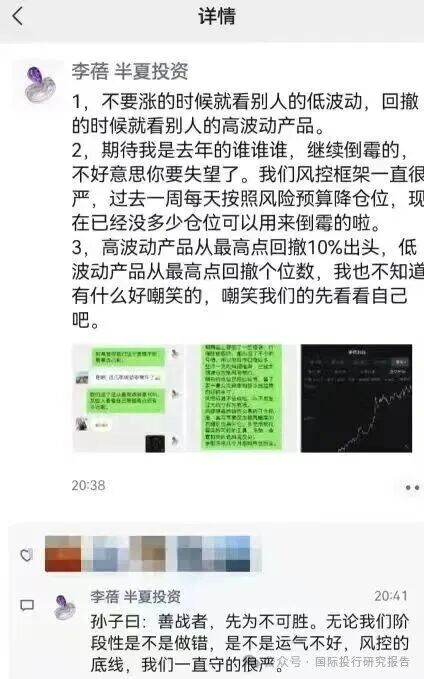
Li Bei of Banxia Investment, who is both beautiful and talented, has once again become a hot topic. However, this time it's not about looking for a marriage partner but about losing money, losing a significant amount of money.
On June 22nd, some media exposed the data of a certain mixed macro - hedging product under her management: the net value of the product plummeted by 15% in a single week. Starting from the net value of 8.113 on May 8th, it has dropped by 30% in one and a half months. All four products on the Private Fund Ranking website have suffered losses this year, with each losing more than 10%. The worst - performing one has an annual decline of over 20%.
What about the scale? According to data from the Asset Management Association of China, the scale of the funds she manages has dropped from over 10 billion to below 5 billion, a halving... Wall Street News also followed up with the same report, indicating that real money has evaporated.
In the monthly report "To Banxia Investors", she said that 7% of the positions are in energy, 53% in domestic demand (consumption, real estate, and building materials). Among them, real estate accounts for 25%, consumption 20%, and building materials 8%. The remaining half of the positions are hedged with put options on the Hong Kong stock index. In other words, more than half of the positions are bet on the recovery of domestic demand.
Her investment logic is quite straightforward. She prefers stocks with low PEs, good dividends, and seemingly attractive valuations. For example, the forward PE of real - estate stocks is less than 5 times. The PE of leading consumer stocks has dropped from 50 times to less than 10 times, and the PE of leading building - material stocks is less than 10 times with a dividend yield of about 5%. It's more cost - effective than depositing money in the bank. Indeed, they are cheap.
However, being cheap and making money are two different things.
Li Bei has a clear - cut attitude of being bearish on AI. In the monthly report, she directly advised investors: "If you want to use this money to chase AI, even if you scold me, I still have to advise you to be extremely cautious."
Her argument is that Anthropic announced revenues of $47 billion on May 28th, up from $44 billion on May 1st, with a month - on - month growth of less than 10%. She believes that the profitability and valuation of AI are at a high level. The leading indicators are declining while the lagging indicators are still rising. Now is the best time for investors to gradually withdraw from AI.
Is there any truth in what she said? Absolutely. The problem is that her account can't wait until this window closes.
Is there a bubble in AI? Definitely... The valuation of NVIDIA has reached an absurd level. The growth rate of GPU demand is slowing down marginally. The price of tokens has peaked and started to decline. The revenue from AI applications is just so - so. The pressure is being transmitted throughout the industrial chain from upstream to downstream. The divergence in the private - fund circle regarding AI has become so great that it's almost like a fight. The value - oriented investors are shouting about a bubble, while the growth - oriented investors are shouting about the continuation of high - growth. Both sides have valid points...
But there is one question that neither side mentions: when will the bubble burst?
The Internet bubble burst in 2000. Amazon has risen many times from its low point, and Google and Apple have become the companies with the highest market capitalization in the world. Those who missed out long before the bubble burst have long disappeared silently. Only those who survived and bought at the bottom after the bubble burst are the winners... Don't ask if the bubble will burst, ask if you can live to see it.
Keynes once said, "In the long run, we are all dead." This sentence has been over - quoted, but it fits perfectly today.
An investor gives you $1 million today. He may need to buy a house next year, and his child may need to go to an international school. He needs money everywhere. You tell him that the valuation will return in two years? He can't wait. You say the AI bubble will burst? He agrees with you. But when he needs the money, you give him a net value with a 30% loss. Then you tell him that you are right in the long run. See what his expression will be.
The "long - term" of a fund manager can't be longer than the investor's lifespan.
Speaking of domestic demand... Li Bei's logic of heavily investing in domestic - demand stocks is based on a premise: economic recovery and a rebound in consumption. But what does the data say?

In May, the CPI increased by 1.2% year - on - year, and non - food prices rose by 1.9%. Transportation and medical costs are all rising. These are all necessities, money that has to be spent, and have nothing to do with consumption willingness. The total retail sales of consumer goods, which truly reflects consumption willingness, decreased month - on - month. After deducting the price - increase factor, what the common people actually bought is even worse than what the data shows. Discretionary consumption has shrunk...
The upstream PPI soared by 3.9%, and the prices of raw materials purchased by enterprises skyrocketed by 5.8%. The cost has increased, but the downstream market is stagnant, and prices can't be raised at all. Profits are being squeezed step by step, and enterprises are starting to cut salaries and lay off employees. The income expectations of residents are declining. There are so many "high - earning" flexible workers everywhere, and people are even more reluctant to consume. When will this vicious cycle end?
What did Li Bei buy? 25% in real estate, 20% in consumption, and 8% in building materials. They are all old - fashioned stocks closely tied to domestic demand. If domestic demand shows no improvement, why should these stocks rise? Because of low PEs? PEs can go even lower. Because of dividends? Dividends can be eaten up when the stock price continues to fall. Because the market is wrong? The market has been wrong for three years. Can your money last for three years?
She is betting on the return of valuation, betting on a Chinese version of the September 24th moment. There was such a moment on September 24th, 2024, when real - estate stocks soared. And then? They went back to where they started. It was just a one - time policy impulse, and the net value quickly retreated.
Li Bei misjudged the timing. There is indeed a bubble in AI. Her logic of betting that funds will flow back to old - fashioned stocks after the bubble bursts is theoretically valid. But she overlooked the most fundamental thing: time.
A fund manager loses 30% in one and a half months. To recover from a 30% loss, the fund needs to rise by 43%. She said that it's meaningless to reduce positions now, which means she has admitted defeat. A fund manager can accept defeat, but investors can't.
If investors redeem their investments today, they can invest the money in other funds tomorrow. What about the fund manager? She can't wait for the day when the AI bubble bursts, nor can she wait for the day when domestic demand recovers... All she can wait for is the liquidation line.
They say you shouldn't put all your eggs in one basket. Well, the beauty didn't put them in one basket, but she put them in several baskets, all on a shelf called "domestic demand". All four of her products have suffered losses this year. The worst - performing one has an annual loss of over 20%, while the Hang Seng Tech Index has risen during the same period.
Regardless of whether there is a bubble or not, the net value of AI - related targets is rising this year. You say there is a bubble in AI, but they are making money. You say old - fashioned stocks have value, but you are losing money. Investors pay management fees, not to listen to your investment philosophy.
The AI bubble will burst. The Internet bubble burst in 2000, and the sub - prime mortgage bubble burst in 2008. No bubble has ever lasted. Bubbles will always burst. The only question is whether you will still be at the table after it bursts.
Keynes was right. In the long run, we are all dead. A fund manager can't fall before the bubble bursts.
Li Bei lost to time, and time is the fairest judge.
This article is from the WeChat official account "Kungfu Finance" (ID: kongfuf), written by Feng Laiyi, and is published by 36Kr with authorization.