Why are US automakers flocking to the energy storage sector
In the first half of 2026, two major established automakers in Detroit, USA, almost simultaneously placed their battery energy storage businesses at the center of their corporate strategies.
On May 12, Ford Motor established a wholly - owned subsidiary, Ford Energy, to layout grid - scale battery energy storage. A few days later, Ford Energy signed its first framework agreement with the North American branch of Électricité de France (EDF). The latter will purchase Ford's DC Block energy storage system from 2028, with a total of up to 20 gigawatt - hours.
Ford plans to invest approximately $2 billion in this, with a capital expenditure of about $1.5 billion in 2026. The goal is to achieve an annual production capacity of at least 20 gigawatt - hours by the end of 2027. The production base is the BlueOval battery factory in Kentucky, which was originally built for power batteries.
General Motors' actions came a few weeks later but were more comprehensive. On June 9, at the GM Empower 2026 event in San Francisco, General Motors' Chief Product Officer Sterling Anderson announced that through software upgrades, General Motors has activated more than 250,000 electric vehicles on the road with bidirectional charging capabilities, making them distributed energy sources that can be dispatched by the power grid. And all new energy vehicle models will be standard - equipped with bidirectional charging in the future. The partners are two electric utility companies - Pacific Gas and Electric Company (PG&E) in California and DTE Energy in Michigan.
General Motors also announced multiple energy storage and charging platform projects, including collaborating with Denver startup Peak Energy on sodium - ion battery research and development, and partnering with Redwood Materials on a retired battery cascade utilization project - this project has already powered an AI (Artificial Intelligence) data center in Nevada, as well as an energy charging aggregation platform Energy Pass covering about 70% of DC fast - charging piles in the United States. Fortune magazine said that General Motors is "disguising" itself as a "de facto distributed utility company."
The reaction of the capital market was straightforward. After Ford announced the news in May, its stock price rose by about 20% within two trading days and increased by more than 30% in May, reaching a three - year high. Morgan Stanley analyst Andrew Percoco even gave Ford Energy a separate valuation of up to $10 billion - even though this business has not delivered any products yet, and the first batch of projects may not be implemented until 2028. The logic behind this valuation is to re - price Ford as AI infrastructure, and grid - scale energy storage is one of the few solutions that can quickly respond to the power demand of AI data centers.
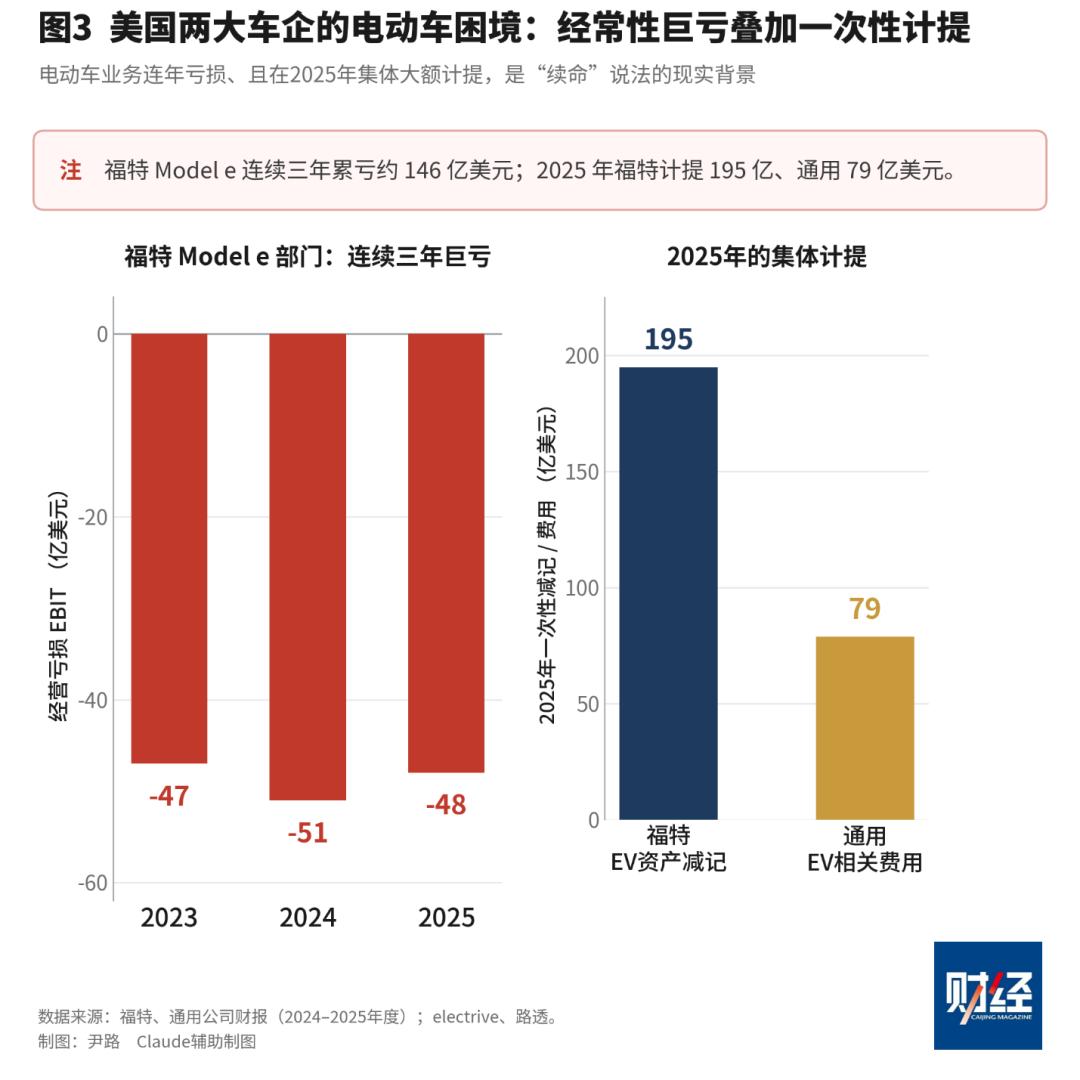
The $7,500 federal tax credit for electric vehicle purchases in the United States was cancelled at the end of September 2025 due to the "Obvious But Beautiful Bill Act" (OBBBA), and market demand cooled. The two automakers successively scaled back their electric vehicle businesses. In December 2025, Ford cancelled multiple pure - electric vehicle models and split its joint - venture battery project with SK On. General Motors sold its stake in a battery factory in Michigan to LG Energy Solution. Due to the relevant business adjustments, Ford and General Motors respectively recorded asset impairments and expenses of about $19.5 billion and about $7.9 billion.
01
The Triple Logic of Turning to Energy Storage
From a business logic perspective, the growth of demand, market barriers, and the reuse of capabilities together constitute the main driving forces for American automakers to enter the energy storage market.
Zeng Yujun, the chairman of CATL, summarized the conditions for a company to decide whether to enter a new field into three points when talking with Caijing magazine in May: "First, the market in this field is large enough; second, there are high entry barriers in this field, otherwise everyone will enter; third, the technology in the new field is adjacent to the company's existing technology and can be connected."
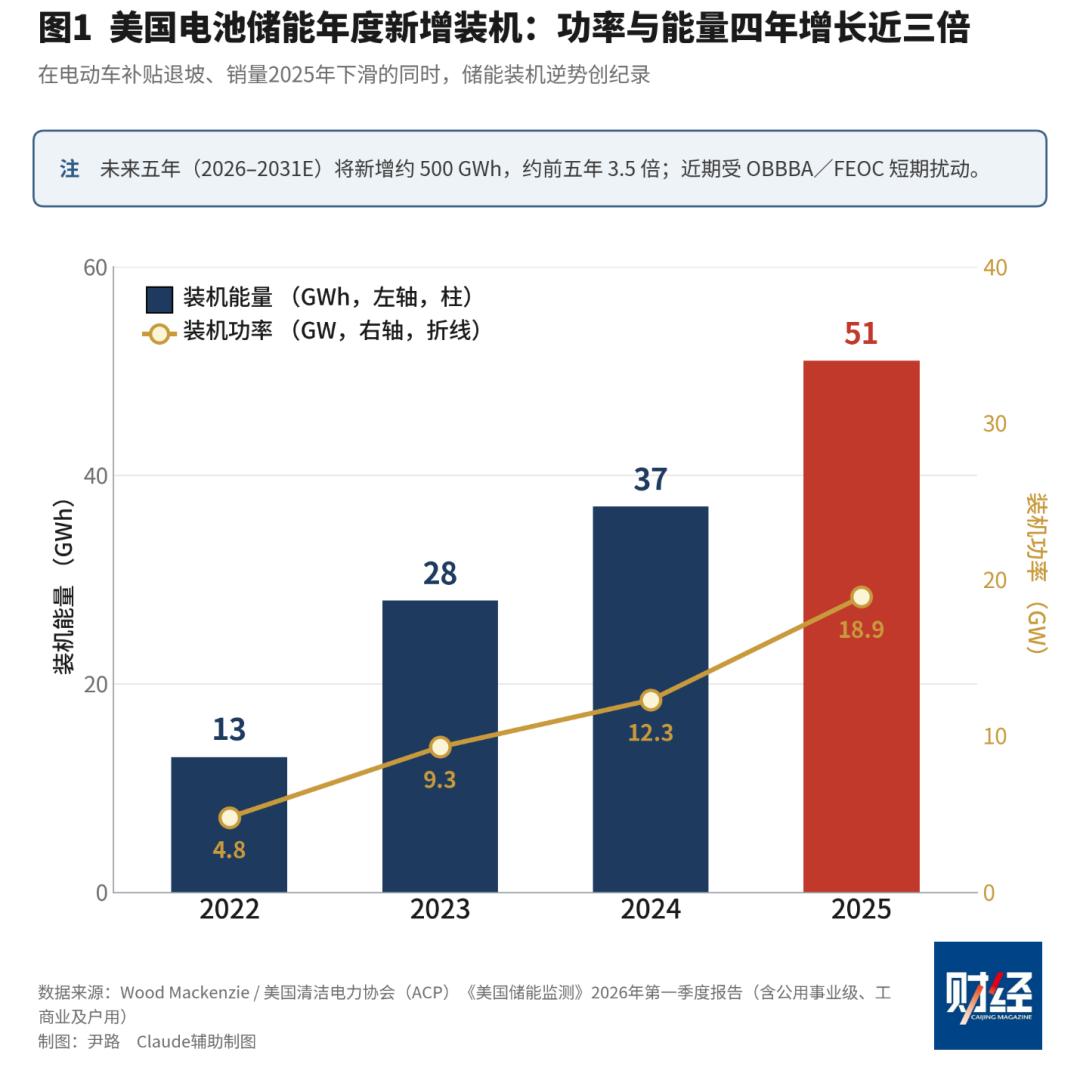
First is the market space. In the United States, the growth direction of the energy storage market is exactly the opposite of that of electric vehicles. According to the "U.S. Energy Storage Monitor" jointly released by consulting firm Wood Mackenzie and the American Clean Power Association (ACP), in 2025, the newly installed capacity of battery energy storage in the United States was 18.9 gigawatts, a year - on - year increase of 52% in terms of power; in terms of capacity, it was 51 gigawatt - hours, a year - on - year increase of 37%. Since 2019, the cumulative installed capacity has exceeded 50 gigawatts/144 gigawatt - hours.
Wood Mackenzie predicts that from 2026 to 2031, the United States will add about 500 gigawatt - hours of energy storage, a 250% increase compared with the previous five years. The core driving force is the power demand of AI data centers. At the same time, the sales volume of electric vehicles in the United States declined due to the reduction of federal purchase subsidies at the end of September 2025.
The rise of energy storage and the decline of power batteries are the most direct reasons for automakers to redirect their idle battery production capacity to energy storage. It is worth noting that affected by the "Obvious But Beautiful Bill Act" (OBBBA) and the "Foreign Entities of Concern" (FEOC) rules, the newly installed capacity of utility - scale energy storage is expected to decline by about 11% and 8% in 2026 and 2027 respectively, and will not return to the 2025 level until 2029.
Second is the entry barrier. The technical and cost barriers have decreased, but trade policies and supply - chain rules dominate the competitive landscape. Lithium iron phosphate has become the dominant route for energy storage, with a lower requirement for energy density than vehicle batteries. Data from Bloomberg New Energy Finance (BNEF) shows that the price of stationary energy storage battery packs dropped to $70 per kilowatt - hour in 2025, a year - on - year decrease of 45%, making it the cheapest battery category.
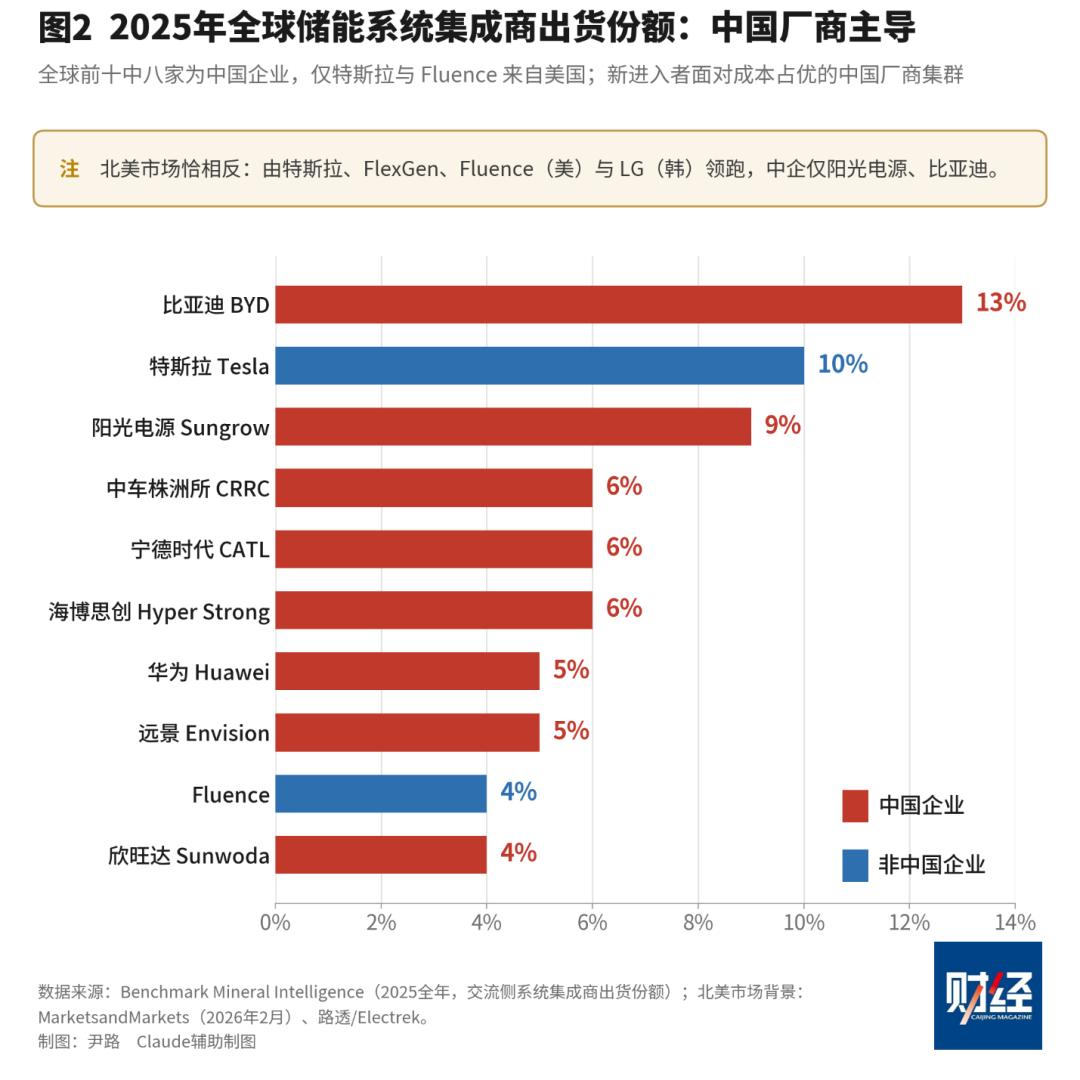
The global and North American market landscapes are completely different. According to research institution Benchmark Mineral Intelligence, among the top ten energy storage system integrators in terms of shipment volume in 2025, eight are Chinese companies. Only Tesla (10%) and Fluence (4%) are from the United States. BYD ranks first with a 13% market share, with a shipment volume of over 60 gigawatt - hours. New entrants will face a group of Chinese manufacturers with cost advantages.
The situation in North America is almost reversed. According to Wood Mackenzie, Tesla alone accounts for 39% of the North American market share (energy storage systems), ranking first for three consecutive years. The combined share of Chinese manufacturers is only 16% and is continuously decreasing. Manufacturers outside China account for a total of 84%. In the North American energy storage market with a total scale of about $10 billion, Tesla, FlexGen, Fluence, LG and other local and allied manufacturers in the United States lead the way. Sungrow and BYD are the only two Chinese companies among the top ten.
This contrast is exactly the source of confidence for American automakers. In the North American market protected by localization rules such as high tariffs, FEOC, and the United States - Mexico - Canada Agreement (USMCA), the real competitors are mainly local American manufacturers, rather than the Chinese battery camp. This "domestic substitution" space is the key advantage of American automakers.
Third, the adjacency of technology is the most convincing reason for automakers to enter the energy storage field. Capabilities such as cell and battery pack manufacturing, battery management systems, power electronics, and thermal management can be directly transferred from vehicle applications to energy storage. Morgan Stanley pointed out that Ford's cooperation with CATL on lithium iron phosphate is an "underestimated strategic competitive advantage" for its energy storage business, which will make it one of the few "semi - vertically integrated local energy storage suppliers."
In addition, automakers have two capabilities that pure energy storage manufacturers cannot replicate: one is the cascade utilization of retired automotive power batteries in energy storage scenarios. For example, General Motors' project with Redwood Materials uses retired power batteries for energy storage in AI data centers and General Motors' own factories; the other is vehicle - to - grid interaction. General Motors has turned 250,000 electric vehicles into virtual power plants, and the vehicles themselves have become flexible grid resources.
The cell is the biggest constraint for American automakers in energy storage. Due to the long - term shortage of domestic production capacity, it was not until 2025 that LG Energy Solution put into operation the first large - scale energy - storage - grade lithium iron phosphate cell factory in the United States in Michigan, with an initial annual production capacity of 16.5 gigawatt - hours, which was later expanded to about 25 gigawatt - hours. The domestic cell production capacity truly oriented towards energy storage is mostly transformed from power battery production lines. The factories of SK On in Georgia and Samsung SDI in Indiana will not be gradually converted to production until 2026, and they are highly dependent on imported raw materials.
Currently, most of the lithium iron phosphate cells, the mainstream route for energy storage, are supplied by Chinese companies. Specifically in the United States, BNEF data shows that in the first seven months of 2025, Chinese - made grid - scale lithium batteries accounted for about 65% of U.S. imports; if all lithium batteries are included, China's share is about 70%. Although the integration of North American energy storage systems is dominated by manufacturers such as Tesla, a considerable part of the cells inside these systems still come from China.
Ford follows the "Chinese technology, American manufacturing" route. Its flagship DC Block energy storage system uses 512 - ampere - hour lithium iron phosphate cells. The cells, modules, and 20 - foot DC containers are all produced at the BlueOval factory in Kentucky, which was transformed from power battery production capacity. The first batch of deliveries is scheduled for the end of 2027. The Marshall factory in Michigan started producing square lithium iron phosphate cells in June 2026, supplying both household energy storage and electric pickups. The chemical system, product design, and manufacturing process of Ford's two cell factories all come from the technology authorization of CATL.
General Motors' energy storage cells are supplied by its joint - venture company Ultium Cells with LG Energy Solution. It started receiving energy storage cells manufactured by LG in mid - 2026. In addition, General Motors is collaborating with Peak Energy to self - develop sodium - ion cells. The prototype is planned to be produced within 2026, and mass production will start after 2028.
02
Revival or Rebirth?
Both Ford and General Motors' electric vehicle strategies underwent a round of contraction in 2025.
Ford's separately listed electric vehicle division, Model e, had operating losses of $4.7 billion, $5.1 billion, and $4.8 billion from 2023 to 2025 respectively. There was no sign of profitability in three years, and this division was officially dissolved in April 2026. In December 2025, Ford announced a $19.5 - billion write - down of electric vehicle assets, stopped production of the F - 150 Lightning electric pickup, and abandoned the next - generation electric pickup T3 project.
General Motors does not separately disclose the profit and loss of its electric vehicle business in its financial reports, but it recorded $7.9 billion in electric - vehicle - related expenses in 2025, which directly dragged down the annual net profit, causing it to decline by 55% year - on - year to $2.7 billion.
The energy storage business was pushed to the forefront in this context, and there emerged a saying in the market that "American automakers are using energy storage to revive their electric vehicle businesses." This judgment captures the defensive nature of the automakers' motives: the energy storage business digests the battery production capacity that was previously prepared for electric vehicles but could not be sold, arranges the relevant engineering teams and supply - chain partners, maintains the automakers' presence in the "clean energy" narrative, and supports the stock price performance when the financial reports are under pressure.
However, the term "revival" cannot fully cover all the content of this collective shift.
First, energy storage is an independent business with faster growth and higher gross profit, not a continuation of the electric vehicle business. Tesla's operating data provides the most intuitive comparison: in 2025, Tesla's energy storage installed capacity reached 46.7 gigawatt - hours, and its energy business revenue was about $12.8 billion. The gross profit margin in the fourth quarter was close to 30%, far higher than that of its vehicle business. This record - breaking energy storage performance occurred precisely when vehicle deliveries declined by 16% year - on - year in the fourth quarter of 2025, hedging against the vehicle cycle rather than being dragged by it.
Second, a more accurate definition of the current layout of American automakers should be the redistribution of capital and production capacity, from the still - loss - making electric vehicle business oriented towards consumers to the energy storage business with higher gross profit, which is oriented towards the power grid and data centers. The two are more like a diversion rather than a blood transfusion or a feedback.
"Revival" is the motive, and "transformation and redistribution" is the essence. For American automakers, whether the energy storage business will ultimately be a continuation of battery - manufacturing assets or a new source of profit depends on their execution ability. There is an obvious gap between American automakers and Tesla and Chinese manufacturers in terms of battery and energy storage technology and scale. Tesla's single - year energy storage installed capacity of 46.7 gigawatt - hours in 2025 has exceeded twice Ford's total planned production capacity. The valuation of the capital market has outpaced Ford's business, which may not be implemented until 2028.
This article is from the WeChat official account "Caijing Magazine". Author: Yin Lu, Editor: Huang Kaixi. Republished by 36Kr with permission.