Back to the Day Without AI, in Search of the First Principle | WAVES 2026
Let's think about it. If AI suddenly disappeared one day, what would we lose? This question is not to create panic but to make us think clearly: When we invest in AI today, are we investing in its capabilities or the human needs behind it? In the next session, let's go back to the day without AI and find the first - principle. Li Feng's speech in the previous session gave us a starting point for thinking. Now, we're going to turn it into a debate.
The following is the content of the round - table dialogue, edited and organized by 36Kr:
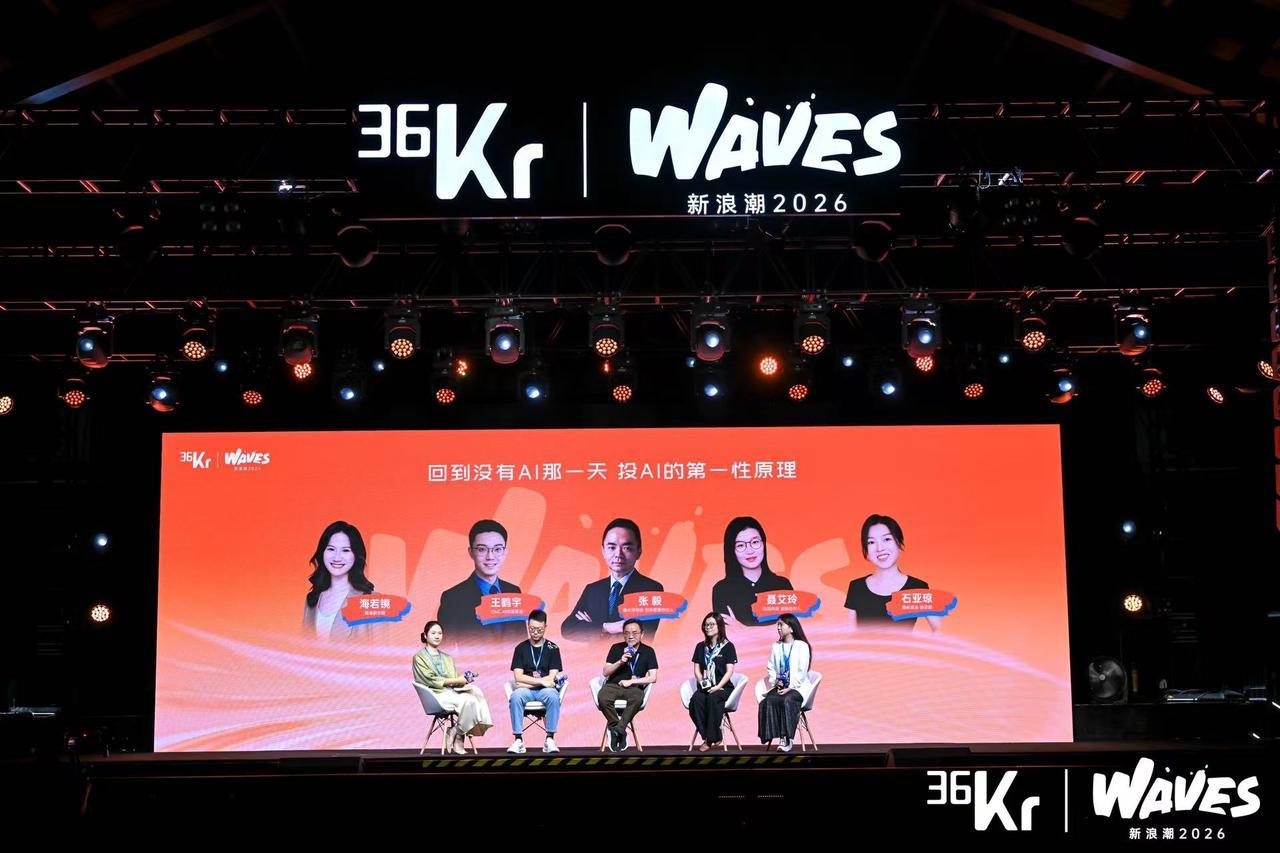
Image source: Waves site
Hai Ruojing | Deputy Editor - in - Chief of AnYong (Host)
Wang Heyu | CMC AI Creative Fund
Zhang Yi | Founding Managing Partner of JingShuiHu Venture Capital
Nie Ailing | Founding Partner of Titanium Mobile Technology
Shi Yaqiong | Vice President of JinQiu Fund
Hai Ruojing: Hello, everyone! First of all, I'd like to warmly welcome all of you to today's WAVES Conference. I'm the host of this round - table, Hai Ruojing from AnYong. Today's theme is quite interesting, called "Going back to the day without AI". The interesting part of this thought experiment is that it makes us think about what human needs really are and what the essence of human - world interaction is.
At yesterday's conference, many guests mentioned that the market is a bit impetuous now. Just now, I was chatting with two guests off - stage. Some companies' valuations are rising very fast, but the direction of future technological changes seems very clear, and there are many consensuses that we can't miss. Today, all the guests here have been in the technology and investment circles for many years and have experienced technological and capital cycles. So, I'd like to talk to you about what has changed and what has remained the same in the AI era. First, please briefly introduce yourselves and your institutions. If possible, please describe the concentration of AI in your current work with a percentage.
Wang Heyu: Hello, everyone. I'm Wang Heyu from CMC Capital. Currently, I mainly manage several funds with AI and technology as the core investment themes. If we draw a timeline from 2023 to now, the investment concentration in AI is basically 100%. Overall, all directions revolve around AI, covering from ToC to ToB, from software to hardware, which is a relatively comprehensive - stage layout. One of the major themes this year might be physical AI.
Zhang Yi: I'm Zhang Yi from JingShuiHu Venture Capital. We are a VC institution focusing on early - and mid - stage equity investment in technology companies. If we summarize our style in one sentence, we are more like "snipers". Compared with institutions of the same scale, we make relatively fewer investments, but from the results, our hit rate is relatively high. Moreover, in these limited investments, 80% - 90% of the projects are led by us in the early rounds. We not only lead the investment in the early rounds but also continue to increase our investment in subsequent rounds. Through long - term capital and resource support, we achieve in - depth binding with the enterprises throughout their life cycles.
All along, we have focused on AI and algorithm - driven innovation, covering the investment in early - stage product - type enterprises with a combination of software and hardware in application fields such as smart energy, industrial technology, and AIDC. In the AI field, we focus on both ends of the AI value chain: one is the upstream Infra hardware, and the other is AI - driven enterprises in B - end productivity scenarios. In our investment portfolio, about 60% - 70% of the portfolio is deeply driven by AI and algorithms. We believe this is a more appropriate proportion because in real productivity scenarios, algorithms must work in collaboration with hardware, terminal products, and solutions to be implemented in real application scenarios and achieve commercialization.
Nie Ailing: I'm Nie Ailing, the co - founder of Titanium Mobile Technology. Titanium Mobile Technology is a global growth digital service company driven by AI, mainly helping Chinese enterprises and brands empower their global growth. Most of our in - house work is in overseas marketing, including social e - commerce, content marketing, and other sectors. Since three or four years ago, we have been making a lot of strategic investments, with two core themes: overseas expansion and AI marketing.
The question about the AI concentration just now is very interesting. I view it in two parts. The first part is within Titanium Mobile. The AI concentration is not about how many Tokens are used but about how much AI has changed the workflow, how many business decisions it has made, how much customer value it has brought, and most importantly, which part of human value it has amplified. From these dimensions, we think it is 80% internally. Specifically, on the front - end, we have Navos multi - agent, which has deeply transformed the workflows in overseas marketing such as market insight, content generation, and advertising optimization. At the base, we have the Titanium vertical large - model, which has accumulated a large amount of in - house enterprise know - how and historical data.
In terms of investment, we basically invest 100% in AI - related fields. As a strategic investor, we don't make many investments. In the past few years, we have invested in nearly 20 start - up companies, all of which are AI - related. I personally think AI will have important applications in three fields: one is coding, which is already a consensus; the second is marketing; the third is general education or general knowledge. Of course, we are continuously delving into the second field. For Chinese enterprises to enter the global stage, the most crucial thing is how to make consumers aware of you, which is what we have been doing. Thank you!
Shi Yaqiong: Hello, everyone. I'm Shi Yaqiong from JinQiu Fund. I'm very happy to come to the WAVES Conference. If described in percentage, our fund is 100%. Our fund was born in this wave of AI - 2022. At that time, the Chinese market was at the low point of this wave of AI, but we saw the opportunity. The generative large - language model has brought several major changes:
First, it allows knowledge to be generated not only by humans but also by machines for the first time. Human knowledge production and dissemination are linear, while machines can work in parallel, which will surely speed up civilization significantly. Second, a large - scale digital workforce will enter the business society. The actual development of AI capabilities is even faster than we expected, which means that there will be a large number of high - quality digital expert labor forces globally, and business civilization will also evolve. Third, in the past, Internet users were mainly humans, but when a large number of AIs enter the network, the infra layer will also be rebuilt. Fourth, the editing link used to be the strongest field of giants in the Internet and mobile Internet eras, but generative AI has weakened this link to some extent and may also assist in generating new content formats.
Based on these judgments, we started to focus on the AI direction in 2022. In August 2024, our new fund completed fundraising. By December 31, 2025, we had completed investments in more than 70 companies and more than 80 transactions. The data for this year has not been fully counted yet. So from an investment perspective, the proportion of AI is 100%.
Internally, we also try our best to AI - enable the workflow and use AI to develop many internal tools, including public opinion monitoring, sales management, and process management systems, which are used very frequently. We are probably one of the VC institutions with the highest reimbursement limits for Tokens and AI tools in the market.
JinQiu Fund invests around the theme of the next - generation intelligent system. We believe that the next - generation intelligent system is no longer just a model for answering questions but a system that can autonomously complete the entire chain of perception, decision - making, and execution after the goal is set. It pushes the boundary of autonomy to the execution layer and can bring about real and verifiable changes in the digital space or the physical world.
Based on this theme, JinQiu has identified four levels of "system - level opportunities". First, the next - generation computing power determines the upper limit and cost of intelligence. Second, intelligent hardware is the first contact point for AI to enter the physical world. Third, embodied intelligence is the key to making machines truly "do". Fourth, AI applications form a commercial closed - loop in real scenarios.
Hai Ruojing: Thank you for the introductions of all the guests. Just now, three of you mentioned that the AI concentration in investment might be 100%. I'd like to ask Mr. Zhang Yi first. Since you mentioned that you are very concerned about the implementation in specific scenarios, and I know that you have invested in many hard - tech companies before, including commercial aerospace, biomedicine, new materials, and other fields. I'd like to ask how you view the implementation process of this wave of AI in productivity scenarios. In addition, you mentioned that many of the companies you invested in are algorithm - and data - driven. What direct and prominent changes does this current technological variable bring to your investment logic in hard - tech?
Zhang Yi: Let's talk about the implementation and application in productivity scenarios first. The progress of AI is visibly fast now. The driving force comes from two aspects:
One is the top - down technological change: AI is changing many habits in people's lives and work, such as coding, autonomous driving and assisted driving, multi - modal image production, and text and voice tools. These have become productivity tools used by many people in their daily lives, and the implementation process is indeed very fast.
The other is the bottom - up industrial demand pull: From our investment portfolio, we can observe that the demand of vertical industry customers is driving the development. There are many pain points that can be solved by the continuously iterated AI technology. So, first of all, you need to have an attitude of embracing AI to try. After trying, you will find an efficient way to meet customer needs. For example, some of the AI application companies we invested in have achieved very fast performance growth in the past two years. The core reason is that customers actively tried AI. Enterprises have deepened and refined single - scenarios through forward - looking R & D, thus verifying that customer pain points can be solved and providing customers with more abundant products and solutions. As a result, the enterprise's orders have increased from millions to over hundreds of millions, although it may be delivered over two or three years. So in the B - end scenario, the effect of productivity improvement is very obvious and has been reflected in the performance, and the trend is also visible. But whether AI is applicable in all B - end scenarios is still hard to say. However, for enterprises that focus on in - depth vertical scenarios, AI is indeed very useful, and these enterprises have indeed received more orders and better performance, which is our observation.
Back to your second question, the impact and changes on the hard - tech investment logic are also very significant. First, the growth expectation has changed from linear to exponential. In the past, hard - tech enterprises had a very obvious pattern: product R & D - pilot test - getting orders - mass production - cost reduction and yield improvement - starting to make a profit. This is a complete closed - loop cycle. After the arrival of AI, people's original expectations of the rhythm of this cycle and the growth ceiling have been broken. In some directions, we have seen the growth expectation change from percentage or even multiple growth to exponential growth. The most obvious is the upstream infra hardware (storage, chips, optics) in the computing power direction, where actual growth has been seen. In addition, fields such as embodied intelligence, general agents, and unmanned driving have also brought exponential imagination space. In the past, when judging a hard - tech direction, an annual growth of two to three times in the early stage and 20% - 30% in the mature stage was considered quite good. But now the growth curve we see is completely different. So, under the influence of AI, the growth expectation in related fields has a significant impact on the investment rhythm, frequency, and valuation. This may be one of the sources of the FOMO sentiment in the market - the expectation has changed, not just a matter of liquidity or money.
Another change is that the competitive barrier has shifted from single - point technology to system ecosystem. In the past, when investing in hard - tech, we highly valued single - point technology or process barriers, but it's not enough to just look at these today. NVIDIA is also allying with HBM manufacturers and has just announced a joint investment with Google in power generation equipment and technology to layout power facilities. Huawei's "Tao's Law" follows a similar logic - using system adaptation and the right to speak in the ecological niche to form an impact on competitors with high barriers. These all indicate that the lead in single - point technology and process can no longer form a particularly safe barrier, and system - level collaboration and ecological integration capabilities are becoming more critical competitive dimensions, which is also a relatively large change in hard - tech investment.
There is also a very direct change: the investment window period has been significantly shortened, and the prediction has been significantly advanced. In the past, people often said "wait a while" and thought it was best to enter half a step or one step earlier in the technology verification period. Now, leading projects may not give you such an opportunity. Now, it requires investors to make far - ahead predictions of technological iterations in advance. The entry time point, valuation, and investment frequency are all "maxed out in expectation". Otherwise, you won't even have the chance to enter the market. This is also a relatively large change reflected in the market in the first half of this year.
Hai Ruojing: Now we can see that there are many old needs in the market being solved by AI. Just now, Mr. Zhang Yi also mentioned some, and there are also some new needs created by AI. As funds that mainly invest in AI, how do you two distinguish the authenticity of the business of an AI company when making a judgment? Which might be real business necessities, and which are more based on technological imagination? If the capital market's pursuit of AI fades, which companies do you think are more likely to survive the cycle?
Wang Heyu: Thank you! I think this question is very good but also difficult to answer. From an economic perspective, there is no concept of real or false needs. It is more about the strength and weakness of price - demand elasticity. What we call real needs actually means that this elasticity is relatively weak. No matter how the price changes, my demand remains. In today's AI era, whether it is in productivity tools or changes in lifestyle, our so - called demand judgment is divided by time. In the short and medium term, we must break down the existing industrial production workflow into different links and then see how AI can reduce costs and increase efficiency in each link. This is what we will focus on in the short and medium term. In the long term, a paradigm change will definitely bring about a new workflow. It will be manifested in the reduction of the original workflow, for example, from 10 links to 5, and then these 5 links may also disappear, and a new workflow will be born. More specifically, since everyone has mentioned overseas expansion and AI marketing, we are also very concerned about it. The first wave may be that people use AI tools to create marketing materials, analyze user portraits, and automate advertising delivery.
Secondly, in the future, if all AI is accompanied by us 100%, it will accumulate all users' intents. It won't be like today, where recommendations are based on people's tags, historical behaviors, and algorithms. In the future, it may be intent recognition. Another thing is the interaction between AIs, which is a longer - term matter.
Therefore, in terms of investment, regarding the last question, we hope to find companies that can find good cash and value support in the short - and medium - term paradigm and optimize the existing workflow. At the same time, your business should be able to support the reform and complete subversion of the workflow in the second stage. Usually, only in this way can there be more long - term capital value. So, we still hope to divide it by time dimension. As a financial investment institution, we still need to exit. Technological changes are long - term and uncertain. We can only connect assets and funds within a limited time frame. This is our view.
Shi Yaqiong: The host's question is very good. I think Mr. Heyu gave a very practical and sincere answer. I'd like to add a few observations on the basis of his answer:
The first observation is about the supply and demand of users. In fact, for entrepreneurs, they also face another supply - and - demand problem, which is the supply and demand of funds. A technology cycle usually goes through four stages: technology - driven, product - driven, business - driven, and industry - driven. In the early stages of technology - driven and product - driven, because the capabilities are brand - new and no one has seen them before, investors will believe that "supply creates demand" - as long as you create something that others can't, the demand will be stimulated.
But when the technological dividend is gradually digested and enters the business - driven stage, investors will return to the essence of business and believe again that "demand creates supply". They will start to