Thematic Roundtable: From Silence to Roar, The Anticipated Consumer Hardware | WAVES 2026
Consumer hardware was once "neglected" by investors because it was too slow, too heavy, and not exciting enough. But now, a new batch of consumer hardware is emerging from obscurity to prominence. They rely on experience rather than stories, and on repeat purchases rather than traffic. In the future, it's all about the product. In this session, let's take a look at the hardware that was invested in by the "early believers" and see how it has developed.
The following is the content of the dialogue, edited by 36Kr:
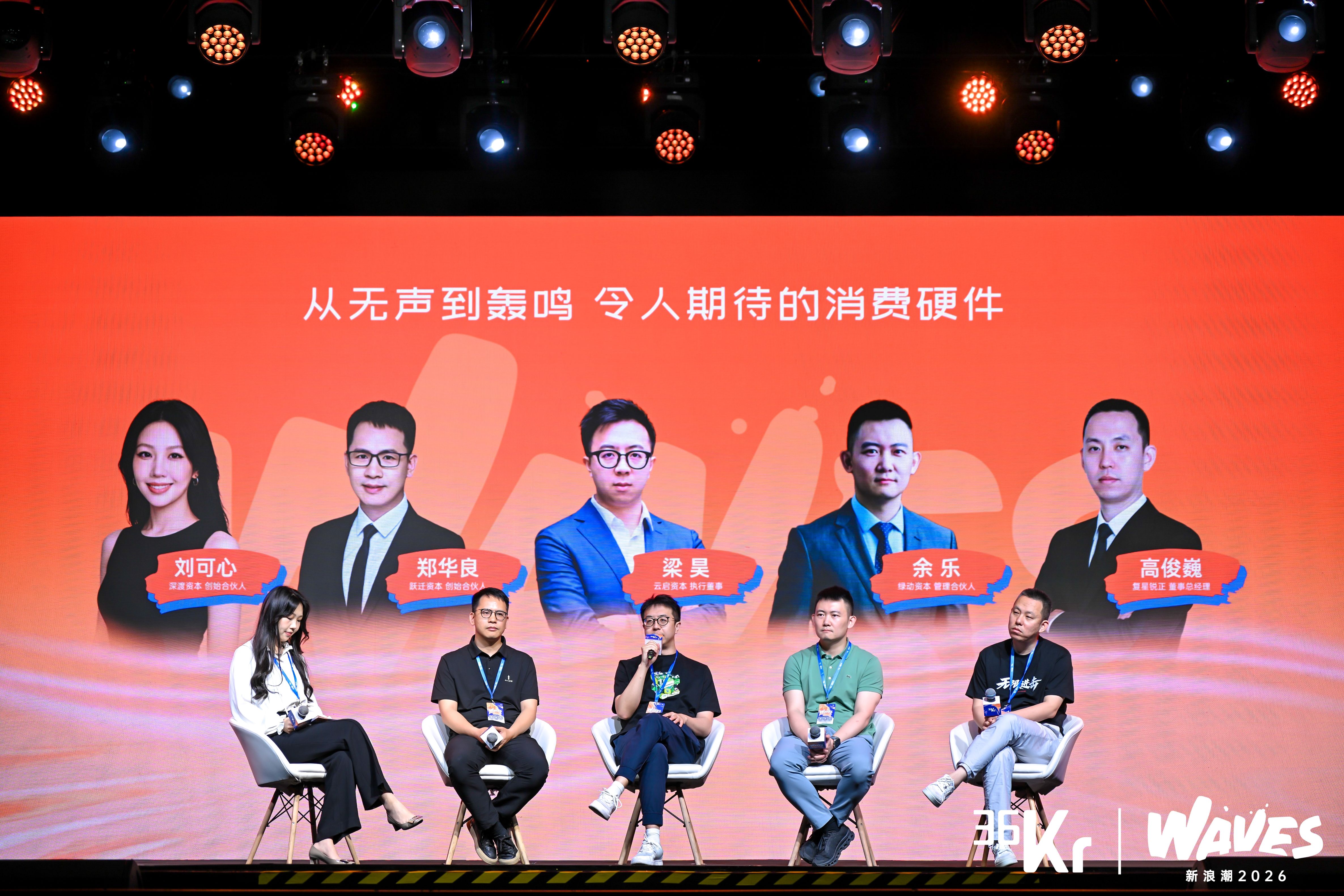
Liu Kexin | Founding Partner of Shendu Capital (Host)
Zheng Hualiang | Founding Partner of Yueqian Capital
Liang Hao | Executive Director of Yunqi Capital
Yu Le | Managing Partner of Green Capital
Gao Junwei | Managing Director of Fosun RZ Capital
Liu Kexin: Hello, friends on-site and online! I'm Liu Kexin from Shendu Capital. The theme of today's roundtable is "From Obscurity to Prominence: Anticipated Consumer Hardware". I'll start today's discussion with three landmark events.
The first is Oura, which just announced its IPO last month with a valuation of over $11 billion. The second is the wearable device WHOOP. I believe many of you here may have worn it. Its valuation also exceeds $10 billion, and it is currently launching an IPO. The third is the Chinese company Insta360, which went public on the Science and Technology Innovation Board of the A-share market in June last year. Its overall increase reached 285%, and its market value reached about 70 billion RMB. These three landmark events have overall revitalized the relatively dull consumer hardware financing environment in the primary market last year.
The core question I want to discuss with you today is: This wave of AI has also restarted the valuation logic of consumer hardware. So, is the valuation change brought about by this wave of AI a real revaluation of value, or is there a certain bubble?
There are four guests on stage today, from different backgrounds. Let's first invite each of you to briefly introduce your fund, investment direction, past portfolio, and also mention a relatively impressive hardware project in the past year or so.
Zheng Hualiang: Hello! I'm Zheng Hualiang, the founder of Yueqian Capital. Our institution is a new one. We got our license in the second half of last year and were lucky enough to join the game.
We mainly invest in smart hardware now, focusing on the top smart hardware companies in various niche markets. Our logic is that China has excellent AI model capabilities and supply chain capabilities, so the top companies in China have a high probability of becoming the global leaders in the future. This is the core logic and preference of our investment.
Since our company is relatively new, the number of projects we've completed is not large. But we've invested in a project called Rokid, which makes AI glasses. In terms of the shipment volume of AI glasses with displays, they should already be the global leader because the shipment volume of Meta's AI glasses with displays is currently less than theirs. We took their products to many overseas users for experience, including many users who had already tried Meta glasses, and the feedback was quite impressive.
Although you may have different views on smart glasses, or the industry has not yet reached a high consensus, from the perspective of investors, we are very pleased to see that in some large categories, Chinese entrepreneurs have already made world-class excellent products and can compete with global giants like Meta and Apple on the same stage. This is really gratifying.
Liang Hao: Hello! I'm Liang Hao from Yunqi Capital. Yunqi Capital was established in 2014. Since its establishment, we've been focusing on two major directions. One is the cutting-edge technology represented by AI, and the other is the hard technology investment around domestic industrial upgrading. In the first half of this year, two of our early-invested AI representative companies went public, namely MiniMax and GroupCore Technology.
Today's theme focuses more on consumer hardware. Actually, this is also a direction we've been deploying in the early stage. About ten years ago, we invested in an American company called Eight Sleep, which is a very popular smart sleep unicorn company in the European and American markets in the past two years. In the past one or two years, we've also invested in Yuanding Smart, the global leading enterprise in pool robots.
I'm very happy to see many old friends today and look forward to sharing our thoughts on consumer hardware with you. Thank you!
Liu Kexin: Many people know about Eight Sleep, but actually, Yunqi Capital was the earliest Chinese investor in Eight Sleep. This is actually a little-known fact.
Next, let's invite Mr. Yu from Green Capital.
Yu Le: Hello! I'm Yu Le from Green Capital. As the name suggests, we are an institution that invests in green technology. We were established in 2016, and this year is exactly our tenth anniversary.
We've divided our definition of green technology into three layers. The bottom layer is energy. All energy is the foundation of the entire green technology. The middle layer is AI, which is an enabler to improve the productivity of the entire society and industry. The upper layer is the green and sustainable future life, which is also in line with today's theme. It includes a series of consumer hardware that can make our lives better. We've defined green technology in these three layers and then look for different investment opportunities within them.
From the perspective of Green Capital's positioning, we are not actually a consumer hardware or consumer-native investment institution. We've been deeply involved in the industrial technology field for a long time, so we've formed a relatively unique judgment perspective, and our investment layout focuses on the upstream of the industrial chain. We've invested in some upstream projects before, such as display material companies. We've found that many things originally used in industrial scenarios and ToB scenarios are gradually being implemented in ToC consumer scenarios under this year's wave. This is also our differentiated investment observation logic.
Liu Kexin: Thank you, Mr. Yu! We'll give you the first question to answer later. Next, let's invite Mr. Gao from Fosun RZ Capital.
Gao Junwei: Good morning, friends on-site and online! I'm Gao Junwei from Fosun RZ Capital. Fosun RZ Capital was established in 2013 and has been focusing on three major investment tracks: global hard technology, new consumption, and going global. I personally focus on the layout around AI, deeply involved in AI software and hardware, and also continue to be optimistic about the implementation opportunities in the field of embodied intelligence.
In the consumer and consumer electronics track, we've already had many representative layouts. The overseas pool robot company Yuanding Smart is one of our investment projects. In the AI field, we've invested in Vbot, the first consumer-grade robot dog company in China.
In addition, I've also led the investment in several embodied intelligence companies, including Qianxun Smart, Daxiao Robot, and Jijia Vision. Just now, Kexin also mentioned that there is a relatively strong investment trend in the current track. In my opinion, it is the comprehensive spillover of AI technology capabilities. Relying on the iteration of AI technology, a large number of new implementation opportunities for consumer electronics have emerged. I'm also very much looking forward to having in-depth discussions with you later.
Fosun RZ Capital's overall investment idea is still to invest in some more early-stage, cutting-edge, and excellent founders. We still quite agree with the investment logic of investing in people and a relatively grand track. This is also highly consistent with my past investment experience in the Internet field. So, if you have some innovative ideas or projects, you're welcome to communicate with us at any time after the meeting.
Liu Kexin: Thank you, Mr. Gao! I'll also briefly introduce our Shendu Capital here. Shendu Capital is an FA with an old team and a new brand established in 2022. We also have our own early-stage fund. I and the founding team have been in the VC FA market for about ten years, and our team has also been working stably together for about seven or eight years.
Shendu is positioned as a comprehensive boutique investment bank. Last year, we completed more than 40 deals in the directions of AI software and hardware, embodied intelligence, and hard technology, covering domestic and overseas leading start-ups. From January 1st to the end of May 2026 this year, we've already disclosed more than 20 deals and been very active in the market.
Next, for the first question, let's make a judgment first: This wave of AI hardware trend is essentially a high-level integration of hard technology and consumer hardware. For example, AI glasses require optical waveguides and Micro LEDs, and recording pens may require NPU on the edge side or even IMU. Smart rings, which were also quite popular in the market last year, also need some ultra-low-power storage. These hard technology components and categories that used to only appear in ToB industrial scenarios are now increasingly entering C-end consumer scenarios.
Combined with the past experiences of the four guests, including some hard technology investment portfolios, what trends have you seen brought about by this wave of consumer hardware?
Yu Le: Thank you, host! I'll share our own investment understanding in this area. To be honest, each institution has its own expertise and judgment logic for the industry. So, we still adhere to investing in targets that we can understand and are within our own cognitive scope.
Our characteristic is that instead of betting on which brand will succeed in the future, I'm more willing to bet on what kind of upstream will benefit when this category succeeds. This logic gives us more certainty and security. So, we've invested in solid-state batteries, silicon-carbon anode battery materials, and OLED display materials in the past. The core logic is the same: it's difficult for us to judge which brand of mobile phones, tablets, and other terminals will win, but no matter which brand succeeds, the upstream will definitely benefit. In the era of AI consumer hardware, we'll also continue to deploy according to this logic.
Second, the emergence of any investment opportunity is that new technologies bring new demands, and new demands drive new supplies upstream. So, for the upstream of traditional manufacturing, this wave of AI provides quite a lot of demands, such as edge-side chips, materials, optical waveguides, or some manufacturing methods like 3D printing. These are the areas we're more concerned about.
Zheng Hualiang: We're different from Mr. Yu and his team. We don't like to invest in components. We prefer to invest in terminals because smart hardware has an advantage in that it is naturally a global market. Once it's made and becomes the global leader, its revenue scale and volume will be very large, and the return multiple for us will also be very large.
Back to the previous topic, in reality, we've seen a large number of consumer products that are doing well now. They were originally industrial products or large medical products. For example, AI glasses were first widely used in industrial scenarios. They were very heavy, with a big helmet and a pair of glasses. We also saw the popularity of small desktop CNC machines last year, and their crowdfunding data on Kickstarter was also very good. Recently, we're conducting due diligence on a medical project. The original equipment in the hospital was very large, but now the company has made it into a small device the size of a palm, and it can produce the same data level. That is, the data measured by the large device and the small device is highly similar. In this way, you can use it at home for daily monitoring, which is a very beneficial thing. We've seen that many companies do have this characteristic.
Gao Junwei: Next, I'll share my views on this track. As mentioned earlier, the development opportunity of this round of consumer hardware and AI hardware stems from the spillover of AI technology capabilities. Let's review the consumer hardware categories with the best commercial performance in the past ten years. In my opinion, electric vehicles are undoubtedly the most representative product. Its core advantage is that the three major links of perception, decision-making, and execution have been fully or partially integrated. Consumer hardware is essentially the implementation of specialized technologies. We rarely see people doing specialized technology research and development for a certain consumer hardware. Generally, after the technology matures, it is applied to consumer hardware.
We can further analyze the reasons for the formation of this round of industry opportunities: The AI large model technology is becoming increasingly mature, the collaborative system of cloud and edge computing power is gradually being improved, the chip cost is decreasing, and the small models in the 1B field can also achieve good operating results. At the same time, each module of perception, decision-making, and execution is continuously being upgraded, which also prompts people to make the decision to catch up with this trend. Looking back at how to view this market, we've seen many projects and talked with founders. I think the industry should focus more on how to deeply integrate consumers' real needs with their own algorithm core, service architecture design, and software system design. At present, many consumer hardware products overemphasize the polishing of appearance and the first visual experience.
Someone also mentioned earlier that smart glasses have recently seen an investment boom and a continuous increase in shipment volume. If you observe the smart glasses industry chain for a long time, it's not difficult to find that there has been no fundamental change in the upstream and downstream supply chains of the industry since 2022. Objectively speaking, the core technologies such as optical waveguides and chips have not made significant progress either. People are mostly making trade-offs and adjustments on the basis of existing technologies. For example, they don't use ink sheets anymore, or they don't pursue such high-nit displays. They give up some things and add some smart hardware solutions, as well as some model and software capabilities, to make the product work. This is the big opportunity in this wave.
Recently, I've made a horizontal comparison of Plaud's related products. I've also noticed that companies like DingTalk and Anker have launched similar hardware, and I've also conducted research on many consumers. Consumers' decision-making points for purchasing are often very clear. For example, many users choose Plaud products because, on the one hand, the body is thin and light, and more importantly, it is equipped with tens of thousands of available templates. This shows that the ultimate competitiveness of a product will be anchored in supporting services, continuously iterated functions, and long-term software operation and maintenance and upgrade capabilities. This is also what new-generation entrepreneurs need to think about: To make a product popular in the market, relying solely on brand co-branding and appearance design optimization is far from enough. This view needs to be changed.
Liu Kexin: Thank you, Mr. Gao! The second question just echoes what you said. Next, let's invite Mr. Liang.
Liang Hao: Actually, before this wave of large models, our attention to the hardware field was not as intensive as it is now. At that time, the opportunities were more in brand capabilities and overall operation capabilities. But this wave of opportunities has emerged very quickly. For example, I heard that there were more than 8,000 companies participating in this year's CES, and about one-third of them were Chinese start-ups. The reason why Chinese entrepreneurs can quickly seize this wave of opportunities is largely due to the upgrading of the domestic industrial chain over the years, including the new energy and semiconductor fields. Many capabilities come from the accumulation of the first wave of the Apple industrial chain. Now, the Apple industrial chain still has tens of billions of RMB in annual revenue in China, and many supply chain capabilities have also been gradually upgraded from this system.
At the same time, many inference capabilities of AI hardware are not on the edge side but on the cloud side. This also benefits from the maturity of large-scale cloud computing providers and cloud resources in China in the past 10 to 15 years.
Second, I think we should actually thank AI. Before the emergence of AI, the consumer electronics industry had a relatively obvious cycle. Mobile phones are usually replaced every three or four years. After mobile phones, it might be TWS earphones, and then smartwatches. For a long time after that, there were no real new categories. But you can clearly see that 2023 and 2024 should normally be off-peak years for consumer electronics, but since 2023, the performance of all consumer electronics, whether it's brand manufacturers or suppliers, has been very good. The important reason behind this is that AI has brought new demands and solved some problems that couldn't be solved in the past.
So, from our perspective, we're also deploying in two directions at the same time. On the one hand, we're paying attention to leading companies with AI product definition capabilities. I think this is the rarest ability. On the other hand, we're also paying attention to some upstream supply chain opportunities with relatively high certainty. Overall, we'll deploy in both the technology and brand directions at the same time.
Liu Kexin: To summarize, it's still the final demand that drives the front-end supply chain. According to our observation, this wave of AI hardware investment boom was relatively rare in that it was first initiated by China. In the United States, when people talk about hardware, they mostly refer to semiconductors and humanoid robots. But in China, consumer technology is the first thing that comes to people's minds.
Mr. Gao mentioned Plaud earlier. This is a very good case. It probably started on Kickstarter in 2023 and just