Players like Green Harmon are trapped in a price war.
Introduction: Currently, harmonic reducers are experiencing a stark contrast. On one hand, the popularity of the market is soaring. Laifu Harmonic has passed the Hong Kong Stock Exchange's hearing, and Green Harmonic has caught the eye of the "internet celebrity stock god." On the other hand, the price war is intensifying with no sign of ending. Amid this mix of heat and cold, a crucial positioning race that will determine the industry landscape is underway.
Harmonic reducers are attracting more and more spotlight and capital attention.
Recently, Laifu Harmonic, firmly holding the "second place" in this market, passed the hearing for listing on the main board of the Hong Kong Stock Exchange, moving closer to becoming the "first harmonic reducer stock" in the Hong Kong stock market. Not long ago, the mysterious "White-Haired Stock God" Serenity on social media recommended Green Harmonic, the domestic leader, to users. Subsequently, the stock hit a 20% daily limit.
However, beneath this glamorous surface, players are engaged in a fierce price war.
From the data disclosed in Laifu Harmonic's prospectus, one can sense the intensity of this war. From 2023 to 2025, the average price of the company's harmonic reducers was 802 yuan, 724 yuan, and 573 yuan respectively, showing a significant decline.
Interestingly, the soaring market attention and the price war have the same origin: the market's growing optimism about the future of harmonic reducers.
According to statistics from the well - known research institution QY Research, the global market size of harmonic reducers will reach $539 million in 2025 and is expected to skyrocket to $2.539 billion by 2032.
The broad prospects have attracted more capital and players to enter the market, leading to a sudden escalation of price competition.
Amid the coexistence of bright prospects and intense competition, the harmonic reducer industry has entered a brutal positioning competition stage. Companies like Green Harmonic are all trying to secure the most advantageous positions before the next era arrives.
01 The "Attractive" Halo: The Trigger for the Price War
Before the rise of humanoid robots, harmonic reducers were actually quite profitable products, and the players in this market also had a scarce label in the capital market. However, the market did not consider it a "sexy" business.
Take Green Harmonic, the industry leader, as an example. In 2020, the company successfully listed on the Science and Technology Innovation Board, becoming the "first domestic harmonic reducer stock." Before 2023, the company's gross profit margin remained above 40% for a long time, making it a rare high - profit precision manufacturing target in the A - share market.
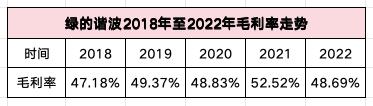
The rise of Green Harmonic is closely related to the narrative of domestic substitution. Since 2013, the company has been launching cheaper products with shorter delivery cycles into the market and successfully overturned the dominance of the Japanese company Harmonic Drive Systems in the domestic harmonic reducer market a few years later.
However, at that time, harmonic reducers were only used in industrial collaborative robots, semiconductor equipment, and small precision instruments, with limited market space. In 2022, the overall domestic market size of harmonic reducers was only 3.26 billion yuan, far from the trillion - scale expectations of industries such as new energy vehicles and AI.
Meanwhile, the valuation logic of institutional investors for players in this market was limited to domestic substitution. Once the substitution was completed, the growth space would quickly shrink.
The turning point came on October 1, 2022. This was Tesla's AI Day, when the prototype of the company's humanoid robot "Optimus" was unveiled. Less than two months later, large models strongly related to embodied intelligence became extremely popular. Capital began to pour into the humanoid robot market.
This also made harmonic reducers "sexy."
Compared with other precision reducers, harmonic reducers have the characteristics of small size, light weight, and high transmission accuracy, and are mainly used in the forearms, wrists, and hands of robots.
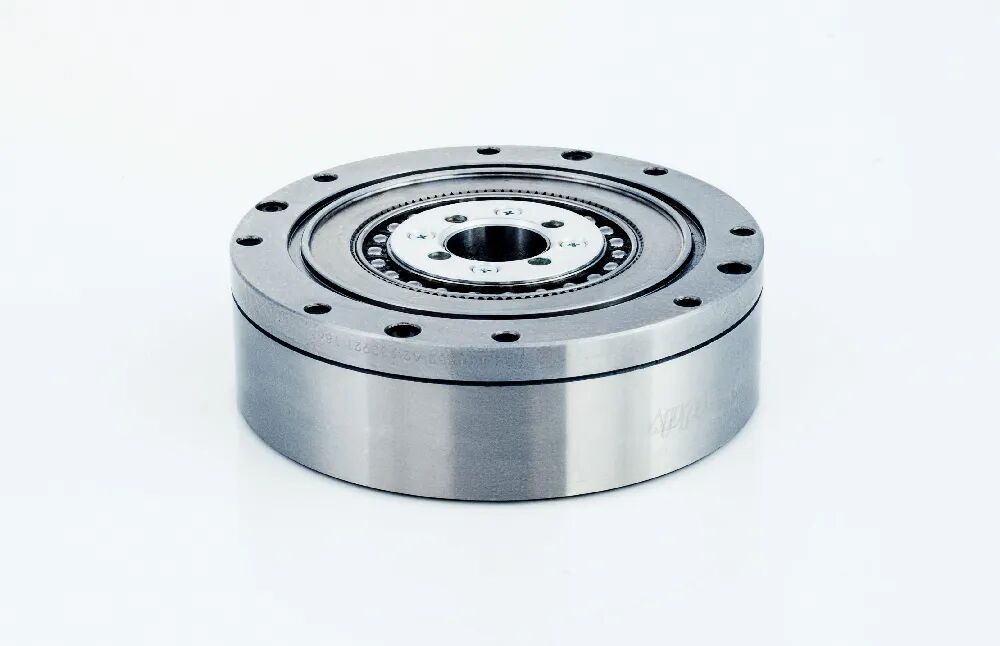
Harmonic reducers of the LCD series under Green Harmonic; Source: Green Harmonic's official website
A traditional industrial robot only needs to be equipped with 3 to 6 sets of harmonic reducers, while a humanoid robot requires 14 to 20 sets.
More importantly, humanoid robots have an incremental expectation that other businesses or products can hardly match.
In 2025, the global shipment of humanoid robots will be about 18,000 units. In the next 25 years, the number will experience exponential growth. Morgan Stanley predicts that by 2050, the global stock of humanoid robots will reach 1 billion units.
It is not difficult to see that the development of humanoid robots will break through the ceiling of harmonic reducers, providing a long - term incremental story that can ignite capital enthusiasm.
Naturally, this has attracted many players to enter the market or increase their investment, such as Siling Co., Ltd., a well - known domestic automotive bearing enterprise, and Fengli Intelligent, the leader in the small - module gear industry.
The influx of new players has naturally intensified the competition. Laifu Harmonic admitted in its prospectus that the company has made strategic price adjustments to its harmonic reducers to gain a larger market share.
Green Harmonic, the industry leader, has also been affected by the price war. According to Bernstein's statistics, in 2017, the average price of the company's harmonic reducers was 1,900 yuan, and by 2024, it had dropped to 1,100 yuan.
Based on the data disclosed in institutional research reports and company prospectuses, in the context of the price war, the fronts of various players are intertwined, with each side attacking and defending.
Taking Green Harmonic as an example again, in 2019, its market share of domestic harmonic reducers was 33%. By 2024, it had dropped to 25%, and last year it rebounded to 27.5%.
02 The Price War Will Become the Norm. How Long Is the Critical Positioning Period Left?
In the foreseeable future, the price war will continue. Soochow Securities said in a research report that there is still significant room for the price of harmonic reducers to decline in the future.
In this context, there are two paths for companies like Green Harmonic. One is to target the high - end market; the other is to firmly bind to humanoid robots.
Targeting the high - end market means entering the market with higher product unit prices.
Currently, this market is still dominated by the Japanese company Harmonic Drive Systems. Market data shows that the unit price of the company's customized or micro - harmonic reducers can reach 7,000 to 8,000 yuan.
However, the space in this market is not very large. According to Laifu Harmonic's prospectus, in 2025, Harmonic Drive Systems' market share in the domestic harmonic reducer market was only 4.4%, far behind Laifu Harmonic (21.4%) and Green Harmonic (27.5%).

In Laifu Harmonic's prospectus, the name of Harmonic Drive Systems is not directly mentioned, but is replaced by "Company D"; Source: Laifu Harmonic's prospectus
It is true that Harmonic Drive Systems' products have a relatively high unit price. However, even if companies like Green Harmonic capture all of its high - end market share, the market is not large enough to satisfy all players.
In terms of revenue, in 2025, Harmonic Drive Systems' revenue from harmonic reducers was 114 million yuan. In the same period, Laifu Harmonic had a net loss of nearly 171 million yuan.
Entering the overseas market also belongs to targeting the high - end market to some extent. Laifu Harmonic said in its prospectus that overseas customers are less price - sensitive, which helps the company improve its gross profit margin.
However, the overseas market is still dominated by Japanese companies such as Harmonic Drive Systems. Domestic players need a long time to complete reliability and lifespan certifications. At the same time, a large amount of capital is required in the early stage of going overseas, such as production line construction and team building. In other words, while going overseas is appealing, the cost is high, and it is hard to say when it will contribute positive profits.
However, some players have established close relationships with overseas leading customers, such as Green Harmonic. In its 2025 annual report, the company said that its harmonic reducer products have achieved mass delivery to international leading robot customers.
It is widely speculated that this "overseas leading customer" is Tesla, and Green Harmonic's products will be used in the Optimus robot. The market also believes that Green Harmonic is the only domestic harmonic reducer enterprise in Tesla's Optimus supply chain.
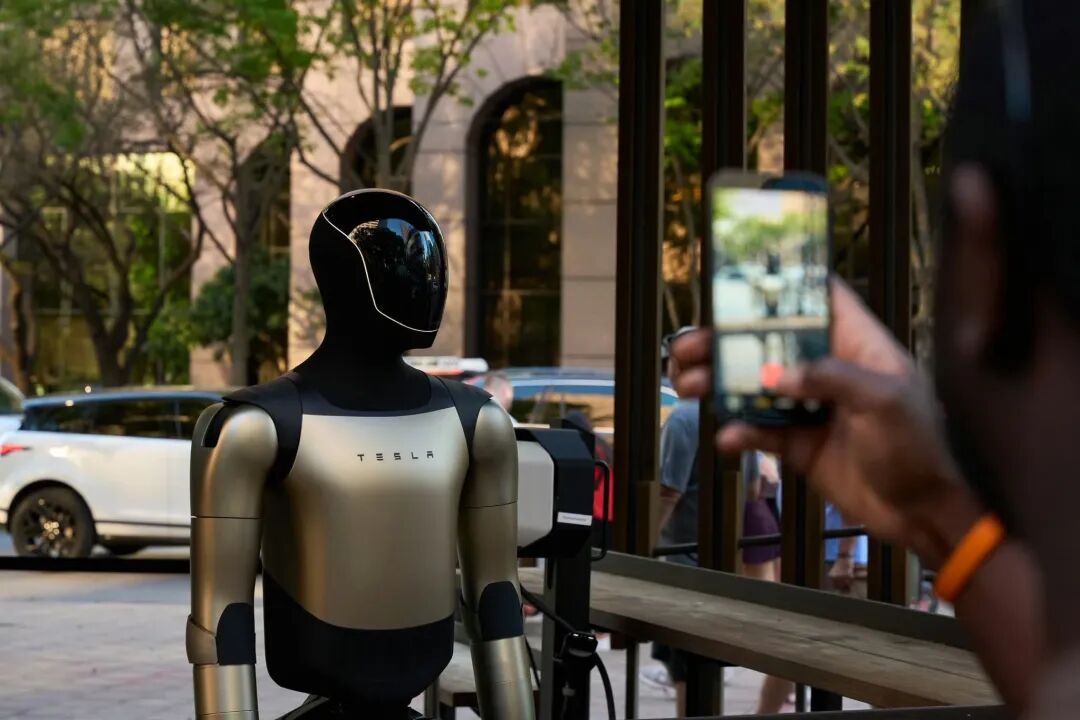
Tesla's Optimus robot; Source: Tesla's official Weibo
It seems that this not only expands overseas customer base but also strengthens the binding with the humanoid robot business. When the latter achieves industrial explosion, the players bound to it can expand the scale effect synchronously, thereby reducing costs and restoring profitability.
So when will humanoid robots really explode?
Currently, the lack of cognitive and decision - making abilities is the biggest obstacle for humanoid robots to enter the consumer market. In March this year, Wang Xingxing, the founder of Unitree, said that he conservatively estimated that it would take two to three years to solve this problem.
This means that before that, companies like Green Harmonic still need to compete for market position through price wars and other means to occupy an advantageous position when humanoid robots truly explode.
It is certain that only a few players will ultimately be able to gain a foothold. At present, the domestic harmonic reducer market has shown a relatively concentrated trend.
In 2025, the shipment of the top five players in the industry accounted for 75.8% of the total market.
Players who have not yet entered the top - tier will naturally not easily give up this historical opportunity presented by humanoid robots. They are very likely to break through the market through more aggressive price wars. After all, this strategy of trading price for volume has already been proven effective in the market.
None of the companies like Green Harmonic can afford to relax.
This article is from the WeChat official account "Alpha Factory Research Institute", author: Si Che. It is reprinted by 36Kr with permission.