The charging industry is bidding farewell to quantity-based competition, with user experience emerging as a brand-new evaluation criterion.
Analysys: The rapid leap of China's new energy vehicle industry is pushing the public charging service industry to a crucial development crossroads. Looking back at the development history of China's public charging service, the industry has gone through a long process of exploration, growth, and explosion. The State Council issued a document requiring the construction of a high-quality charging system, and China's public charging service market officially entered the application maturity stage in 2025.
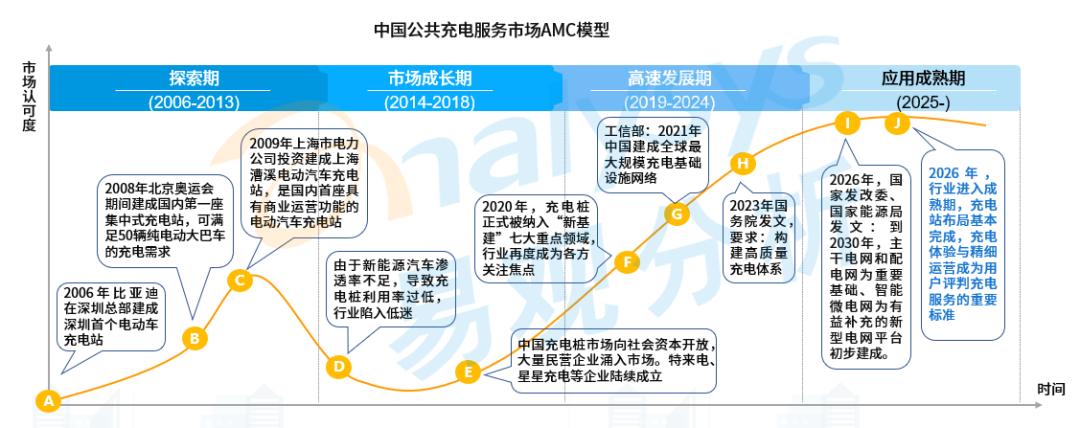
Against this development background, the supply-demand relationship of public charging infrastructure has undergone a profound transformation. Data shows that as of March 2026, the number of public charging guns in China reached 4.863 million. Judging from the ratio of the increase in charging piles to vehicles, which reflects the supply-demand balance, this indicator has been rapidly optimized from 1:3.7 in 2021, 1:2.7 in 2022, 1:2.8 in 2023, 1:2.7 in 2024 to 1:1.9 in 2025, and reached 1:1.4 from January to March 2026. This indicates that the construction of China's public charging infrastructure has basically met the rapid development of new energy vehicles in terms of total volume, and the large-scale expansion on the supply side has basically been completed.
However, the abundance of the total supply has not brought about a simultaneous improvement in users' charging experience. Under the long-term inertia of blind expansion in the industry, the traditional evaluation system often uses the number of connected charging piles and guns as the only yardstick to measure the development of enterprises and the industry. This "quantity-only theory" evaluation system has led to serious industry imbalances, pushing the industry into a whirlpool of extensive competition that emphasizes scale over service. To adapt to the trend of the public charging market's transformation from "scale expansion" to "quality improvement", the industry evaluation standards urgently need to be reconstructed. A new evaluation standard centered on users' charging service experience, covering the three levels of the industry, enterprises, and users, is becoming a new guide to lead the high-quality development of public charging services.
I. Market Landscape: Characteristics and Market Differentiation of Three Types of Operators
In the process of the industry moving towards maturity and the reconstruction of new standards, the competitive landscape of China's public charging service market has also shown a clear division of camps. Currently, the core players in the market are mainly divided into three categories. They are state-owned and central enterprise operators, with representative manufacturers including State Grid (e-Charging), China Southern Power Grid (Shunyi Charging), PetroChina (Kunlun Network Power), and Sinopec (PetroChina Easy Power); vehicle manufacturer operators, with representative manufacturers including Tesla, BYD, XPeng, Li Auto, etc.; and third-party operators, including heavy-asset operators represented by TELD, Star Charge, and Wanma Aichong, as well as light-asset operators represented by Didi Charging (formerly Xiaoju Charging), Yunkuai Charge, Xindiantu, and Kuai Charge. They have their own characteristics in asset models, network layouts, and operation strategies.
In terms of market share performance, the head effect is very significant. As of March 2026, the number of public charging guns in China's public charging market had reached 4.863 million. Among them, the top ten operators in terms of the number of public charging guns owned a total of 2.45 million charging guns, accounting for about 50% of the total. The top three were TELD (480,000), Star Charge (380,000), and Didi Charging (370,000). In terms of charging volume, the total annual charging volume of China's public charging market (excluding dedicated charging) in 2025 was about 57.35 billion kWh, showing an increasing trend every month. In the market share of public charging volume as of March 2026, Didi Charging accounted for more than 34%, followed by Yunkuai Charge, Star Charge, TELD, and Xindiantu. This highly concentrated market landscape puts forward higher requirements for enterprises' competition in terms of efficiency and service.
II. Industry Level: Standardized Transformation from "Scale Expansion" to "Quality Improvement"
From the industry level, the traditional "quantity war" has had a significant negative impact on the healthy development of the public charging industry. Under the traditional evaluation standard centered on the number of charging guns, the industry evaluation system is seriously imbalanced, misleading the development direction of enterprises and causing serious waste of resources. Due to the lack of reasonable planning and refined operation guidance, a large number of inefficient and "zombie" charging piles flood the market, not only occupying precious land and power grid capacity resources but also making the overall development of the industry appear rough and disorderly.
The reconstructed industry-level evaluation standard focuses on refined and high-quality development. The new standard no longer simply counts the physical number of charging piles but pays more attention to the optimization of infrastructure layout, equipment operation and maintenance guarantee, standardization and intelligent upgrading of services, and transparency of charging fees. In the maturity stage of the industry, the key to evaluating the energy replenishment network of a region or an operator lies in whether it can promote the standardized and refined development of the industry, effectively avoid resource waste, and guide the overall industry towards the track of sustainable development.
The high-quality development at the industry level also requires the in-depth integration of the energy replenishment network with the construction of a new power grid. Through digital aggregation and two-way energy interaction, it promotes the transformation of the power grid from "centralized regulation" to "source-grid-load-storage coordination". Among them, the aggregation of massive charging loads and energy storage resources can form a dispatchable virtual power plant, participating in electricity spot, demand response, and carbon trading, opening up new revenue for energy services. At the same time, by upgrading the charging piles to V2G (vehicle-grid interaction) nodes through two-way interfaces, electric vehicles can become mobile energy storage units, discharging electricity to the power grid when the grid load is high, thereby reducing the investment in grid expansion and improving the coordination efficiency of the entire energy industry.
III. Enterprise Level: Refined Deepening from "Quantity-Only Theory" to "Efficiency and Profitability"
From the enterprise level, the traditional evaluation yardstick has pushed enterprises into blind heavy-asset expansion and vicious price wars. In order to gain an advantage in the number of charging guns, enterprises blindly expand their scale but ignore the reliability of equipment, operation and maintenance efficiency, and user experience, resulting in a high equipment failure rate, slow service response, and thus facing huge asset depreciation pressure and profit dilemmas.
Guided by the new standard, the evaluation dimension at the enterprise level has shifted to focus on profitability, single-pile operation efficiency, and core competitiveness. In this process, the average daily number of vehicles charged per charging gun and the ratio of fast charging guns have become two key hard indicators to measure the operation quality of enterprises. The average daily number of vehicles charged per public charging gun directly reflects the operation efficiency and actual utilization intensity of a single pile, determining whether the income of a single pile can cover fixed costs such as depreciation, electricity fees, and operation and maintenance. It is the key for enterprises to get rid of price wars and improve their profit levels. At the same time, this indicator can truly reflect the demand differences in different regions, scenarios, and time periods, guiding enterprises to accurately shut down inefficient piles and increase the density in high-demand areas, realizing the transformation from "emphasizing quantity" to "emphasizing efficiency".
The new standard encourages enterprises in different camps to give full play to their respective advantages. Through refined platform operation, membership subscriptions, joint subsidies, etc., they can upgrade the single "electricity sales" model to a comprehensive service space of "charging + business", adding services such as rest, catering, retail, and maintenance at charging stations to expand the profit boundary.
IV. User Level: Remodeling the Ultimate Value Yardstick with "Real Energy Replenishment Experience"
From the user level, the traditional quantity indicators are completely divorced from users' actual charging feelings. Prominent problems such as frequent equipment failures, slow charging speed, opaque prices, and gasoline vehicles occupying charging spaces that users encounter in actual charging are completely ignored in the traditional "quantity war", resulting in a low level of user satisfaction.
The new standard takes users' charging experience as the ultimate evaluation yardstick, and a survey of 3,000 car owners in the top 30 cities in terms of new energy vehicle ownership conducted by Analysys provides detailed data support for the evaluation standard at the user level:
Firstly, charging speed and efficiency. More than 70% of new energy vehicle owners will give priority to fast charging guns when charging, indicating that car owners' demand for fast charging has become normalized. Shortening the charging time and popularizing high-power super charging to compress the energy replenishment time to the minute level is the core element to meet users' fragmented energy replenishment needs and improve users' time efficiency.
Secondly, charging stability and safety. Users expect operators to ensure the stability of power supply and facilities, eliminate equipment problems such as gun tripping and power outages, and ensure the certainty of energy replenishment. At the same time, safety protection needs to move from "basic qualification" to "full-dimensional protection". Not only should the equipment itself be reliable, but also the payment and data encryption security on the network side, as well as the personal safety of car owners such as site monitoring and lighting, should be taken into account to jointly build users' trust in safety value.
Thirdly, economy and convenience. Reducing charging prices and improving the APP operation experience are the most urgent expectations of car owners. Car owners expect operators to reduce the actual electricity cost through refined operation methods such as membership systems and package systems (such as monthly cards, annual cards, and fast charging packages). In terms of APP use, users expect the operation experience to be further optimized to help them quickly locate the most affordable charging stations and improve the supporting service information of charging stations and their surroundings to eliminate worries during the process of finding charging piles and waiting for charging.
Under these user-level evaluation indicators, the recognition and satisfaction of mainstream brands in the market also show a clear echelon. The survey shows that Didi Charging, TELD, and Star Charge are the top three brands with higher user brand recognition, accounting for 44.1%, 33.7%, and 28.3% respectively. In the comprehensive score of user satisfaction (including overall satisfaction, charging pile coverage, charging experience, charging speed, charging safety, etc.), Didi Charging, TELD, and Yunkuai Charge rank among the top three. In terms of user recommendation, Didi Charging, TELD, and Star Charge occupy the top three positions. This indicates that enterprises that can effectively solve users' pain points and provide efficient and stable services have taken the lead in the new evaluation system at the user level.
The New Standard Leads the New Future of Public Charging
China's public charging service market has bid farewell to the old era of blindly enclosing land and building charging piles. The newly reconstructed evaluation standard is depicting a clear development blueprint for the entire industry from three dimensions: the standardized and high-quality development at the industry level, the improvement of operation efficiency and profitability at the enterprise level, and the energy replenishment experience and service satisfaction at the user level.
Public charging service operators must follow this trend and completely shift their development focus from scale expansion to refined operation. On the basis of ensuring the safety and stability of equipment, they should improve charging efficiency, innovate business models, and thus achieve real high-quality development in the stock game of the maturity stage.
This article is from the WeChat official account "Analysys Digital Science" (ID: enfodesk), author: Analysys Data. It is published by 36Kr with authorization.