Aiming for 12 million units in exports, China's auto industry faces its coming-of-age test
"The bourgeoisie, by the rapid improvement of all instruments of production, by the immensely facilitated means of communication, draws all, even the most barbarian, nations into civilization. The cheap prices of its commodities are the heavy artillery with which it batters down all Chinese walls, with which it forces the barbarians' intensely obstinate hatred of foreigners to capitulate."
One hundred and seventy-eight years ago, Marx and Engels co-authored "The Communist Manifesto", revealing the core secret of modern capitalism sweeping across the globe: Commodities are the invisible heavy artillery for European and American powers to conquer the world. Relying on the low - cost commodities empowered by industrialization, European and American powers broke through geographical constraints, reconstructed global supply and demand, and built a "center - periphery" global value chain that has been stable for hundreds of years. They also used the discourse system of "free trade" to cloak their monopoly hegemony with the guise of justice.
Looking back at the past three hundred years of modern history, European and American powers relied on this "commodity heavy artillery" to blast open the doors of countries in Asia, Africa, and Latin America, including China. However, just as it was then, now the subject holding the muzzle of the global industrial game has completed a historical change.
According to the latest data from the China Association of Automobile Manufacturers, this magnificent industrial change is recorded. In May this year, China exported 930,000 vehicles in a single month, a year - on - year surge of 68.7%. For two consecutive months, the monthly export volume has remained at a high level of 900,000 vehicles. From January to May, the cumulative domestic automobile exports reached 4.059 million vehicles, a year - on - year increase of as high as 63%. The momentum of going global is extremely fierce.
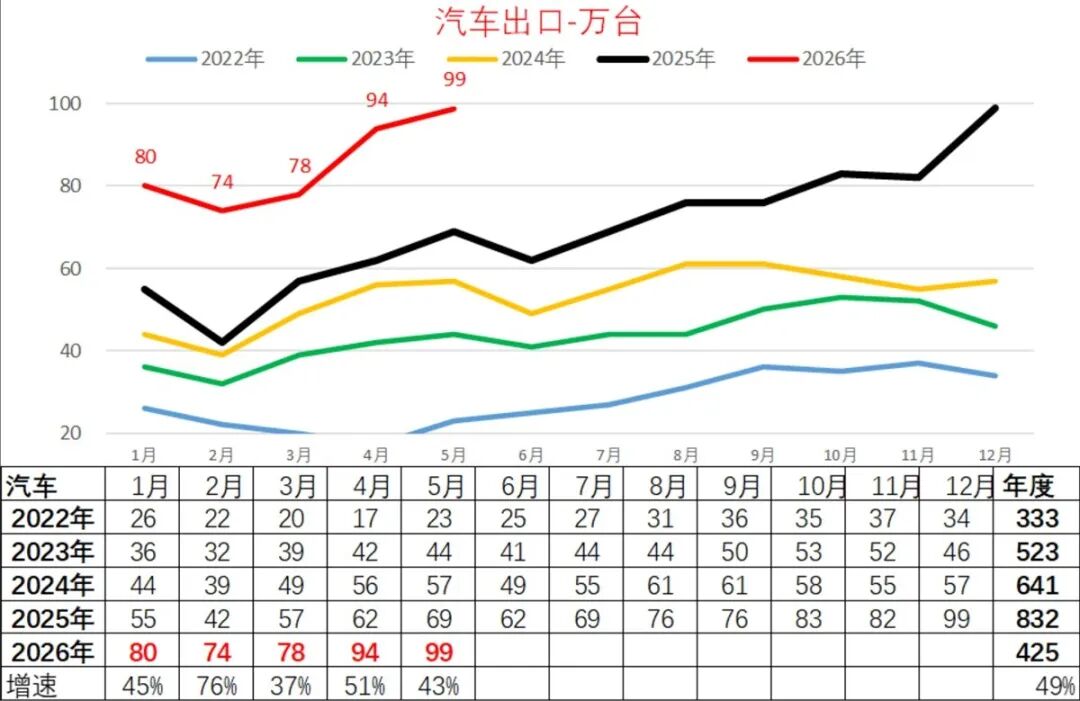
Note! This picture is taken from an individual analysis article by Cui Dongshu, the secretary - general of the Passenger Car Association. It uses the broad concept of vehicle exports, which may include the conversion of KD parts, etc.
Relying on strong production capacity, abundant orders, and increasingly improved overseas channels, the industry predicts that the export volume of Chinese automobiles in the first half of this year will approach 5 million vehicles, and the total annual export volume is expected to exceed 10 million vehicles for the first time, setting a new historical benchmark. Cui Dongshu, the secretary - general of the Passenger Car Association, makes an even more optimistic judgment. Combining with the cyclical law of the industry's production and sales volume increase in the second half of the year, the export scale of Chinese automobiles is expected to reach 12 million vehicles in 2026, opening a new era of going global.
This mighty wave of going global has injected great vitality into the domestic automobile industry, which is in the cold winter of domestic demand. In the first five months of this year, domestic automobile sales declined by 19.5% year - on - year. The rapid growth of the overseas market has offset the pressure of the downward domestic cycle and stabilized the business foundation of enterprises.
However, beneath the prosperity, undercurrents are surging.
As the "commodity heavy artillery" of Made in China gallops across the globe, gradually squeezing the living space of established European and American automobile enterprises, the century - old trade pattern has suddenly loosened. A profound era - related proposition follows - Can the free - trade order dominated by Europe and America in the past continue?
When the global "center - periphery" pattern is completely reversed, established industrial powers will inevitably break the rules, set up barriers, and launch all - round game counterattacks in the face of the reverse breakthrough of emerging economies.
01
Exports Can Buy Time
But It's Not the Real Solution to the Problem
To understand the profound meaning of the overseas export of tens of millions of vehicles, we must first clarify the essence of the industry: The automobile is the most advanced terminal product with the longest industrial chain and the widest range of linked fields in the modern industrial system. The birth of a complete vehicle involves tens of thousands of parts and spans many categories such as heavy industry, chemical industry, electronics, and intelligent algorithms.
Today, the absolute advantage of Chinese automobiles galloping overseas comes from the in - depth accumulation of the entire industrial chain. From the intensive processing of core lithium - battery minerals, to the independent iteration of battery materials and cell manufacturing, and then to the global new - energy map built by BYD and CATL, China's new - energy automobile industry has built an independent and controllable entire industrial chain system. After the tempering of the white - hot competition in the domestic market, the production efficiency and cost control of the entire industrial chain have reached the global top level.
In 2026, the domestic automobile retail market declined by nearly 20% year - on - year. Against this background, the overseas export of tens of millions of vehicles has become a strategic buffer zone to support the domestic manufacturing industry and a flood - discharge channel to relieve the production - capacity pressure of the entire industrial chain. Without a large amount of external demand to absorb the production, the capital risk of the industrial chain will spread and ferment, and millions of jobs in the upstream and downstream may be under chain pressure.
However, we must be soberly self - aware that the current unbalanced pattern of "weak domestic demand and strong external demand" is breeding hidden development misunderstandings. At present, the domestic residents' consumption confidence is weak. On the premise that the shortcoming of domestic demand has not been fundamentally cured, the industry's dependence on the overseas market continues to deepen, which easily breeds the cognitive illusion that "external demand can permanently offset the weakness of domestic demand". It should be noted that every large - scale commodity export is a reconstruction and impact on the local industries of the importing countries. The larger the export scale, the more intense the resistance and counter - balance of global local industries will be.
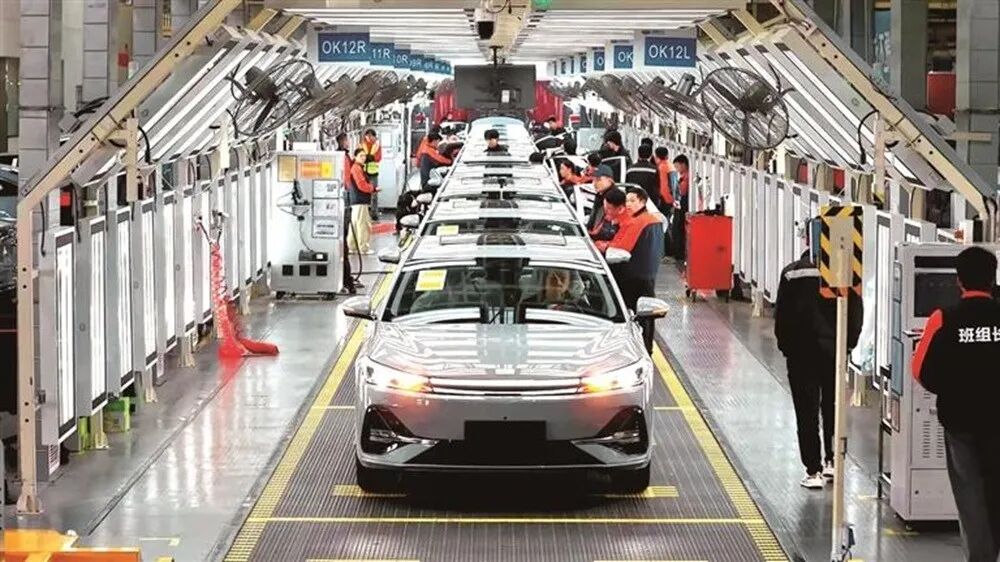
Meanwhile, the unbalanced structural distribution of export dividends is becoming increasingly prominent. High - tech new - energy industrial areas such as the Yangtze River Delta, the Pearl River Delta, Chongqing, and Hefei enjoy the full benefits of going global, while the old industrial chains such as heavy industry and casting in traditional fuel - vehicle strongholds are gradually declining. The eye - catching GDP data created by tens of millions of exports cover up the deep - seated problems of regional industrial differentiation and industrial structural imbalance.
On a deeper level, various contradictions are intertwined: How to balance the distribution of export dividends between public and private capital? Does the increase in industrial concentration squeeze the employment space and bargaining power of workers? Does the overly export - oriented policy crowd out the resources for domestic - demand cultivation?
These intertwined structural contradictions are the core bottlenecks that restrict the long - term and healthy development of the industry. Before these deep - seated problems are completely solved in this wave of going global, it is only a strategic window period for domestic industrial transformation and domestic - demand repair, rather than the ultimate answer for sustainable development.
02
Beware of the Siege of Europe and America's "Weaponization of Rules"
The export blueprint of an expected 10 million vehicles annually, with a maximum of 12 million vehicles, has been simplified into a "Made in China wins completely" carnival narrative in the current online public opinion field obsessed with "success studies", while the real risks are rapidly accumulating.
As mentioned above, with its amazing scale, the automobile industry has never been a simple manufacturing industry, but a vital industry related to the rise and fall of a region or a country. Therefore, when China's automobile exports lead the world and the trade volume crosses the critical point, pure commercial trade no longer exists. It will inevitably be upgraded to a game of rules and a confrontation of strength at the national level.
The so - called "free trade" that Europe and America have boasted about for hundreds of years has never been a universal truth. It is just a tool for them to reap benefits when they hold industrial hegemony. When emerging economies shake their monopoly profits, Europe and America will immediately abandon the free - trade narrative, use "security" and "compliance" as excuses, and even create false cards on issues such as "human rights", and use the state machinery to intervene in the market.
Judging from existing experience, compared with conventional tariff barriers, the means of suppressing China's automobile industry by Europe and America are more concealed and thorough. In essence, they package state coercion such as judicial sanctions, financial control, and administrative intervention as a "non - military institutional heavy artillery" to implement an all - round siege on China's automobile exports.
Tariffs and quotas are the most straightforward pre - set barriers. The EU implements a stepped tariff, while the US isolates Chinese complete vehicles from its domestic market. Generalizing the concept of national security is the core means of the US for precise strangulation. The US deliberately magnifies the data attributes of intelligent connected vehicles and uses administrative tools such as foreign investment review and entity lists to distort business competition into a national - security confrontation. Europe focuses on standards and carbon barriers, building a high - walled compliance fence. A series of strict new regulations such as battery passports, full - life - cycle carbon - emission accounting, and supply - chain due diligence are precisely targeted at China's new - energy upstream industrial chain, significantly increasing compliance costs.
Behind the straightforward trade barriers, the undercurrent surging beneath the surface is that the US and Europe are jointly promoting technological and financial decoupling, weaving a global blockade net. The US continues to expand the so - called entity list to suppress Chinese enterprises, colludes with so - called ally countries to cut off the technological channels for Chinese automobile enterprises to expand overseas, and coerces transit markets such as Mexico, Turkey, and ASEAN to set a "threshold for Chinese components" to prevent re - export to avoid risks.
Looking at the entire set of suppression logic of European and American forces, its core is to bypass the WTO multilateral arbitration system and unilaterally rewrite trade rules under the moral guise of "national security and climate justice". This is the inevitable result of the deep binding of monopoly capital and the state machinery: When market means are unable to contain the rise of China's industries, state coercion steps to the forefront.
It should be noted that the risks of going global are not only in developed European and American markets. Although emerging markets such as Southeast Asia and the Middle East are the blue oceans for the growth of Chinese automobiles, most developing economies generally have problems such as weak governance systems and scarce foreign - exchange reserves. As the import scale of Chinese automobiles surges, such countries may introduce policies such as import bans, foreign - exchange controls, and mandatory local production at any time, burying sudden risks for automobile enterprises going global.
In a nutshell, the more fierce the trend of Chinese automobiles going global, the stronger the power to reshape the global inherent industrial pattern. Normalized, multi - level, and all - around trade games have become the long - term background for Chinese automobiles going global.
03
Under the "Muzzle"
What Is the Real Moat?
Marx's theory of the "commodity heavy artillery" reveals the deep - seated core of capitalist globalization - The market has never been a fair exchange in a vacuum, but a concrete extension of national strength and industrial discourse power. When examining the historical leap of the overseas export of tens of millions of vehicles, we should have a dialectical and sober thinking. This breakthrough is a magnificent counter - attack of modern Chinese industry. However, we also need to face up to our shortcomings: Currently, we only hold the "commodity heavy artillery", while our opponents hold the "rule barriers" built by the entire state machinery.
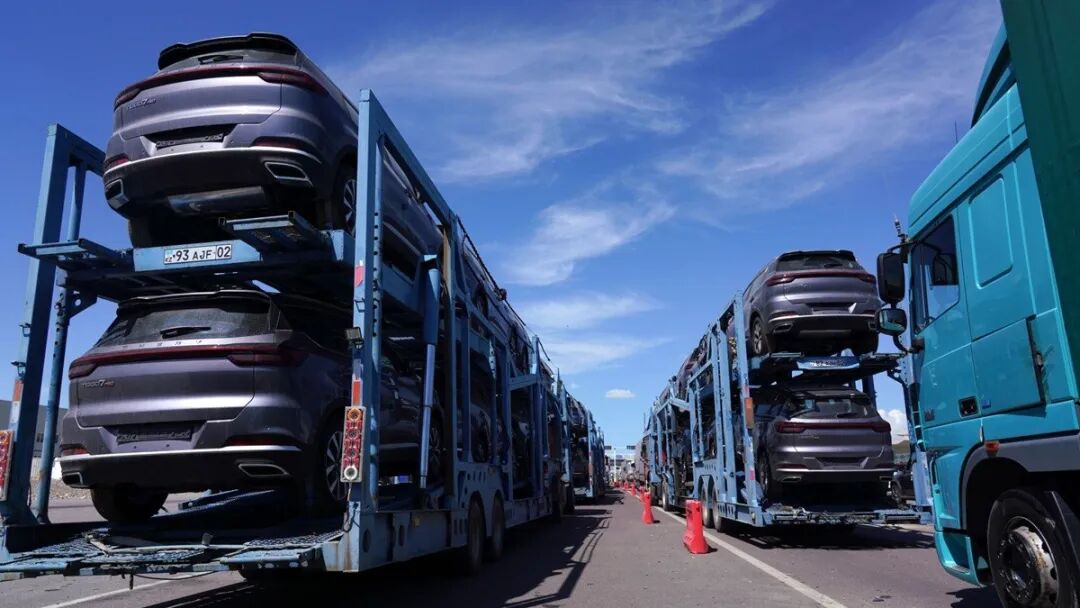
Tariff barriers are just the outpost of the game. The real deep - seated crisis is that after Europe and America define China's automobile industry as a "systematic challenge", they use all - around national power such as technical standards, data security, and financial isolation to implement compression. This means that in the second half of China's automobile going - global journey, the single advantage of cost - performance is no longer sufficient to support long - term breakthrough.
The real industrial moat has never been short - term peak sales, but long - term industrial rooting ability and overall game resilience. In the future, Chinese automobile enterprises need to break out of the shallow logic of "low - price and high - volume", adapt to the interest patterns of different regions, and deeply embed themselves in the local economic fabric through production - capacity localization and supply - chain localization, so as to eliminate the excuses for external siege.
Of course, enterprises' foothold in the market and down - to - earth in - depth operation are the foundation for maintaining achievements. However, relying solely on the single - force breakthrough of market players is difficult to resist the systematic siege at the national level. The "commodity heavy artillery" can break through market barriers, but only by rooting and coexisting, adapting to rules, and binding interests can we maintain the foundation of the market. The export volume of tens of millions of vehicles is the coming - of - age ceremony of Chinese manufacturing - It is the first time we stand in the core arena of global games, breaking through with industrial sharpness and facing the siege with calm and stable strength.
This mighty wave of going global has won us a precious window period for repairing domestic demand and optimizing the structure. We should not only use the penetrating power of the "commodity heavy artillery" to break through the century - old industrial barriers, but also precipitate the breakthrough edge into the industrial tenacity for in - depth global operation. While enterprises are actively involved at the front line, the state needs to provide strong support with institutional opening - up, international - rule games, and the power of Chinese - style rule of law to build a safety barrier for the industry going global, forming a two - way synergy of "enterprises charging forward and the state providing escort".
Marx once said, "Of course, the weapon of criticism cannot replace the criticism by weapons. Material force can only be overthrown by material force. But theory also becomes a material force as soon as it has gripped the masses." As the most representative industrial material force in the contemporary era, the automobile will eventually carry the half - century accumulation of Chinese manufacturing and complete the transformation from scale breakthrough to pattern victory in the wave of global games.
This article is from the WeChat official account "Automobile Commune" (ID: iAUTO2010). The author is Zha Youyin, and the editor is He Zengrong. It is published by 36Kr with authorization.