Brazil's comprehensive reduction of the "Apple Tax" renders its promise of a "global minimum rate" for China practically meaningless
On June 22, 2026, 48 small, medium-sized, and individual Chinese iOS developers jointly submitted a complaint letter to the State Administration for Market Regulation, requesting the establishment of a case to investigate Apple's suspected abuse of market dominance. They also demanded that Apple fulfill the commitment it made in its announcement on March 13 this year - "The App Store commission rate for Chinese developers shall not be higher than the overall rate in other markets."
The reason for this complaint letter is not entirely because of "Apple's high tax" (i.e., in-channel commission), but rather the issue of "third-party distribution and payment channels" that should be included in the concept of "overall rate": On June 18, Apple opened three alternative channels in Brazil that are cheaper than the in-channel commission (IAP), with the lowest rate reaching 5%. However, Chinese developers are still locked into the single IAP channel and do not even have the option of an "alternative channel."
Therefore, Apple's commitment to Chinese developers in March that "the overall rate shall not be higher than that in other markets" has become a mere formality.
I. Panorama of Four Markets: Openness and Institutional Driving Forces
For many years, Apple has always adhered to a rule for iPhone/iPad applications: all applications must be listed on the App Store, and Apple will take a cut (Apple tax) from each digital transaction on the App Store, with a standard rate of 30%. This fee has become one of Apple's highest and most stable sources of income. According to the latest figures released by Apple in June 2026, the digital product revenue and sales of the App Store reached $149 billion in 2025, higher than last year's $131 billion. Apple specifically emphasized that its growth in China is very significant - the settlement amount and sales of the App Store in China have more than doubled in the past six years.
However, with the Epic Games case verdict and the implementation of the EU's Digital Markets Act (DMA), Apple's old model is gradually being changed. Apple has not only reduced the Apple tax rate in some regions but also started to allow developers to distribute applications in new ways and accept payments outside the Apple system.
On June 18, 2026, with the launch of iOS 26.5, Apple implemented a new distribution rule in Brazil: in addition to reducing the IAP rate to 26%/15%, it officially opened in-app third-party payment (21%/10%), external link jump to web payment (15%/10%), and third-party app stores/side-loading channels (5% core technology commission CTC). The plan is exactly the same as the template implemented in Japan at the end of 2025, both following the EU's updated rate framework.
The reason this rule could be implemented is not because Apple suddenly had an epiphany or was generous, but because of the result of the administrative investigation by the Brazilian competition regulatory agency, CADE:
In December 2022, the Mercado Livre Group complained about Apple's dominant position in the iOS device application distribution market. After a long-term investigation, in June 2025, the General Inspector's Office of CADE (SG) recommended convicting Apple. Apple then requested to negotiate an agreement with CADE. Subsequently, CADE decided to suspend the deadline for implementing the interim measures during the negotiation. Finally, in December 2025, the two parties signed an administrative enforcement order (TCC) settlement agreement - which put forward four clear and specific obligations for Apple:
(1) Open alternative app stores (alternative distribution channels): Apple can maintain the Notarization review process, but it must be transparent, non-discriminatory, and within a reasonable time limit, without adding unnecessary friction steps or intimidation screens;
(2) Allow in-app use of third-party payment: Developers can offer better prices/promotions for the PSP channel, and Apple shall not set unreasonable obstacles or discrimination;
(3) Allow "external links/steering": Developers can direct users to external web pages for transactions; there is no limit to the number of links, and there is no need to notify Apple in advance;
(4) Redesign the rate structure: This is not just a general "commission reduction," but rather to break down each fee and fix it.
The Brazilian regulatory agency used the regulatory principal and heavy penalties - a maximum single fine of 5 million reais, a cumulative total default fine of 150 million reais (approximately 200 million RMB), and the restart of the administrative process - to turn the above requirements into enforceable administrative law obligations.
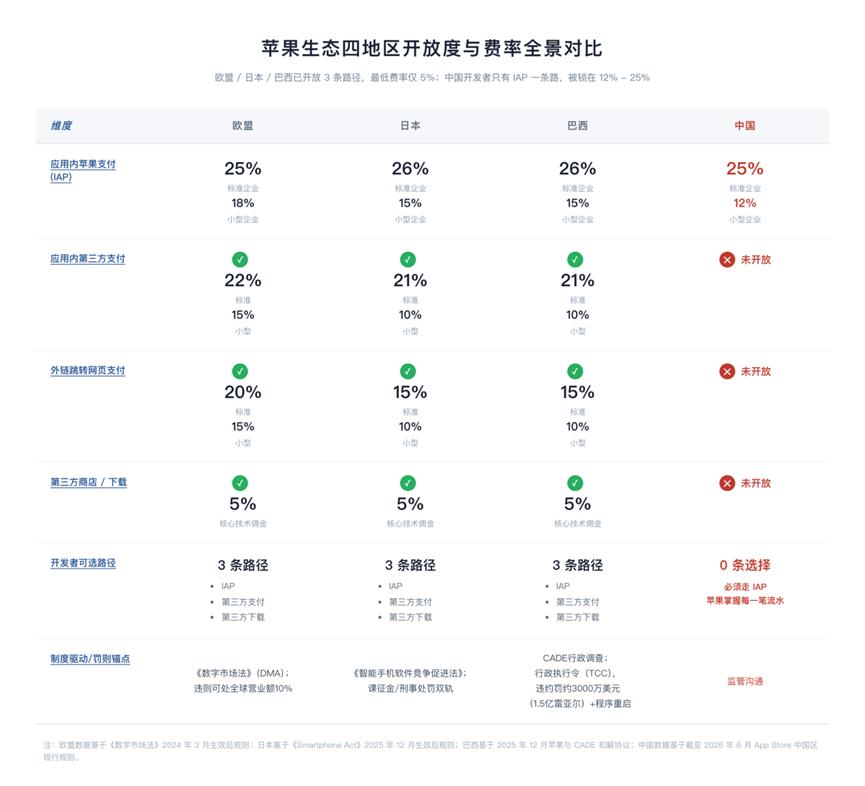
Comparing Brazil and other countries/regions, China's "25%/12% global lowest rate" is true, but it only covers one column of the table. In any normal business context, the "overall rate level" should refer to the weighted average of all channels or the achievable lower limit - that is, the 5% that Brazilian developers can reach at the lowest. However, Chinese developers only have the 25%/12% (in-channel commission) option, with no alternative payment channels, no external links, and no side-loading - which means that Apple's 25%/12% is not a price formed in competition but a price unilaterally set within a closed ecosystem. So the key issue is not "25% is one point lower than 26%," but whether Chinese developers have any choice at all - a "lowest" rate without choice is by no means the real lowest.
The 48 small, medium-sized, and individual Chinese iOS developers officially submitted a joint complaint letter to the State Administration for Market Regulation, accusing Apple of exactly this: Apple's "global lowest rate" commitment to China has not been fulfilled, and its differential implementation constitutes discriminatory treatment.
II. Comparison of Two Official Statements: "Commitment" to China and "Fulfillment of Obligations" in Brazil
The above table also shows that Apple will make different degrees of concessions according to the institutional coercion in different regions, and the upper limit of the concessions is determined by the enforceable lower limit. The law enforcement narrative in Brazil is particularly illustrative: In December 2025, the TCC settlement agreement was signed, locking in a 105-day deadline - Apple fought its defense until the last moment and then implemented the opening plan of iOS 26.5 three days before the penalty countdown reached zero. In the EU, Apple also determined the current lower rate framework after some tug-of-war with the regulatory authorities. This is the operation of a structure that adheres to the law.
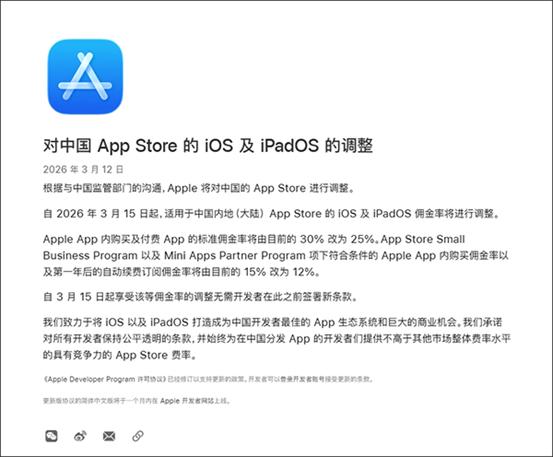
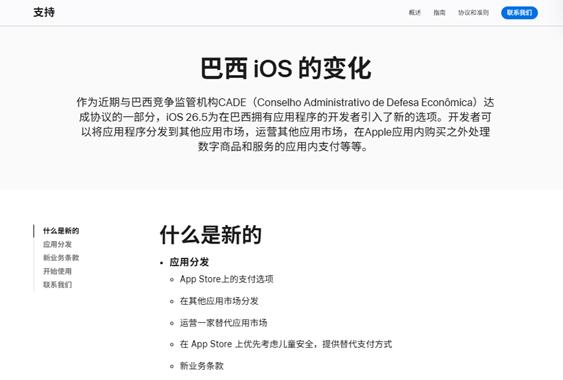
Comparing Apple's announcement in China on March 12 with its official statement in Brazil on June 18 side by side, we can better see the gap between regulatory "discussions" and law enforcement "agreements":
Apple's "commitment" to Chinese developers is based on "discussions" with the regulators. The announcement only used 308 words to tell developers that "the commission has been reduced, and they can enjoy the treatment without signing any agreement." However, without a "specific ruling," there is no "supervision benchmark," and without a "case number," there are no specific measures for "how to punish non - implementation."
In the Brazilian version, Apple admitted that this is a "agreement" that must be enforced with CADE. It used two or three times the length of the Chinese announcement to explain why it was forced to open side-loading/third-party payment (CADE agreement). At the same time, it explained the risk - security - child protection narrative, framing the opening itself as a "dangerous but controlled concession," almost verbatim reusing the security narrative template when the EU's DMA was implemented.
If in Brazil, the EU, and Japan, the same iOS technology stack can use "Notarization review + authorized app market + age grading + parental control" to manage the security risks of third-party distribution, then the reason for not enabling the same mechanism in China is by no means at the technical/security level, but only at the commercial/strategic level. "Security" has become a selective shield for Apple under global regulatory pressure: it uses it to frame the cost of opening when needed and puts it away when not needed to make "reducing the rate" seem like pure goodwill.
So, going back to the commitment at the end of Apple's announcement in China in March - "not higher than the overall rate level in other markets" - the word "overall" is written on Apple's own official website. When the "overall" in other markets already includes the 5% channel while China still only has 25%/12%, the gap in fulfilling this commitment should not be a vague area that requires "further discussion," but a fulfillment dispute that can be determined by textual interpretation and comparative law.
III. From the Gray Area to the Legal Procedure
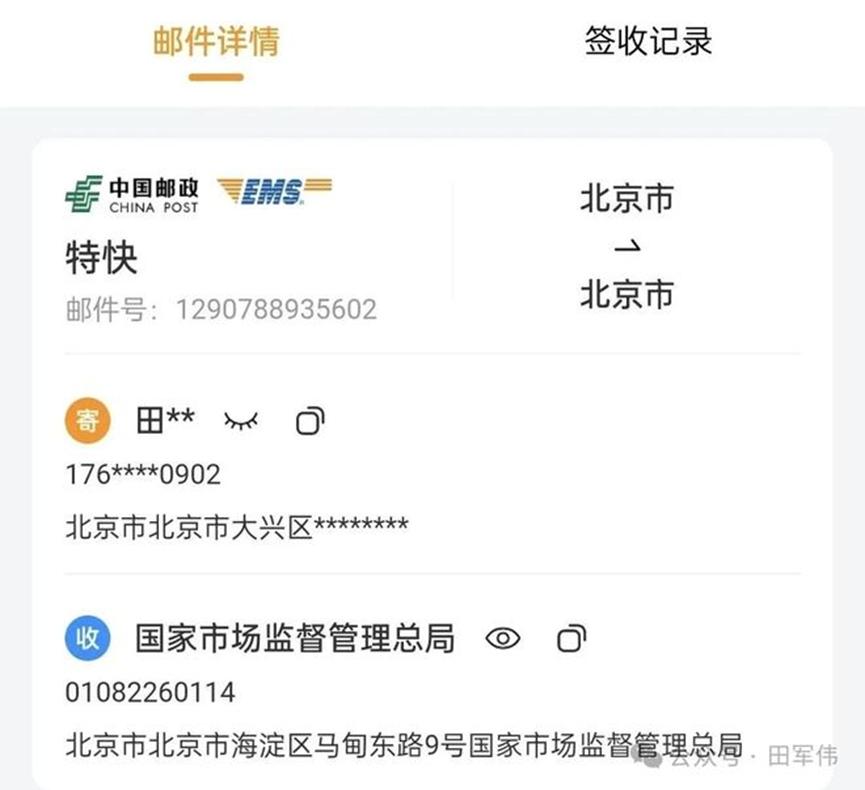
The technical significance of this complaint by the 48 developers lies in that it uses "Apple's own announcement commitment" as an independent basis for the right of claim, used in parallel with Article 22 of the Anti - Monopoly Law:
1. The binding force of unilateral promises. As a platform operator with market dominance (the Shanghai Intellectual Property Court has already determined in the Jin v. Apple case that it has a dominant position in the "iOS application transaction platform in mainland China" market), Apple's public rate commitment to unspecified developers has a binding effect on itself. Once the word "overall" is written in the official website announcement, it becomes the standard for measuring its own behavior, not just a marketing copy.
2. The connection point of Article 22 of the Anti - Monopoly Law. Even without considering the commitment, there are three phenomena that are worth examining within the framework of Article 22:
(1) Restricting transactions: exclusive distribution (only through the App Store) + exclusive IAP (the anti - steering clause prohibits developers from informing users that they can pay on the web), and the "anti - steering clause" has been abandoned in the United States, the EU, Japan, and Brazil. China is the only major market still implementing it;
(2) Unfairly high prices: When there are no alternative channels for price discovery, whether the "unit price" of 25%/12% is still restricted by competition is a question that can only be answered by opening up channels;
(3) Discriminatory treatment: For the "rationality" that the same enterprise cannot abandon certain clauses in China while it can in comparable legal jurisdictions, the burden of proof should be on Apple.
3. Logical contradiction. Apple cannot claim both (a) "there are security issues with opening channels, so they cannot be opened" and (b) "offering the lowest overall rate in China" - because Apple itself has proven the feasibility of "opening but controllable" in Brazil, the EU, and Japan, and the meaning of "overall" naturally includes the channel structure. Therefore, the overall rate in China should include the opened channels.
4. The most core procedural request - "automatic alignment supervision mechanism": When Apple introduces a new fee - reduction/opening policy in any overseas market, it should be implemented in China on the same day without setting a transition period - the legal basis refers to Article 53 of the Anti - Monopoly Law and Articles 32 - 36 of the General Administration's "Regulations on Prohibiting the Abuse of Market Dominance" (suspension of investigation and continuous supervision of the operator's commitment).
The real value of the complaint letter is not "the pressure from 48 people," but to activate the regulatory authorities' obligation to review the complaint in accordance with the law - to move the matter from the gray area of "informal communication and voluntary concessions" to the formal procedure under the framework of the Anti - Monopoly Law. The Brazilian CADE can use a TCC to limit Apple's obligation fulfillment within a 105 - day time limit, and the EU uses the DMA to turn opening into a legal obligation. China's path does not have to always stay at the level of "communication."
IV. Conclusion
Apple has repeatedly emphasized that not opening side - loading and third - party payment is for user safety, privacy, and fraud prevention. There is a reasonable part in this statement - but reasonable does not mean without boundaries.
The opening plans in the EU, Japan, and Brazil tell us the same thing: ensuring safety and opening up channels are not mutually exclusive. Apple already has a "open and controllable" template technically, but it still insists on not enabling it in the Chinese version.
It should be noted that after the implementation of the EU's DMA, although Apple's first - version "compliance plan" opened up alternative payment channels, through designs such as a 17% external link commission, single - link restrictions, and warning screen intimidation, it actually made the alternative plan more expensive and more difficult to use than the original Apple channel. The European Commission found this to be a violation in April 2025 and fined Apple 500 million euros. Therefore, every detail design in Brazil's TCC - warning screen wording, number of links, attribution period, etc. - is to block the "loopholes" that Apple had previously exploited.
The inspiration for China is that if future supervision or law enforcement of Apple enters the substantive stage, the focus of the review should not only be on "whether the channels are formally opened," but also on whether it uses means such as fees, friction, and attribution rules to undermine the "opening."
Otherwise, Apple's so - called "global lowest rate" commitment to us is just a statement that can be defined by itself at any time.
This article is from the WeChat official account “Internet Law Review”, author: Zhang Ying. It is published by 36Kr with authorization.