Seres Robotics Unveiled: Why Are Automakers Developing Robots In-House?
On June 15th, at the SERES Super Factory in Longxing, Chongqing, the "Xiaosai" series of robots made a collective appearance. This is the first public display of SERES' R & D achievements since it announced the promotion of embodied intelligence implementation last year.
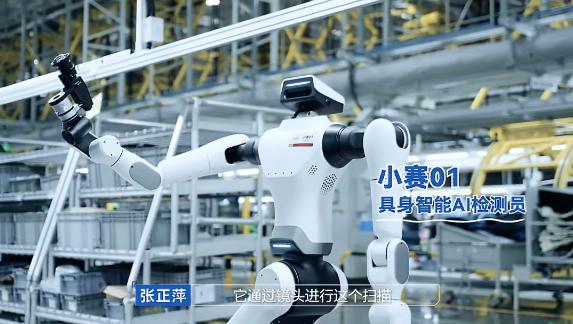
A humanoid robot "Xiaosai" with multi - modal perception capabilities conducted a full - tour guide. Other members appeared one by one in the form of "taking up positions": Xiaosai 01, responsible for chassis assembly inspection; Xiaosai 02, used for vehicle appearance inspection; collaborative robotic arms on both sides of the production line; AGVs for cargo handling; and aerial logistics drones.
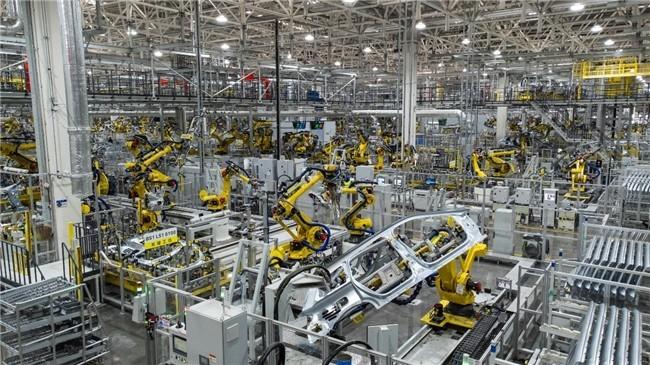
In this highly automated factory, more than 1,600 intelligent devices and over 3,000 industrial robots are working synchronously. The addition of the Xiaosai robots mainly undertakes flexible operations that traditional industrial robots cannot achieve.
It can be seen that in the robot design, SERES does not insist on universality and full - scale humanoid forms. Instead, it determines the form and capabilities of the robots according to specific tasks. Some have wheeled feet, some have detection guns as hands, and some have robotic arms as their main bodies. This idea of defining robots from the industrial scenario in reverse may provide a new paradigm for the industry.
It is worth noting that, different from the mainstream full - stack self - research or the migration path of intelligent driving technology in the industry, in robot R & D, SERES chooses to entrust the "brain" to Volcengine.
In October 2025, Phoenix Intelligence Creation, a subsidiary of SERES, signed the "Framework Agreement for Embodied Intelligence Business Cooperation" with Volcengine. The two sides jointly tackled key problems around multi - modal cloud - edge collaboration and control and human - machine enhancement technology projects. Simply put, the body is self - developed by SERES, and the brain is undertaken by Volcengine. It is not difficult to see that this model is similar to the one used in the creation of the AITO brand.
Whether this "strategic alliance" can replicate the success of the "AITO model" depends on whether the Xiaosai robots can reach the nerve center of the manufacturing industry.
Does SERES entrust the "brain" of its robots to Volcengine?
Under the wave of embodied intelligence, industrial implementation is the most crucial proposition in the industry this year.
In June 2026, the Ministry of Industry and Information Technology and the State - owned Assets Supervision and Administration Commission jointly launched the "Special Action for Real - world Training of Humanoid Robots and Embodied Intelligence". It was clearly stated that the "operation mode" of humanoid robots and embodied intelligence would be launched by the end of the year, and industrial manufacturing was listed as the primary implementation scenario.
To achieve this goal, there are currently two main implementation methods in the industry:
One is full - stack self - research, extending intelligent driving technology to robots. The most typical example is Tesla's Optimus. Elon Musk said that the AI5 chip originally developed for autonomous driving will also be used in the robot. IRON, led by He Xiaopeng himself, shares the same Turing AI chip and Tianji AIOS as those used in cars.
The other is for robot manufacturers to cooperate with factories, allowing robots to "work" in deterministic scenarios. For example, last year, nearly a hundred Yuanzheng A2 - W robots from Zhiyuan were deployed in Fuling Precision, an auto parts factory, covering the handling work of three assembly lines. The industrial robot T800, mainly promoted by Zhongqing, was also deployed in a leading 3C electronics assembly factory in South China this year for pilot verification.
SERES takes a third path - self - developing the body, outsourcing the brain, and then applying it to factory manufacturing.
In choosing this path, SERES has its own considerations based on experience.
In past cooperation, the AITO brand was a successful case of "soul and body" cooperation. In 2021, SERES had in - depth cooperation with Huawei. Huawei brought over its HarmonyOS intelligent cockpit, HUAWEI ADS advanced intelligent driving system, DriveONE electric drive platform, and quality control system, while SERES was responsible for vehicle manufacturing and quality control. This division of labor once made AITO one of the most successful brands in the high - end new energy vehicle market.
Now, SERES replicates the same model in robot R & D - doing what it is good at in terms of hardware and entrusting the intelligent part to those who are good at it.
So far, this model has at least enabled SERES to achieve good implementation efficiency. From signing the agreement with Volcengine in October last year to the various forms of robots taking up positions in June this year, in less than a year, going from 0 to being on the production line, this speed is quite fast. In addition, Kang Bo, the vice - president of SERES, said that more robots covering C - end retail, service, companionship, and B - end manufacturing and logistics will be launched within this year.
But in 2026, when the embodied intelligence industry is increasingly discussing ROI, is it cost - effective for SERES to launch so many types of robots at once?
Why are car manufacturers getting involved in robot production?
In today's highly competitive environment, both in terms of hardware and intelligence, the robot track has become a gathering place for car manufacturers to seek new growth.
First, there were Xiaomi, XPeng, and Li Auto. Later, Changan and BYD joined. New players enter the market every once in a while. Currently, Chery's Mojia M1 has been launched on JD.com's self - operated platform for sale. XPeng's new - generation IRON is expected to enter mass production by the end of this year. Changan registered the "Tianshu Intelligent Robot" in March this year, and recently there have been reports that BYD is getting involved in robot production.
Why do car manufacturers spend so much money on making robots?
At least for SERES, reducing factory costs may not be the primary goal. Financial data shows that in 2025, SERES' gross profit margin for the whole vehicle was as high as 29.14%, and in the first quarter of 2026, it still remained at a high level of 26.24%. Looking at the cost side, in Q3 of 2025, the average cost per vehicle of SERES was 237,500 yuan, basically the same as that of its peer Li Auto, which was 234,800 yuan.
Compared with other intelligent car manufacturers, both in terms of profit quality and cost per vehicle, SERES is in a relatively reasonable range, without putting pressure on cost reduction and net profit.
However, if we focus on production and manufacturing itself, robots have a deeper meaning for the factory.
In the four major processes of automobile manufacturing - stamping, welding, painting, and final assembly, most car factories can easily achieve an automation rate of 80% in the first three processes, and some leading car manufacturers can even reach 100%. However, in the final assembly part, the automation rate is only 20% - 30%. These non - standard and flexible tasks are exactly what programmed mechanical equipment is not good at, but are most suitable for the entry of embodied intelligence.
For example, in the vehicle quality inspection process, detecting gaps, surface differences, paint quality, and abnormal noises all require experience for perception and decision - making. This means that what is really valuable is not the cost saved, but allowing robots to do things that traditional automation cannot do.
According to the demonstration at SERES' super factory: Xiaosai 01 conducts chassis assembly quality inspection, and Xiaosai 02 conducts vehicle appearance configuration inspection. In essence, these two humanoid robots use AI vision and flexible execution to make up for the flexible operation part. Through on - site demonstrations, it can be seen that although SERES' robots are still in the primary stage, they are already usable.
Moreover, when the production line changes the vehicle model, embodied intelligent robots often adapt faster.
Although traditional industrial robots can switch between two vehicle models in seconds through the RFID recognition system, this switch relies on a pre - set program library. Every time a new vehicle model is added, the debugging before SOP often takes several months. However, embodied intelligence like Xiaosai, which relies on visual recognition and large - model reasoning, can be directly put into use.
This adaptability may be able to adapt to the current iteration rhythm of intelligent vehicles. After all, compared with the era of traditional fuel vehicles, the iteration speed of intelligent vehicles is twice as fast. At the same time, car manufacturers also hope to occupy a position in the embodied intelligence track through the actual use of robots.
Data and scenarios: Car manufacturers' strategy to occupy the embodied intelligence track
In 2026, the humanoid robot industry entered the first year of mass production. As the body and movement ability have been gradually verified, data, as the most important factor for the growth of the robot's brain ability, has been constantly mentioned in various forums recently.
Embodied data has become a "battlefield" for the entire robot industry chain.
In the primary market, embodied data companies have been "snapped up". On June 1st, Jianzhi Robot announced the completion of multiple consecutive rounds of financing totaling hundreds of millions of yuan, becoming the company with the highest cumulative financing amount in the "data without body" field. This year, several companies mainly focusing on embodied data, such as Guanglun Intelligence, Wuwen Zhike, and Heshuju, have successively completed financing.
The same competition is also reflected in the strategies of large companies. In April this year, Baidu Smart Cloud and JD.com successively launched data - related platforms to compete for the data operation market. In February this year, Zhiyuan spun off Mifeng Technology to become a supplier of embodied intelligent data.
Super factories like SERES are themselves sources of real data and real needs. From the way robots are implemented, it seems that car manufacturers are looking for a new implementation paradigm in the embodied intelligence industry - defining robots in reverse according to scenarios.
In the past implementation of embodied intelligence applications, robot manufacturers often had to choose either the B - end or the C - end route first.
For example, players like Unitree and Zhiyuan take the route of penetrating from the C - end to the B - end. For instance, Unitree's H1 and Zhiyuan's A1 took the stage with their superior movement performance and multi - modal perception. They first served the entertainment industry and the education market, and then entered factories intensively for "practical training" to verify industrial implementation.
Tesla basically takes the opposite route, expanding from the B - end to the C - end. From the day of its project establishment, Optimus was designed to replace humans in Tesla's super factory, and then try to enter the home scenario. Battery sorting and parts handling in the Fremont factory were its main work scenarios in the past year or so. Elon Musk said that the home - use version of Optimus will not be mass - produced until 2027 or even later.
However, for car manufacturers, robots are "natively" implemented in factory applications, taking the "factory system + robot" model. Based on the original digital ecological system of the factory, it infers what capabilities and forms the robots should have.
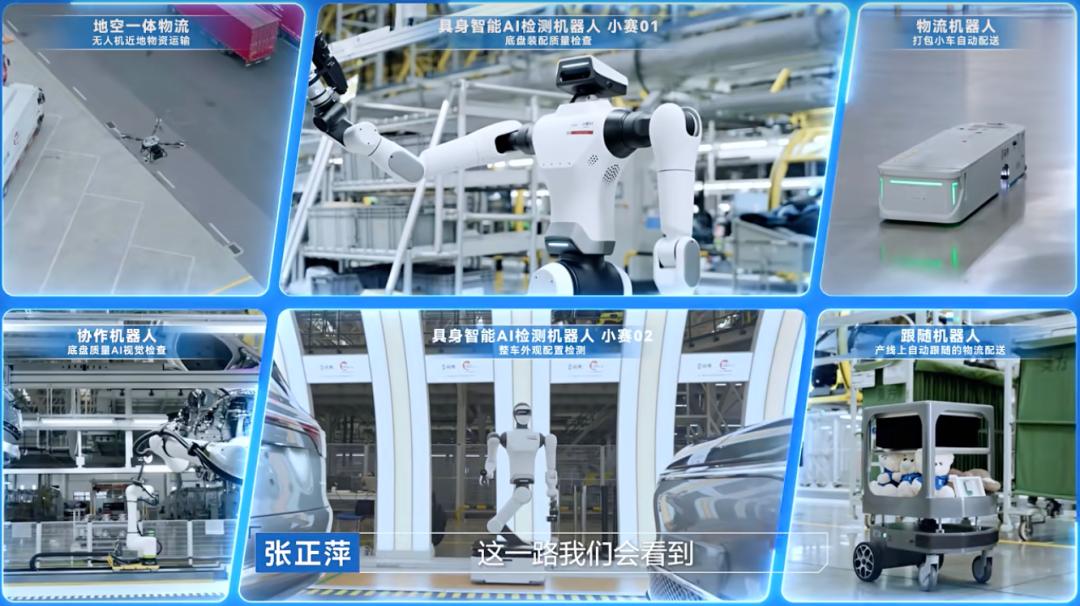
As shown in the demonstration, SERES does not insist on all robots being humanoid. Instead, it designs the form and capabilities of the robots according to the original rhythm of the automated factory and specific tasks.
The humanoid robots responsible for inspection can detect different points with multiple degrees of freedom like humans. They don't need dexterous hands but can be directly equipped with a detection gun. In places where all points can be detected at a fixed position, they are made into robotic arms, forming a "heterogeneous embodied intelligent cluster" that collaborates with the factory.
Technically, compared with leading robot companies, whether it is competing in movement ability or large - model development, they are essentially pushing robots towards the general - purpose path. SERES is more concerned about whether robots can be seamlessly integrated into the existing factory system.
For the manufacturing industry, what they need most is not a star employee for a single job, but a systematic solution that can directly improve the overall equipment effectiveness (OEE) of the production line. If the "robot team + digital system" model is successfully verified, this combination can be replicated to other car manufacturers.
This article is from the WeChat official account "Guangzhui Intelligence" (ID: guangzhui - tech), written by Luo Zhenhao and edited by Liu Junhong. It is published by 36Kr with authorization.