Automakers can no longer make exaggerated claims in their marketing, as the national standard for autonomous driving has been issued and will be implemented in July next year.
The first mandatory national standard for L3/L4 autonomous driving in China is publicly announced.
According to a report from CheDongXi on June 22nd, recently, the Ministry of Industry and Information Technology released a public notice seeking opinions on two mandatory national standards (draft for approval), namely "Safety Requirements for Autonomous Driving Systems of Intelligent Connected Vehicles", and the foreign - language version (draft for approval) of the mandatory national standard "In - vehicle Emergency Call System".
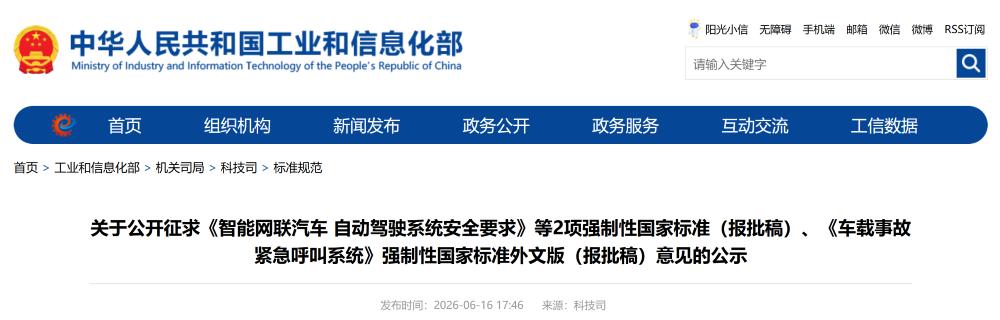
▲The public notice released by the Ministry of Industry and Information Technology
Among them, "Safety Requirements for Autonomous Driving Systems of Intelligent Connected Vehicles" (hereinafter referred to as the "Requirements") replaces GB/T 44721 - 2024 "General Technical Requirements for Autonomous Driving Systems of Intelligent Connected Vehicles". It aims to stipulate the safety technical requirements, guarantee requirements and inspection methods for passenger - carrying and freight - carrying vehicles (excluding automatic parking systems) equipped with Level 3 (L3) and Level 4 (L4) autonomous driving systems.
The proposed implementation date of the "Requirements" is July 1st, 2027. For new vehicle models applying for type approval, the "Requirements" will be implemented from the date of implementation. For vehicle models that have already obtained type approval, the "Requirements" will be implemented starting from the 13th month after the implementation date.
01. L3/L4 Usher in Mandatory National Standards, Not Applicable to Automatic Parking Systems
What exactly does the "Safety Requirements for Autonomous Driving Systems of Intelligent Connected Vehicles" publicly announced by the Ministry of Industry and Information Technology this time regulate?
According to the "Requirements", the "Requirements" apply to M - class (passenger - carrying) and N - class (freight - carrying) vehicles equipped with Level 3 (L3) and/or Level 4 (L4) driving automation systems, and do not apply to automatic parking systems.

▲Scope of application of the "Requirements"
At the same time, it can be seen that the "Requirements" are in the nature of a mandatory national standard (code GB), which means it will become part of the law. Vehicles that do not meet the requirements are not allowed to be produced, sold and driven on the road in China.
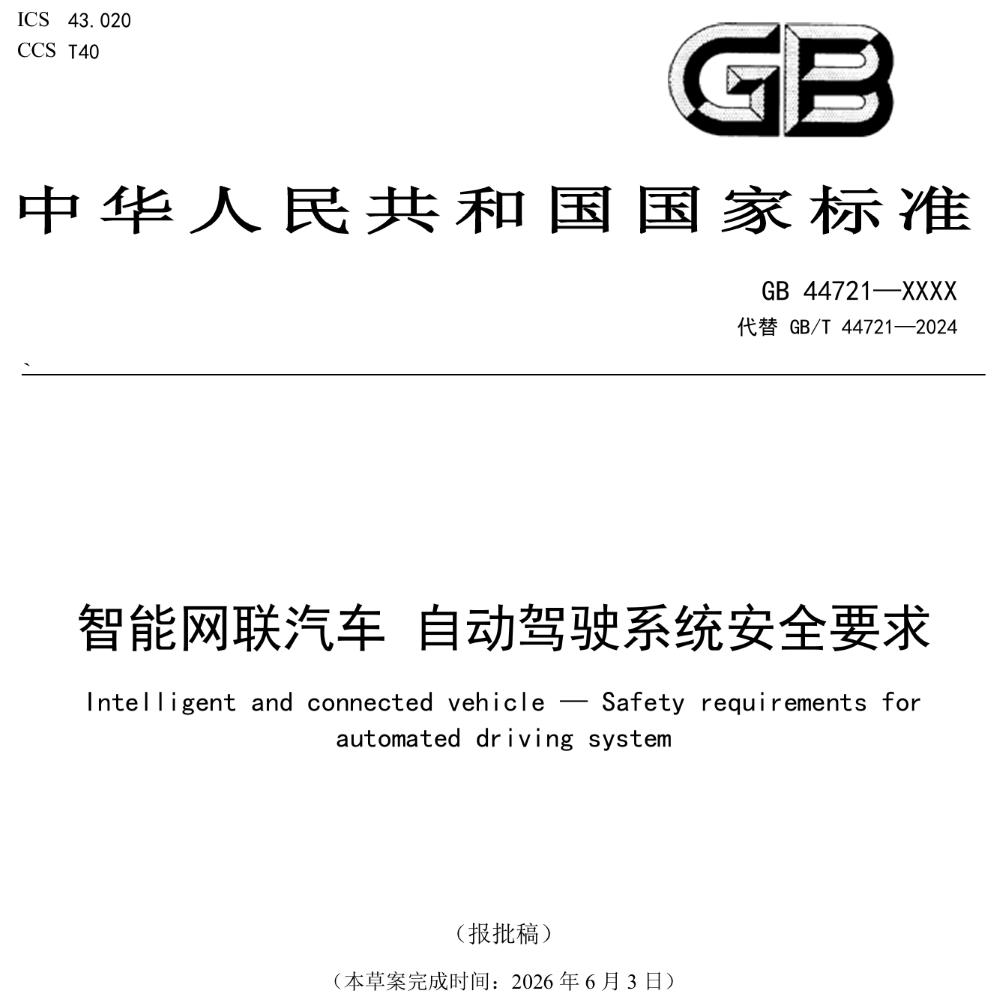
▲"Safety Requirements for Autonomous Driving Systems of Intelligent Connected Vehicles"
So, what requirements are put forward for L3/L4 autonomous driving systems in the latest "Requirements"?
Specifically, the "Requirements" cover four sections including driving ability, human - machine interaction, user notification, and general mandatory requirements, and distinguish the ability requirements and differential indicators for L3/L4 autonomous driving systems:
1. Driving ability: The safety level is not lower than that of a compliant human driver, and the vehicle can be controlled in various scenarios.
In the "Requirements", it is required that the safety level of the ADS (Autonomous Driving System) is not lower than that of a compliant human driver. For L3 - level autonomous driving systems, if the designed operating range includes non - high - speed/fast roads, they need to have the capabilities of lane cruising, lane changing, and passing through intersections; for L4 - level autonomous driving systems, they need to have the capabilities of lane cruising, lane changing, detouring, reversing, turning around, etc. depending on the designed operating range.
At the same time, the "Requirements" set the behavioral guidelines for L3/L4 autonomous driving systems in four types of scenarios:
(1) Nominal scenario: The system should maintain the vehicle distance under normal road conditions, give way to priority vehicles, respond to traffic police commands, and reasonably control the vehicle speed. It is prohibited to disrupt traffic without reason. In a nutshell, "the autonomous driving system should drive like a normal person drives".
(2) Risk scenario: The system can predict dangers, reduce damage when a collision is inevitable, and automatically brake to a stop after a collision. That is to say, the system will try its best to avoid collisions, and even if an accident occurs, it should be able to stop the vehicle.
(3) Failure scenario: The system can timely identify faults and minimize the overall risk. If a fault makes the system unable to safely execute driving, activation is prohibited; if it can still execute safely, the capabilities are adjusted according to the severity. That is to say, the system will automatically judge the state and can even adjust the available capabilities according to the severity of the system fault state.
(4) Scenario beyond the designed operating conditions: The system needs to make foreseeable predictions. If the conditions do not meet the designed operating conditions, the system cannot be activated.
2. Human - machine interaction: There are differences between L3 and L4. L3 needs to reserve sufficient takeover time.
In terms of human - machine interaction, the interaction logic is designed for two types of vehicle models: those that support manual exit (mainstream L3, some L4) and those that do not support manual exit during driving (driverless L4);
(1) Systems that allow exiting to manual driving function during driving (L3 and some L4)
It is required to have a dedicated operation method to activate/exit, which can prevent misuse, and at the same time indicate the activation state of the system. Before activating the system, it is necessary to confirm whether the user has received training and understood the instructions.
After activating the system, the relevant operating parts can prevent unsafe interference, set an intervention threshold, and the system will exit if the threshold is exceeded. The L3 - level autonomous driving system also needs to continuously evaluate the user's takeover ability and reserve sufficient takeover time.
When exiting, the system needs to make a safe handover, evaluate the user's preparation (holding the steering wheel, looking attentively), the emergency assistance will not be turned off after exiting the system, and the driving assistance will not be automatically activated.
(2) Systems that do not allow exiting to manual driving function during driving (L4)
The system needs to provide safety - related information and respond to passenger safety risks (such as not wearing a seat belt); if there are manual driving operating parts, the system needs to prevent interference.
3. User notification: A mechanism for driver training and reading confirmation should be established, and verification is required every time the vehicle is restarted.
First of all, automobile manufacturers need to provide a complete user manual through multiple channels such as the official website, in - vehicle infotainment system, and mobile terminal.
At the same time, a mechanism for driver training and reading confirmation should be established. The training records need to be verified every time the vehicle is restarted. If the user has not confirmed within 30 days or after a software update, the user needs to confirm again to ensure that the user is aware of the classification limitations, takeover obligations, and fault handling methods.
4. Other general mandatory requirements: All vehicles must be equipped with an autonomous driving data recorder.
All vehicles must be equipped with an autonomous driving data recorder, and vehicle models that support trailers also need to verify the safety of trailer adaptation.
02. The Specific Technical Requirements for L3 and L4 Are Different. The Maximum Forward Detection Range of L3 Is Up to 130 Meters
In this "Requirements", the special provisions in Appendix B and Appendix C that high - speed L3 and full - domain L4 must meet respectively are clearly given, listing the specific technical requirements.
First, let's look at the specific requirements for the L3 - level autonomous driving function on highways/urban expressways, which are mainly divided into four aspects:
1. Dynamic driving task execution: The system needs to keep the lane, not cross the lane without purpose, have forward/side/rear detection capabilities. The lane - changing control requires a safe distance, the lateral acceleration during the lane - changing execution phase should be ≤1m/s², the deceleration required for emergency collision avoidance control should be >5m/s², and the collision avoidance across the lane line needs to be fully evaluated. In summary, the system should be able to change lanes safely, but not change lanes without reason, and the lane - changing speed also needs to be controlled.
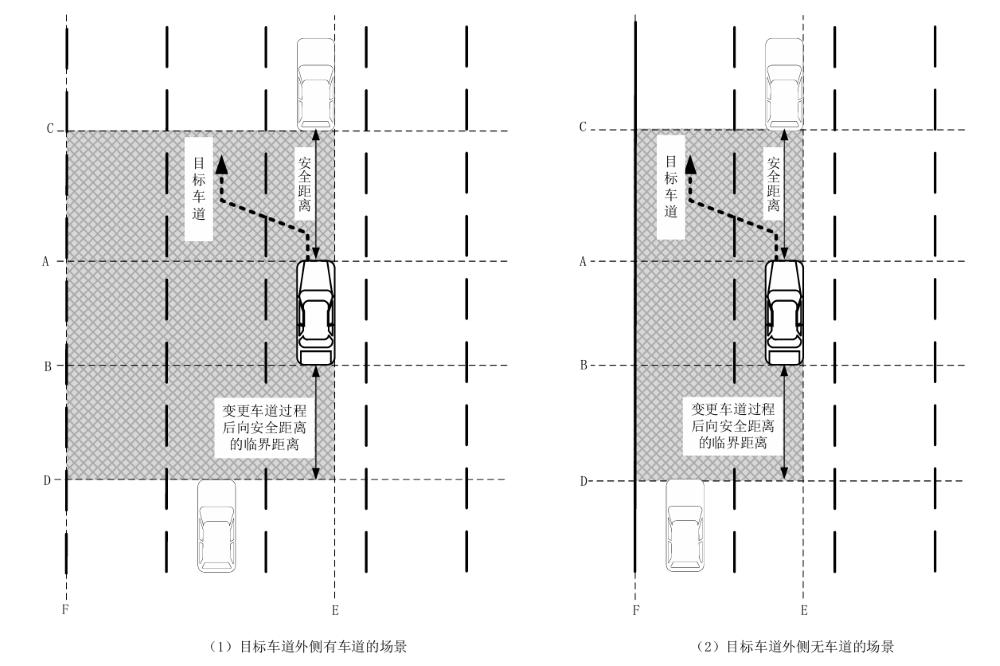
▲Schematic diagram of the lane - changing control scenario
2. Intervention request: Sufficient time needs to be reserved. At the latest, the intervention should be upgraded 4 seconds after the intervention request is issued. If the system fails seriously, the minimum risk strategy can be directly implemented to give the user sufficient time to take over the vehicle.
3. Human - machine interaction: The activation conditions need to meet that the driver is sitting in the driver's seat, wearing a seat belt, the system has no failure, the weather/road conditions allow, the self - inspection is confirmed, and there is no upgrade, etc. The status prompt of the autonomous driving system needs to have a dedicated optical signal, and the intervention request is upgraded to an acoustic or tactile signal.
4. Perception system: The forward detection range changes according to the vehicle speed. It needs to reach 50m at a speed of 60km/h and below, and 130m at a speed of 120km/h. The lateral detection range should cover an area at least 9m wide on each side, and the rear - direction detection should meet the requirements for lane - changing safety assessment.
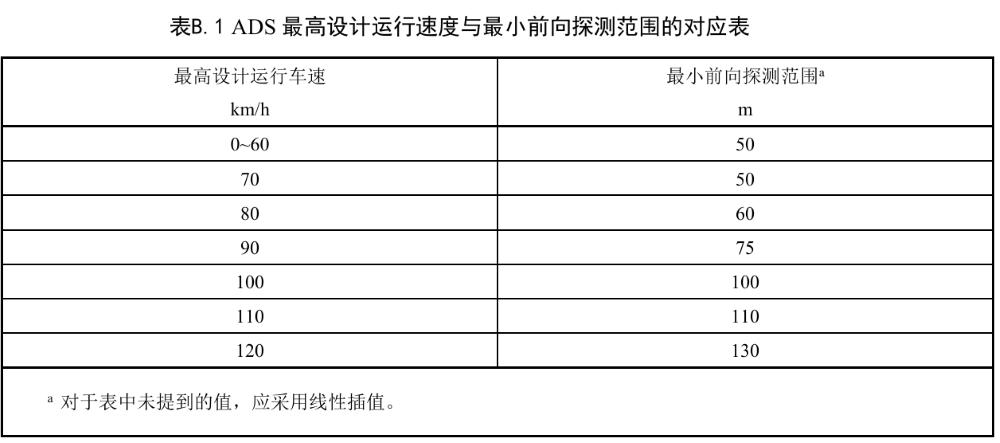
▲Forward detection range of the autonomous driving system
For the specific requirements of the L4 - level autonomous driving system function, it is mainly divided into four aspects:
1. Dynamic driving task execution: The system needs to be able to keep the lane, deal with temporary road changes, identify risks such as the deceleration, cutting - in, reverse driving of the vehicle in front, and pedestrians. If passengers are allowed to stand, the acceleration/deceleration should be ≤2.4m/s², and the rate of change should be ≤5m/s³. The requirements for lane - changing and emergency collision avoidance are the same as those of the L3 - level autonomous driving system. Compared with the L3 - level autonomous driving system, the L4 - level autonomous driving system also takes into account the situation when passengers are standing.
2. Remote assistance: The system cannot rely on remote assistance for execution. If remote assistance is needed, the system also needs to perform all specific operations.
3. Human - machine interaction: The activation conditions of the system include that the system has no failure, the weather/road conditions allow, there is no upgrade, and the route is within the designed operating range, etc.
For the L4 - level autonomous driving system that allows exiting to manual driving during driving, it needs to meet the intervention/exit requirements similar to those of the L3 - level autonomous driving system; if exiting is not allowed, the exit is only limited to the stationary state or switching to the parking function.
4. Status prompt: A dedicated optical signal is needed to display the system status.
03. Conclusion: The Standardization Process of the Autonomous Driving System Has Begun
According to what the official mentioned in the compilation instructions of the "Requirements", the autonomous driving system of intelligent connected vehicles is a key carrier for the application of technologies such as artificial intelligence, information communication, cloud computing, and big data in the automotive field, and is also the strategic direction for the transformation and upgrading of the global automotive industry, bringing comprehensive changes to automobile development and manufacturing, testing and evaluation, application models, etc.
However, the autonomous driving system involves multiple complex links, such as perception, decision - making, and control. Any mistake in these links may lead to traffic accidents and pose a threat to personal safety.
The standardization of the autonomous driving system can further ensure the safety of users during driving, promote automobile manufacturers to advance their layouts in accordance with regulations, reduce the risk of accidents, and also promote the orderly and stable development of the autonomous driving industry in China.
This article is from the WeChat public account “CheDongXi”. Author: R. Republished by 36Kr with authorization.