Roundtable: Riding the Waves as an Entrepreneur Before Anyone Believes in You | 36Kr WAVES 2026
Every entrepreneur has a period of "nobody believing". It was precisely that period that propelled them to the forefront. Entrepreneurship is vivid. In the following session, let's hear from those entrepreneurs who grew up amidst doubts on how they turned "impossible" into "no, it's possible".
The following is the content of the round - table dialogue, compiled and edited by 36Kr:
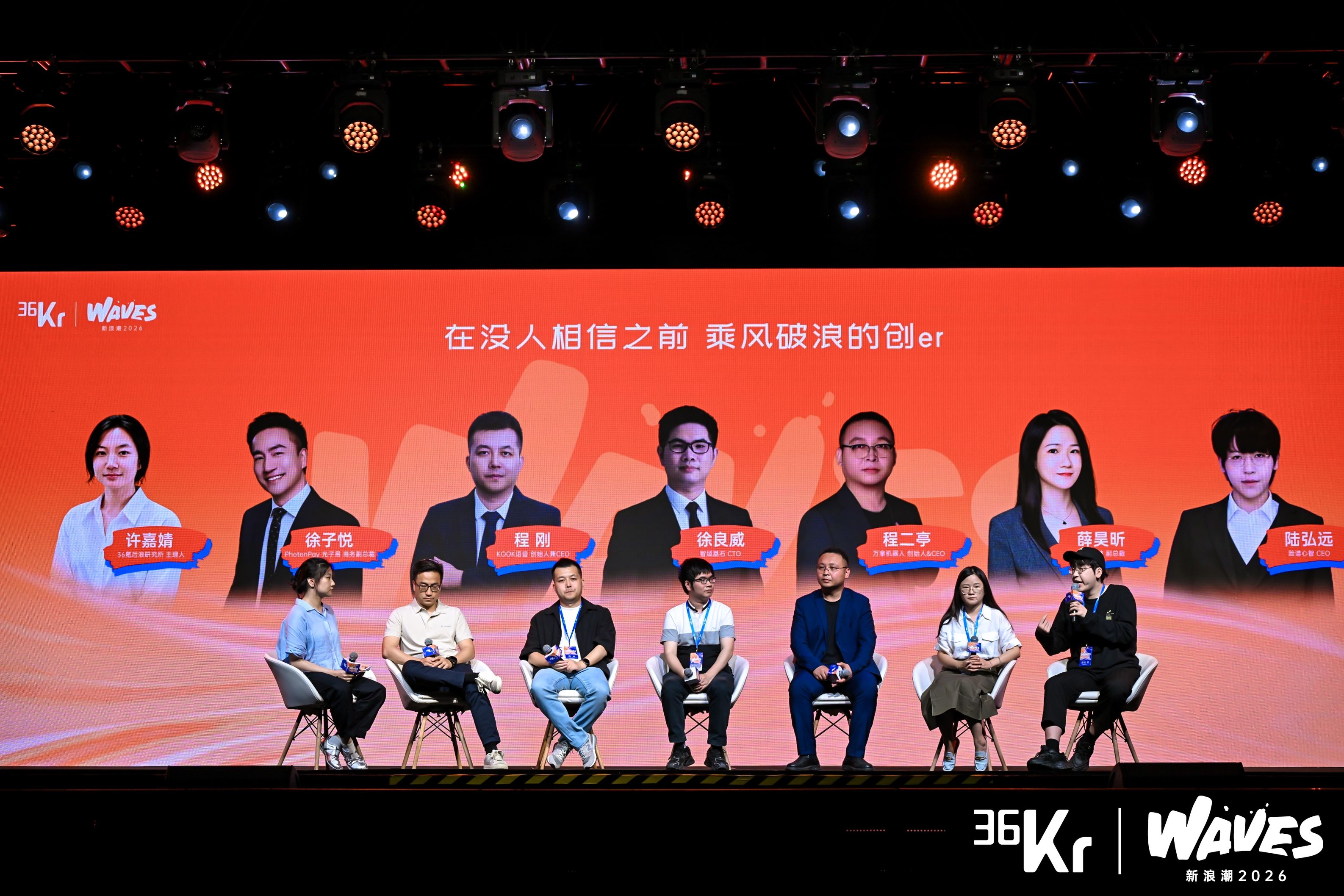
Xu Jiajing | Host and curator of 36Kr's Rising Stars Research Institute
Xu Ziyue | Vice President of Business at PhotonPay
Cheng Gang | Founder and CEO of KOOK Voice
Xu Liangwei | CTO of Zhiyu Jishi
Cheng Erting | Founder & CEO of Wanna Robot
Xue Haoxin | Vice President of Luchen Technology
Lu Hongyuan | CEO of FaceMind
Xu Jiajing: Hello, dear audience!
I'm Xu Jiajing from 36Kr's Rising Stars Research Institute. The theme of our research this time is "Before Nobody Believes". Our institute has reported on many stories of young entrepreneurs before. The most interesting part is about those early - stage projects that are still in the "underwater" phase. We can find many stories full of conflicts, dramas, and struggles because this stage is full of uncertainties. So today, we're very honored to have invited six guests. There's a statistic that in 2024, there were more than 6 million newly registered enterprises in China, but less than 2% of them received Series A or higher - round financing. Most projects died before dawn. Today, let's invite these 2% of people to talk about how they survived this battle.
First, on my left is Xu Ziyue, the vice president of PhotonPay. PhotonPay is a company that completed its Series B financing in January 2026, with investors including IDG Capital. They mainly focus on the overseas payment track. Actually, it's very difficult to explain this track to ordinary people in one sentence, and few people specialized in this area in the early days. But now, PhotonPay has 14 operation centers globally with over 500 employees, helping many enterprises cut their cross - border capital costs by more than 75%. Today, I'd like to ask Mr. Xu a question. When you were doing this in the early days, were you questioned by many people about why it was you doing this? And when did you realize that this thing was feasible?
Xu Ziyue: Let me share briefly with you. The domestic payment industry has developed for more than a decade. People's inherent impression of this track is price competition, which is also the long - standing inertia of the industry. In many people's eyes, payment is not a "sexy" business. Coupled with the fact that the customer departments we deal with are mostly conservative - style, low - risk - preference, and long - decision - cycle financial teams, it makes this business seem even less imaginative.
But for us, the biggest proposition is to reverse users' perception. Many people think that payment is a necessary basic support but has nothing to do with business growth. What we need to do is to make it a compulsory course for Chinese enterprises going global.
For example, new business opportunities related to AI going global and tokens are constantly emerging. We're the first to sense the changes, just like "ducks sensing the warming spring water". We're the first institutions to see the real overseas income cash flow of enterprises. So what we've been doing is accompanying Chinese enterprises going global to seize the new growth opportunities brought by technological and market changes, ensuring that enterprises' overseas income can be safely and smoothly received.
Second, Chinese enterprises going global have to face different regulatory, tax, and data - security requirements in different countries. Through our one - stop solution, we help enterprise owners and financial teams handle the entire process of receiving, paying, remitting, and exchanging funds in multiple payment methods, multiple currencies, and multiple countries, significantly reducing the friction in cross - border capital flow. These capabilities don't come out of thin air. They're all precipitated from real cases of serving overseas customers in various industries and countries.
Take the recent e - commerce market as an example. Since 2020, the global e - commerce has been growing rapidly. Currently, the growth rate in developed countries has slowed down, but the e - commerce in South America, represented by Brazil, is growing very rapidly. Affected by local tax policies, a large number of Brazilian e - commerce platforms operate in the local - store model, which brings a series of problems to our customers: how to withdraw funds from the e - commerce platform, how to legally remit cross - border payments from Brazil to the domestic supply chain, and at the same time, cover various local expenses in Brazil.
A more realistic difficulty is that according to local Brazilian policies, enterprises need to open multiple local accounts in the name of local entities. However, many overseas enterprises don't have the conditions to open bank accounts locally. Without a proper solution, enterprises can only convert Brazilian reais into US dollars for cross - border transfer. In the process, they have to bear exchange losses and handling fees, and their funds may also be frozen due to risk - control investigations by financial institutions, making it impossible to use the funds flexibly. Moreover, enterprises also have various local expenses in Brazil, such as taxes, warehousing fees, and advertising fees, so the friction in the entire capital chain is very large.
This is just the situation in the Brazilian market and on the Mercado Libre platform. Mercado Libre's business covers the whole of South America. When the same problem is magnified to five or six countries like Mexico and Chile, the complexity will increase exponentially.
So what we do is to actually help enterprises solve one after another small pain points, ultimately improving the efficiency of capital use, reducing the time cost of financial teams, and significantly shortening the capital turnover cycle. This is our answer to this seemingly "unsexy" business: turning basic payment services into core solutions that can really help enterprises achieve high - speed growth.
Xu Jiajing: Indeed, this is something that requires multi - party collaboration, including how to empower overseas enterprises as their business partners.
Now, let's welcome our second guest, Mr. Cheng from KOOK Voice. KOOK's predecessor was launched in 2019, called "Kaiheila". In February this year, KOOK announced that it would fully embrace AI and carry out an AI - integrated brand upgrade. But in the early days, there was a problem. In the overseas voice - social field, many people use Discord, especially teenagers, who are very used to this kind of voice - social platform. However, there has never been a voice - social platform in China. Many people said, "The social landscape in China has been defined." But you still insisted on doing this.
Today, I'd like to ask Mr. Cheng. In the early days, how did you firmly believe that this direction was correct? Did you really believe in your heart that "China would have its own Discord"? If you were to re - explain what KOOK is, how would you put it?
Cheng Gang: Thank you, host.
Hello, everyone. I'm Cheng Gang, the CEO of KOOK Voice.
In answer to the host's question, Discord is undoubtedly a very great product. But if I were to define KOOK today, I think "KOOK is not just China's Discord". Discord has made some good innovations in its development, such as the server organization form and the open ecosystem. These are the aspects we respect and appreciate.
For KOOK, in the early days, to make it easier for first - time users to understand, we would say that we're "China's Discord". But in our hearts, we hope to define KOOK as a real - time community infrastructure for Chinese game players and the general entertainment population. I need to explain this definition a bit.
First, "Chinese game players". What KOOK wants to do is not general social networking or office collaboration, but games. The ecosystem of Chinese game players, game content, and game developers is very different from that abroad. This also determines many differences between KOOK and Discord. We're not simply copying but growing from the real scenarios of Chinese players.
Another is "real - time". Most of the currently used community products are based on asynchronous communication, such as browsing, posting, and commenting. But we've found that game players and the general entertainment population have a strong need for real - time communication. They organize various activities in voice channels, play games, watch movies, and listen to music together. So for KOOK, we think "real - time" is a very important point for game players and the general entertainment population, which is significantly different from ordinary community products.
Third, I want to talk about "infrastructure". It's easy to talk about infrastructure, but difficult to implement. KOOK was originally called "Kaiheila" and was first regarded as a voice tool for gaming. But as it developed, more and more users didn't just use it as a gaming voice tool. The basic capabilities we provided from the very beginning, including instant messaging and real - time audio - video conversations, the rich developer ecosystem formed by resolutely opening the underlying API from day one, the active robot ecosystem based on this, and the increasingly introduced AI capabilities. I think all these are moving towards the same goal - providing a simple, reliable, and easily expandable real - time community communication infrastructure for Chinese game players and the general entertainment population, so that people can create more interesting things based on it.
Speaking of AI, in fact, we're very welcoming of AI and have been embracing it. But for KOOK, AI doesn't replace people. Instead, it makes the connection between people richer, more fun, and more interesting. For example, we have many communities with tens of thousands or even hundreds of thousands of people online at the same time. It's very difficult for community managers to manage so many people. So we use AI to provide small tools for convenient management. At the same time, because of the rich developer ecosystem, our users also create some very interesting things based on AI. For example, they can provide interesting voice assistants in channels and turn chat channels into self - made mini - games based on the AI framework. These are all very interesting.
Going back to your previous question, the so - called "the social landscape in China has been defined", we don't think so. For KOOK, the real - time community based on game users and the general entertainment population is in a stage of vigorous development and rapid progress. Here, I can briefly reveal to you that KOOK exceeded 2.5 million DAU at the end of last year, with a cumulative registered user base of over 24 million, and the average daily voice duration exceeded 500 million minutes. I think besides these numbers, more importantly, we hardly invested a single cent in promotion for this user growth. For us, user - to - user growth is actually the healthiest growth mode for a good community and a good community ecosystem.
From a commercial perspective, we have two natural commercialization paths. One is value - added services, including BUFF memberships, screen sharing, etc.; the other is the connection value between game manufacturers and users. Both paths have been successful. So our commercial revenue is also growing very rapidly. It's expected to grow by more than 200% this year, and user growth may be around 70%. In the face of these data, I think the social ecosystem in China, at least the social ecosystem based on game users and the general entertainment population, is far from over. It's in a stage of vigorous development, or even just beginning.
Going back to the original question, I actually don't want KOOK to be defined as "China's Discord". The real definition of KOOK is not in the business story of "matching someone" but in every daily life where it's "needed by users". We're not in a hurry to prove that we're a big story. We first need to prove that users really can't do without you. This is also what KOOK hopes to keep doing.
Xu Jiajing: I almost interrupted you just now. As game players ourselves, we think this entry point is quite good. Indeed, because the Chinese game market is very different from the overseas ecosystem, now you're expanding from game - social to a larger general - entertainment social platform. We're really looking forward to the future changes of KOOK.
Next, let's welcome our third guest, Xu Liangwei, the CTO of Zhiyu Jishi. Zhiyu Jishi was founded very recently, at the end of 2025. But in less than four months, it has received orders worth over 100 million. Now, we're entering the field of embodied intelligence.
Zhiyu Jishi has invested in several relatively large embodied - intelligence companies like Youlingchu and Qiongche. But they don't focus on robots themselves. Instead, they focus on the data direction, just like being a "shovel supplier" for those who are going to mine gold. This track will face many doubts from investors. For example, why do you start making shovels before the gold mine has been dug out? How did you choose such a specific entry point for industry layout?
Xu Liangwei: Hello, everyone. Let me briefly introduce Zhiyu Jishi to you.
Zhiyu Jishi hopes to use an industrialized method to digitize human behaviors into high - quality training input data for embodied intelligence. This is what Zhiyu Jishi is currently doing. Simply put, it provides high - quality data for robot training to these model companies.
Just now, the metaphor of digging for gold and selling shovels was mentioned. I'll break it down into two parts. First, for a gold mine, when can we dig out gold? Only when there's a clear goal does selling shovels make sense. Second, on the way to the gold mine, when should we sell shovels?
Let's talk about the first one. The first one is the overall problem of embodied intelligence. Although this problem is very big, there's actually an answer. That is, the gold mine must exist because embodied intelligence is the current or next - generation real technological revolution that can bring about changes in social structure and overall productivity. But its occurrence may not be that fast because after all, it requires technological development and industrial iteration to truly apply embodied intelligence to real production scenarios.
So the first signal we're concerned about is when robots can truly replace humans in important and labor - intensive physical work. This is the change we, as a data - production infrastructure company for embodied - intelligence data, hope to see.
Because we've seen that a large number of model companies have gradually moved their original in - laboratory demos to families, factories, and various scenarios. We've seen this phenomenon, so we judge that these companies may dig out gold this year, next year, or in 3 - 5 years. They're going to achieve their goals soon.
We've also seen that although everyone is on this path, all the companies doing embodied - intelligence models don't have a handy tool yet. Because the embodied - intelligence industry is still very young, and it needs to make such a big breakthrough in just two or three years. They're still using tools from the laboratory or other industries to transform their original demos into real - world applications. At this time, we see our own value - providing a complete, industrialized data - production infrastructure to convert human labor and behaviors into high - quality data for model training.
We need to pay attention to several things.
First, whether these model companies are doing research or actually launching a product. Undoubtedly, everyone is gradually transitioning from research to real - world applications. This is the first phenomenon we've observed.
The second phenomenon is whether the demand of model companies is just to buy whatever data you have or to have a continuous, stable data demand that can be linked to their long - term goals. This is also gradually changing. If you pay attention to the embodied - intelligence industry, you'll find that since 2023, people have started talking about data. But regarding data indicators, data types, what tasks are needed, how to collect the data, and how to evaluate whether the data is good or not, it's actually very scattered. In the past two or three years, it has gradually started to converge. That is, among the downstream model - making companies, they've started to converge their task requirements and data requirements into continuous orders. This is the second phenomenon we've observed.
The third phenomenon is about the orders. In the past in the embodied - intelligence industry, when a company approached a supplier, they often just said they wanted to have a communication. But now we find that they come straight to the point and say they have an order and hope we can take it. This is the third phenomenon we've observed.
Combining these three phenomena, it shows that embodied intelligence has gradually developed from "there's a gold mine in the distance, and everyone is using different tools" to "the gold mine may be dug out in the near or foreseeable future", and at the same time, everyone is looking for a good enough shovel. So Zhiyu Jishi chooses to leverage our advantages in this environment to provide high - quality data - production infrastructure to promote the development of the entire embodied - intelligence field.
Thank you!
Xu Jiajing: Just now, when talking with Mr. Xu, we also mentioned that the embodied - intelligence field is developing very fast, and they need to be more aggressive in achieving their goals.
Next, Mr. Cheng from Wanna Robot is also in the embodied - intelligence track, and there's actually an upstream - downstream relationship. Mr. Xu focuses on data, while Mr. Cheng focuses on