The US version of "High-Flyer Quant" didn't build DeepSeek, but bet on Anthropic and made a 50x windfall profit.
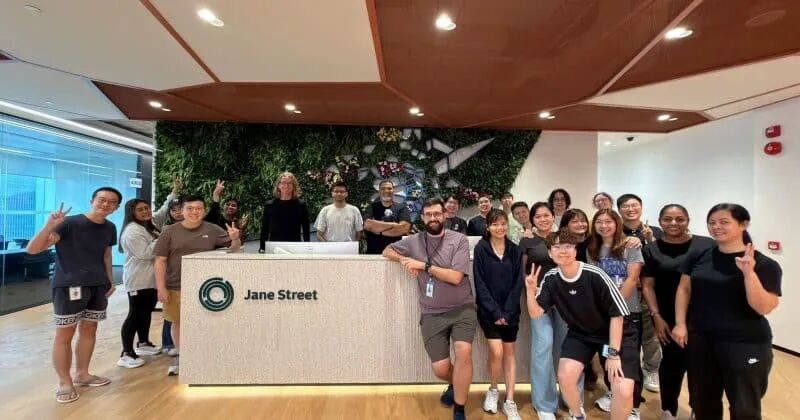
What would happen if Magic Square Quantification, managed by Liang Wenfeng, had chosen to focus on investment instead of developing large models?
This is a very interesting question. Jane Street, a quantitative trading firm on Wall Street, not only achieved a net profit of up to $39.6 billion but also held a significant stake in Anthropic several years ago, and has now made a 50-fold profit.
While a16z transformed into a KOL and advocated a new transformation of investment institutions into media, Jane Street explored a new form of becoming an "AI-native financial organization" by betting on AI models and AI infrastructure.
All in AI
Jane Street is a somewhat mysterious quantitative trading firm on Wall Street, known for its high density of mathematical geniuses, exorbitant salaries, and extreme low - key approach with almost no public relations. In 2025, their net trading profit reached $39.6 billion, exceeding the trading revenues of Goldman Sachs and JPMorgan Chase, equivalent to the profit a medium - sized investment bank would make in ten years.
This firm has recently done two things that seem a bit "off - track" to outsiders.
First, in April this year, Jane Street reached an agreement worth approximately $7 billion with CoreWeave, one of the world's most important AI computing infrastructure providers: about $6 billion was used to purchase its AI cloud computing power, and an additional $1 billion was used to buy shares of CoreWeave at a price of $109 per share.
Second, they hold a stake in Anthropic, and it's not a small amount: the entire private AI investment portfolio is valued at about $20 billion, with Anthropic being the major position.
The question is, how did they initially acquire the stake in Anthropic?
There is a detail worth clarifying here - after the collapse of FTX in November 2022, this part of Anthropic's stake was trapped in the bankruptcy liquidation process. It wasn't until March 2024 that the FTX bankruptcy asset management team officially finalized the sales plan: selling about two - thirds of their Anthropic shares to a group of institutional buyers for a total of $884 million. Jane Street was the second - largest buyer in this transaction, spending nearly $100 million to buy approximately 3.33 million shares.
The implied valuation of Anthropic corresponding to this transaction at that time was about $16.6 billion - not exactly cheap, but far from the astronomical figures that came later. By early 2026, the subscription price offered by VCs for Anthropic had exceeded $800 billion; after the Series H financing completed in May, the post - investment valuation soared to $965 billion.
Calculated, Jane Street's nearly $100 million investment back then has seen a book value increase of more than 50 times.
This is not just good luck. It's a typical Jane Street approach: accurately pricing when others are fearful and liquidity dries up, and then waiting - it's just that this waiting time was longer than many people expected.
The Money - Making Flywheel of Investment + AI
However, the high investment return itself is not the most interesting story. The really interesting part is that Jane Street's investment in Anthropic is completely different in nature from that of an ordinary VC.
An ordinary VC invests in Anthropic with the logic of "this company will grow, and I will make money."
Jane Street invests in Anthropic with the logic of "this company creates a stronger model, our trading system will also become stronger, then we make more money, then we have more money to continue betting on AI, and then the model continues to get stronger..."
Some in the industry call this a "synergistic compound flywheel." I think a more straightforward way to put it is that Jane Street is playing a game of "mutual acceleration between the investor and the investment target." They are not doing charity, nor are they simply making financial allocations. They are using capital to purchase a source of ability that can feed back into their core competitiveness.
To understand this, we must first understand that Jane Street's core competitiveness is not capital, but "the ability to price uncertainty faster and more accurately".
The essence of quantitative trading is to find signals in a vast amount of information that the market hasn't reacted to yet and complete the transaction before the price corrects. This ability will be magnified exponentially in the AI era - or, if you don't have top - tier AI, you will be left far behind by your competitors.
This explains why Jane Street has quietly built a data center with 4032 liquid - cooled GPUs in Texas, expanding from the initial six Dell servers to the current scale. This is not just about "using AI to assist trading"; it's about vertical integration - from chip computing power to the model, to the final trading decision, forming a complete chain that is difficult for others to replicate.
By the way, currently, Jane Street has more than 3,500 employees and is still continuously expanding. This growth rate is a bit unexpected for a company known for its low - key style.
"Quiet Money" Reshaping AI
When you look at this in a broader context, you'll find something a bit disturbing.
Just last month, two things happened almost simultaneously around Anthropic. On the one hand, on June 12, the U.S. Department of Commerce issued a directive requiring Anthropic to obtain U.S. government approval before foreign users can access its most powerful models, Fable 5 and Mythos 5 - behind this is the escalating tension between the government and Anthropic over the past few months, and it was even once listed as a "supply - chain risk" by the Pentagon.
On the other hand, at the G7 summit after this storm, when Trump was interviewed by Axios, he said something thought - provoking: "It's not a threat now, but maybe it was a week ago." - In other words, he admitted that he had regarded Anthropic as a national security threat, but his attitude softened after the meeting. Behind this statement is a regulatory crisis that has just subsided but is far from being as calm as it seems.
Meanwhile, just last week, John Jumper, the Nobel laureate and the father of AlphaFold, announced that he was leaving Google DeepMind to join Anthropic. The significance of this talent signal needs no explanation to those in the industry.
Anthropic's situation is the result of the simultaneous pressure of geopolitical stress, regulatory uncertainty, and rapid improvement in research capabilities. And Jane Street holds a large stake in Anthropic at this time and continues to increase its investment in AI infrastructure - this shows that there is "quiet money" that has made its own judgment.
It's worth asking a question here: When a trading institution with an annual income of nearly $40 billion starts to allocate AI assets on a large scale in the private market, it changes not only its own balance sheet but also the competitive dynamics of the entire early - stage AI financing market. The annual commitment of billions of dollars to AI infrastructure is a figure large enough to influence market pricing itself in a track where single - round financing often reaches tens of billions of dollars. In other words, Jane Street's entry has made the price signals in the primary AI market more complex.
Of course, there are risks. The valuation of private companies is not as transparent as that of the public market. In a $20 - billion investment portfolio, how much is "paper wealth" rather than real liquidity is a real problem. Anthropic has not gone public yet. Although there are rumors in the market that it may go public as early as October this year, this monetization path is not a certainty in an environment of policy uncertainty.
"AI - Native Financial Institution"
You may have been wondering what term to use to describe Jane Street's current form. "A quantitative fund that has invested in AI" is not accurate enough, and "an AI company" is also incorrect.
A recent statement might be more appropriate - "an AI - native financial institution." It means that it is not a bank that uses AI tools, but a trading institution where AI capabilities have become the core of its business model, and the capital of this institution is in turn nurturing the AI companies that generate such capabilities.
This is a new species, not just an old species with an AI shell.
Looking back, the timeline of Jane Street's entry into AI seems somewhat inevitable: the collapse of FTX in 2022 put Anthropic's shares into the liquidation process. In early 2024, they completed a bottom - fishing at a price far lower than the later valuation. From 2025 to 2026, as Anthropic's valuation soared from more than $10 billion to nearly $1 trillion, they achieved an excess return. In 2026, they continued to increase their investment in CoreWeave, built their own GPU data center, and expanded their team size simultaneously. Each step is not an isolated financial decision but part of building an overall system.
Currently, the scale of this system includes more than 3,500 employees, a $20 - billion AI investment portfolio, self - built computing infrastructure, and a deep interest tie - up with Anthropic, the most cutting - edge AI laboratory.
Jane Street has reached the middle stage of this game.
*Image source: Jane Street
This article is from the WeChat official account “GeekPark” (ID: geekpark), author: Hua Lin Wuwang. Republished by 36Kr with permission.