What will the listing of the first batch of commercial real estate REITs bring?
On June 18th this year, there was no longer the atmosphere of the mid - year e - commerce promotions of previous years. Instead, the video footage of the bell - ringing ceremony at the Shanghai Stock Exchange kept flooding my WeChat Moments and groups.
Huatai - PineBridge Shanghai Real Estate Commercial REIT, CSC Capital First Agricultural Commercial REIT, Guotai Junan Haitong SASIAO Commercial REIT, and CICC Vipshop Commercial REIT. Four commercial real estate REIT products were listed on the Shanghai Stock Exchange simultaneously!
Since the China Securities Regulatory Commission (CSRC) issued relevant pilot policies at the end of December last year, in less than half a year, China's public offering REITs market has officially entered a new stage of dual - wheel drive of "infrastructure and commercial real estate" from the single track of "infrastructure".
The Door to Public Offering REITs
Is Opening at an Accelerated Pace
To see how fierce the momentum of commercial real estate REITs is, we can first make a comparison with the situation when the first batch of 3 consumer infrastructure real estate REITs were listed in China in March 2024.
At that time, the three products, Huaxia JINMAO Commercial REIT, CCBPrincipal Wumart Consumer REIT, and Huaxia China Resources Commercial REIT, included 2 shopping malls and 4 community commercial properties (chain supermarkets), with a total fundraising scale of 8.923 billion yuan.
After more than two years, there are already 12 products in the market on this track, with a total issuance scale of 30.258 billion yuan.
And the commercial real estate REITs track is completely at a different speed. Including the 4 products that have already had their bell - ringing ceremonies, within half a year, a total of 21 commercial real estate REITs have been accepted in the entire market, with a proposed fundraising scale of over 60 billion yuan, which is nearly twice the issuance scale of the listed consumer infrastructure public offering REITs.
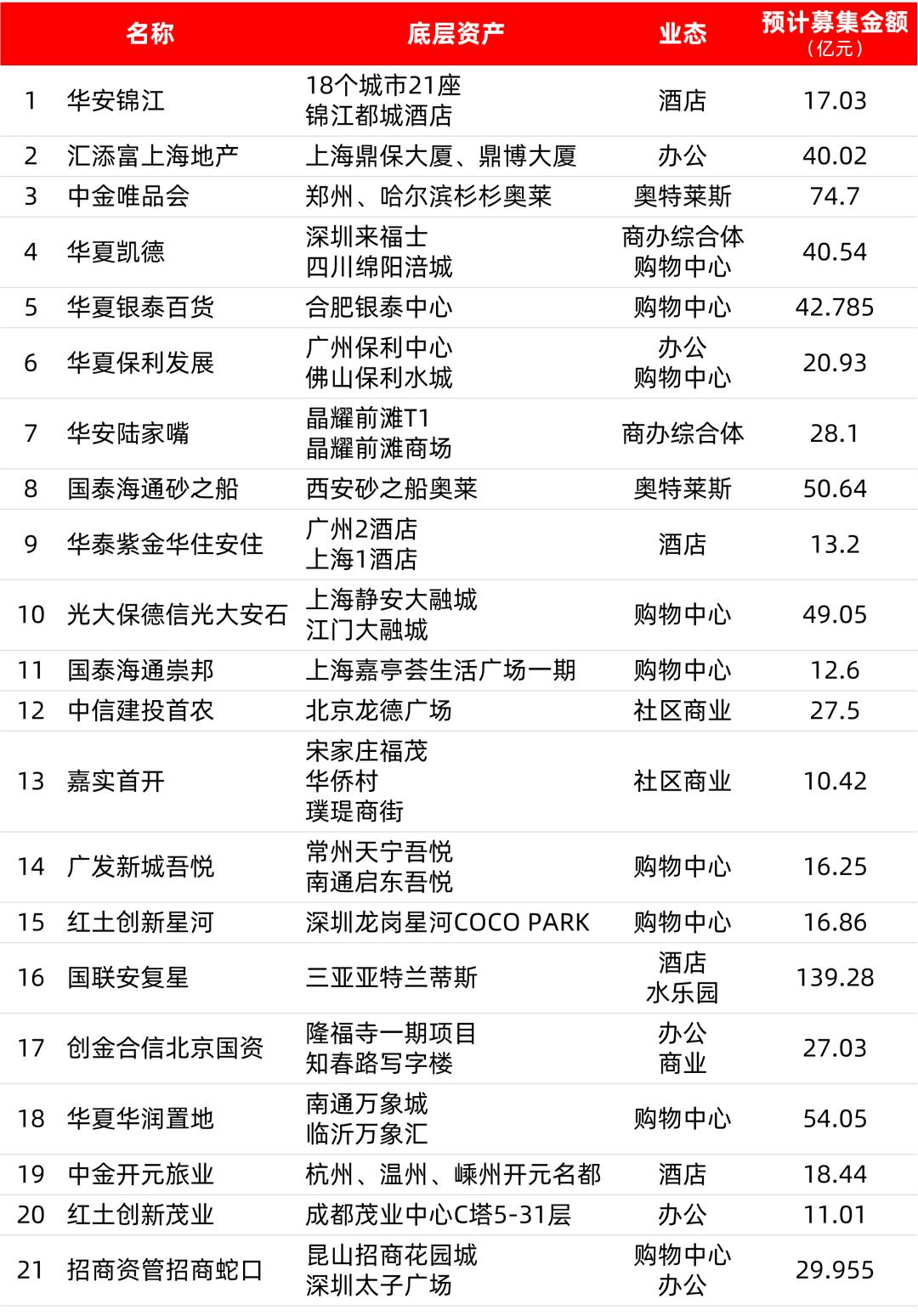
In terms of asset types, the first batch of commercial real estate REITs cover shopping malls, outlet malls, and office buildings, with a more diverse range of types. In addition, among the currently declared projects, there are also hotels, water parks, comprehensive complexes, and even partial floors of a project.
Comparing the two tracks, the conclusion is clear: The door to REITs for commercial real estate is opening at a visible speed.
On the one hand, with infrastructure REITs as the "pioneers", the original equity holders this time: Shanghai Real Estate, Vipshop, and the First Agricultural Food Group are all "multi - round players" in the mainland REITs track, and SASIAO also has experience in issuing REITs in Singapore. They can be said to be mature players.
On the other hand, different approval processes have indeed shortened the cycle of "declaration - approval - listing" for products. Some brokerage peers shared with me that under all - smooth circumstances, it may only take less than a quarter of a year for a commercial real estate REIT product to go from the brokerage team's start of work to the acceptance of the declaration.
After the Bell - Ringing
The Market Test Becomes More Stringent
But just because the door is wide open doesn't mean everyone who enters can achieve the same results. Just like the number of college admissions this year has exceeded the number of newborns last year, but still, more parents are worried that their children won't be able to find jobs after graduation.
Judging from the performance on the first day, although all four products had a "good start" at the closing, the data has shown differentiation.
Guotai Junan Haitong SASIAO Commercial REIT led with an 11.08% increase. It was also the product with the highest offline subscription multiple and the largest increase during the pricing stage.
Huatai - PineBridge Shanghai Real Estate Commercial REIT, whose underlying assets are two office buildings in Shanghai, ranked last with a 0.02% increase. In fact, for most of the trading time, its price fluctuated below the issue price.
Although the six underlying assets of these four products are all high - quality and mature projects with a rental rate of over 98%, there are disputes over the underlying operation value.
For example, some people are worried that assets like office buildings are exposed to a more severe industrial cycle than retail properties, and there are too few good tenants. Among the existing tenants, the proportion of large - tenant income is too high, and it also includes a design institute that is experiencing an industry downturn, which is also a risk factor.
Of course, some friends firmly believe that state - owned property owners and state - owned enterprise tenants will definitely have measures to reassure investors in terms of stability.
This difference in confidence in "operation quality" will become the key to the decision to buy or sell.
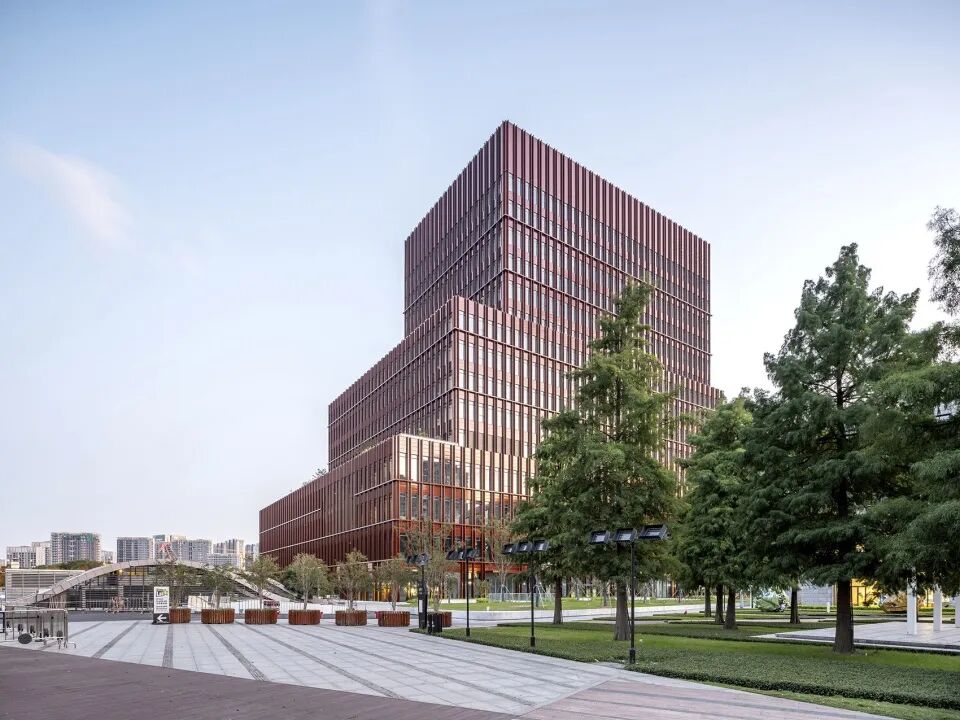
One of the underlying assets of Huatai - PineBridge Shanghai Real Estate Commercial REIT is Shanghai Dingbo Building | Source: Gooood
Considering that in the first four products, institutional investors generally hold more than 90% of the shares, and some hold more than 99%. The price trend on the first day is almost a statement made by professional investment institutions with real money:
Whether to believe in the price - supporting ability of the original equity holders and fund managers or to bet on the market - oriented competitiveness of the assets themselves, the price has given the answer.
From this perspective, what I wrote in an article before: Commercial real estate is not "better" REITs. On the contrary, it may be "more difficult" REITs. This is beginning to show signs - for investors, not every underlying asset has excellent operation data that allows them to buy without thinking. In addition to office buildings, some of the declared shopping malls have also experienced adjustments of anchor stores, declines in rental rates or unit rental prices in recent years. More professional judgment is needed to select suitable targets.
For original equity holders, the access threshold may be getting lower, but the market's scoring criteria have not decreased. In fact, due to more choices and the recent strong performance of the stock market, investors have become more picky.
For the operation team, the bell - ringing moment determines whether the boss can get on board, but it is the closing moment that determines whether they can really be recognized by the market. The market will prove once again that operation is king.
Beyond Public Offerings
The Multi - Level REITs Market Is Growing at an Accelerated Pace
In the past half - year, in addition to the various commercial real estate REIT products being declared in a hurry, the entire chain around public offering REITs has also been accelerating simultaneously.
This means that even if the project you are involved in will not issue commercial real estate or consumer infrastructure public offering REITs, you may still be exposed to capitalization operations through various channels.
At the end of 2025, the CSRC issued the "Notice on Promoting the High - Quality Development of the Real Estate Investment Trust Fund (REITs) Market", clearly stating "Support qualified public funds to include REITs in their investment scope". Currently, several bond - based public funds have included REITs in their investable scope.
That is to say, even if you don't directly buy REITs in the future, the other funds you buy may "invest in REITs on your behalf".
On June 17th, the CSRC approved the first batch of 4 public funds tracking the CSI REITs Total Return Index, with an estimated fundraising scale of about 1.2 billion yuan. They currently cover 53 REITs, accounting for 60.9% of the total number of REITs in the market and 76.6% of the total market value, thus providing a new index investment tool for more passive investors.
In addition, in last year's document, the CSRC also clearly mentioned promoting the inclusion of REITs in the Shanghai - Hong Kong and Shenzhen - Hong Kong Stock Connect programs, researching and exploring REITs ETFs, and guiding long - term funds such as insurance, social security, and annuities into the market.
These measures will bring more capital inflows to the entire market and enhance the trading liquidity of public offering REITs.
Beyond the public offering market, the inter - institutional REITs and Pre - REITs markets, which are in earlier stages, have also become more active.
Just last week, the CITIC Securities - China Resources Commercial Real Estate Asset - Backed Special Plan was successfully issued on the Shanghai Stock Exchange. This is an inter - institutional REIT (also known as a private REIT) issued by China Resources Land with properties such as Chengdu Mixc City and Chengdu Kapok Hotel as underlying assets.
The project's registered amount is 9.527 billion yuan. The face value of the current asset - backed securities does not exceed 6.027 billion yuan, with each having a face value of 100 yuan, and the issue price reached 116.14 yuan per 100 - yuan face value.
Going back to December 25th last year, China Resources Land, together with CITIC Jingshi Fund and Huaxia Equity, jointly established two private equity investment funds for shopping malls with a total scale of 3 billion yuan, targeting Xi'an Xixian Mixc City, Guiyang Mixc Mall, and an under - construction shopping mall in Dalian, and clearly stated that they would give priority to exiting through public offering REITs in the future.
It's not just China Resources. On May 27th, the inter - institutional REIT with the Wuhan Xintiandi project as the underlying asset: Huatai Asset Management - Caitong - Shui On Xintiandi Hold - type Real Estate Asset - Backed Special Plan was accepted by the Shanghai Stock Exchange, with a proposed issuance scale of 5.792 billion yuan.
At the end of April, the TEDA Aircraft Carrier Hold - type Real Estate ABS was issued on the Shanghai Stock Exchange, with an issuance scale of 1.32 billion yuan. The underlying asset is the Tianjin Aircraft Carrier Theme Park. This is the first inter - institutional REIT in the cultural and tourism field in China.
In November 2025, Seazen Holdings issued the first consumer - type inter - institutional REIT in China with the Shanghai Qingpu Wuyue Plaza as the underlying asset. And in March this year, it successfully applied for its first expansion and was accepted by the Shanghai Stock Exchange, with an estimated fundraising scale of 1.625 billion yuan.
From cities, enterprises, to project types, issuance, and expansion, around the ultimate and most important exit door of public offering REITs, a series of multi - level REITs markets are quietly growing at the same rapid pace.
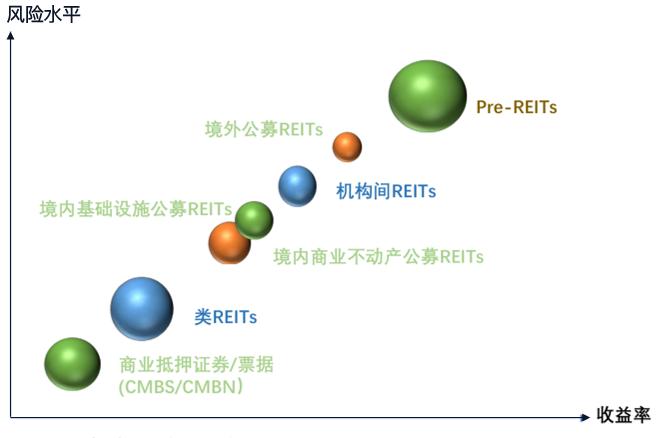
Illustration of the multi - level REITs market. The size of the spheres represents the relative size of the market | Source: REITs Industry Alliance
Yesterday marked the 5th anniversary of the first batch of public offering infrastructure REITs being listed. From 0 to 82 products, with a total scale exceeding 210 billion yuan, many people believe that China will soon become the largest REITs market in Asia.
But compared with the stock of assets, this figure is still just the tip of the iceberg. According to the sharing of Cai Yun, the secretary - general of the Commercial, Cultural, and Tourism Real Estate Professional Committee of the China Real Estate Association, it is roughly estimated that the capital value of China's overall physical assets (as of the end of 2021) should be between 150 and 200 trillion yuan, among which narrow - sense commercial real estate (only referring to retail properties, office properties, and hotels) is between 40 and 50 trillion yuan.
I made an estimate. Comparing the market share of REIT - based commercial real estate in the United States, Japan, and Singapore, the space for REIT - based narrow - sense commercial real estate (retail properties, office properties, and hotels, excluding other infrastructure) in China is at least over 200 billion yuan in scale.
The new listings of 20 billion yuan and the declarations of 60 billion yuan are just the starting point of this market.
Start with the End in Mind
Embrace the Next Decade
As more and more investors start to pay attention to this track and more and more projects are put on the exchange's list, more and more peers are asking what we should do and what to do with the projects.
Some of the questions I've received recently are from the pre - planning and product departments of some leading operators: What kind of shopping malls do REITs like? How should we match this preference from the product development stage?
I think the phrase "start with the end in mind" will appear more frequently in the meetings of many companies and projects than ever before.
Many developers have already taken action. For example, I heard that some central state - owned enterprises have clearly required in the contract terms for new land acquisition that the project should be allowed to exit through REITs in the future to avoid the exit restrictions caused by the common 10 - year or 20 - year self - holding and sales requirements of local governments.
At the end of last year, when I interviewed Lu Zhisheng, the managing director and head of CapitaLand Investment (China) Commercial Management, Mr. Lu also shared a unique competitiveness of CapitaLand in entering the light - asset field. As the largest REITs manager in the Asia - Pacific region, for property owners aiming for late - stage exit, CapitaLand Investment will, through its investment and fund teams and various market partners, share its unique advantages and mature experience and make pre - resource grafting and basic preparations for them from the early stage of cooperation.
They all agree that REITs have already affected the most front - end of land acquisition decisions and product planning. From the moment of project establishment, space should be reserved for exit in ten years.
In addition to new development, another major beneficiary may be urban renewal.
In the past, there was almost no standardized exit channel for such projects, and they could only rely on fiscal funds, special bonds, and local state - owned enterprises for incubation. But in December 2025, the National Development and Reform Commission included urban renewal facilities as an independent category in the issuance scope of infrastructure REITs for the first time. Coupled with the implementation of commercial real estate REITs, this path has now been truly opened up.
In April this year, the first "urban renewal + technological innovation" REITs in China were declared and accepted. The Beijing Longfu Temple Phase I project among the underlying assets is a landmark project for urban renewal and old - city revival in Dongcheng District.
Its acceptance means that even urban renewal projects with certain public attributes can enter the capital market as