Smaller cities in third- and fourth-tier regions are also striding into the all-electric era.
"Little sister, what do you think of this car?"
In mid - May, my cousin from my hometown suddenly forwarded a promotional short video of a pure electric vehicle, seemingly interested in buying one.
Before this, I had discussed the matter of purchasing a pure electric vehicle with many friends. Logically, I should have been used to it by now. However, when the communication partner became my cousin from my hometown, I was still quite surprised.
I'm from a low - tier city in the north. Two years ago when I returned home, I specifically asked several elders, cousins, and even my friends' parents about their views on electric vehicles. At that time, the responses were highly consistent: electric vehicles are not safe, and in winter, there's a fear of running out of power and getting stranded. If you really want to buy a car, it has to be a fuel - powered one. In recent years, several relatives in my family have indeed replaced their cars one after another, and all of them are fuel - powered vehicles. Not even one person has included an electric vehicle in their list of alternatives.
For this reason, when I received the video sent by my cousin, what I felt was not just a loosening of his personal attitude, but also a microcosm of the quiet change in the attitude towards pure electric vehicles in low - tier cities.
Two years ago, electric vehicles were regarded as "a scourge" here: there were only a few charging stations. The hearsay that the winter range was cut in half spread faster than the real data. A joke among relatives and neighbors like "How can that electric vehicle work?" was enough to completely kill the hesitant idea of buying an electric vehicle.
However, now, the popularization of electric vehicles seems to have become quite common. During my observation when I went home for the Dragon Boat Festival, it's not hard to find that there are more and more green - licensed vehicles on the roads in my hometown; in the community where there used to be only fuel - powered vehicles parked, new energy vehicles have begun to appear sporadically; at the gas station I often go to, there is even a new sign of "EV Charging Station" behind the original sign, and several new charging piles have been set up in the empty space.
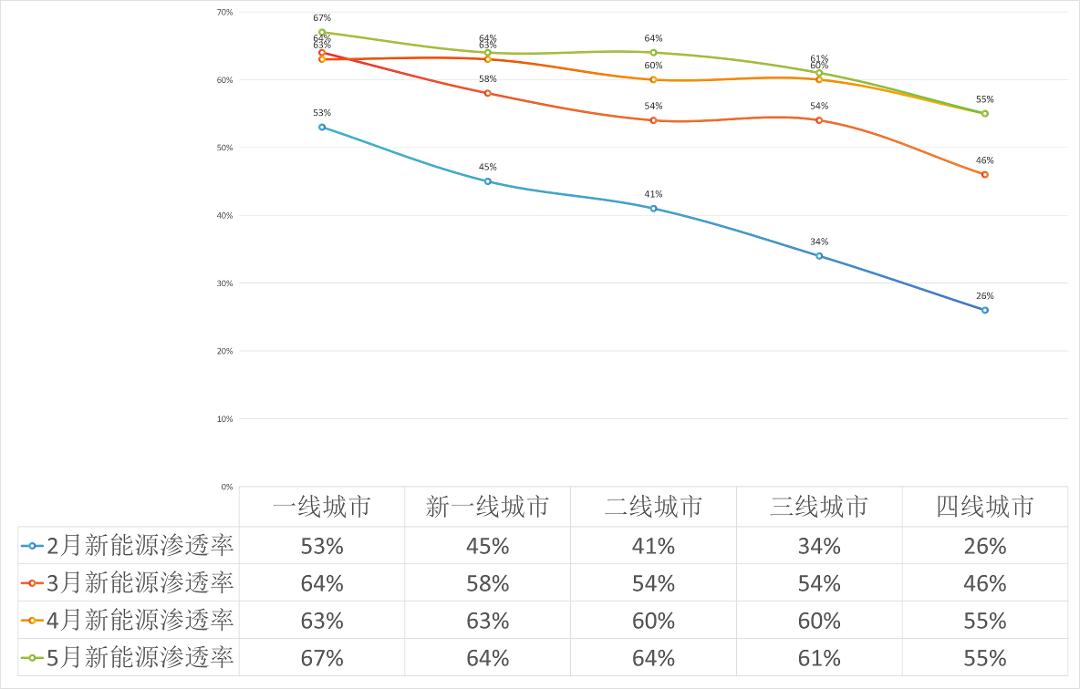
The domestic new energy retail penetration rate exceeded 60% for the first time in April and climbed to 62.9% again in May. Behind the rising new energy penetration rate, the efforts of low - tier cities cannot be ignored. Jielanlu data shows that the new energy penetration rate in third - tier cities has jumped from 34% in February to 61% in May, and in fourth - tier cities, it has climbed from 26% to 55%.
Under the rolling wave of new energy vehicles, small third - and fourth - tier cities have also begun to charge forward into the pure - electric era.
01
Two generations, the old and the young,
Two quarrels about pure electric vehicles
"Don't drive. I'll come and pick you up."
When I was about to drive the family's fuel - powered car to a dinner, my childhood friend called me. Ten minutes later, my childhood friend drove her newly - purchased Xiaopeng MONA M03, which she had bought half a year ago, slowly towards me.
"How is the car to drive?" Since it was my first time in her new car, I took the opportunity to ask about her driving experience.
"I love it so much. It's so comfortable to drive." When talking about her beloved car, my childhood friend's tone clearly rose. "I've already driven 30,000 kilometers in it so far."
"Didn't your family used to disagree with you buying an electric vehicle? What happened later?" I remembered that when I went home before, due to the non - standard driving of the oncoming driver, my childhood friend had just experienced a minor car accident. The old Ford that she had gotten from her parents, which was more than ten years old, was scrapped. The whole family was looking for a new car.
At that time, my childhood friend, who had always driven the family's old - style fuel - powered car, was eager to buy a pure electric vehicle. "I have a cousin who runs a seafood store. He bought a Xiaomi SU7 and said it's good. I also have an uncle who drives a Tesla. He said it's great."
However, my childhood friend's rather conservative father stubbornly believed that the development of electric vehicles was not mature and was very resistant to it. He even said bluntly, "Those who buy new energy vehicles are fools."
For this reason, my childhood friend and her father had several fierce quarrels. They couldn't reach an agreement on whether to choose an electric vehicle or a fuel - powered one. My childhood friend's mother, who was in charge of the family finances, had a more relaxed attitude towards electric vehicles. "On the one hand, there are already two fuel - powered vehicles in the family, so my mother thinks it's acceptable to buy an electric vehicle. On the other hand, several relatives in the family have bought electric vehicles and said they're okay, so my mother isn't as worried anymore."
Finally, after being persuaded by my childhood friend's mother, her father finally made a compromise. On December 31, 2025, on the last day of the new energy vehicle purchase tax exemption, my childhood friend finally bought an electric vehicle as she wished. With the start of the new year, the attitudes of my childhood friend's parents also changed greatly with the addition of the new car.
"Before buying the car, we quarreled about buying an electric vehicle. After buying it, we quarreled about who would drive it."
According to my childhood friend, although her father made a compromise before buying the car, he still had doubts about electric vehicles. However, after driving it, his doubts disappeared. "My father also had a great driving experience in this car. Like me, he likes it very much. My mother was afraid to drive at first, but then she dared to. Now we have a conflict."
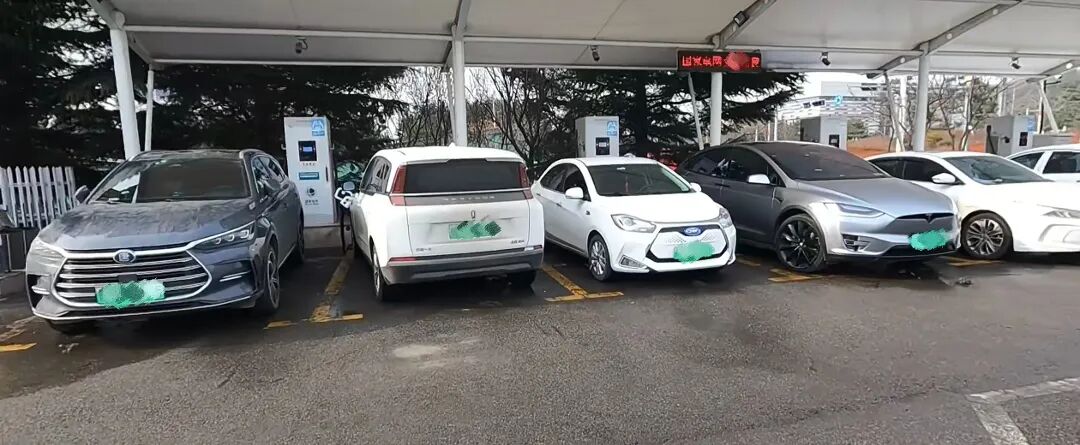
My childhood friend said that her mother just retired this year and is looking for a small business. She needs a car to transport goods. Electric vehicles not only have low electricity costs but also are easier to drive than the old fuel - powered car she has. So she sometimes asks to swap cars with my childhood friend.
"One morning when I was about to go to work, my mother told me she wanted to drive my car to deliver goods. I got really angry. Before that, we had swapped cars for two days. Her car's seats can't be laid flat for a nap at noon, and I haven't had a good nap for two days.
Moreover, since I'm used to driving an electric vehicle, I find the steering wheel of a fuel - powered car heavy and the brakes not as sensitive. I almost hit someone several times. I was very angry and didn't want to swap cars, so I had a quarrel with her."
Besides the driving experience, there is another important reason why my childhood friend loves electric vehicles: convenient and cheap energy replenishment. There is a fast - charging station across the road from where she works. "The first time I charged the car, it only cost me more than ten yuan, and it was fully charged in a short time. Now, when the battery level is below 50%, I send the car there to charge. Although the range is reduced in winter, I don't have range anxiety. However, the electricity price has increased recently, and it costs five or six more yuan to charge each time."
After the real - life experience, my childhood friend said that the family will probably choose an electric vehicle again the next time they change a car.
02
The middle - aged and young in between,
Hesitation and turn
The young are open to the new energy trend, and the elderly can be driven by the young to try and gradually accept new things. However, the middle - aged and young group in between has very real anxieties.
Take my cousin as an example. In a situation where few relatives and friends around him have bought electric vehicles, choosing to buy an electric vehicle is quite a risky move.
"There are concerns. We don't know whether the development of new things is perfect or if there are some tricks that consumers don't know about. We're in the dark about these issues."
More specifically, after driving fuel - powered cars for nearly twenty years, consumers' understanding of electric vehicles in terms of insurance, sheet metal, in - car systems, batteries, and maintenance is only based on hearsay and online information. They lack real - life driving feedback. Especially with the mixed voices on the Internet, it's difficult for them to distinguish the truth about key driving experiences such as battery range, maintenance, and replacement. They want to buy but are afraid of problems in the future.
However, with the development of battery technology, the decline in the price of new energy vehicles, and the short - term increase in fuel prices, consumers' concerns about vehicle - use costs gradually outweigh their doubts about pure electric vehicles. The sales of electric vehicles in third - and fourth - tier cities have increased rapidly.
"This year's sales situation is very obvious. It wasn't as obvious last year. Although there is a purchase tax now, more cars are sold than last year, and there are obviously more electric vehicles on the road, especially since March." Xiao Wang, a salesperson at a Changan Qiyuan 4S store, has a deep feeling about the market change.
Xiao Wang's personal feeling also echoes the overall market situation. Jielanlu data shows that in February this year, the sales volume of new energy vehicles in third - tier cities was less than 90,000, with a penetration rate of only 34%; in fourth - tier cities, the sales volume was only 72,000, with a penetration rate of less than 30%. However, in March, affected by the oil price, the sales volume of new energy vehicles in third - and fourth - tier cities doubled year - on - year, and the penetration rate soared to 54% and 46% respectively. In April and May, the sales volume of new energy vehicles continued to grow steadily, and the penetration rate was even on par with that of second - tier cities.

Xiao Wang introduced that due to the hot sales, many popular models are out of stock, and they need to transfer goods from other places. "Take this car (Qiyuan Q05) as an example. Now, two cars are shipped out every morning and delivered at noon. There are still more than 300 undelivered orders in the whole city."
When talking about the reason for the sharp increase in the sales of new energy vehicles, Xiao Wang believes that besides the influence of the oil price, the change in consumers' concepts is also a key factor. "In the past, few people around bought electric vehicles. If you wanted to buy one, you'd have second thoughts or just not consider it. Now that they're gradually becoming popular, you start to wonder whether to buy one or not. But when you see more people around you buying them, you're more willing to buy one."
This view is also confirmed in other 4S stores. In 4S stores of BYD, Leapmotor, Li Auto, etc., there are customers of all ages. In fact, in the Li Auto store, because test - drives are so popular, I went to the store several times but didn't see any salespeople.
Although the acceptance of electric vehicles among consumers in low - tier cities has increased significantly and the new energy penetration rate has been rising, the other side of the market is also real and cruel. Driven by the "herd mentality for stability", the situations of different brands in the emerging market are like ice and fire.
On the Dragon Boat Festival, I visited more than a dozen new energy stores in the local area, and the huge difference in the scenes was very impressive. In the showrooms of leading and mainstream brands such as BYD, Geely Galaxy, Leapmotor, and Changan Qiyuan, there were crowds of people. Customers who came to look at the cars and inquire about the prices kept coming. To arrange a test - drive, you usually have to wait for twenty or thirty minutes. Next to these stores, some new energy brand stores with lower popularity were deserted. The salespeople were bored at the door, waiting for customers to come. The test - drive cars were parked neatly at the door of the showroom, rarely attracting anyone's attention.
Compared with the relatively dense charging network in first - tier cities, the energy - replenishment conditions in third - and fourth - tier cities are still a bit insufficient. Take the layout of BYD's flash - charging stations as an example. Although all three districts and one county in my city have been allocated construction quotas and the projects are planned to be completed one after another in the second half of this year, it's still doubtful whether they can really relieve the charging anxiety after they're put into use. The nearest flash - charging station to my home is about 6 kilometers away, and it takes more than ten minutes to drive there one - way. Even without considering the waiting time in the queue, a single charging itself takes nearly 40 minutes.
However, besides the shortcomings, there is also a comforting aspect. The energy - replenishment cost in third - and fourth - tier cities is really attractive. Although the charging price has been adjusted recently, it's still not difficult to find a charging station with a price of four cents per kilowatt - hour. Even during peak hours, there are few stations with an electricity price exceeding six cents per kilowatt - hour.
This economic calculation really hits the pain point of "vehicle - use cost", which is what consumers in low - tier cities care most about when buying a car. Once car owners accept the geometric drop in mileage cost, the real cost - effectiveness becomes the most powerful reason to persuade them to take the step from fuel - powered to electric vehicles.
This change is most obvious in the word - of - mouth communication in the acquaintance society. Just like my childhood friend's father, the electricity cost of only about a thousand yuan for 30,000 kilometers in half a year is enough to make this once - firm supporter of fuel - powered cars do a 180 - degree turn.
Although these cases and facts are just the tip of the iceberg, it's undeniable that pure electric vehicles, which were once regarded as "impractical and unreliable", are now rewriting people's inherent perceptions on the streets and alleys of third - and fourth - tier small cities with the most real driving experiences. From firm rejection to active inquiry, from being ignored to waiting in line for a car, from family quarrels to the whole family scrambling, the pure - electric wave in low - tier cities is coming faster and more violently than expected.
In this sudden era shift, third - and fourth - tier cities are no longer bystanders but real participants and promoters. With the awakening of residents in third - and fourth - tier small cities, the era of all - electric vehicles in the sinking market is fully unfolding.
This article is from the WeChat public account "Automobile Commune" (ID: iAUTO2010), author: Sai Jiatong, editor: He Zengrong. Republished by 36Kr with permission.