When new technologies advance with overwhelming momentum, there exists a smart way of life, which is to take the initiative to retreat.
When new technologies emerge, it may not always be feasible for old technologies to make a bold retreat, and it's even less likely to be the most appropriate choice. However, it's an option that must be considered when reviewing strategies. If a company retreats to its existing niche or enters a new market, it may continue to operate successfully, although perhaps on a smaller scale than before. Such a market position can serve as a safe haven for the company to regain strength and wait for new growth opportunities.

When a new and superior technology is about to emerge and threaten your current main business, what will you do? The traditional answer is usually to transform and embrace the new technology. However, in reality, too many companies are reluctant to admit that they lack the ability to transform, and end up failing miserably on the path of blind transformation.
Of course, some companies may judge that they cannot or should not transform, perhaps because they lack the necessary capabilities or financial resources, or they believe that the new technology may not ultimately prevail. So they choose to double down on their existing technologies and try to improve their performance. In fact, such an approach can sometimes be effective. For example, in the face of the rise of digital word processing, electric typewriter manufacturers launched more popular new models and added eye - catching features such as spell - checking, whole - line deletion, and multiple fonts; while traditional film camera companies developed the "Advanced Photo System" (APS) in the face of the threat of digital cameras, improving print quality and introducing new experiences such as the option of multiple photo formats and cassette - style index printing.
However, this "last - ditch effort" strategy can mostly only delay the outcome. Eventually, the new technology with better performance will almost always prevail. When managers of old - technology companies try to delay the inevitable change, they often waste resources in vain and weaken the company itself.
Our research on the history of technological change shows that when new technologies emerge, companies relying on mature technologies actually have a third option - retreat to those niche areas where they still have an advantage and let the old technology continue to play its value in the niche market. Long after the glory of the core market fades, these companies can still maintain a stable business performance.
For example, after the popularization of marine engine power systems, Linjett's leisure sailboats remained popular; after jet turbine engines dominated commercial aviation, Continental still successfully held onto the piston - engine market for private planes; and StorageTek found a profitable niche for its tape - drive technology in large - data file storage, effectively resisting the attack of disk drives in the mainstream storage market.
Retreat is not just a concession
What these companies do is what we call a "bold retreat". It is called a "retreat" because they actively give up the main market they originally occupied, cede the opportunity to the rapidly emerging new technology, and then look for a safer position where they can remain competitive.
This strategy is "bold" because it is not a passive defense but an active choice: instead of confronting the new technology head - on, they reposition their own advantages. Take Linjett, Continental, and StorageTek as examples. They readjust their market layout and expand the value boundary of their capabilities; they choose to maintain a stable and sustainable niche in the traditional market, or simply turn to niche areas where the old technology still has an advantage, or they may take a two - pronged approach.
When formulating traditional strategies, a bold retreat should always be considered. In this way, managers can avoid taking excessive risks by overestimating their own strength and blindly competing with new technologies. At the same time, a bold retreat can provide valuable time and resources for a company's real transformation - especially during an economic downturn, extending the profit cycle of the old technology is often crucial.
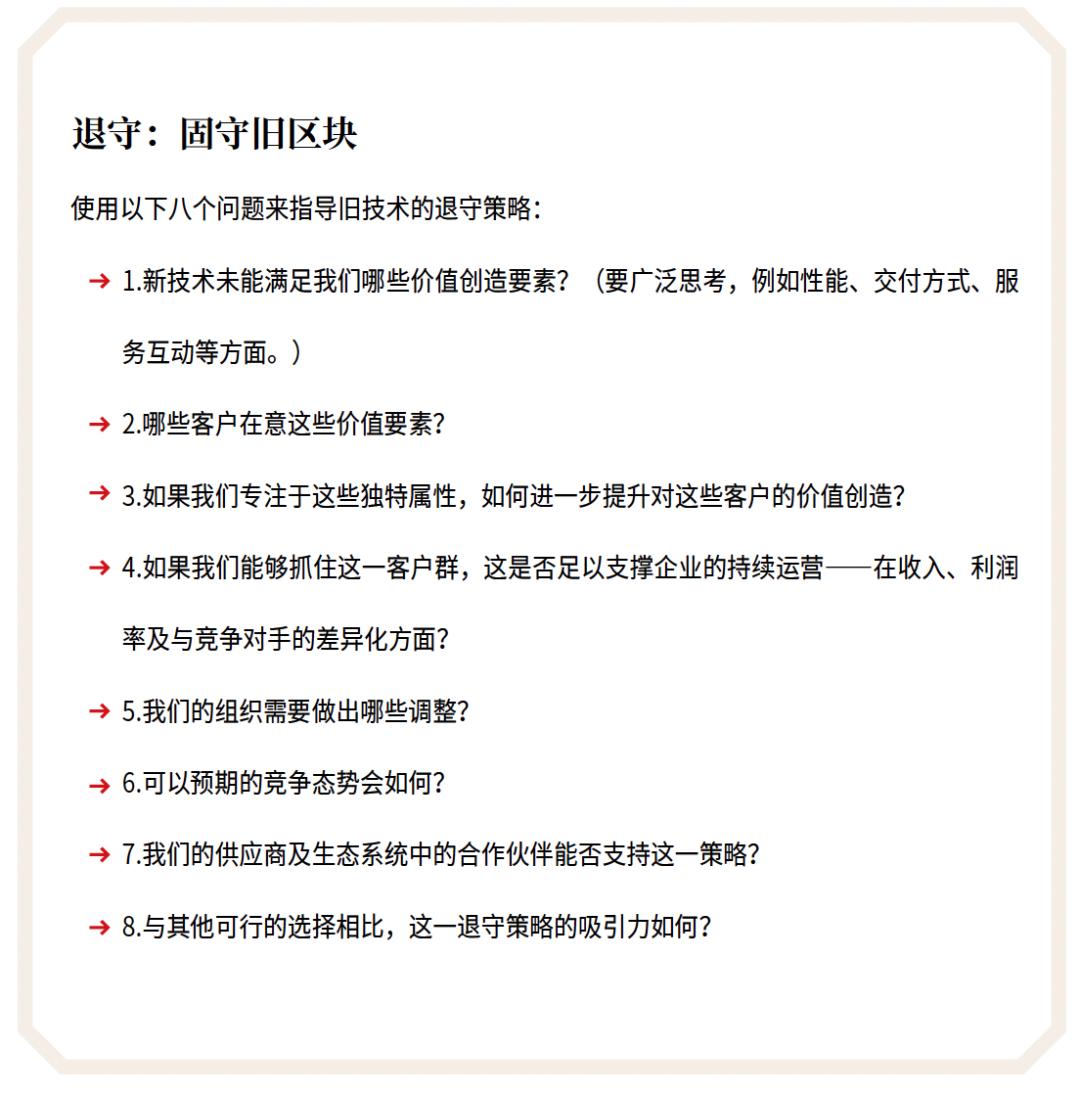
Strategy 1: Retreat to a long - lasting niche
The arrival of new technologies not only means increased competition but also a change in the way of competition. The value propositions provided by new and old technologies do not completely overlap. Therefore, companies do not have to be persistent in competing head - on with new technologies in the overlapping areas. When facing the pressure of technological substitution, managers should think about a different question: "What needs have been overlooked? After the emergence of the new technology, have we discovered new unique values in our products or services?" These overlooked areas are often the niches where the old technology can take root and thrive.
Take watches as an example. Before 1969, a watch was just a watch: there were expensive watches, cheap watches, manually and automatically wound watches, calendar watches, and many other categories, each with its own customers. All these watches were driven by mechanical movement systems, and an important indicator for evaluating watch functions was accuracy. In 1969, the quartz watch was introduced, with ten times better accuracy and a much lower price. Within less than a decade after its introduction, the quartz watch became the mainstream watch technology. Mechanical watch manufacturers were faced with two obvious but unappealing choices: bear a high degree of uncertainty and try to transform to produce quartz watches (even though they lacked the relevant technology), or redouble their efforts to improve the price and function of mechanical watches, which could only narrow the functional gap with quartz watches but not completely eliminate it.
Companies that truly understood the market changes caught a key turning point: the emergence of the quartz watch made consumers realize for the first time that "a watch doesn't have to be mechanical", and also made another group of consumers realize that "what they really love is the mechanical aspect itself". Therefore, these mechanical watch manufacturers chose to retreat from the "time - keeping function" to the "craftsmanship value". They redesigned the product structure, no longer hiding the precision components in an opaque watch case, but allowing the mechanical beauty of the movement to be seen and appreciated through a transparent case back, a large balance wheel, and a complex tourbillon.
The niche of watch consumers who value mechanical quality is obviously smaller than the broader overall watch market, but these consumers are willing to pay a high price. And perhaps more importantly, this niche is not affected by the attacks of quartz watch manufacturers.
This market dynamic also determines whether other old technologies can survive, and many of these old technologies do not occupy the high - end part of their respective markets. Dot - matrix printers perform better than laser printers in many industrial applications because their print heads are less sensitive to dust, vibration, and temperature changes, and they can print thick multi - layer forms. Similarly, pager networks are still very successful in the healthcare and emergency service markets because pagers do not generate transmission signals like mobile phones, which can interfere with medical equipment. In these examples, old - technology companies find ways to make use of the performance differences between new and old technologies instead of trying to eliminate them.
During our research, we observed various retreat strategies: up - market, down - market, mid - market, and a combination of these strategies. We couldn't find a simple formula to determine which strategy is the best. Managers must try to find all the possible safe havens, evaluate the scale of these business opportunities, the resources required to utilize them, and judge whether these opportunities are sufficient to make the business reach an acceptable scale. If they find that there are no retreat opportunities or the opportunities are too small to support the business, they may consider another option: enter a new market.
Strategy 2: Enter a new market
The so - called "entering a new market" means using existing old technologies to meet the new needs of the same group of customers or to solve the existing problems of a new group of customers. This means that companies must actively look for new market opportunities and be willing to give up their original market positions.
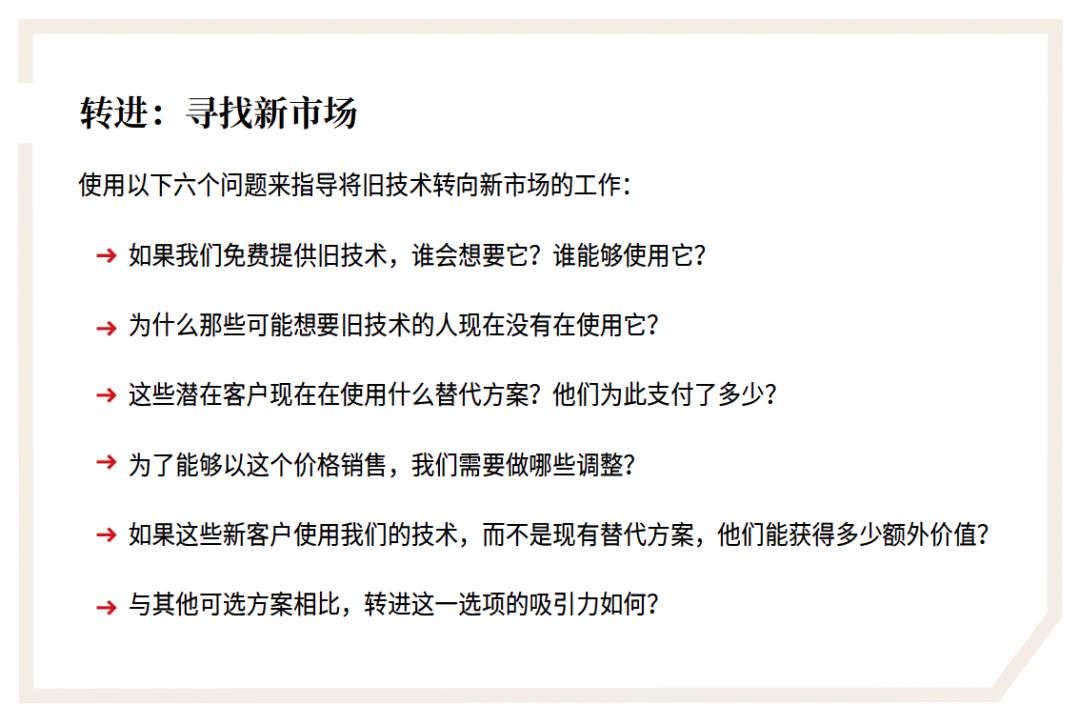
If these opportunities are really that good, why don't companies plan ahead during the normal expansion phase, that is, before the emergence of new technologies? The reason is simple: new technologies will change the business priorities and strategic judgments of old technologies. Under normal circumstances, the primary goal of diversification is to pursue growth; while under the impact of new technologies, the primary goal of the "entering a new market" strategy becomes survival. Therefore, before the emergence of new technologies, those niche opportunities outside the traditional market often seem unattractive, and companies will not actively invest. But when the growth space of the traditional market is squeezed and gradually disappears due to new technologies, these originally "unattractive" markets will become extremely valuable - especially when they can provide a stable foothold for old - technology manufacturers.
For example, in the commercial and scientific research fields, programmable electronic calculators have long been replaced by computers for complex calculations. However, these calculators are now popular again in the education market. They are inexpensive, portable, and easy to operate, making them very suitable for teaching drawing and basic calculations. Another example is that many restaurants use regional wireless pager systems to notify customers of their seats. Although this technology is not new, it is still irreplaceable in service scenarios due to its stability and low cost. These examples show that when losing the advantage in the main battlefield, the marginal market may become a new safe haven for old - technology products.
Develop a bold retreat plan
It is of course very difficult to transform from old technologies to new technologies. It can be expected that there will be many obstacles ahead, such as a lack of technical capabilities; very different requirements for production, sales, and support; and cultural conflicts between advocates of new technologies and supporters of old technologies.
People may not notice that the retreat or entry into a new market of old technologies requires a major adjustment of the organization. The priorities in product development, manufacturing, marketing, and sales must all be readjusted to focus on the new target market to create the highest value. Since the organizational adjustment required for a retreat is much more subtle than adopting new technologies, leaders may have to personally manage daily activities. Here are some guidelines to follow when leading such a transformation.
Guideline 1
Adjust the organization's focus, cost structure, and talent base
A retreat often requires a painful adjustment of the organization's scale. The space and cost structure of the company should be consistent with what the niche can support. For example, the research and development department must shift its focus from exploring the latest technological trends in the industry to improving existing technologies to meet the needs of different types of users, which usually requires finding a new balance between price and performance. The sales and marketing departments also need to be adjusted to establish different customer groups and support different market positions. This may require a major personnel adjustment. Indeed, some star talents are good at finding ways to extend the performance of old technologies in the mainstream market, but they may be the least capable of leading old technologies out of the mainstream market.
Guideline 2
Prepare for major changes in the ecosystem
After the rise of new technologies, it will inevitably prompt members of the old - technology ecosystem (suppliers, complementary manufacturers, distributors, and even financiers) to re - evaluate their roles and relationships with each other. Some members may decide to stop supporting old technologies and concentrate their resources on new technologies. Even if members of the ecosystem cannot adopt new technologies, they may think that the business opportunities of the re - positioned old technologies are insufficient and choose to exit this business. As a result, there will be crucial gaps in the ecosystem that are difficult to fill. For example, high - end audio equipment manufacturers have to search hard for suppliers of vacuum tubes. If an important partner abandons the old technology, the company may have to take on that partner's role itself.
Guideline 3
Understand the risks of adopting both new and old strategies
It is not necessary to choose only one between embracing emerging technologies and re - positioning old technologies. At first glance, compatibility between new and old technologies does have benefits: it may generate synergies and spill - over effects, promote mutual learning, and maximize the return on investment in old technologies. In fact, these benefits are difficult to achieve. It is easier said than done to require the team chasing new technologies and the team trying to extend the life of old technologies to share resources and capabilities, especially when the two teams are competing for the same group of customers. If the management can clearly state the basic rules, such as which market segments the old technology will not touch, it can reduce internal conflicts and enable both teams to achieve the best performance.
Guideline 4
Keep competition in mind
The target market is likely to be small enough to support only a small number of companies. Therefore, it may be extremely important to enter a niche earlier than competitors.
Guideline 5
Don't underestimate the challenge of promoting the retreat strategy
For a long time, military strategists have regarded retreat as a legitimate and responsible strategic option, but this is not the case in the business world. Most senior executives have reached their high positions because they promised to lead the company to grow, succeed, and create a better future. Surrendering without a fight and giving up a market position goes against the optimistic and enterprising attitude we expect from business leaders. After a company suffers serious losses, it is easy to explain to the whole company and the board of directors why a retreat is necessary. However, it is really difficult to convince others to call off the battle before it even starts. Don't give up a realistic and foresighted mindset just because you are accused of being timid.
Wait for the opportunity to start again
When new technologies emerge, it may not always be feasible for old technologies to make a bold retreat, and it's even less likely to be the most appropriate choice. However, it's an option that must be considered when reviewing strategies. If a company retreats to its existing niche or enters a new market, it may continue to operate successfully, although perhaps on a smaller scale than before. Such a market position can serve as a safe haven for the company to regain strength and wait for new growth opportunities.
But in any case, a retreat must be carried out boldly, before losing the technology war and exhausting the company's resources. And it must be carried out before the encroaching new technology takes root and thrives, causing a crisis for your business. By doing so, you can avoid a complete failure.
Ron Adner, Daniel Snow | By
Ron Adner is a professor of strategy and entrepreneurship at the Tuck School of Business at Dartmouth College. In his book "The Wide Lens: What Successful Innovators See that Others Miss", he proposed a new ecosystem strategy thinking framework to help companies identify key cooperative relationships and systematic risks during the innovation process. Daniel Snow is an associate professor in the Department of Business Administration at Brigham Young University, and his research focuses on technology innovation management and industrial evolution.
This article is from the WeChat official account "Harvard Business Review" (ID: hbrchinese), author: HBR - China, editor: Shi Qingjing. Republished by 36Kr with permission.