Is the "Token subsidy war" among AI giants almost over?
The cost of tokens is high, which makes people feel heartache.
This is not only the voice of people currently obsessed with Vibe Coding. Even the big Silicon Valley companies that previously hyped up Tokenmaxxing have started to impose token limits on their employees.
But in fact, an anti - common - sense point is that for those who are currently using AI subscriptions, the tokens you are using have already been subsidized by big AI companies. The highest subsidy could even be as much as 70 times the subscription fee!
What's even more worrying is that OpenAI and Anthropic, the two leaders in the AI field, have entered the IPO sprint stage. After these two companies go public,
will it be like after the "subsidy war" in the Internet era, when the remaining companies start to raise the unit price for customers, and let the token price return to a rational level?
The good news is that this situation may not happen. Recently, Bill Maris, the founder of Google Ventures, raised a question in the All - in podcast:
If Google decides to cut the token price by 80%, how will OpenAI and Anthropic respond?
Coincidentally, not long ago, the startup team Agnes AI, in a live broadcast with GeekPark, explained in detail the possible "Token - free era".
So, will the price of tokens rise or fall in the future? And what does this mean for people who are already addicted to AI?
01 The Token subsidies are at an all - time high
Why is it said that the current price of tokens is actually not high?
Because at least in the AI subscription system, the current prices of various AI companies are already the "heavily discounted prices" after subsidies.
Recently, SemiAnalysis conducted a detailed evaluation of the comparison between the actual value of tokens consumed and the subscription fees under the subscription models of OpenAI and Anthropic.
SemiAnalysis did a simple but effective thing - using AI to complete various tasks under the subscription plans of each AI platform, and then using the public API pricing to calculate the value of tokens for these tasks. The results are as follows:
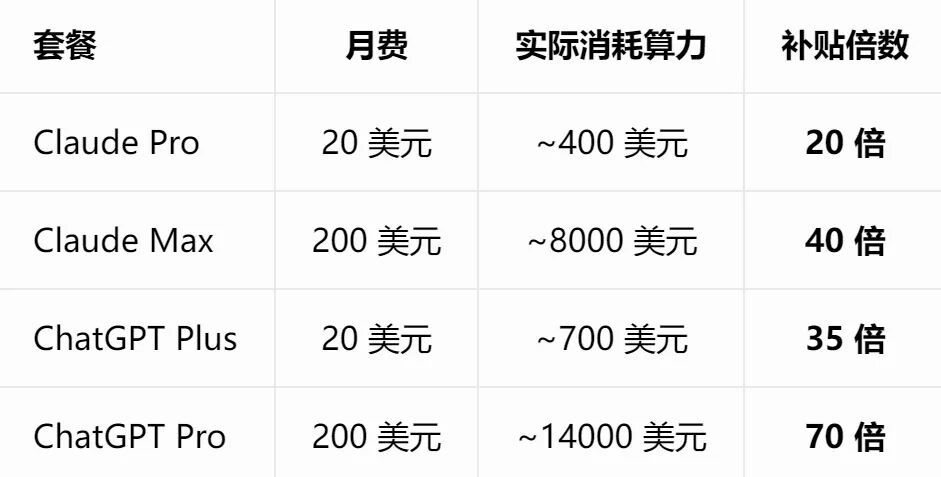
Notice a pattern: the more expensive the package, the higher the subsidy multiple. This in itself shows that these high - end packages are not for making money - they are a form of "reverse pricing", using the most radical losses to retain the most heavy - user customers. Because heavy - user customers are developers and corporate decision - makers. Once they are bound to a certain platform, they will bring in their entire team and product line.
Why do they still do it when it results in such losses? The standard answer is: burn money first to gain scale, and then raise prices to recover costs after the scale is established. This is how the mobile Internet worked - Didi and Uber subsidized billions of RMB in taxi fares, and the taxi fares increased after the subsidies ended; Meituan subsidized countless takeaways, and the delivery fees increased after the subsidies ended. For this logic to hold, there is a key premise: a locking effect was established during the subsidy period.
Didi was able to raise prices because drivers couldn't do without the order flow on the platform, and passengers couldn't do without the drivers on the platform. Meituan was able to raise prices because merchants couldn't do without its traffic and delivery network. When the subsidies ended, users were already "locked" in the ecosystem, and the switching cost was extremely high.
But there is a fundamental difference between the AI war and the Internet - tokens have almost no locking effect.
If Claude raises prices, developers can migrate API calls to GPT or Gemini within a day - the interfaces of each company are becoming more and more standardized, and many development frameworks even have built - in multi - model switching functions. It's even simpler for ordinary users: just change a website. AI is not like the taxi industry with a local driver network, not like the takeaway industry with a delivery system, and not like social media with a friend relationship chain. Tokens are just tokens, no matter which company produces them, they are the same thing.
This means that once the subsidies stop, users can disappear instantly. Subsidies are not "building barriers", but more like "maintaining the heartbeat" - as long as someone offers a lower price, users will leave.
And this doesn't even take into account a new variable that is making everyone's bills out of control: AI Agent.
When you chat with ChatGPT, a single conversation may consume a few thousand tokens. But when you let an AI Agent execute a complex task - write a piece of code and then automatically debug it, analyze a document of dozens of pages and then generate a report - in one round, the token consumption is 5 to 30 times that of an ordinary conversation. Some developers have measured that on the $100 Claude Max plan, a single Agent programming session can burn tokens worth nearly $100. Uber's CTO recently revealed that the company burned through its entire 2026 AI budget in four months.
The question is, can this token subsidy war continue? Who is likely to still stand at the end after the chaos?
Bill Maris believes the answer is obviously the traditional giants.
02 Token as a weapon
To understand the real cruelty of this subsidy war, we need to first see a structural asymmetry - the sources of ammunition for the participating parties are completely different.
Google's annual advertising revenue exceeds $300 billion. This is not money from investors, nor is it money burned from financing. It is a money - printing machine that runs automatically every day. Billions of people around the world open search engines, watch YouTube, and use Gmail every day, and the advertising fees automatically flow into the account. It doesn't need roadshows, doesn't need to please analysts, and doesn't need to explain to anyone why it spends this money.
Google using advertising profits to subsidize AI tokens is like a person who owns an oil well engaging in a price war in the gas station business - his oil comes from his own land, while his opponents' oil is bought with bank loans.
OpenAI and Anthropic are those who buy oil with loans.
OpenAI has raised more than $180 billion in cumulative financing, and its latest valuation exceeds $850 billion. Anthropic has raised more than $130 billion. This money comes from venture capital and strategic investors - they don't give money out of charity. They expect these companies to go public and get generous returns when they exit.
And after going public, the real trouble begins. Going public means that the financial statements are made public to the world. Every quarter, Wall Street analysts will stare at revenue, profit, user acquisition cost, and marginal cost. When they calculate that you actually lose $70 for every $1 of subscription fee received - no matter how glorious the growth story is, it won't be able to support the stock price.
Bill Maris put this logic very straightforwardly in the podcast. His exact words were: "If I were Google and decided to cut the token price by 80% at will, what would happen to the business models of OpenAI and Anthropic?"
The host asked how likely that was. Maris didn't hesitate: "100%. Capital as a weapon, tokens as a weapon."
This is not an analyst's speculation. Bill Maris is the founder and CEO of Google Ventures, and also the vice - president of Google's special projects. He once incubated Waymo and Google X. Everyone present understood: this is not a hypothesis, but what he has seen with his own eyes about how Google fights.
The scenario he described is very simple: Google announces an 80% price cut for the Gemini API. What will corporate customers do? If the product quality is similar - in many benchmark tests, Gemini is already on par with Claude and GPT - but the price is four - fifths cheaper, will you continue to use the more expensive one?
Maris himself gave the answer: "If you are a company and can pay 80% less at Google and Gemini to buy basically the same product, why wouldn't you? Then the pressure on those companies will become very severe."
OpenAI and Anthropic have almost no symmetrical counter - measures. They can't follow the price cut - they don't have a money - printing machine, and every dollar is from investors. They also can't maintain a premium based on technological differences - the gap between large models is rapidly narrowing. If you are three months ahead today, you will be caught up in three months. This is not like the technological gap between the iPhone and Nokia that spanned a generation. The moats between AI models are more like sand dikes that will be flooded when the tide rises.
In Bill's narrative, Google has a high chance of winning. But in the AI world, can Google really monopolize? Meta can open - source a free model at any time. There are DeepSeek and ByteDance in China, and Amazon is promoting its own model. When you drive the token price down to rock - bottom, the competitors don't disappear - they are also cutting prices.
There may be no winner in the AI war.
03 The "infinite game" of Tokens?
Even those who know little about history will make the following judgments about the end - game of the current AI war:
The first is the "Internet service" scenario - the stories of Didi and Amazon: first subsidize, then monopolize, and then raise prices to reap profits. In this scenario, today's price war is just the prologue. Eventually, one or two winners will occupy most of the market and gain pricing power. If so, the current huge losses are a worthwhile investment - just like Amazon lost money for twenty years and finally became the dual - champion in e - commerce and cloud computing.
The second is the "water, electricity, and coal" scenario. Tokens become a standardized basic resource, just like electricity, bandwidth, and cloud storage. No one can maintain pricing power in the long run because the product differences are too small and the switching costs are too low. Competition will drive the price infinitely close to the cost line, and the profit margin will approach zero. Eventually, the government may intervene in regulation - just like what was done to the electricity and telecommunications industries a hundred years ago.
The difference between the two scenarios depends on one word:
Lock - in.
Didi was able to raise prices because passengers were locked in the driver network, and drivers were locked in the order flow. Amazon was able to raise prices because merchants were locked in its logistics and traffic ecosystem.
The lock - in effect is the cornerstone of the "losing first, then making money" model.
But as previously argued repeatedly, there is almost no lock - in for AI tokens. The API is standardized, and the switching cost is almost zero. The core condition for the first scenario to hold does not exist for the token product.
If the second scenario, the end - game of "water, electricity, and coal" infrastructure, is closer to reality, what we are witnessing is not a war that will eventually have a winner, but a consumption race without an end.
Wang Xing, the founder of Meituan, once described this competitive state. His insight is that in some competitions, there is no concept of "winning". The goal of participants is not to defeat their opponents, but to ensure that they always stay in the game. Because as long as you are still in the game, you can continue to raise funds, recruit people, and iterate. Leaving the game is the only way to lose.
Re - examining today's AI landscape with this framework, many seemingly contradictory things suddenly become clear.
OpenAI's latest round of valuation exceeds $800 billion, not because training the model requires that much money. It needs so much money to continue the price war. Raising funds is not for winning, but for "being qualified to continue fighting".
Google's plan to cut the token price by 80% is not to eliminate OpenAI and Anthropic. It is to ensure that it remains a core player in the AI era - just like it ensured that it was not left out of the mobile era through the free Android system.
And Anthropic raised the API pricing of its latest flagship model Fable 5 to twice that of the previous generation - $10 per million input tokens and $50 per million output tokens. It may seem like a "price increase", but in fact, it is actively screening corporate customers who are willing to pay for high - end capabilities, because it knows clearly that it can't win the subsidy war in the consumer market against Google.
Each round of price war will expand the scale of AI usage. The expansion of the scale means more data, more scenarios, and more developers flowing into the ecosystem. This in turn makes the models of all participants stronger. The participants use the war itself to attract resources to upgrade themselves - this is not a zero - sum game where one side wins and the other loses, but a process where everyone becomes stronger through competition, but it's also unlikely that anyone will make huge profits.
Doesn't this sound like what the electricity industry ultimately became?
140 years ago, Edison and Westinghouse both thought they were competing for a winner - takes - all market. They bet their entire fortunes, believing that "whoever defines the standard for electricity will own electricity". But the fate of electricity tells us a simple truth:
When a technology is important enough, general enough, and standardized enough, it no longer belongs to any single company. It belongs to the infrastructure.
On the surface, the AI competition is between Google, OpenAI, and Anthropic, a comparison of model capabilities and a contest of financing scales. But looking at the big picture, the real effect of this competition is that it is accelerating the process of pushing AI to an infrastructure level that no company can monopolize.
When Bill Maris said "it will definitely happen", he may not just be predicting that Google will cut prices. He may be unconsciously predicting a bigger trend - in the AI world, tokens will ultimately not belong to anyone. Just like no one "owns" electricity today.
For OpenAI and Anthropic, this means something disturbing: even if they are technologically advanced and raise a huge amount of funds, the future of "making big money from AI" that they are chasing may not exist from the start. What they are facing is not a temporary price war, but a structural fate - what they are trying to build may essentially be the next - generation water, electricity, and roads.
For users, to some extent, it may be good news. Because as long as the token subsidy war continues, people can still enjoy the "good deal" of getting $400 worth of computing power at a cost of $20.
This article is from the WeChat official account “GeekPark” (ID: geekpark), author: Yuhangyuan. Republished by 36Kr with permission.