Ist der "Token-Subventionswettbewerb" der KI-Giganten fast vorbei?
Tokens are expensive, and it hurts to use them.
This is not just the feeling of those who are currently enthusiastic about Vibe Coding. Even the Silicon Valley giants, who previously vigorously promoted token maximization, are starting to impose token restrictions on their employees.
In fact, it is a counter - intuitive point: Those who are currently using an AI subscription are already using subsidized tokens from the large AI companies. The maximum subsidy can even be up to 70 times the subscription fee!
What is even more worrying is that the two AI pioneers, OpenAI and Anthropic, have already entered the IPO sprint phase. What will happen after these two companies go public?
Will the remaining companies, similar to what happened after the "subsidy wars" in the Internet era, increase the prices for customers and bring the token price back to a reasonable level?
The good news is that this may not happen. Recently, Bill Maris, the founder of Google Ventures, asked a question in the All - in podcast:
How would OpenAI and Anthropic react if Google decides to reduce the token price by 80%?
Coincidentally, the startup team of Agnes AI recently explained in detail the possible "era of free tokens" in a live broadcast with GeekPark.
So, will the token price rise or fall in the future? And what does this mean for those who are already addicted to AI?
01 Token subsidies are already at the limit
Why isn't the current token price actually expensive?
Because at least in the AI subscription models, the prices of different AI companies are already the "discounted prices" after subsidies.
Recently, SemiAnalysis conducted a detailed comparison between the actual consumption value of tokens and the subscription fee in the subscription models of OpenAI and Anthropic.
SemiAnalysis did a simple but effective thing: It actually used AI in the subscription plans of different AI platforms to perform various tasks, and then calculated back the value of the tokens for these tasks based on the public API prices. The results are as follows:
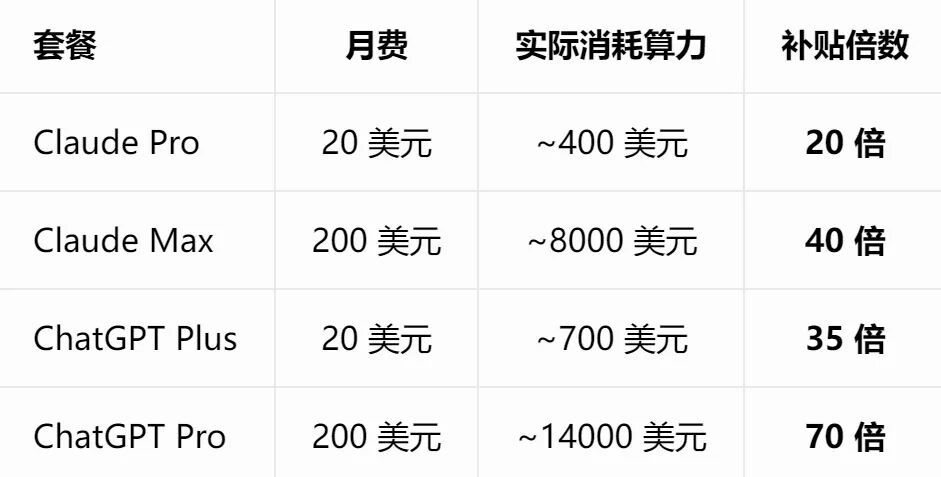
Note a rule: The more expensive the package, the higher the subsidy ratio. This indicates that these premium packages are not intended for profit - it is a "reverse pricing" where the strongest users are retained through the most radical losses. Because stronger users are developers and corporate decision - makers. Once they are tied to a platform, they bring their entire team and product line with them.
Why is it pushed so far? The standard answer is: First spend money to achieve scale, and after achieving scale, increase prices to make up for the losses. This is what the mobile - internet industry did - Didi and Uber spent hundreds of millions of yuan on fare subsidies, and after the subsidy, the fares increased; Meituan subsidized countless delivery services, and after the subsidy, the delivery fees increased. A key prerequisite for the validity of this logic is: The lock - in effect was established during the subsidy period.
Didi could increase prices because drivers rely on the platform's order flow and passengers rely on the platform's drivers. Meituan could increase prices because businesses rely on its traffic and delivery networks. When the subsidy ends, users are "locked in" the ecosystem, and the switching costs are extremely high.
But the AI competition has a fundamental difference from the internet - Tokens have almost no lock - in effect.
If Claude increases prices, developers can switch API calls to GPT or Gemini within a day - the interfaces of different companies are becoming more and more standardized, and many development frameworks even have the function of switching between multiple models. For ordinary users, it is even easier: You just need to visit another website. AI does not have a local driver network like the taxi business, a delivery system like the delivery service, or a friend relationship chain like social media. Tokens are tokens, no matter which company produces them, they are the same thing.
This means that users can leave immediately once the subsidies stop. The subsidies "do not build barriers", but "only keep the heartbeat going" - as soon as someone offers a lower price, users leave.
And this does not even take into account a new variable that throws everyone's accounts out of control: AI Agent.
When you chat with ChatGPT, you may consume thousands of tokens in one conversation. But if you let an AI Agent perform a complex task - write a code and then automatically debug it, analyze a document with several dozen pages and then generate a report - the token consumption can be 5 to 30 times higher compared to a normal conversation. Some developers have measured that in a $100 Claude Max plan, an agent - programming session can consume almost $100 worth of tokens. The CTO of Uber recently revealed that the company has used up its entire AI budget for the year 2026 within four months.
The question is, can this token subsidy war continue? Who might be the one standing at the end after the chaos?
Bill Maris believes that the answer is obviously the traditional giants.
02 Tokens as a weapon
To understand the real brutality of this subsidy war, one must first recognize a structural asymmetry - the ammunition sources of different parties are completely different.
Google earns over $300 billion in advertising revenue every year. This is not money from investors and not money from financing, but a money - printing machine that runs automatically every day. Billions of people around the world open search engines, watch YouTube videos, and use Gmail every day, and the advertising fees automatically flow into the account. It doesn't need to do roadshows, appease analysts, or explain to anyone why it has to spend this money.
If Google subsidizes AI tokens with its advertising profits, it's like someone who has an oil well leading a price war in the gas station industry - his oil comes from his own land, while the oil of his competitors is bought with bank loans.
OpenAI and Anthropic are the ones buying oil with loans.
OpenAI has so far raised over $180 billion in capital, and its latest company valuation is over $850 billion. Anthropic has raised over $130 billion in capital. This money comes from venture capitalists and strategic investors - they don't give the money out of charity but expect these companies to go public and get a rich return.
And the real problem starts after the IPO. Going public means that the financial reports are accessible to the whole world. Every quarter, Wall Street analysts will pay attention to revenues, profits, customer acquisition costs, and marginal costs. If they calculate that you actually lose $70 for every dollar of subscription fees - even the most brilliant growth story can't hold up the stock price.
Bill Maris explained this logic very directly in the podcast. His words were: "If I were Google and decided to reduce the token price by 80%, what would happen to the business models of OpenAI and Anthropic?"
The host asked what the probability of this was. Maris didn't hesitate: "100%. Capital as a weapon, tokens as a weapon."
This is not an analyst's speculation. Bill Maris is the founder and CEO of Google Ventures and also the vice - president for special projects of Google. He launched Waymo and Google X. Everyone present knew: This is not a hypothesis, but he has seen how Google fights.
The scenario he described is simple: Google announces an 80% price reduction for the Gemini API. What will corporate customers do? If the product quality is similar - in many benchmark tests, Gemini is already comparable to Claude and GPT - but the price is four - fifths cheaper, would you still use the expensive one?
Maris himself gave the answer: "If you are a company and you can pay 80% less at Google and Gemini to buy essentially the same product, why wouldn't you do it? Then the pressure on these companies will be very high."
And OpenAI and Anthropic have almost no symmetrical counter - measures. They can't follow the price reduction - they don't have a money - printing machine, and every dollar is the investors' money. They also can't rely on technological differences to get a price premium - the differences between large models are quickly shrinking. If you are three months ahead today, you will be caught up in three months. This is not like the technological generation gap between iPhone and Nokia. The protective walls between AI models are more like sand dikes that can be flooded by the tide.
In Bill's story, Google has a good chance, but can Google really monopolize in the AI world? Meta can open - source a free model at any time, in China there are DeepSeek and ByteDance, and Amazon is developing its own model. If you push the token price to a minimum, the competitors won't disappear - they will also lower the prices.
There may be no winners in the AI competition.
03 The "endless game" of tokens?
Even those with little knowledge of history will to some extent judge the end - phase of the current AI competition as follows:
The first scenario is the "internet - service" scenario - the story of Didi and Amazon: First subsidies, then monopoly, and then price increase. In this scenario, the current price war is just the introduction, and in the end, one or two winners will capture most of the market and gain pricing power. If this is the case, the current huge loss is a lucrative investment - similar to Amazon having losses for twenty years and finally becoming a double - winner in the e - commerce and cloud - computing industries.
The second scenario is the "water, electricity, gas" scenario. Tokens will become a standardized basic resource, like electricity, bandwidth, and cloud storage. No one can maintain pricing power in the long run because the product differences are too small and the switching costs are too low. Competition will push the price infinitely close to the cost line, and the profit margin will approach zero. Eventually, the government may step in for regulation - similar to what happened with electricity and telecommunications a century ago.
The difference between the two scenarios depends on one word:
Lock - in.
Didi could increase prices because passengers were "locked in" the driver network and drivers were "locked in" the order flow. Amazon could increase prices because businesses were "locked in" its logistics and traffic ecosystem.
The lock - in effect is the foundation of the "first losses, then profits" model.
But AI tokens - as already repeatedly argued - have almost no lock - in effect. API standardization makes the switching costs almost zero. The core condition for the first scenario does not exist for the token product.
If the second scenario, the end - game of the "water, electricity, gas" infrastructure, is closer to reality, we are not in a war that will finally have a winner, but in an endless war of attrition.
Wang Xing, the founder of Meituan, once described this competitive state. His insight was: In some competitions, there is no concept of "winning". The goal of participants is not to defeat the opponent, but to ensure that they always stay at the table. Because as long as you stay at the table, you can continue to raise capital, hire employees, and improve the product. The only loss is to leave the table.
If we re - examine today's AI environment with this framework, many seemingly contradictory things suddenly become clear.
OpenAI's latest company valuation is over $800 billion, not because training the model requires so much money. It needs so much money to continue leading the price war. The financing is not for victory, but for "the right to keep fighting".
Google plans to reduce the token price by 80%, not to eliminate OpenAI and Anthropic. It wants to ensure that it always remains a core player in the AI era - similar to how it ensured not to be thrown off the table in the mobile era through free Android.
And Anthropic has doubled the API price of its latest flagship model Fable 5 - $10 per million input tokens and $50 per million output tokens - which seemingly is a "price increase", but actually is an active selection of corporate customers who are willing to pay for premium capabilities. Because it knows that it can't win against Google in the consumer - side subsidy war.
Every price war expands the application scope of AI. The expansion of scale means more data, more scenarios, and more developers flowing into the ecosystem. This in turn makes the models of all participants stronger. The participants use the war itself to attract resources and improve themselves - this is not a zero - sum game with a winner and a loser, but a process in which everyone becomes stronger through competition, but can hardly achieve exorbitant profits.
Doesn't this sound like the end - phase of the power supply industry?
140 years ago, Edison and Westinghouse thought they were fighting for market dominance. They risked their entire fortunes and bet that "whoever defines the electricity standard has the electricity". But the fate of electricity shows us a simple