The "iron law" of chip equipment is being broken.
For a long time, the pricing power distribution in the semiconductor supply chain has presented a distinct pyramid structure. At the top of the pyramid are tech giants such as Apple, NVIDIA, Microsoft, Google, and Amazon, which control terminal demand, cloud computing power orders, and system definition rights. Below them are manufacturing powerhouses like TSMC, Samsung, SK Hynix, and Micron, which dominate advanced manufacturing, advanced storage, and key production capacities. In contrast, although equipment suppliers are upstream in the manufacturing system and have extremely high technological barriers in some segments, they still often face pressures such as annual cost reduction, price cuts for repeat purchases, and order cancellations due to acceptance rhythms and cycles in the procurement systems of major customers.
As a result, an unwritten rule has emerged in the semiconductor equipment industry: When introducing new equipment (Design-in), equipment suppliers often have to make significant price concessions. During the subsequent repeat purchase (Repeat Order) phase, wafer fabs usually require suppliers to continuously lower prices based on supply chain management practices. Especially during the downward cycle of the storage market and when wafer fabs reduce their capital expenditures, it is not uncommon for equipment suppliers to accept a price cut of about 10% in order to secure orders, maintain market share, and keep production lines running at a high utilization rate.
However, this long - standing "iron law" of the buyer's market is now starting to loosen.
Recently, several first - tier equipment suppliers of SK Hynix have proposed a 3% - 4% price increase for their supplies. South Korean media reported that SK Hynix has asked relevant suppliers to submit materials justifying the price adjustment and is currently evaluating the requests. This is almost unthinkable in the previously rigid semiconductor equipment market, where buyers had absolute dominance.
Behind this abnormal phenomenon is the imbalance between equipment supply and demand caused by the rapid growth of AI computing power. When the expansion speed of wafer fabs directly determines whether they can secure AI orders from major chip manufacturers, "acquiring equipment" has become the most urgent arms race.
TCB Equipment Is Selling Like Hotcakes
A clear example is that recently, TCB (Thermal Compression Bonding) equipment has been in high demand. As SK Hynix is expanding its HBM4 production capacity, two South Korean TCB equipment manufacturers, Hanmi Semiconductor and Hanwha Semitech, have recently received TCB Bonder orders of similar sizes. In the complex structure of AI chips, TCB equipment plays a crucial role.
In the TCB equipment market, Hanmi Semiconductor, Hanwha Semitech of South Korea, and ASMPT are the three major players.
Among them, Hanmi Semiconductor is currently the leader in the HBM TC Bonder market. A TechInsights report shows that as of the first three quarters of 2025, Hanmi accounted for 71.2% of the HBM TC Bonder market in terms of revenue, leading SEMES, ASMPT, Yamaha Robotics, and Hanwha Semitech. Hanmi's advantage lies in its early partnership with SK Hynix and its coverage of two HBM production routes, NCF and MR - MUF.
According to a report by The Elec on June 10, on June 8, Hanmi Semiconductor announced that it had received a 44.2 billion - won TCB Bonder order from SK Hynix for HBM4 production. The equipment model is TC Bonder 4.5 Griffin, and the delivery period is until early September. Based on an estimated price of about 3 billion won per unit, the market believes that this order corresponds to approximately 15 units of equipment.
However, Hanmi Semiconductor also faces obvious risks. Its customers are diversifying their suppliers. SK Hynix has already introduced ASMPT and Hanwha, and Micron may also introduce more alternative suppliers.
Hanwha Semitech is evolving from a challenger to a major alternative supplier for SK Hynix. Recently, Hanwha Semitech also received an order from SK Hynix. It not only supplied the D2W hybrid bonding cluster system to SK Hynix but also obtained an additional HBM4 TC Bonder order. Therefore, Hanwha has two strategies to compete with Hanmi: one is to compete for SK Hynix's HBM4 orders with its TC Bonder, and the other is to expand into hybrid bonding. The Elec reported that its SHB2 Nano hybrid bonding cluster system entered SK Hynix's production line for quality assessment and optimization in April.
TrendForce said that this order is seen as alleviating market concerns about the cautious capital expenditure and delayed capacity ramp - up during the transition from HBM3E to HBM4. SK Hynix is clearly implementing a multi - supplier strategy by placing orders with multiple TCB equipment manufacturers simultaneously. Hanmi, Hanwha, and ASMPT are all entering its TCB supply chain. As early as 2025, The Elec reported that SK Hynix planned to purchase up to 80 TCB Bonders that year, up from the initial plan of 50 units. At the same time, Hanmi also received an order for about 50 TCB Bonders from Micron.
ASMPT's market focus is different from that of Hanmi and Hanwha. Although ASMPT's market share in HBM is not very high, it is very strong in C2S/C2W. The orders it has publicly disclosed are mainly concentrated in C2S for AI chips and C2W for logic chips. It claims that the global installed base of its TCB equipment exceeds 500 units and expects the total addressable market (TAM) for TCB to exceed $1 billion by 2027, aiming to capture 35% - 40% of the market share. ASMPT is more like a platform - type player in advanced packaging rather than a single - product HBM equipment supplier.
In December 2025, ASMPT received orders for 19 and 15 units of C2S TCB equipment respectively from the main OSAT partners serving the AI chip business of leading wafer foundries. ASMPT said it is the sole supplier and POR of the C2S TCB solution for this customer.
On June 8, 2026, ASMPT announced that it had received a repeat order from a global leading IDM to supply 8 units of C2W TCB equipment for the production of advanced client - side and data - center CPUs. ASMPT specifically emphasized that the Chiplet architecture is entering client - side and data - center processors, driving the demand for C2W TCB.
Overall, this wave of TCB order boom is essentially a resonance of three trends: HBM stacking, AI chip C2S, and logic Chiplet C2W.
Is Hybrid Bonding Still on the Horizon?
The market once believed that as the line width and pin pitch (Pitch) continued to shrink, more advanced hybrid bonding would replace TCB. However, it now seems that this replacement process has been prolonged.
First of all, in the HBM4 stage, TCB remains a more practical mass - production path.
HBM4 requires higher stacking, higher bandwidth, and better heat dissipation. However, hybrid bonding has higher requirements for surface flatness, particle control, cleanliness, and yield ramp - up. Therefore, memory and logic wafer fabs are still using TCB bonding while also preparing for hybrid bonding production lines.
Although in April this year, SK Hynix purchased a hybrid bonding online system jointly developed by Applied Materials and BESI (Applied Materials bought a 9% stake in Besi in 2025, and the two parties cooperated to develop a die - based hybrid bonding system). According to a report by The Elec, this equipment order worth about 20 billion won is mainly for the R & D of next - generation HBM rather than an immediate full - scale replacement of TCB for mass production. This online equipment integrates Applied Materials' chemical mechanical polishing (CMP) and plasma processing equipment as well as BESI's hybrid chip bonder and is expected to be installed and used on the R & D production line soon. This system has also been put into mass production at TSMC.
Applied Materials' own Kinex system also emphasizes that hybrid bonding requires the integration of modules such as wet cleaning, plasma activation, in - situ measurement, and queue time control, indicating that it is not a simple pick - and - place machine but a more complex system closer to the integration of front - end and back - end processes.
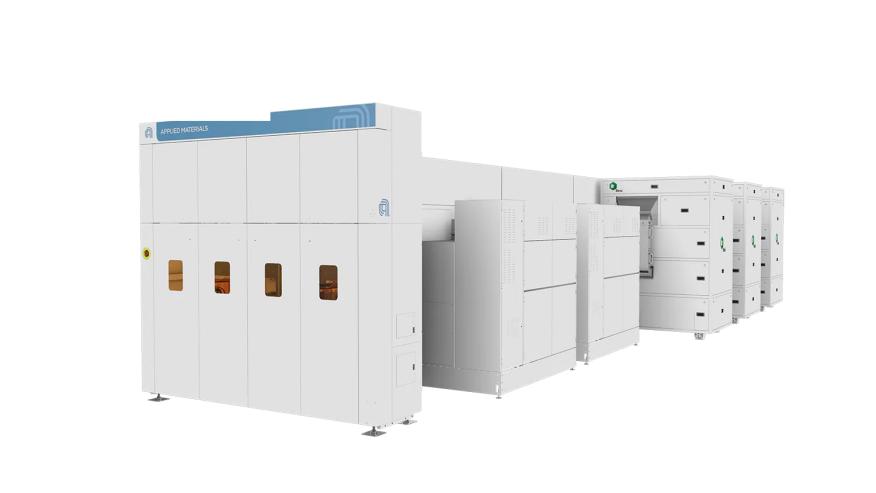
Kinex system (Source: Applied Materials)
The wafer fabs' bets on hybrid bonding are also driving the rapid development of BESI. In the first quarter of 2026, BESI's orders increased by 104.5% year - on - year to 269.7 million euros. Reuters reported that the growth was mainly driven by the demand for hybrid bonding, and a second customer in the memory market has entered the HBM - related qualification certification process.
Secondly, the relaxation of standards is giving TCB a new lease on life.
According to a report by TrendForce in April, JEDEC is reportedly discussing relaxing the height specification of the next - generation HBM from 775 microns to about 900 microns, which may slow down the adoption of hybrid bonding. Once the stacking height limit is relaxed, manufacturers can continue to use the mature TCB path to support more layers of stacking without immediately taking on the yield risks associated with hybrid bonding.
Finally, TCB equipment is also being upgraded and not standing still.
For example, ASMPT recently launched the AOR TCB technology, which focuses on flux - free, active oxide removal, reducing residual pollution, and improving bonding uniformity. The goal is to address the challenges of the next - generation HBM in terms of stacking height, precision, and yield.
Therefore, based on the current situation, a more reasonable industry judgment is that in the HBM4/HBM4E stage, TCB and hybrid bonding will coexist. It may not be until the HBM5 and higher - layer era that the proportion of hybrid bonding will increase significantly.
Overall, TCB is not just a short - lived trend but a structural change in back - end equipment. A relevant report by Yole points out that back - end equipment is evolving from a supporting part of traditional packaging to a strategic equipment market for advanced packaging. Among them, TCB and hybrid bonding are the two fastest - growing areas. Yole expects the TCB market to reach $936 million by 2030, with a compound annual growth rate (CAGR) of about 11.6% from 2025 to 2030. The hybrid bonding equipment market is expected to reach $397 million by 2030, with a CAGR of about 21.1%.
Relevant data from Counterpoint also shows that AI GPUs and custom AI ASICs are driving the growth of advanced manufacturing and advanced packaging. It is expected that the advanced packaging capacity of the industry may expand by about 80% year - on - year in 2026, and advanced packaging has become a "gating factor" for AI deployment.
Due to AI, Testing Equipment Is Also Facing Supply Constraints
The AI - driven expansion wave not only makes wafer fabs scramble for equipment but also causes the supply chains of equipment suppliers themselves to be constrained by key components such as FPGAs, CPUs, and Driver ICs.
According to a report by The Elec on May 29, South Korean semiconductor testing equipment manufacturers are facing the "most severe" component shortage in history. There is even a sarcastic saying in the industry: "Without semiconductors, you can't make semiconductor testing equipment." The report said that the delivery time for FPGAs used in testing equipment has been extended from the previous 8 - 10 weeks to a maximum of 52 weeks. Driver ICs, which could be purchased immediately from distribution channels in the past, now require a waiting period of at least 10 weeks. There is also a shortage of x86 CPUs and GPUs, and the price of some products has increased from about 1 million won to 3 million won, a maximum increase of three times.
Since AI data centers are absorbing high - end chip production capacity, allocation priorities, and inventory buffers, testing equipment suppliers have become the "downstream of the downstream" and are being squeezed in the allocation of key components. For example, Sourceability recently pointed out that the main reason for the extended FPGA delivery time of more than 52 weeks is the demand from data centers. Large - scale cloud providers and AI infrastructure companies, with their larger orders and stronger bargaining power, have received higher - priority supply allocations, leaving other industries that rely on similar components behind. The same is true for CPUs and GPUs. Although testing equipment suppliers are technologically important, their procurement scale is difficult to compare with that of cloud providers and AI server manufacturers.
The shortage of Driver ICs has a different logic from that of FPGAs, CPUs, and GPUs. In essence, these niche high - performance analog/mixed - signal devices have poor supply elasticity when faced with the increasing demand for testing equipment. ADI's official website lists Automatic Test Equipment as a dedicated product direction, indicating that these chips are key and specialized components in the testing equipment industry chain.
The shortage of these key components has already affected equipment delivery. The Elec mentioned that a semiconductor testing equipment manufacturer recently signed a supply contract worth more than 10 billion won with Samsung Electronics but was forced to postpone the delivery time by three months due to component shortages. The report also said that equipment manufacturers have started discussing the quantity and delivery time of equipment with customers several months in advance before the official purchase order (PO) is placed in order to secure components first.
So, in the AI era, there is a rather paradoxical chain: Shortage of AI chips → Wafer fabs expand production → More testing equipment is needed → Testing equipment requires FPGAs/CPUs/Driver ICs → These chips are preferentially taken by AI data centers → Delivery of testing equipment is delayed.
Behind the Crazy Expansion, the Equipment Industry Enters a New Upward Cycle
If the shortages of TCB and testing equipment are individual outbreaks, when we take a broader view, we will find that the entire semiconductor equipment industry has entered a magnificent and comprehensive upward cycle driven by the hard power of AI.
SEMI predicts that the global semiconductor manufacturing equipment sales will increase from $133 billion in 2025 to $145 billion in 2026 and reach a record high of $156 billion in 2027. SEMI specifically pointed out that this round of growth mainly comes from AI - related investments, especially in advanced logic, storage, and advanced packaging.
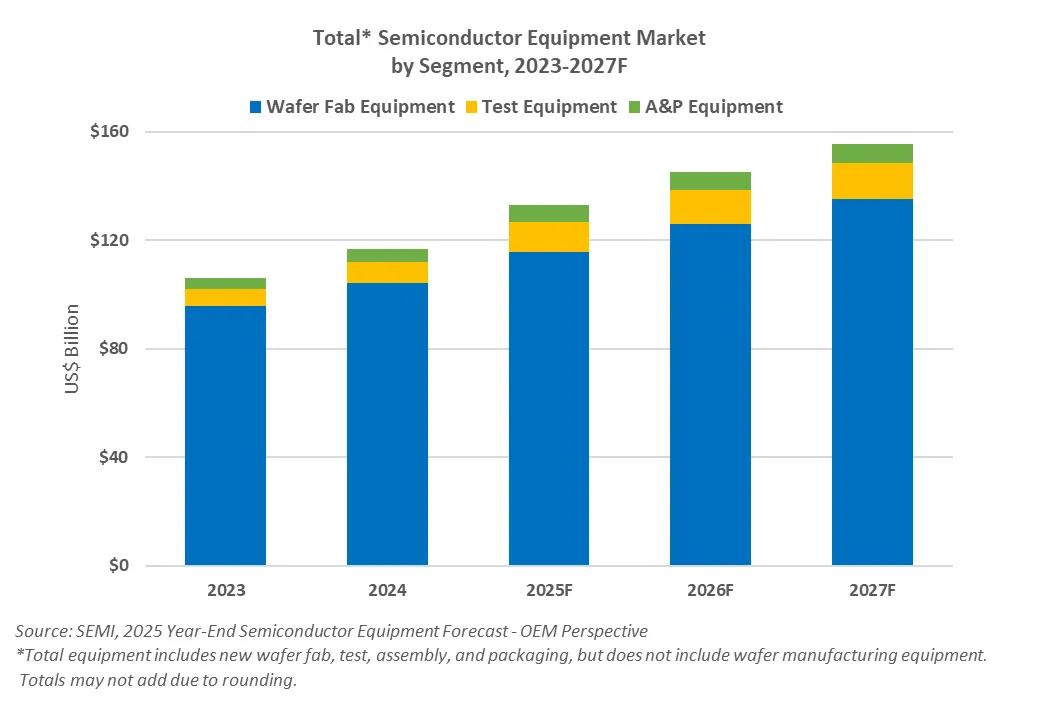
Moreover, SEMI also predicts that the equipment expenditure of global 300mm wafer fabs will increase by 18% to $133 billion in 2026 and then by 14% to $151 billion in 2027, stating that AI is reshaping the scale of semiconductor manufacturing investment.
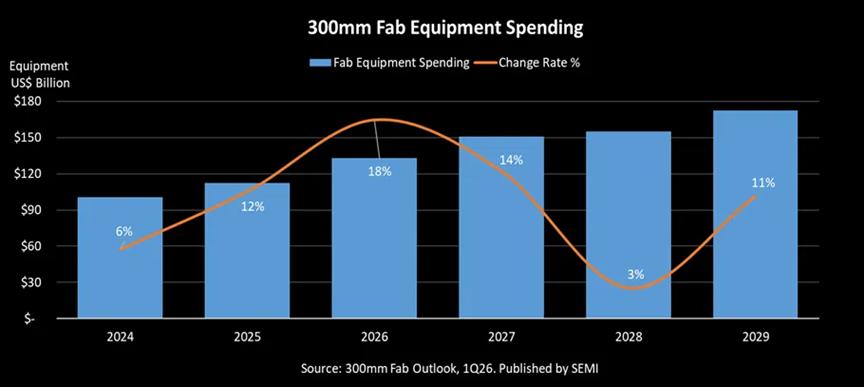
This round of equipment opportunities mainly comes from three main expansion lines:
First, advanced logic manufacturers such as TSMC, Intel, and Samsung are expanding production for AI accelerators; TSMC predicts that the global semiconductor market will exceed $1.5 trillion by 2030, with AI and HPC accounting for 55%. At the same time, TSMC plans to build nine - stage wafer fabs and advanced packaging facilities in 2026, and the production capacity of 2nm and A16 is expected to increase at a compound growth rate of 70% from 2026 to 2028.
Second, in the storage field, HBM has reignited the DRAM expansion cycle; SK Hynix Chairman Choi Tae - won said in Taipei in June that SK Hynix plans to double its overall wafer production capacity in the next five years and believes that the global storage supply bottleneck may persist until 2030. According to Counterpoint data, SK Hynix's global market share in the HBM market reached 58% in the first quarter of