During this year's 618 Shopping Festival, AI helps merchants run their businesses well.
By | WANG Yi
01. The AI dividend is emerging, but have businesses seized it?
Undoubtedly, the 618 shopping festival is the most certain business opportunity for merchants in the first half of the year.
But this year, this "certainty" takes on new connotations. After more than a decade of large-scale promotions, merchants have long been fully familiar with processes including registration, stock preparation, bidding, and ranking grabbing. The difference is that in the past, completing these steps could indeed bring growth and profits. However, as the industry enters a mature stage of high-quality development, repeating the same old practices may still bring some growth, but profits are far from guaranteed.
Changes are taking place. On the one hand, merchants' mindset has shifted from "pursuing scale" to "seeking efficiency", focusing on tangible operational profits and long-term brand mindshare. On the other hand, AI has begun to be truly embedded into specific business chains.
In reality, most merchants hold an "ambiguous excitement" attitude towards AI: they know it is the trend, but have no idea "where to apply it, how to apply it, and what changes it can bring".
This is also one of the backgrounds for major platforms to focus on AI development. Alimama released AI Xiangwan in March this year, embedding it as a core capability engine into all its AI products. During Tmall's 618 period, more than 1 million merchants called the tool over 3 billion times, making it a large-scale AI practice for e-commerce platforms.
Now we finally have a batch of samples that can be closely observed to verify whether AI can really help businesses operate differently.
02. What exactly has AI changed in e-commerce business?
The help AI brings to the e-commerce sector is more practical than expected. It not only improves the efficiency of operational links, but also reshapes the very business models of merchants.
Finding blue ocean in the red ocean
"To be honest, the current beauty track is extremely competitive. General traffic is getting more and more expensive, and the customer acquisition cost keeps rising. Everyone is promoting anti-wrinkle and firming effects, so why would consumers choose your brand?" ZHENG Que, Chief External Affairs Officer of CHANDO, pointed out the core issue straightforwardly: "The real problem is not in advertising placement, but in communication. The messages we deliver must be understandable to consumers."

The predicament of CHANDO is a microcosm of the current beauty industry. The anti-aging track has been fiercely competitive for years, with all brands shouting the same slogans: anti-wrinkle, firming, and fine line reduction. Consumers have long been fatigued by these homogeneous promotions. When all brands in the track have the same selling points, the only remaining competition is price.
The 7th generation Little Purple Bottle, the core product of the brand with its core ingredient Silinol, once fell into a dilemma. As a self-developed yeast technology ingredient, it is objectively a high-quality ingredient, but the problem is that consumers do not know what it is, nor do they care. On the shelf, it has to compete head-to-head with ingredients like Pro-Xylane and Retinol, which have been educated in the market for many years.
Under the traditional advertising placement logic, brands would set target crowds based on their own understanding, for example, labels like 30+ years old, female, with anti-aging needs, and place advertisements around keywords such as "anti-wrinkle" and "firming".
This logic itself is not wrong, and keyword placement is still the basic operation of e-commerce advertising to this day. However, merchants can only understand what consumers need based on their own cognition, and then select placement targets from existing labels and keywords. In other words, merchants' cognition defines the boundary of their business.
The value of AI lies in breaking through this boundary.
During the 618 period, CHANDO used Alimama's "Brand New Power WIN" (an AI brand growth model launched by Alimama, which helps brands build a full-domain asset evaluation system, making every step between content seeding and conversion visible and measurable) to analyze consumers' real search behaviors and content browsing data across the whole network with AI. The analysis found that in the anti-aging track, the most searched expressions are not "recommendations for anti-wrinkle and firming essences", but scenario-based and emotion-driven questions such as "how to rescue dull skin from staying up late" and "how to improve poor skin condition after working overtime".
For example, a 23-year-old girl who works overtime until late every night does have anti-aging needs, but in the standard e-commerce context, she does not have the "anti-aging" crowd label. There are also people searching for "can sensitive skin do anti-aging", who want a gentle anti-aging solution, but in the past placement system, these potential crowds were not included in the placement chain, making it difficult for brands to reach them.
The traditional e-commerce placement logic is that merchants first define demands, then find matching people from the structured label library. This easily forms a pool of similar crowds, which are repeatedly converted. AI does the opposite: it first observes what consumers are actually looking for, then deduces which products can meet these demands. It does not rely on pre-defined labels, but dynamically builds connections between demands and products based on the understanding of consumer behaviors, thus breaking the old path dependence and crowd boundaries.
For example, after a new anti-sensitivity underwear product is launched, AI helps the brand not only match underwear consumers, but also match anti-sensitivity skincare crowds, acquiring new customers from users who search for "skin allergy". Another example is that electronic lock merchants used to only target crowds who are renovating their houses, but AI found that girls who do manicures have long nails and are inconvenient to carry keys, so they have higher demand for electronic locks. AI helps merchants find new customers that they could never have thought of even with racking their brains.
It is exactly this capability that helps CHANDO find the blue ocean in the red ocean, extract the differentiated positioning of "resilient skin anti-aging", and shift the battlefield to a more precise track.
More critically, AI translates this ingredient into language that consumers can really understand.
What is Silinol? Consumers will not search for this term, nor do they need to know it. But expressions like "emergency recovery kit for dull skin from staying up late" and "reassuring anti-aging solution for sensitive skin" can be understood by consumers in seconds. The hard-core technological selling points are decomposed into perceived benefits for different crowds.
At the same time, a typical pain point CHANDO faced in the past is that content seeding outside the platform was very popular, consumers were attracted by content on Douyin and Xiaohongshu, but the conversion path back to Taobao was broken. Brand New Power WIN helps the brand leverage the full-domain retargeting capability of ShowMAX (in-Tmall brand display advertisement that integrates multiple high-quality resource positions, so that users can see brand information as soon as they open Taobao, quickly deepen their impression and accelerate conversion), to re-engage crowds that flow back from outside the platform, and accurately intercept competing brands' crowds at the same time, thus connecting the whole path of "content seeding - search - transaction".
During this year's Mother's Day, the GMV of CHANDO's Tmall flagship store increased by 30% year-on-year, the number of new customers increased by 70% year-on-year, and the number of new members rose by 14% year-on-year. The growth of new customers and new members means new blood and new relationships, which is a completely different business from the conversion brought by pure ad placement.
The brand's 618 performance is also very impressive: the popular freeze-dried mask was sold out as soon as it went online, with sales exceeding 10 million yuan; the new 7th generation Ultra-Resistant Little Purple Bottle immediately won the first place in "Tmall Facial Essence Category Ranking" and the first place in "Tmall Anti-Aging Liquid Essence Positive Review Ranking" upon its launch. New trend products and popular products in the store contributed 30% of the total transaction, optimizing the product structure and getting rid of the single dependence on traditional old products.
More importantly, CHANDO's user structure is more balanced and healthy. During the 618 period, the new customer acquisition rate increased by 8% year-on-year, the repurchase rate of old customers increased by 36% year-on-year, and the proportion of 88VIP super members among transaction users continued to rise, realizing the integrated long-term operation of customer acquisition, retention and repurchase on Tmall.

This same capability will show completely different effects when applied to different merchants. Baoshu is a founder-led brand that makes Tibetan incense beads, which inherits the intangible cultural heritage Tibetan incense craft and turns it into healing accessories that modern people can wear on their bodies. Its founder WANG Yue used to think that her products are too niche with a very narrow audience. The search volume of the Tibetan incense bead category itself is very low, so under the traditional keyword placement logic, the ceiling is clearly visible.
But AI's reasoning capability opens up a new perspective: people who search for "Hetian jade" may not be looking for jade, but for a warm gift; people who search for New Year gifts want cultural souvenirs; people who search for emotional healing need a ritual portable item. AI identifies that the same search term may hide completely different motivations, such as gifting demand and self-reward demand, and then helps merchants match different product lines and communication strategies in a targeted manner.
Baoshu's reach scope has expanded from the small category of "Tibetan incense beads" to much larger circles such as emotional healing, intangible cultural heritage, and oriental aesthetics. This is not a random category expansion, but cross-circle crowd matching based on real demand signals made by AI.
A large domestic beauty brand and a small intangible cultural heritage workshop are both empowered by the same capability. The former finds a blue ocean track in the red ocean, while the latter discovers mass demand from a niche category. No matter the size of the merchant, AI can help them find new opportunities.

The cost of trial and error has been greatly reduced
Finding the right direction is one thing, but having the courage to invest is another. Especially for small and medium-sized merchants, "innovation" sounds good, but every innovation is accompanied by real monetary risks.
Youkela from Yiwu has the most say in this. It is a factory that has been deeply engaged in the star light track for more than 15 years, with about 80 employees, and once ranked top in the projection lamp category. But in recent years, it has clearly felt that the iteration of popular products is getting faster and faster, and peers are catching up too quickly. Among 10 launched products, 7 may end up with no return.
Children's Day on June 1st is a key node for this industry. For factories, it means that the whole process of product selection, model testing, stock preparation and placement must be completed before the festival, with extremely small error tolerance.
But the traditional process takes at least two weeks for one round. By the time the conclusion is drawn, there is little time left for promotion.
AI reconstructs the whole chain. Youkela first uses the market analysis function of Alimama's Damo Platform to directly see the supply and demand pattern of the entire star light track. The system brings them an interesting discovery: what consumers search for are not clear demand keywords such as "star light", but "what gifts to give for Children's Day", "birthday gifts that little girls like", "baby bedtime story machine", which actually correspond to three completely different consumption scenarios. Festival gifting requires decency and surprise, parent-child interaction requires fun and companionship, and daily sleep requires warmth and comfort. Under the Children's Day gifting scenario, the demand for children's star lights is strong but high-quality supply is insufficient, which presents a structural incremental opportunity.
After the direction is determined, Youkela hands over the alternative products to AI for model testing, and uses the upgraded full-site product promotion tool to automatically match the full-scene traffic of search and recommendation, find the core popular product, and automatically adjust the marketing strategy.
"AI is much faster and more accurate than human judgment." WEI Jun, founder of Youkela, exclaimed that AI opened up a new world for him, and the uneasiness of being the first to try new things was relieved after seeing the results: the success rate of new product launch jumped from 30% to 92%, the average daily GMV of new products rose from several thousand yuan to more than 20,000 yuan, and the model testing cycle was shortened from two weeks to 7 days.
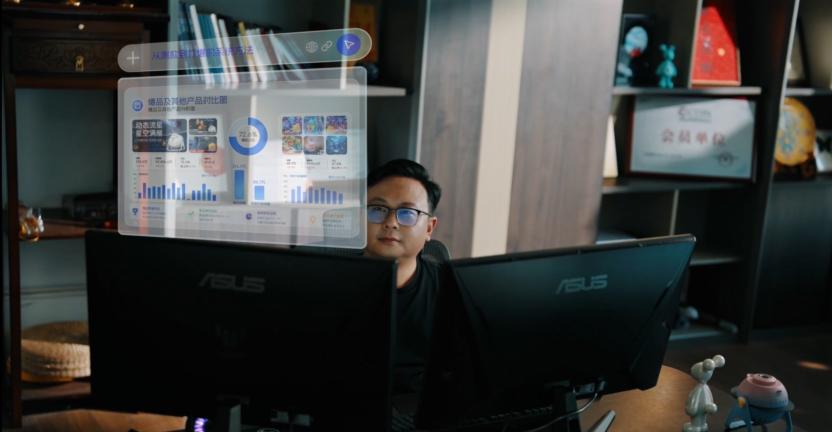
Baoshu's trial and error focuses on content. As a niche category, content seeding is the core driving force. At present, with the AIGC creative capability of AI Xiangwan, this founder-led brand can automatically generate seeding videos adapted to different crowds and different needs according to product materials, such as content for gifting, popular science and other directions, increasing content production efficiency by more than 5 times and greatly saving content production costs.
It is not difficult to find that what AI brings to merchants is to make up for their shortcomings and amplify their strengths. When the cost of trial and error is reduced, innovation is no longer a life-threatening gamble.
03. Those who are the first to taste the crab
Looking at these three cases together, some common points emerge.
In the past, the growth logic of e-commerce can be simplified as the cycle of "ad placement - order generation - re-ad placement". When traffic becomes expensive, spend more money; when efficiency is low, replace the materials. Essentially, it is renting growth. But this batch of merchants who use AI first finally have more possibilities.
For example, relatively small merchants like Baoshu used to need a small team of several people to ensure the basic operation of the store. But now, Xiangwan Intelligence helps merchants find crowds, Xiangwan Intelligence translates selling points, Xiangwan Intelligence creates content, and Xiangwan Intelligence Investment automatically optimizes 7×24 hours. The system lowers the threshold of organizational capability. Small teams or even one-person stores can now run the full operation chain that only large companies could master in the past.
Another example is factory merchants like Youkela. Due to the lack of mature market research, data analysis and product insight capabilities, their general business logic is production-driven: make products first, then find ways to sell them. They can make a big profit if they bet on the right product, but will be stuck with overstocked inventory if they bet wrong, which is somewhat "depending on luck". Now with AI, they reverse the decision-making chain: check the demand first, then conduct verification, and finally expand the scale, realizing the transformation from experience-driven to data-driven.
Whether it is full-link closed loop or data-driven decision-making, they are all common topics in the industry, or "correct nonsense". Small merchants and factory merchants did not have such capabilities before, but now AI enables these capabilities to be owned by merchants themselves.
"We Yiwu people value practicality in doing business. We use AI to understand the market, use data to drive placement, and not only sell products, but also create popular products." said WEI Jun.