"618 Consumer Insights Report (2026)": AI has not yet "taken over" the 618 shopping festival, but it is reshaping the logic of the retail industry
On the 18th, the New China Jwview Research Institute, the National Advertising Research Institute, and Inspur Zhuoshu jointly released the "618 Consumption Insight Report (2026)".

The "Report" shows that during the 618 online shopping festival in 2026 (the monitoring period is from May 31st to June 11th, the same below), the national online retail sales increased by 7.7% year-on-year.
The "Report" believes that this 618 presents four major trends: AI has been upgraded to the underlying infrastructure for e-commerce promotions, platforms are moving away from scale competition, shelf e-commerce remains the main battlefield, and service consumption is accelerating.
The research group also conducted an online questionnaire survey. The results show that during this year's 618, 60% of consumers chose shelf e-commerce, and consumers' trust in shelf e-commerce platforms such as JD.com, Taobao/Tmall is making a comeback.
01 AI is Fully Implemented and Upgraded to the Underlying Infrastructure
The 618 in 2026 is the first e-commerce promotion with full implementation of AI. The "Report" shows that AI is accelerating its popularization and has been upgraded to the core underlying infrastructure for promotions, penetrating comprehensively from marketing, customer service to live streaming and advertising.
On the consumer side, functions such as AI shopping guides, intelligent recommendations, and intelligent after-sales services have been fully implemented, simplifying the user decision-making process and optimizing the overall shopping experience.
On the industrial side, AI is integrated into supply chain links such as product selection, inventory, marketing, and logistics, helping merchants reduce costs and increase efficiency, and achieve refined operations.
However, the AI promotion strategies of various platforms are significantly different.
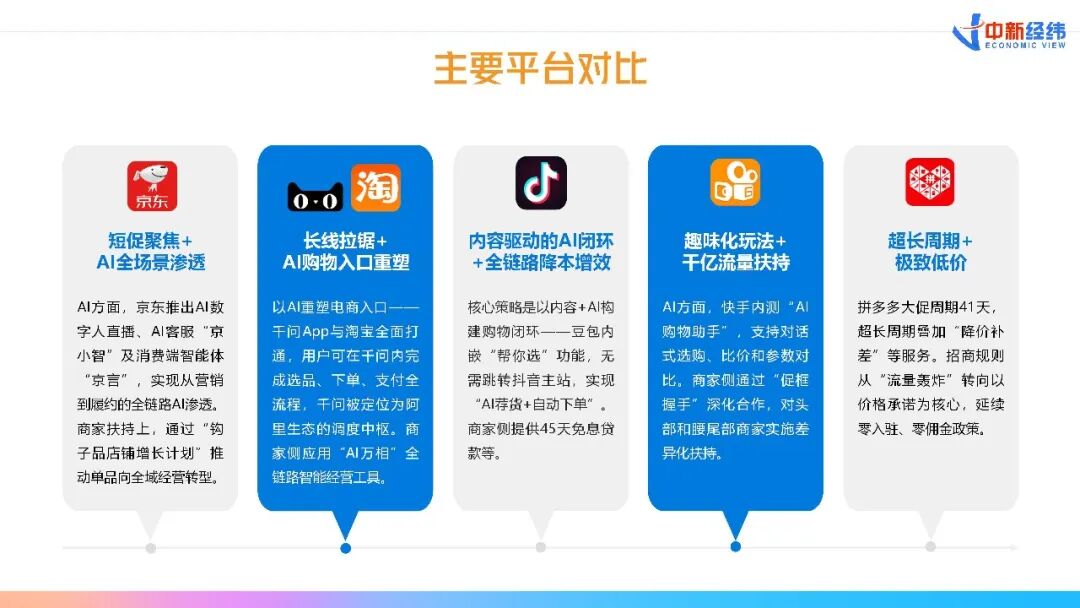
JD.com focuses on short-term and focused promotions + full-scenario AI penetration, launching AI digital human live streaming, AI customer service "Jing Xiaozhi", consumer-side intelligent agent "Jing Yan", and the logistics super-brain in the fulfillment link, achieving full-link AI penetration from marketing to fulfillment.
Taobao/Tmall focuses on long-term competition + reshaping the AI shopping entrance, fully connecting the Qianwen App with Taobao. Users can complete the entire process of product selection, ordering, and payment within Qianwen.
Douyin drives an AI closed-loop through content + reduces costs and increases efficiency across the entire link. Doubao has an embedded "Help You Choose" function, enabling "AI product recommendation + automatic ordering" without jumping to the main Douyin website.
Zhu Keli, the founding dean of the New Economy Research Institute of the National Development and Reform Commission and the chief expert in intelligent economy, believes that this differentiation is rooted in the inherent development characteristics of the platforms.
For a long time, the self-operated model, a complete supply chain, and an efficient logistics system have been JD.com's core competitiveness. Taobao/Tmall has many brand merchants, a large product pool, and a mature content ecosystem, while Douyin has advantages in short videos and live streaming content.
Zhu Keli said that the long-term positioning formed by platforms based on their own genes, user structures, and business ecosystems basically outlines the ultimate competitive landscape of the domestic e-commerce industry in the next three to five years.
02 The E-commerce Industry is Moving Away from Single-price Wars
The "Report" shows that during the 618 shopping festival in 2026, the e-commerce industry as a whole shifted from "price wars" to "efficiency wars" and "ecosystem wars". The focus of competition has continuously shifted from simple price subsidies to the competition for operational efficiency, ecosystem collaboration, and long-term user value. For example, JD.com promotes the transformation of single products to all-round operations through the "Hook Product Store Growth Plan", while Taobao/Tmall promotes merchants to use "AI Wanxiang" as a full-link intelligent operation tool.
The "Report" believes that the core of future competition will be refined operations, AI supply chain efficiency improvement, and high-quality profitability, rather than simple price wars.
Zhu Keli believes that this is an inevitable change driven by technological iteration. Low-price competition will only continuously compress merchants' profit margins, while competition in experience and efficiency can force platforms and merchants to deeply explore technology, polish products, and optimize services.
This also conforms to normal business logic. In the view of Lü Dapeng, the vice president of the China Public Relations Association, any industry competition will ultimately return to the essence of business, that is, sustainable development and healthy profitability.
For platforms, giving up extensive competition and turning to strengthening the operational foundation, and truly investing in the supply chain, products, services, and technological infrastructure is not only a policy requirement to prohibit "involution" by the state but also a sign of the platforms' own maturity.
03 Shelf E-commerce Returns to the Main Battlefield
The "Report" also shows that shelf e-commerce platforms such as JD.com, Taobao/Tmall have become the main battlefield for promotions, relying on the mutual preferences of merchants and users.
From the perspective of merchants, the industry's business logic has shifted from chasing short-term traffic to pursuing definite profitability. Problems such as high investment costs, large order fluctuations, and high return rates in live-streaming e-commerce have led many brands to adjust their resource allocation.
From the perspective of users, under the trend of rational consumption, users no longer blindly follow live-streaming recommendations but prefer the shopping mode of independent search and free price comparison.
Wang Xin, the deputy dean of the National Advertising Research Institute, believes that this is mainly due to the stability and diverse inclusiveness of shelf platforms.
In his view, the two are the same in terms of strategy. The goal of live-streaming e-commerce is to quickly accumulate users' attention resources and complete conversions; to further retain users, it still has to rely on shelf e-commerce.
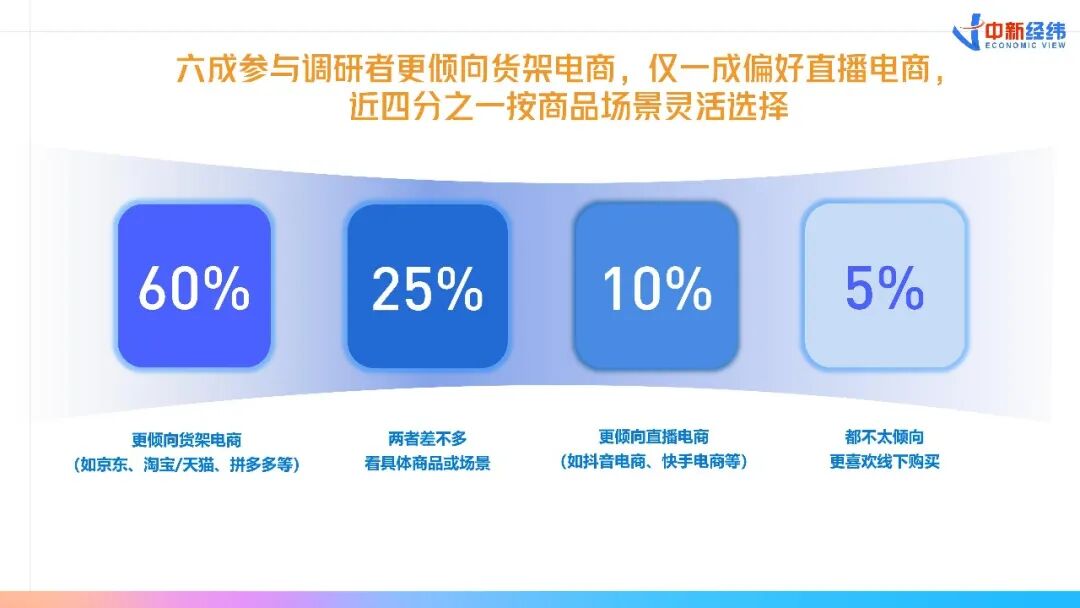
The results of the online survey by the research group also show that consumers are returning to shelf e-commerce platforms. When comparing live-streaming e-commerce and shelf e-commerce, 60% of consumers chose shelf e-commerce, while the proportion of those choosing live-streaming e-commerce was only 10%.
Judging from the sales of major e-commerce platforms, the advantageous categories of platforms such as JD.com, Taobao/Tmall, and Douyin Stores are significantly different.
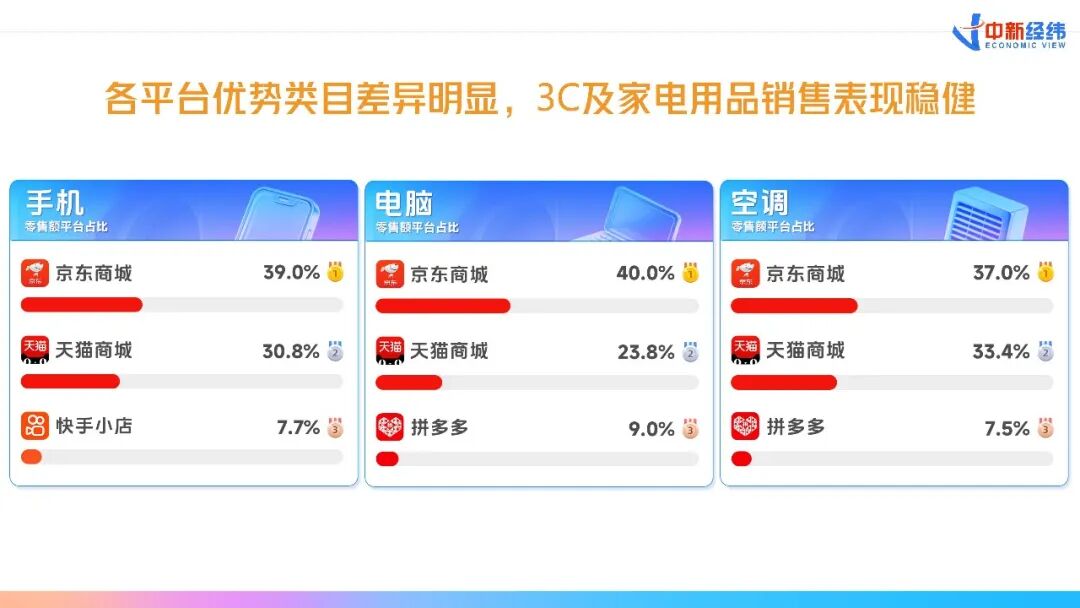
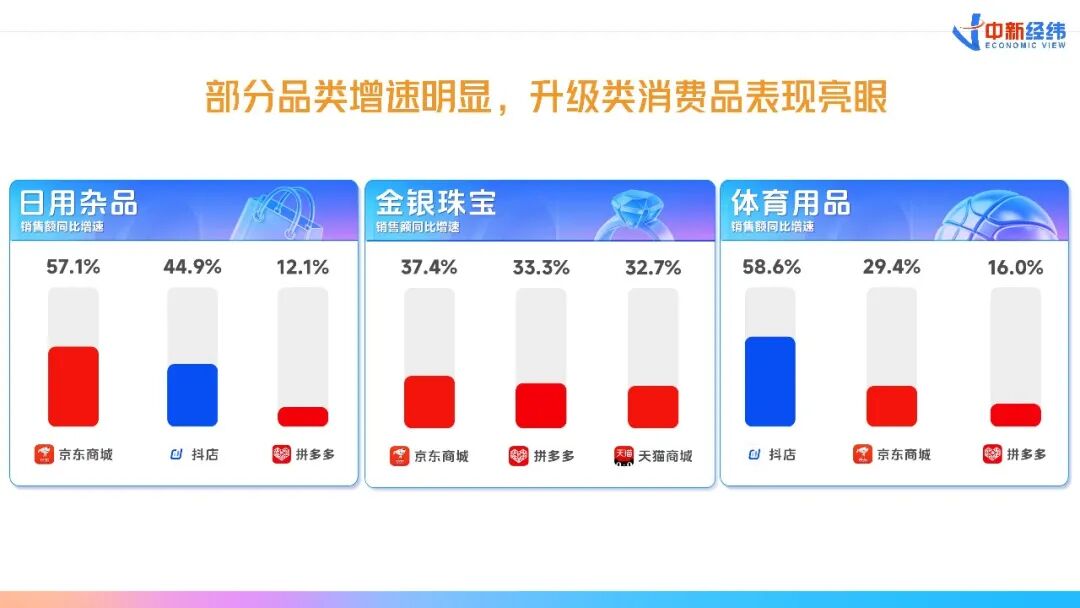
For example, JD.com Mall continues to consolidate its leading position in the 3C digital and home appliance fields, ranking first in the 3C digital fields such as mobile phones and computers, with the sales of computers accounting for up to 40%.
04 Smart Products are in High Demand, and Service Consumption is Accelerating
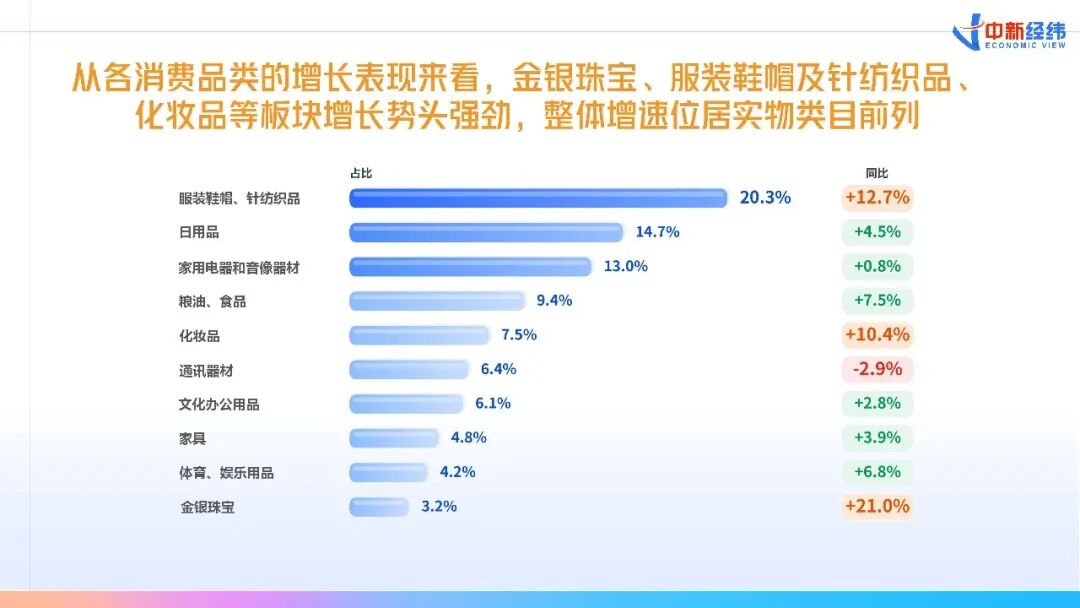
Judging from the growth performance of various consumer categories, the "Report" shows that during the event, sectors such as gold and silver jewelry, clothing, footwear, and knitted textiles, and cosmetics had strong growth momentum, ranking among the top in the physical product categories in terms of overall growth rate.
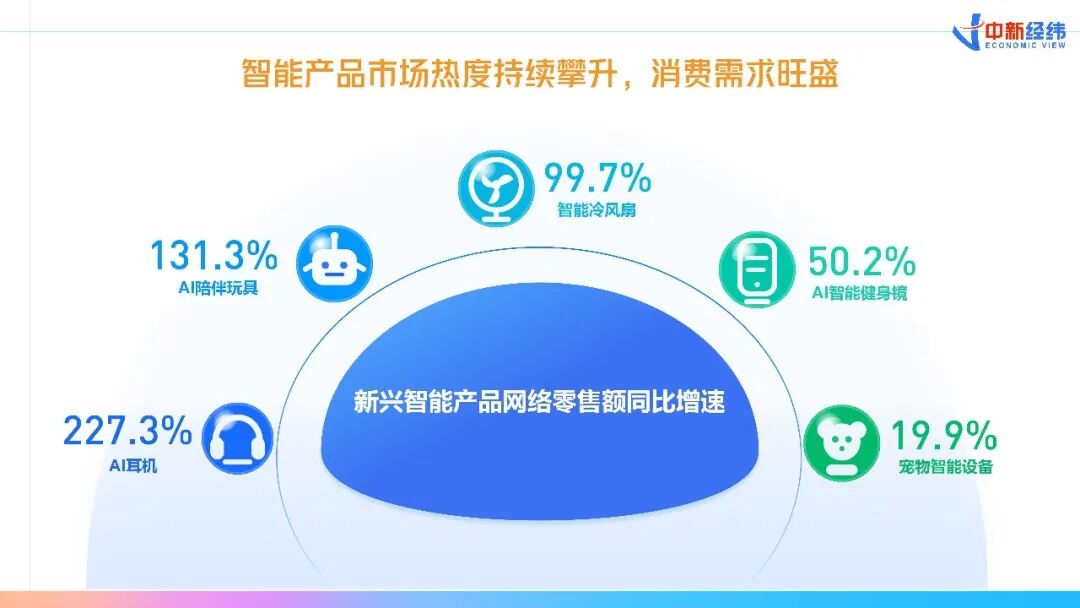
At the same time, the market popularity of various AI smart products continues to rise. Among them, AI headphones, AI companion toys, and smart cooling fans are particularly prominent, with their online retail sales increasing by 227.3%, 131.3%, and 99.7% year-on-year respectively.
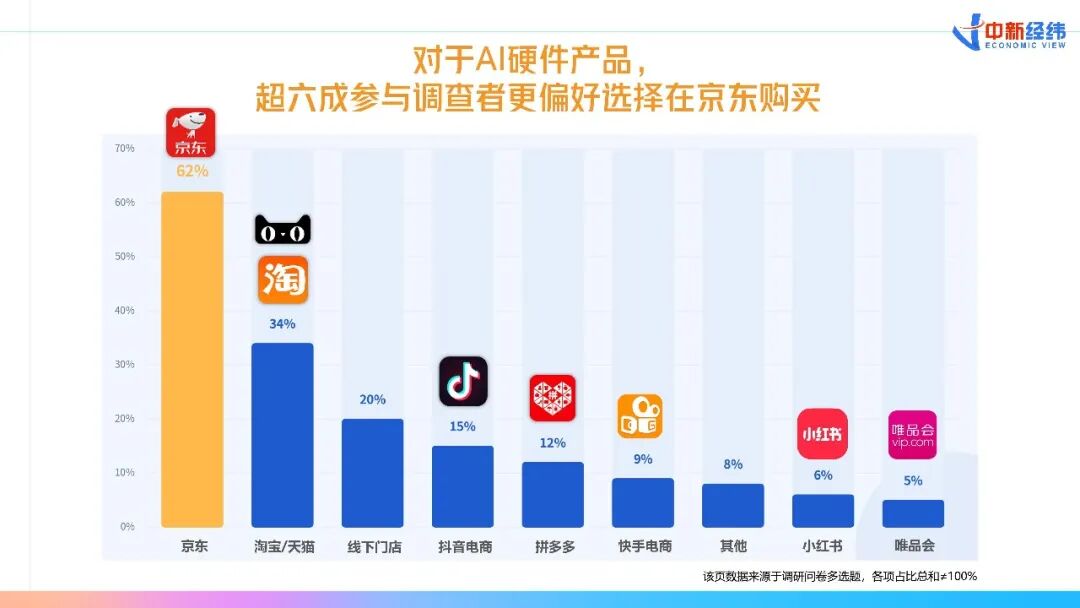
The above online questionnaire survey also shows that in the field of AI hardware sales, JD.com has obvious advantages, and 62% of consumers prefer to buy AI hardware products on JD.com.
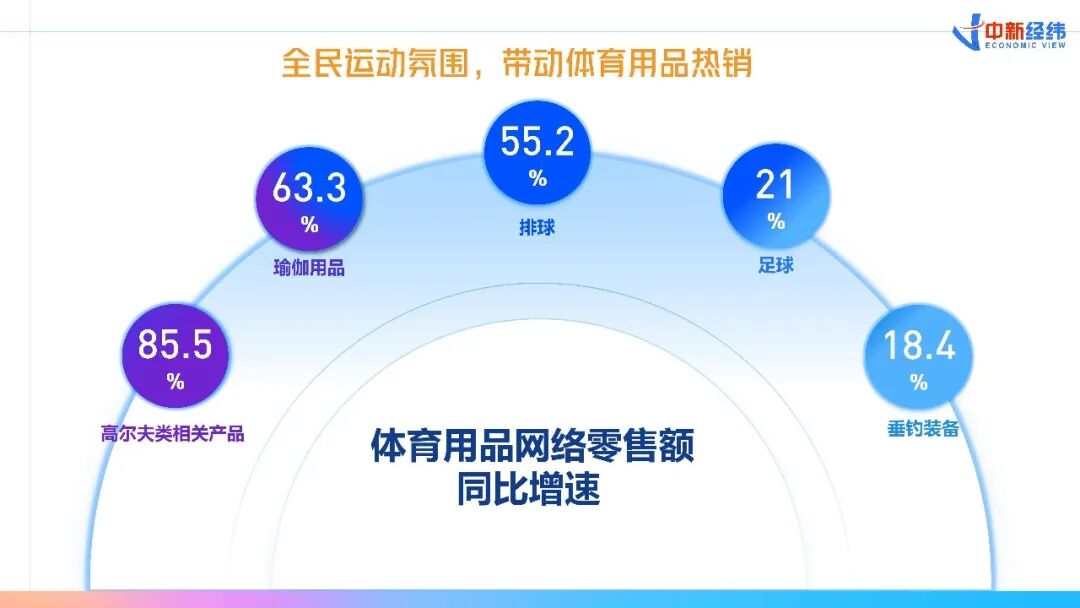
The national sports atmosphere has also driven the popularity of sports goods consumption. The year-on-year growth rates of online retail sales of golf-related products, yoga supplies, volleyballs, footballs, and fishing equipment are 85.5%, 63.3%, 55.2%, 21%, and 18.4% respectively.
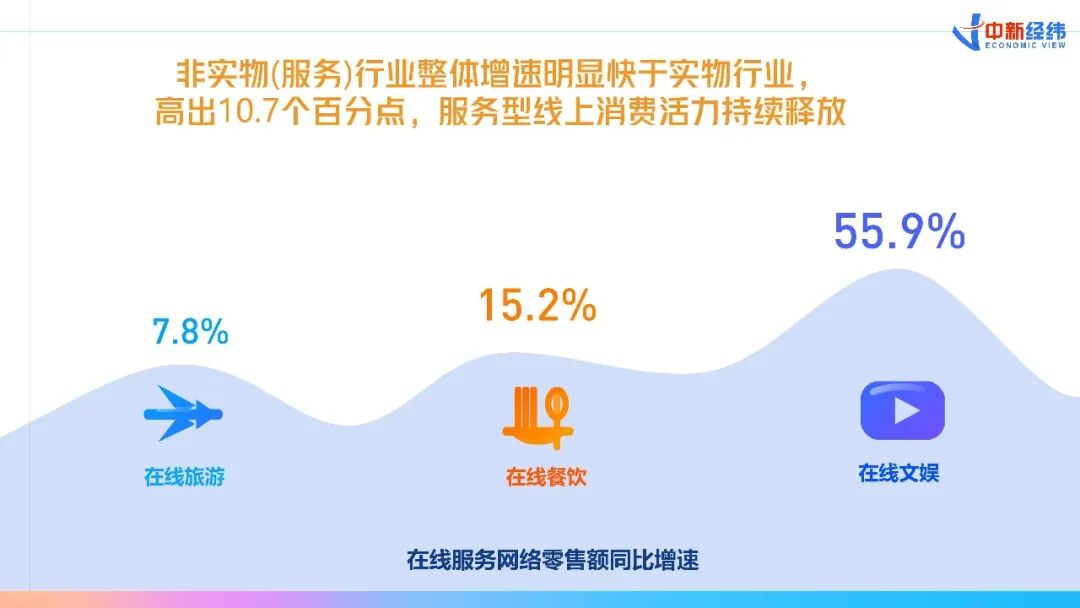
In addition, the overall growth rate of the non-physical (service) industry is significantly faster than that of the physical industry, 10.7 percentage points higher, and the vitality of service-based online consumption continues to be released. Among them, online entertainment performs the most prominently, with online retail sales increasing by 55.9% year-on-year.
In the view of Lü Dapeng, this marks that the consumption stage of the Chinese people has reached a new turning point. "It has been more than forty years since the reform and opening up, and the material needs are basically saturated. Naturally, mass consumption has begun to develop towards the improvement of living quality and spiritual experience. People are more and more willing to spend money for fun and pay for saving time."
He also believes that the fact that the growth rate of service-based consumption exceeds that of physical consumption is not a short-term promotion effect but a profound change in China's consumption structure.
This article is from the WeChat official account "New China Jwview" (ID: jwview), author: Song Yafen, published by 36Kr with authorization.