Liblib has broken the financing record for China's AI application layer: those who have real combat experience do not believe in misplaced competition
The boundaries of the model in the scenario are Evoken's main battlefield.
Evoken Technology, formerly known as Liblib, recently announced a nearly $300 million Series B+ financing round completed in the first half of this year. The company's current valuation exceeds $2 billion.
This investment amount is close to Evoken's annual revenue scale. Evoken's ARR reached $300 million in May this year. When this financing round was completed just a few months ago, this figure was less than one-third of the current amount, showing a nearly threefold increase in a short period. In other words, investors had already shown great confidence in this company at that time, betting on a company that has successfully achieved PMF for multiple AI products and is gradually becoming the fastest-growing AI application company globally, believing that it can further promote the development of the video generation field. And the facts have proven that its commercialization progress is even faster than the market expected.
After intense competition in the video generation track to date, the benchmark for value judgment is changing. Model capabilities and Agent gameplay are still important, but AI video generation should ultimately be regarded as an ability to be integrated into real scenarios. The flow of money is rational. Among the many players in this field, Evoken is currently the one closest to the endgame.
The largest financing this year
This is the largest financing in the domestic AI video generation field this year.
This financing round was jointly led by Granite Asia, Tencent, and Shunwei Capital, with the participation of HT Investment and Jeneration Capital. Existing shareholders such as Gao Rong Capital, Ant Group, Ying Ce Capital, Ming Shi Venture Capital, Source Code Capital, Sequoia China, and several other institutions continued to increase their investments.
This is also the financing round with the most participants in Evoken's history. Its shareholder portfolio includes both US dollar funds, Internet industry capital, and many shareholders from the previous round. The AI video generation field clearly has not yet entered a stable pattern, and Evoken has received rare trust at this stage in this still volatile track.
AI video generation is one of the directions where global capital is most intensively betting at present. In the overseas market, Video Rebirth received $80 million in financing in March this year, and the valuations of Runway and Luma AI both exceeded $3 billion last year. Companies focusing on character, marketing, and short - video production have also continuously attracted capital attention. Higgsfield became a company with a valuation reaching the $1 billion threshold this year.
It was not until the emergence of Sora 2 that people realized that a more intense battle was taking place in China.
The rapid expansion of the AI short - drama industry has made AI video generation a predictable "rigid demand" productivity tool in China. In this track, Internet giants, first - tier model companies, and product companies focusing on vertical video generation scenarios are sitting at the same table, competing for attention and the flow of funds.
Large - company models such as Kuaishou Keling, ByteDance Seedance, Alibaba, and Tencent Hunyuan do not rely on external financing. Instead, they represent a picture of concentrated internal resource investment, continuous iteration of content ecosystems, and business scenarios. Whether it is the listing and stock price changes of leading model companies represented by MiniMax or the narrative changes of startups in the vertical field of AI video generation, there is a trend that business data is starting to replace technical parameters as the core evaluation indicator.
This is also the special feature of Evoken's financing. It is not just a tool company that only focuses on basic model capabilities or simply packages model APIs. When it received $300 million in financing, Evoken was already a commercially established company. Roughly calculated based on a valuation of over $2 billion, its revenue multiple is much lower than that of many model companies still in the technical narrative stage. In other words, this investment is not just paying for "future possibilities" but for the established commercialization slope.
Money flows to profitable companies
From a "GitHub" to a "professional studio", Evoken has spent three years proving that AI video generation technology can find a stable and considerable commercialization path in China.
When Evoken was known as LiblibAI in the market in 2023, it was positioned as the "GitHub in the field of AI painting". At that time, this was a reasonable entry point. With the rapid expansion of the Stable Diffusion open - source ecosystem, model authors, designers, and AI painting enthusiasts all needed a platform to share models, exchange parameters, and reuse prompts and work cases. Two months after its establishment, Evoken completed its angel - round financing, receiving a $3.5 million investment at a valuation of approximately $15 million. That round of financing was like buying an early ticket for the explosion of AIGC applications. Specifically for LiblibAI, the outside world believed that large - model capabilities would redefine the image of creators, and the creator ecosystem would also be reorganized around AI capabilities.

This was the "0 - 1" stage for creators. However, in the content creation scenario, which is extremely result - oriented, the PMF for commercialization can only be found in the "last mile".
At the end of 2023, LiblibAI began to expand from a model library to cloud - based tools and a creator community. Users can directly call computing power on the platform to complete text - to - image, image - to - image, local redrawing, ControlNet, model training, and video generation, without the need for local graphics cards and complex environment configuration. Works can be displayed, parameters can be viewed, and gameplay can be re - created.
In 2024, Evoken further shifted its product focus from a toolset to a workflow, starting to allow creators to complete more creation steps on the platform. In January, Evoken received Pre - A round financing, introducing industrial assets and starting to verify the commercialization direction. Just six months later, the Series A financing of hundreds of millions of dollars led by Ming Shi Venture Capital continued to increase the investment, indicating that Evoken's performance in user growth was recognized, and it entered a stage of rapid expansion.
Also starting from this year, the company gradually hid the "github" label. Upstream are original models and the creator ecosystem, in the middle are cloud - based tools and multi - modal capabilities, and downstream is connected to the professional design, e - commerce, poster, IP, video, and enterprise customer ecosystems. The attributes of a creative platform began to gradually emerge.
Coincidentally, in 2025, demanders of professional video content such as short dramas, comic dramas, and brand - series advertisements began to turn to AI generation on a large scale. Data from iiMedia Research shows that the market scale of Chinese animated micro - short dramas, mainly AI comic dramas, reached 18.98 billion yuan that year, a year - on - year increase of 276.3%. 2025 is also regarded as the "first year" of the explosion of AI comic dramas in the industry.
This directly changed the valuation method for the video generation track. When the demand for video generation quickly shifted from gameplay and demos to the delivery of final works, the consistency of generated content assets, the reusability of assets, and the perfection of the entire creative process began to become the key thresholds for a commercial closed - loop.
With a monthly active user base of 4 million and a total user base of 25 million, in the most important year for the domestic video generation industry, Evoken, at the node when the industry turned to commercialization, changed the product positioning of LiblibAI to an "AI professional creative studio". Throughout 2025, Evoken completed four rounds of financing in a row, setting a new record for the financing speed in the AI application track. What capital is betting on is no longer the imagination of an "AI painting GitHub" but a creator community closest to the video content industry and its opportunity to define a new AI video creation paradigm.
A few months ago, Evoken took another step in this direction - LibTV.
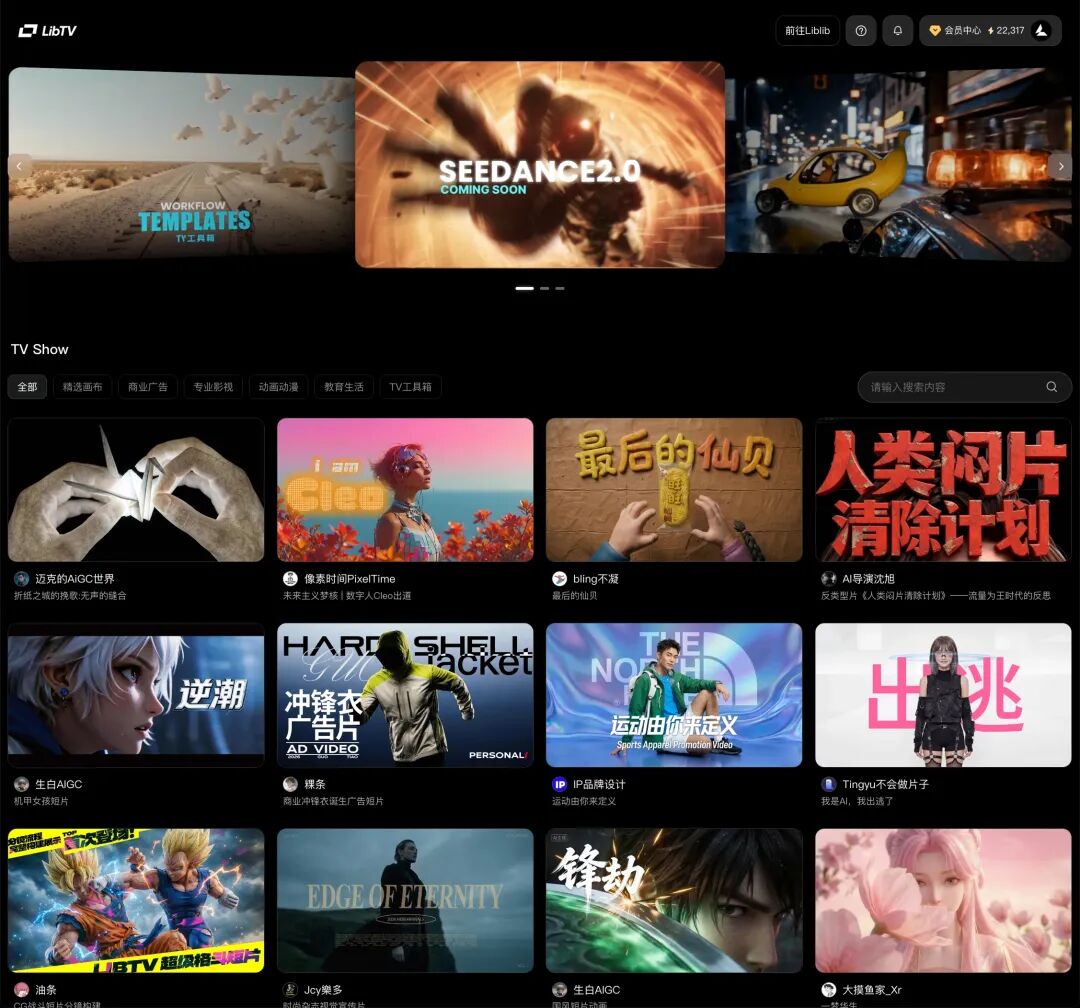
Evoken integrates its strongest model - calling capabilities and the deepest workflow into the new product LibTV, directly targeting creators, studios, brands, and film and television teams focusing on AI video creation. This is the most elite group in the entire content creation ecosystem and the one that can best verify commercialization.
"Different models have different characteristics. Seedance is the last step in video generation. It's still more convenient to use Midjourney for the original paintings before that. In the script and storyboard stages before that, a good text model is needed," an AI short - drama director described his experience of using LibTV.
Payment is the most honest way to vote. After LibTV was officially launched in March this year, its daily revenue exceeded $1 million in the first month, serving nearly a thousand short - drama teams, film and television production institutions, advertising companies, and brand customers. By May, its revenue had more than tripled compared to the first month of launch, and it has begun to become an important infrastructure for many professional content teams to enter the AI video era.
Evoken currently has more than 30 million creators in its ecosystem, and its overall revenue increased by more than 3000% year - on - year in May this year. Investments in the AI video generation field are starting to flow more concentratedly to these truly profitable companies.
Those who have been in battles don't believe in misaligned competition
To some extent, LiblibAI is an exception in the short - lived battle in the video generation industry in the past year.
Since 2025, a group of new AIGC video application startups in China have rapidly emerged. Some star projects, such as Vivix, reached a valuation of $1.32 billion from its establishment to the end of 2025, jumping three rounds in less than a year and directly entering the unicorn range. ONE2X, with a star founder who left Kimi, and its product Medeo, which focuses on low - threshold video generation through multi - round conversations, also raised $23 million at the end of last year. Almost at the same time, Pollo AI also officially announced the completion of a $14 million seed - round financing.
The popularity of the entire video generation track last year can be seen from the capital market. In the six - month period after September last year, the financing amount in this track exceeded 1 billion yuan.
It was an extremely fast period. New interaction methods, low - threshold video generation, automated scripts and storyboards, and short - content production for social platforms were all sufficient to gain popularity in the early stage. Users were willing to try new things, investors were willing to see growth, and platforms were willing to reward novel content.
But the excitement soon hit a boundary.
The underlying selling points of this group of products are often similar: disassembling video creation into more automated script, storyboard, and generation processes, allowing non - professional users to create a short video more quickly. They can easily attract attention in the early stage but are also easily overshadowed by stronger model capabilities. Once creators find that a certain model has better effects in a specific scenario or is cheaper with the same effects, the switch may happen overnight.
When models and products polished by platform companies such as Seedance 2.0 continue to iterate, and players with stronger model - iteration capabilities and larger user entrances turn around, the seemingly clever "misaligned competition" of many video generation Agent products suddenly becomes fragile.
Such "misaligned competition" is often a beautiful illusion. This may also be the experience that Chen Mian, the founder of Evoken, gained when he left ByteDance to start a business.
Chen Mian was once the youngest 4 - 1 at ByteDance, in charge of the commercialization of CapCut. CapCut did not establish its advantage through a single editing function but by reducing the overall friction for creators from material, templates, editing, music, subtitles to publishing. If a creative tool can accommodate users' creative habits, material assets, and delivery processes, it is no longer just a tool but a production environment.

At that time, CapCut, leveraging Douyin's huge content ecosystem, migrated the creative habits of video creators to itself, challenging Adobe, Pr, and Canva. Now, Evoken, leveraging the transformation of content production by AI, has an opportunity to redefine the new production environment.
Therefore, Evoken's judgment on AI video generation has always been more practical. Chen Mian once said that when developing AI applications, one needs to predict the evolution of models and "show off" the product when the model is ready. There are actually two meanings behind this statement: application companies need to be close enough to technology to know which capabilities will soon be supplemented by models, and they also need to be close enough to users to know which problems will still exist even if the models are stronger.
Once video creation enters the real production environment, most of the problems encountered by AI tools belong to the latter category.
Models can make generation faster, clearer, and more controllable, but they cannot automatically understand the shooting rhythm of a short - drama team, the brand specifications of an advertising client, the character asset management method of a film and television institution, or the style - continuation requirements of a designer. The stronger the model capabilities, the more creators need someone to organize these capabilities. Generation is just an intermediate step, and delivery is the end goal.
If you have used LiblibAI or experienced the latest LibTV, you will find that the core components of the latter product, including the script generator, character consistency, AI director's console, subject library, SD2 prompt optimization, and batch storyboarding, are all accurately abstracting the content production link and productizing it.
In essence, what Evoken provides for creators is a project management tool that deeply understands the content creation process and operates more efficiently with the enhancement of AI capabilities. A lot of know - how is outside the model capabilities, and the boundaries of the model in the scenario are Evoken's main battlefield. Once creators' assets, habits, project processes, and delivery relationships are settled, they will become more difficult to migrate.
"Chinese people are willing to pay for services and final results but have a relatively low willingness to pay for pure tools. So the key lies in whether AI is ultimately a tool, a service, or a result?" Chen Mian expressed his judgment on commercialization in an interview last year.
Now, serving creators to complete work delivery has become the proven commercialization main line for Evoken.
And these creators will ultimately become Evoken's unique moat.