Stepping out of the negative turmoil and returning to growth, can Haitian Flavouring replicate the success of "Kikkoman"?
Product diversification and global expansion will become the two magic weapons for Haitian Flavoring Industry to return to the "spotlight" of the capital market.
The Abandoned "Soy Sauce King"
Since 2026, the A-share market has witnessed an extreme style shift. On one hand, the technology sector has siphoned market liquidity with its strong narrative logic, and stock prices have repeatedly hit new highs. On the other hand, the once glorious value blue-chip stocks have fallen into the "Davis double whammy" of declining performance and shrinking valuations, and have been brutally abandoned by funds.
Under the increasingly intense structural differentiation market, a large amount of passive index funds are systematically adjusting their positions and reallocating. On June 3rd, FTSE Russell, the world's second-largest index compiler, announced the quarterly adjustment results of the FTSE China A50 Index. Among them, several technology stocks such as GigaDevice Semiconductor, Montage Technology, Dongshan Precision, and Shenghong Technology were included in the FTSE China A50 Index, while five stocks, including China State Construction, Haitian Flavoring Industry, Haier Smart Home, Ping An Bank, and Mindray Medical, were removed.
As the core indicator for foreign investors to observe the A-share market, the constituent stocks of the FTSE A50 Index are mainly selected from the 50 leading enterprises with the largest market capitalization and the strongest liquidity in the Chinese A-share market. In the current relatively weak macroeconomic environment, the financial, real estate, infrastructure, and traditional manufacturing industries generally face severe operating pressures, and the growth rates of corporate revenues and profits have significantly slowed down.
Judging from the quarterly reports of the first quarter of 2025 and 2026, four enterprises, including China State Construction, Haitian Flavoring Industry, Haier Smart Home, and Ping An Bank, have all experienced a stall or even negative growth in performance. This has also led global capital to be more inclined to allocate funds to hard technology tracks such as AI computing power and semiconductors, which have stronger performance explosive power.
With the mechanical position adjustment of index funds such as FTSE, the "blood loss" of traditional blue-chip stocks has been further accelerated. However, it should be noted that among the five "old stocks" abandoned by FTSE Russell, the situation of Haitian Flavoring Industry is relatively special - whether from the annual report performance or the first-quarter report performance, Haitian Flavoring Industry has performed commendably, and it can even be said that it has shown a trend of counter-cyclical growth.
The annual report data shows that in 2025, Haitian Flavoring Industry achieved an operating revenue of 28.873 billion yuan, a year-on-year increase of 7.32%; the net profit attributable to the parent company was 7.038 billion yuan, a year-on-year increase of 10.95%; the non-recurring net profit attributable to the parent company was 6.845 billion yuan, a year-on-year increase of 12.81%. In terms of revenue scale and net profit, the operating performance of Haitian Flavoring Industry in 2025 reached a record high.
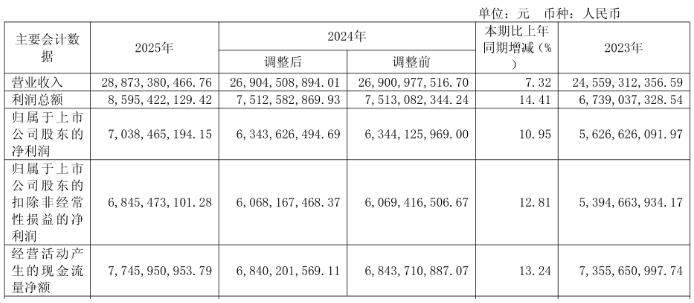
The subsequent first-quarter report shows that from January to March 2026, Haitian Flavoring Industry achieved an operating revenue of 9.029 billion yuan, a year-on-year increase of 8.58%; the net profit attributable to the parent company was 2.444 billion yuan, with a year-on-year increase of nearly 10.97%. The gross profit margin further rebounded to 42%, reaching the highest level since the second quarter of 2020.
The "White Paper on the Development of the Chinese Condiment Industry" released by the China Condiment Association in 2025 shows that in 2025, the overall market scale of the domestic condiment industry reached 512.3 billion yuan, a year-on-year increase of 6.8%. According to the 2025 annual report released by Zhongju High-tech, the condiment business of Zhongju High-tech achieved a total operating revenue of 4.13 billion yuan, a year-on-year decrease of 944 million yuan, a year-on-year decline of 8.61%. At the same time, the operating performance of Qianhe Flavor Industry also showed a "double decline" in revenue and net profit.
It is not difficult to see that in 2025, the revenue growth rate of Haitian Flavoring Industry outpaced the industry average, and its performance was significantly better than that of Zhongju High-tech, the "second in the industry", demonstrating the performance resilience of a leading enterprise.
However, from the secondary market perspective, the short-term recovery of Haitian Flavoring Industry's performance has not driven the rebound of its stock price. As of the close on June 15th, the latest market value of Haitian Flavoring Industry has fallen below the 200 billion yuan mark, with a cumulative decline of more than 6% in 2026, and a shrinkage of 500 billion yuan compared with the historical high.
As a well-known Chinese time-honored brand, Haitian Flavoring Industry is the largest condiment producer in China. In February 2021, the highest market value of Haitian Flavoring Industry exceeded 700 billion yuan, surpassing giant companies such as Sinopec, and becoming the veritable "Soy Sauce King" in the A-share market. After that, with the peak of the "Mao Index" and the slowdown of performance growth, the stock price of Haitian Flavoring Industry fell into a downward trend.
In June 2025, Haitian Flavoring Industry successfully listed in Hong Kong at an issue price of HK$36.30 per share, becoming the first enterprise in the condiment industry to have both A and H shares. From the perspective of the Hong Kong stock market, the stock price of Haitian Flavoring Industry has also been below the issue price for a long time. As of the close of the latest trading day, the Hong Kong stock price of Haitian Flavoring Industry closed at HK$30, a decline of more than 10% compared with the issue price.
It is not difficult to see that whether in the A-share market priced by domestic capital or the Hong Kong stock market priced by foreign capital, the stock price of Haitian Flavoring Industry seems to be indifferent to its steadily recovering performance. So, why has the once glorious "Soy Sauce King", Haitian Flavoring Industry, been abandoned by investors?
High Growth Is in the Past
According to public information, Haitian Flavoring Industry originated from a sauce garden in Foshan in the Qing Dynasty. In 1955, 25 sauce gardens were merged to form the "Foshan Soy Sauce Factory", and in 1994, it was restructured into a joint-stock company. As a well-known Chinese time-honored brand, Haitian Flavoring Industry mainly produces soy sauce, oyster sauce, seasoning paste, as well as vinegar, cooking wine, and compound seasonings. Among them, the market shares of soy sauce and oyster sauce rank first in the country.
From the perspective of industry characteristics, the condiment industry has a strong "rigid demand" attribute. Consumers are relatively insensitive to prices and are less affected by macroeconomic fluctuations. Among them, Haitian Flavoring Industry has formed a strong Matthew effect through long-term brand building, a large dealer network, and strong control over the terminal, and its operating performance has also achieved stable growth.
Data shows that from 2014 to 2020, the revenue of Haitian Flavoring Industry increased from 9.817 billion yuan to 22.792 billion yuan, with a compound growth rate of about 15.11%. During the same period, the company's net profit increased from 2.09 billion yuan to 6.4 billion yuan in 2020, and the compound growth rate of the net profit attributable to the parent company exceeded 20%.
With a stable performance growth rate, Haitian Flavoring Industry has been sought after by investors. In February 2021, the highest market value of Haitian Flavoring Industry exceeded 700 billion yuan, with a more than 14-fold increase in seven years, becoming the veritable "Soy Sauce King" in the A-share market.
However, since 2021, affected by factors such as the weak macro-consumption environment, the condiment industry has officially bid farewell to the previous extensive high-growth stage. According to the data in the "In-depth Research Report on the Operation and Investment Plan of the Chinese Soy Sauce Industry from 2025 to 2030" released by the China Report Hall, from 2017 to 2021, the retail sales of domestic soy sauce increased from 68.399 billion yuan to 96.939 billion yuan, with an average annual compound growth rate of 7.2% during the period. From 2018 to 2023, the compound annual growth rate was only 3.2%.
On the other hand, with the improvement of national health awareness, the per capita demand for soy sauce has also declined significantly. Data shows that from 2015 to 2023, the per capita demand for soy sauce in China decreased from 7.28 kilograms to less than 5 kilograms in 2023. During the same period, the total domestic soy sauce production also decreased from 10.1194 million tons to 7.95 million tons, and the situation of over-supply in the industry has become increasingly serious.
In this context, the growth rates of both revenue and net profit of Haitian Flavoring Industry fell to single digits in 2021, and signs of weak performance began to appear. In terms of different businesses, the sales revenues of the company's three main products, soy sauce, seasoning paste, and oyster sauce, all declined year-on-year.
In the fourth quarter of 2022, it was reported that the Haitian soy sauce sold in China contained food additives, while the Haitian soy sauce sold in Japan was "additive-free". This was also called the "double-standard gate" of Haitian Flavoring Industry by netizens, and the public opinion crisis further aggravated the company's performance decline. In 2023, Haitian Flavoring Industry delivered its worst report card since listing, with both revenue and net profit showing negative growth, and the company's stock price also plummeted.
In September 2024, Haitian Flavoring Industry announced a leadership change. The former chairman, Pang Kang, officially stepped down, and Cheng Xue, the company's executive president and a "veteran" who had worked at Haitian for more than 30 years, became the new leader of the company. Under the leadership of this "Soy Sauce Queen", Haitian Flavoring Industry comprehensively promoted the three major reforms of "products, channels, and brands". In 2024, the revenue of Haitian Flavoring Industry increased by 9.53% year-on-year, and the net profit increased by 12.74% year-on-year, successfully reversing the previous downward trend of performance. The revenues of the three core products, soy sauce, oyster sauce, and seasoning paste, also got rid of the previous "three consecutive declines".
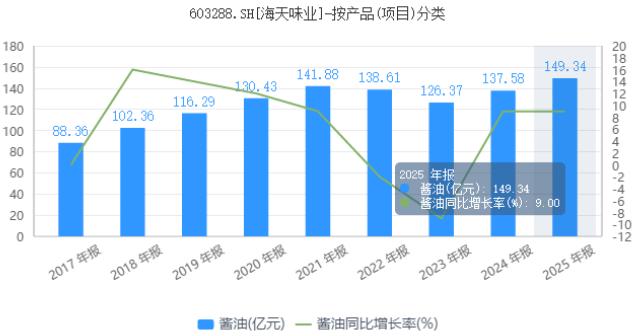
Judging from the 2025 annual report, both the revenue scale and net profit of Haitian Flavoring Industry reached record highs. In terms of different businesses, the sales revenues of the company's soy sauce, oyster sauce, and seasoning paste were 14.934 billion yuan, 4.868 billion yuan, and 2.917 billion yuan respectively, with year-on-year growth rates of 8.55%, 5.48%, and 9.29% respectively.
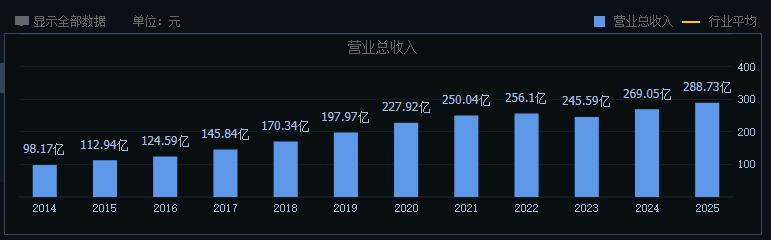
However, it should be noted that from the data of 2024 - 2025, the growth rates of both revenue and net profit of Haitian Flavoring Industry are in single digits, which is in sharp contrast to the previous seven consecutive years of "double-digit growth". On the other hand, in terms of valuation, the current dynamic price-to-earnings ratio of Haitian Flavoring Industry is still as high as 28 times, significantly higher than that of consumer goods leading companies such as Yili and Tsingtao Brewery.
It is not difficult to see that although Haitian Flavoring Industry has emerged from the shadow of the "additive double-standard" storm and achieved a recovery-style growth in operating performance, it has not returned to the previous high-growth period. At the same time, although the stock price of Haitian Flavoring Industry has fallen significantly, it is still not "cheap" in terms of relative valuation. This is also a major reason for the continuous decline of the company's stock price.
How to Recreate Another Haitian?
In fact, since its listing in 2014, the valuation of Haitian Flavoring Industry has long maintained a price-to-earnings ratio of over 40 times, far exceeding the valuation levels of the food and beverage and even the liquor industries. The reason why the capital market has long given Haitian Flavoring Industry a relatively high valuation is largely because it is benchmarked against Kikkoman, the leading Japanese condiment company.
Public information shows that Kikkoman was founded in 1917. Its main business covers more than 2,000 kinds of condiments such as soy sauce and teriyaki sauce, as well as fruit juices, alcoholic beverages, etc. It is the largest soy sauce producer in Japan and also a globally leading food seasoning manufacturer. In terms of market share, Kikkoman's market share in the Japanese domestic soy sauce market is approximately between 33% and 37.6%. Data shows that from 2007 to 2024, the average PE of Kikkoman was as high as 41 times, and the static PE in normal years also maintained at around 30 times.
In contrast, the market share of Haitian Flavoring Industry in the Chinese soy sauce market is only 13.2% (in 2024). Obviously, if Haitian Flavoring Industry can replicate Kikkoman's glory in the Japanese domestic market in China, it can naturally enjoy the valuation premium as the leading domestic condiment enterprise.
However, some analysts point out that the reason why Kikkoman can occupy a very high market share in the Japanese market is largely due to the high uniformity of the preference for soy sauce flavor across Japan, which allows a single brand to cover consumers across the country through standardized products. Compared with Japan, a single market, China has a vast territory, with significant differences in taste preferences in different regions, obvious regional consumption characteristics, and natural protection for local brands. This results in a relatively limited upper limit for the market share of industry leaders.
Therefore, considering the huge differences in national conditions between China and Japan in terms of food culture, market structure, and population size, it is difficult for foreign condiment companies in the domestic soy sauce market to reach the height of Kikkoman soy sauce in the Japanese domestic market. Judging from the company's revenue data in the past five years, the sales volume of Haitian