Research Report on User Insights of Online Travel Platforms
Service consumption and tourism demand continue to be released. The traffic and usage depth of online travel apps have steadily increased. Qunar APP has differentiated advantages in terms of price, category integration, event benefits, transaction efficiency, and service guarantee. The report further depicts the profiles of groups such as family trips with children, high - end quality tours, self - driving tours, outbound tours, college students, and the silver - haired population. It also focuses on associated consumption opportunities such as AI travel assistants, content marketing, and related industries like 3C digital, financial payment, food and beverage, beauty and skin - care, pharmaceuticals, and automobiles, providing references for the growth of travel platforms, user operations, and business cooperation.
Panorama of the consumer market
The consumer market shows "stable volume and improved quality", and the service consumption and tourism sectors show prominent momentum
Structural upgrading continues: In 2025, the total retail sales of social consumer goods in the country expanded steadily. The service retail sales increased by 5.5% year - on - year, leading the retail sales of goods by 1.7 percentage points. The per - capita service consumption expenditure of residents reached 13,602 yuan, accounting for 46.1% of the per - capita consumption expenditure, approaching "half of the country" of residents' consumption. The consumption structure is continuously evolving from "dominated by goods" to "equal emphasis on services and goods".
The momentum at the beginning of 2026 continues: In the first quarter, the service retail sales continued to grow at a year - on - year rate of 5.5%, the same as the whole year of the previous year, and the growth rate was 3.3 percentage points higher than that of goods retail. Among them, the retail sales of cultural and recreational services and tourism consulting and rental services both achieved double - digit growth. Holiday consumption heated up, and residents' travel demand was released.
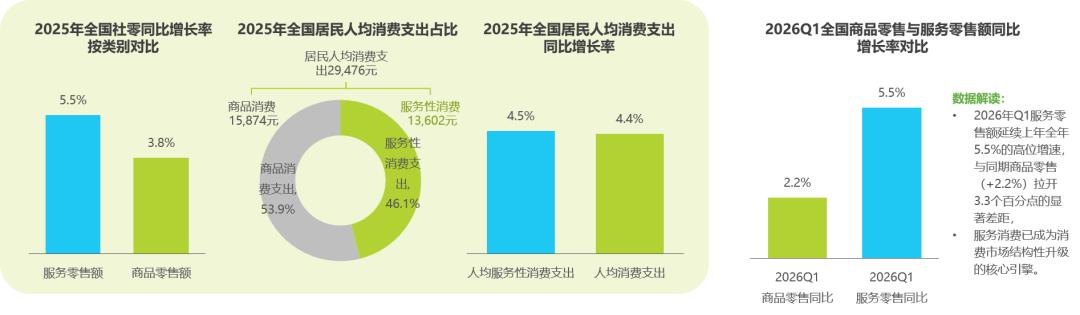
Data source: National Bureau of Statistics; Explanation of data indicators: The National Bureau of Statistics uses two parallel methods to count consumption: ① At the enterprise sales end: The total retail sales of social consumer goods (retail sales of goods + catering revenue) and service retail sales (transportation/accommodation/culture and tourism, etc.) are counted separately. Service retail is not included in the total retail sales of social consumer goods, and they jointly reflect the market sales scale. ② At the resident expenditure end: The per - capita consumption expenditure of residents includes service consumption (transportation, education, medical care, culture and tourism, etc., accounting for 46.1%) and commodity consumption (food, clothing, household appliances, etc., accounting for 53.9%), which jointly reflect the living standards and consumption structure of residents.
Latest policies for the development of the tourism industry
In 2026, the first year of the 15th Five - Year Plan, policy dividends continue to be released, and the construction of a tourism power has entered a period of full - speed acceleration
2026 is the first year of the 15th Five - Year Plan. The tourism industry is fully entering a new stage of "building a tourism power" from "post - pandemic recovery". At the national level, the policy main line has been upgraded from "recovery + regulation" in the 14th Five - Year Plan period to "integration + opening - up + digital intelligence + quality": At the top level, the "15th Five - Year Plan Outline" clarifies the strategic pillar position of culture and tourism; at the middle level, three measures, namely, cultivating service consumption, opening up to inbound tourism, and building a tourism power, open up incremental space; at the bottom level, new productive forces promote the intelligent reconstruction of the industry. Five policies form a complete policy closed - loop of "top - level design - demand stimulation - opening to the outside world - quality upgrading - digital intelligence empowerment", continuously releasing institutional dividends for the online travel industry.
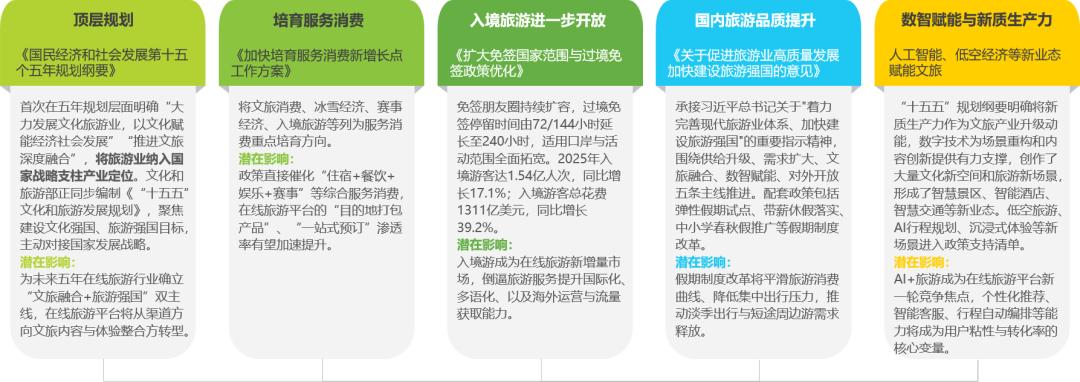
Policy dividends and new tourism trends
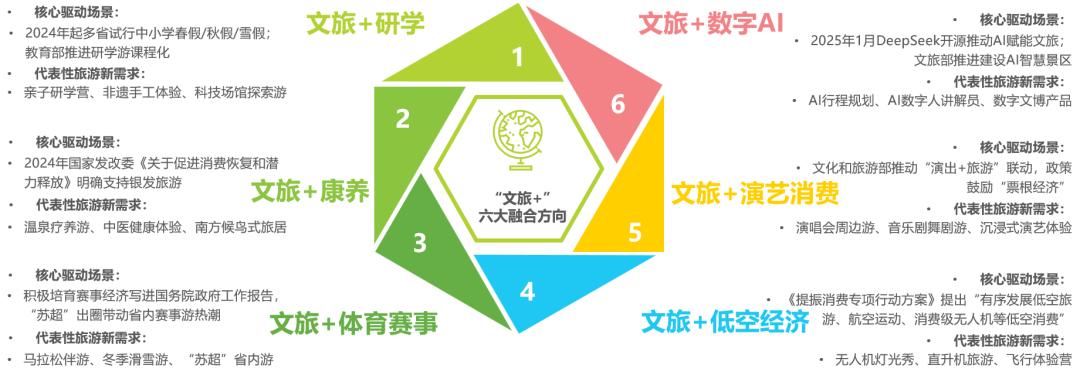
The era of in - depth integration of "culture and tourism +"
In 2026, the tourism industry has received unprecedented strategic support at the policy level, and at the same time, a variety of emerging tourism forms have risen rapidly, jointly reshaping the content structure and industrial chain of tourism consumption. The data in the first quarter of 2026 has verified that multiple trends have entered the implementation stage: The order amount of family trips with children during the Spring Festival accounted for 37%, the superposition of the Tomb - sweeping Festival and the spring holiday promoted a boom in family outings, and the proportion of cultural and tourism revenue in counties reached a record high.
The golden age of the tourism industry is coming
In 2025, the number of domestic tourist trips and tourism consumption reached historical peaks. In 2026, the Spring Festival, Tomb - sweeping Festival, and May Day holidays continuously set new records, and the tourism market started strongly
Since 2023, the number of domestic tourist trips has maintained double - digit high growth for three consecutive years, fully exceeding the pre - pandemic level. In 2025, the Chinese tourism market made a historic breakthrough. The total number of tourist trips reached 6.522 billion, and the total expenditure reached 6.3 trillion yuan, both setting new historical highs. In 2026, the momentum continued. During the 9 - day Spring Festival holiday, 596 million people traveled; during the Tomb - sweeping Festival, 135 million people traveled; during the May Day holiday, 325 million people traveled. The scale of travel during the three holidays all refreshed the historical records of the same period, and the tourism market continued to grow strongly in the first year of the 15th Five - Year Plan.
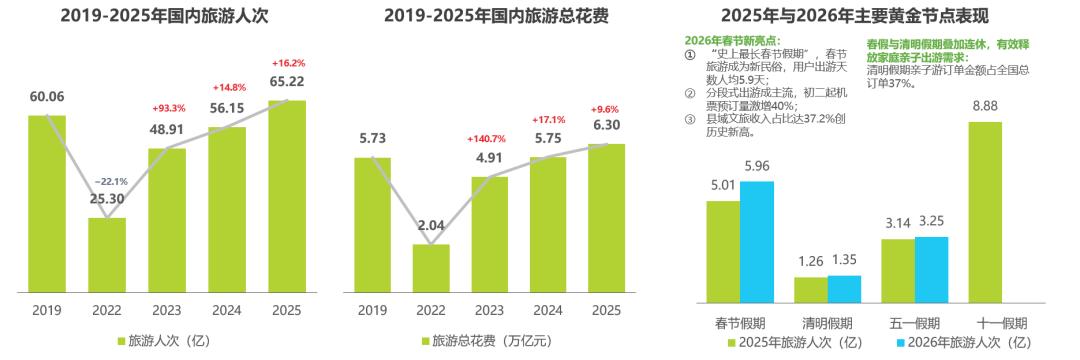
Source: Public data, self - research and drawing by iResearch.
User traffic in the online travel industry
The traffic of online travel apps has grown steadily, and users' travel demand is strong
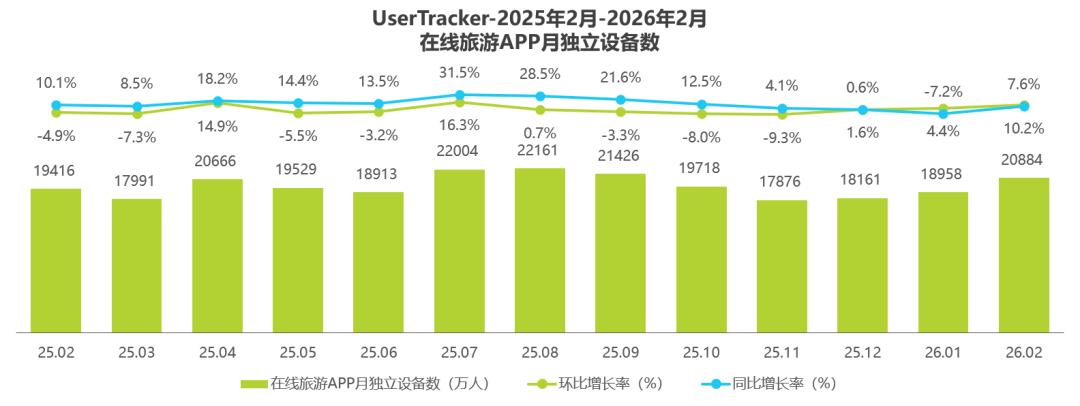
According to iResearch UserTracker data, from February 2025 to February 2026, the number of monthly independent devices of online travel apps increased steadily, with an average monthly scale of about 198 million. The average year - on - year growth rate was about 12.6%. The traffic peak was concentrated in the summer. In August 2025, the number of independent devices reached about 222 million, setting the highest value in the period. The year - on - year growth rate in July reached 31.47%, the peak growth rate of the year.
The pre - holiday preparation market is obvious: In April 2025, the month - on - month increase was 14.87%, reflecting the concentrated planning and booking behavior of users before the May Day holiday; the month - on - month growth of 16.34% in July corresponded to the start of summer travel. By the Spring Festival in 2026, the year - on - year growth rate of traffic rebounded to 7.56%, indicating that users' travel demand continued to be released.
Source: UserTracker multi - platform online behavior monitoring database (intelligent terminals)
User traffic in the online travel industry
The total monthly usage times and usage time of online travel apps have increased, and users' enthusiasm for tourism consumption is positive
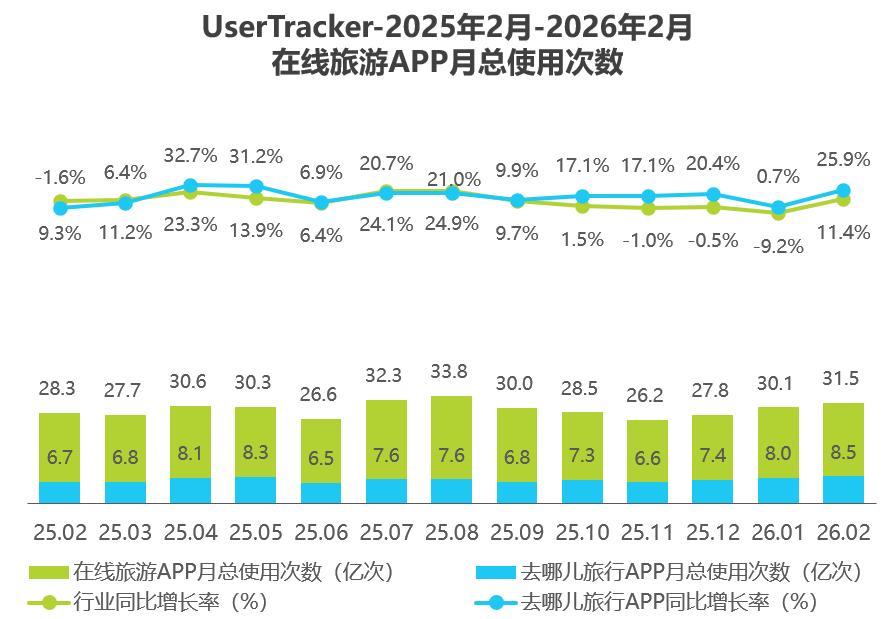
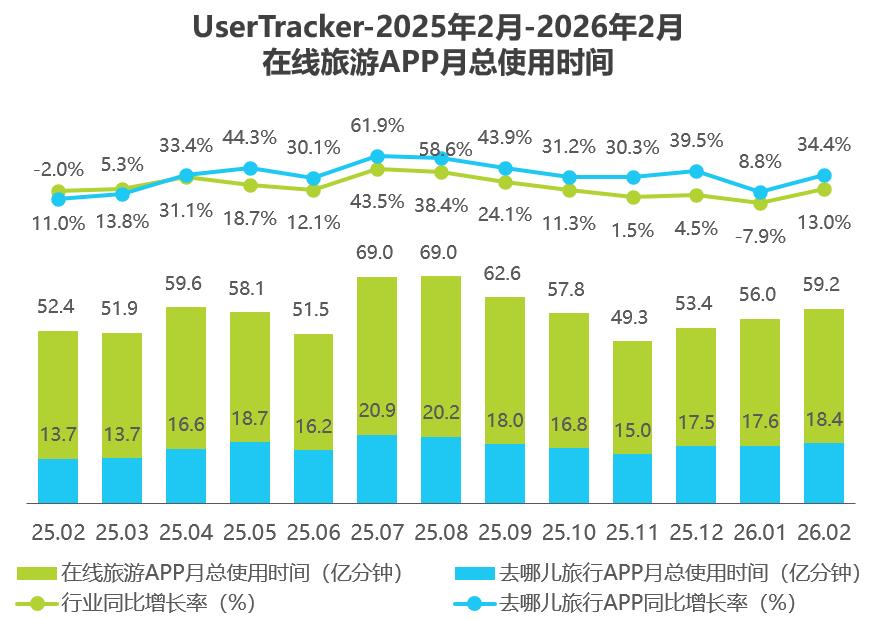
According to iResearch UserTracker data, from February 2025 to February 2026, the total monthly usage times of online travel apps increased by about 8.4% on average year - on - year. Among them, the average year - on - year growth rate of the total monthly usage times of Qunar Travel APP was about 17.2%, about twice that of the industry as a whole, and the user activity increased significantly. The average year - on - year growth rate of the total monthly usage time of Qunar Travel APP was about 33.9%. During the same period, the total monthly usage time of the industry as a whole also increased steadily, and the usage depth per device continued to be strengthened, overall reflecting strong user stickiness and consumption potential.
Source: UserTracker multi - platform online behavior monitoring database (intelligent terminals)
User stickiness in the online travel industry
Qunar Travel APP has an advantage in user stickiness among its peers
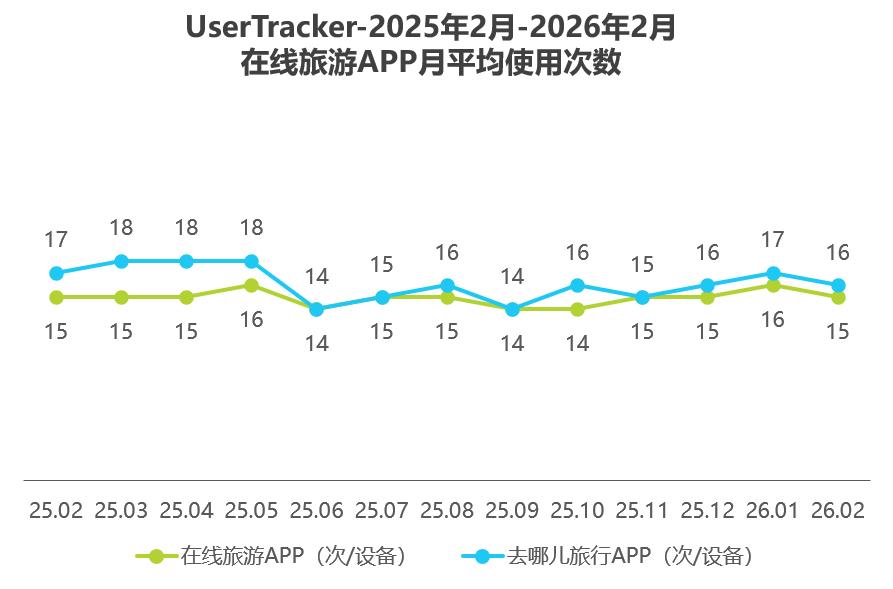
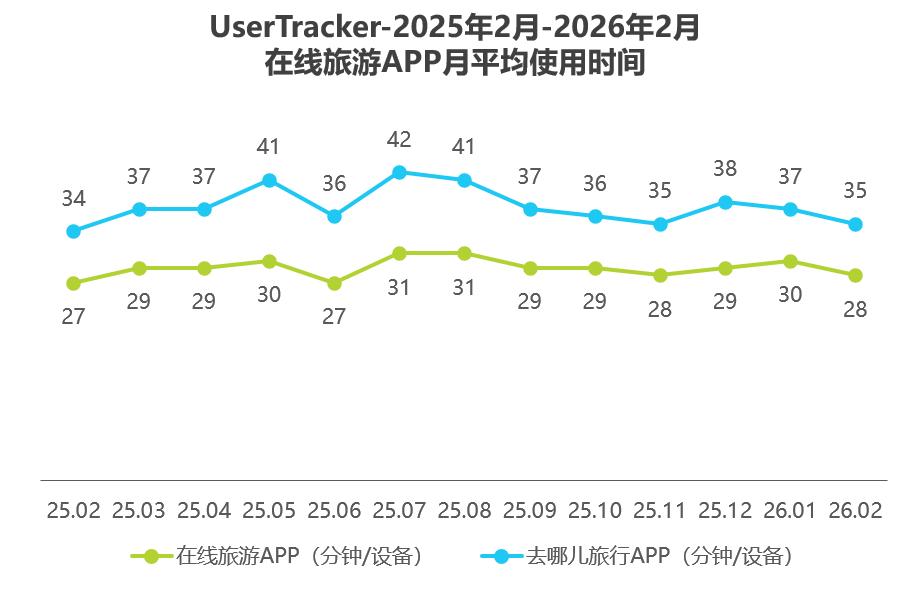
From the perspective of the average monthly usage times per device, from February 2025 to February 2026, users of Qunar Travel APP used it about 16 times per month on average, about 8% higher than the industry average (about 15 times), ranking among the top in the industry. From the perspective of the average monthly usage time per device, users of Qunar Travel APP used it about 37 minutes per month on average, about 29% higher than the industry average (about 29 minutes). This comprehensively shows that Qunar Travel users have good stickiness and high usage loyalty, which helps to promote consumption conversion.
Source: UserTracker multi - platform online behavior monitoring database (intelligent terminals)
The core reasons for users to choose Qunar APP
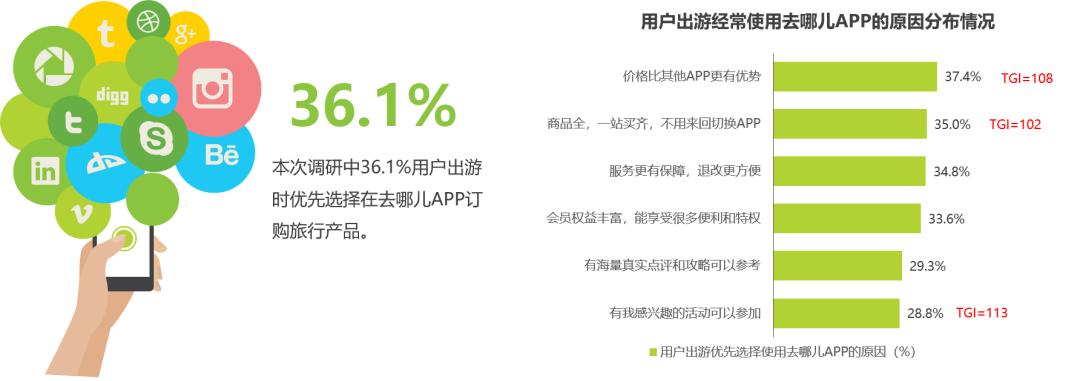
Price advantage, complete categories, and rich activities are the advantages for users to choose Qunar to order travel services
More than 30% of travel users list Qunar as their preferred platform. The price advantage is the most prominent reason for users to choose Qunar (TGI = 108), and the cost - performance orientation is significantly stronger in this group than in the industry as a whole. One - stop category integration has also been widely recognized (TGI = 102). The convenience of solving air tickets, train tickets, hotels, and tickets on the same platform has a stronger perceived value among Qunar users. The richness of activities (TGI = 113) is also a differentiated attraction of Qunar. The willingness of this group of users to actively participate in promotional activities is significantly stronger. These three advantages together constitute the selection logic of Qunar users different from the industry as a whole.
Sample: N = 3547; obtained through an iClick questionnaire survey in April 2026. TGI: Target Group Index, which can reflect the strength or weakness of the target group within a specific research scope. TGI index = [the proportion of the group with a certain characteristic in the target group / the proportion of the group with the same characteristic in the overall group] * standard number 100. TGI = 100 means the same as the overall level; TGI ≥ 110 means the group's preference is significantly higher than the overall level, and ≥ 130 is regarded as a typical population characteristic; TGI ≤ 90 means weak preference. The industry baseline (TGI = 100) is calculated after comprehensively removing duplicates from all online travel platform users covered in this survey. The APPs involved in this user survey are only online travel comprehensive platforms, excluding vertical direct - sales channels such as Air Travel Master, official APPs of airlines, and the official 12306 railway APP. Therefore, the "similar platforms" mentioned on this page refer to the sample scope of online travel comprehensive platforms covered in this survey and do not represent the terminal market share of the entire industry.
Analysis of Qunar APP users' preferences: Air tickets
Transparent refund and change policies, clear connection flights, efficient ticket issuance, and member rewards. Users believe that Qunar does better in "guarantee - type" services
Fast ticket issuance and large discounts are the primary