Former miHoYo International President Jin Wenyi Joins Kimi
Recently, there were reports that Jin Wenyi, who once built HoYoverse's global distribution system, officially joined Moonshot AI two weeks ago to take charge of Kimi-related business.
As early as when she officially announced her departure from HoYoverse at the end of April, there were many speculations in the industry that this executive, who had been deeply involved in game globalization for nearly a decade, would eventually enter the AI track.
So far, since her official departure was announced at the end of April, the long-discussed destination in the industry has been settled.
Different from some executives who cross over for part-time jobs or make shallow attempts, Jin Wenyi completely left the gaming industry where she had been deeply involved for nearly a decade, gave up the mature overseas expansion track, and chose to fully commit to AI.
Looking back at Jin Wenyi's industry resume, her career has always been closely linked to the two core concepts of "globalization" and "content commercialization".
Before joining HoYoverse, she had a comprehensive experience in McKinsey Consulting, DeNA's overseas market, and FunPlus' overseas business. She was familiar with the market logic of players in various regions around the world, localized operations, and the logic of building transnational brands.
In 2017, when HoYoverse was still in the stage of overseas exploration and "Honkai Impact 3rd" urgently needed to open up the global market, Jin Wenyi officially joined. As the international vice president, she built the entire overseas distribution, business, localization, and community systems from scratch.
During her nine years at HoYoverse, Jin Wenyi delivered an outstanding overseas expansion report that can be regarded as an industry benchmark.
From "Honkai Impact 3rd" being launched in more than 200 countries and regions around the world, to "Genshin Impact" becoming a global hit and topping the best-selling mobile game lists in many countries for a long time, and then to the stable overseas launch of new games such as "Honkai: Star Rail" and "Undawn", she led the establishment of the independent global brand HoYoverse, and completed HoYoverse's transformation from a local second-generation game company to a world-class game IP company.
Different from traditional distribution that only focuses on advertising investment, Jin Wenyi's approach pays more attention to long-term IP operation: regional cultural adaptation, in-depth cultivation of overseas communities, cross-border business cooperation, and the shaping of a global brand image. This mature methodology is still a reference model for Chinese games going global.
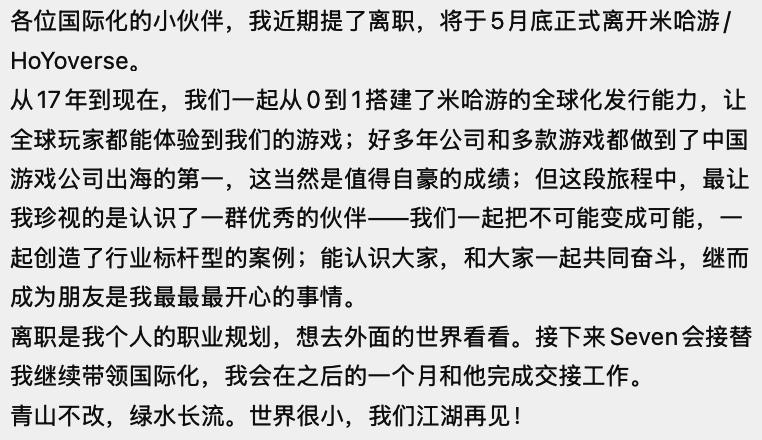
At the end of April 2026, Jin Wenyi sent an internal letter announcing her departure, saying that due to her personal career plan, she "wanted to see the outside world". She completed the handover of all business within a month, and Wang Yuyang, a former Bilibili executive, took over the international business. At that time, the industry generally predicted that she would not stay in traditional game companies.
Kimi, under Moonshot AI, is a leading large model product that has achieved success in both the consumer and business markets in China, thanks to its long context, multi-modal, and Agent intelligent agent capabilities. However, it currently lacks mature experience in content commercialization and global implementation, which is exactly where Jin Wenyi's core capabilities can make up for the gap.
From the perspective of business synergy, Jin Wenyi's past experience at HoYoverse can precisely make up for Kimi's shortcomings.
Firstly, the ability of global implementation. Kimi is currently mainly focused on the domestic market, and its overseas expansion is still in its infancy. Jin Wenyi is familiar with the user preferences, compliance rules, and channel ecosystems of the global game markets in Europe, America, Japan, South Korea, Southeast Asia, etc. She can quickly promote the overseas launch of Kimi's multi-language versions and build an overseas user operation and business cooperation system.
Secondly, experience in interactive content commercialization. HoYoverse has long been operating long-term storylines and character IPs, and is proficient in player emotion management and content payment design. This logic can be transferred to AI-native interactive content, AI games, and virtual companion products.
Thirdly, the establishment of an IP industrial pipeline. Jin Wenyi has led the cross-regional content synchronization and localized production of multiple long-term games. She can combine Kimi's long-text and multi-modal generation capabilities to create an AI industrial toolchain for game companies, serving the entire process of story writing, art generation, localized translation, and intelligent operation of player communities.
In turn, Kimi's AI technology will also bring new business imagination space to Jin Wenyi.
Some in the industry also believe that Jin Wenyi's departure and cross-over also reflect the development bottleneck of the traditional gaming industry.
Currently, the overseas expansion of Chinese games has entered a stage of stock competition, with the cost of advertising investment continuously rising and the growth space of traditional distribution reaching its peak. Meanwhile, AI is reconstructing the entire chain of content production, interaction, and distribution, and has become a new growth curve in the content industry.
For Jin Wenyi, who has a mature global operation methodology, joining a leading large model company is a crucial opportunity to seize the next generation of content industry transformation.
Of course, cross-over challenges also objectively exist.
The underlying logic, team structure, and commercialization cycle of the gaming industry and the AI industry are completely different. Jin Wenyi needs to transform from a game distribution manager to a content business leader of a large model.
At the same time, the current AI game products have not yet formed a stable and replicable business model. How to balance technology R & D, content creativity, and global commercialization is the core problem she needs to solve next.
This article is from the WeChat official account "Game Value Theory" (ID: gamewower), author: Rina. It is published by 36Kr with authorization.