Aibao wants users to "speak up", while WeChat aims to make AI "ubiquitous".
When A Bao learns to “listen” and WeChat learns to “hide”; one allows you to handle everything just by speaking, and the other makes you unaware of the presence of AI; the one whose AI understands you better will get the ticket to the next era.
As the AI version of Alipay starts testing, an AI competition between Alipay and WeChat has emerged.
As early as June 8th, WeChat announced the opening of its AI platform, and apps such as JD.com, Meituan, and Didi have successively connected to it. Alipay also quickly launched its AI version and introduced its exclusive AI assistant, A Bao.
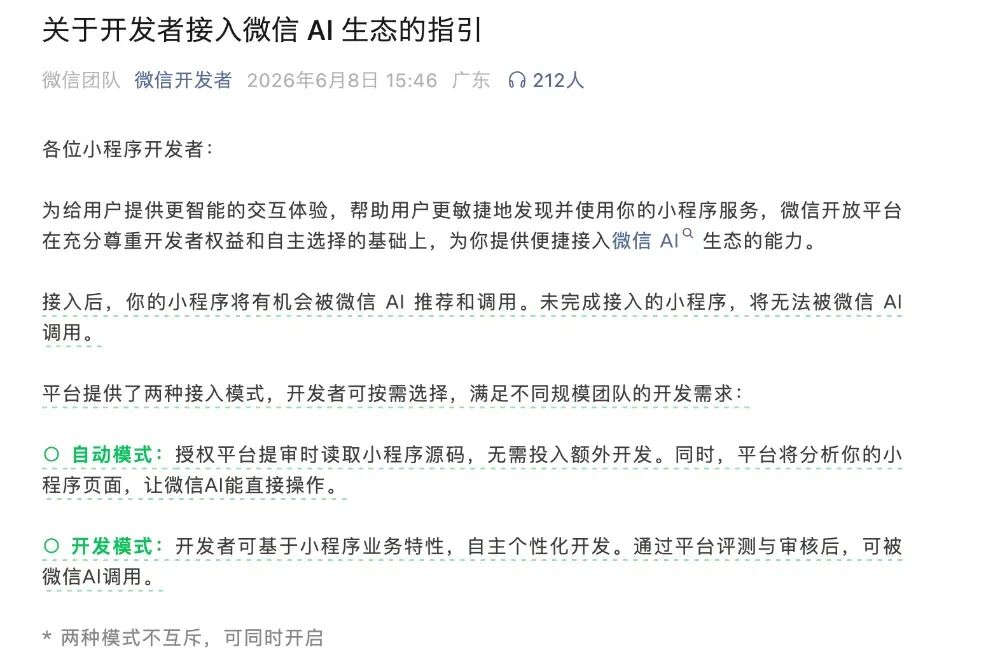

When two platforms with billions of users almost simultaneously promote the implementation of AI Agents, what they are competing for is no longer the payment entry, but the key connection point between users and services in the AI era.
Alipay: Instead of thickening the city wall, tear it down and rebuild

At first glance at the AI version of Alipay, you may hardly associate it with the payment app you've been using for years.
Simplicity is the keyword of the new version of Alipay.
The entire interface is reconstructed into two major sections - Assets and A Bao. The asset area on the left dynamically displays liquid assets, investment holdings, and credit scores in the form of a cardholder. On the right is the AI assistant named “A Bao”. Tens of thousands of services are all folded into an input box, forming a sharp contrast with the previously function - dense interface.
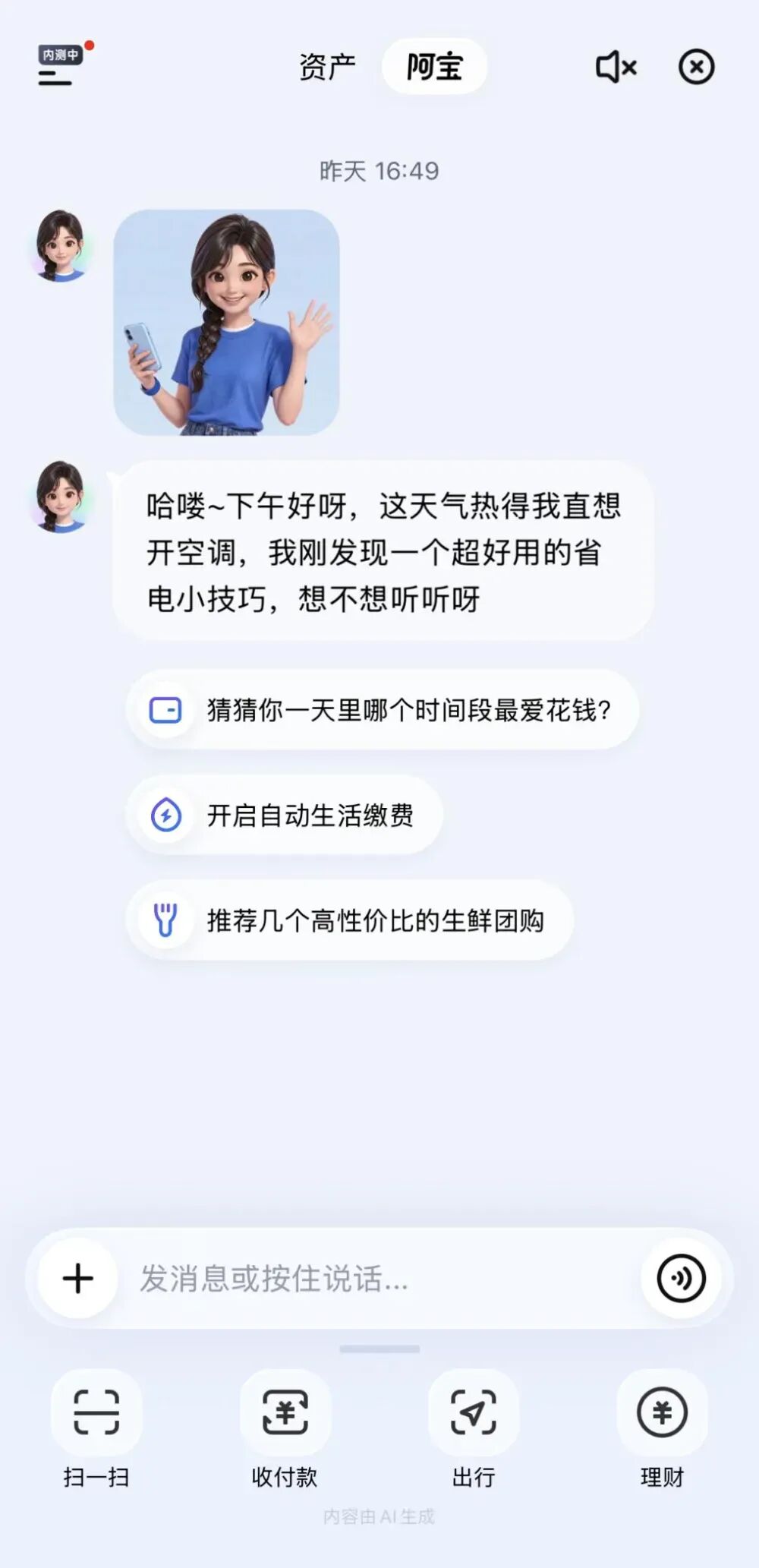
From the perspective of UI design, Alipay's AI transformation this time is extremely radical. It directly changes the graphical interface that has been used for many years and replaces the traditional interaction with a dialogue - based intelligent service center centered on AI.
Alipay's intention can be glimpsed from the name “A Bao”. The character “Bao” brings a sense of intimacy, and with the colloquial “A”, A Bao can naturally integrate into the daily life context of the public.
A tool - type app that users use and leave doesn't need a named partner. What A Bao wants to change is precisely the reason for users to open Alipay.
More notably, at the Alipay AI Payment Ecosystem Conference at the end of May, Han Xinyi, the CEO of Ant Group, clearly stated that AI agents will subvert the “traffic is king” logic of the mobile Internet era. In the future, the era of traffic entry determined by humans is coming to an end, and it will be replaced by the “ecosystem of agents”.
It can be seen that what Alipay wants is not just an AI entry, but to become the payment infrastructure for the entire agent ecosystem in the AI era. As of the end of May, Alipay's AI payment already supports 95% of the general agent framework, and its layout direction is clear.
WeChat: Don't change the foundation, just install an AI engine for the ecosystem

Different from Alipay's “heart - changing” transformation, WeChat has chosen a completely different path, which is relatively conservative. It doesn't directly add an AI entry inside the app but chooses to transform itself into a service scheduling center, dispersing and integrating AI capabilities into every corner of WeChat. Users can enable AI services through various methods such as searching, @AI conversations, and invoking mini - programs.
Mini - program developers can actively connect to the WeChat AI ecosystem, allowing the system to directly call the mini - programs to complete operations without leaving WeChat.
The strategic depth of this layout is rooted in WeChat's unique foundation. WeChat currently serves over a billion users and has three underlying capabilities: high - frequency social interaction, life services, and a million - level mini - program ecosystem, which provides a natural foundation for its AI transformation.
What WeChat wants to do is not to rebuild an entry in the AI era but to optimize what it already has with AI: a national - level life entry, a mini - program ecosystem covering 108 sub - industries, and a deeply integrated WeChat payment system.
WeChat's idea is to make AI the “neural network” of this huge ecosystem. Without changing the existing structure, every node can be intelligently scheduled. Just like the scan function, it naturally appears in specific scenarios and disappears after solving the problem, without changing the user's familiar interaction logic.
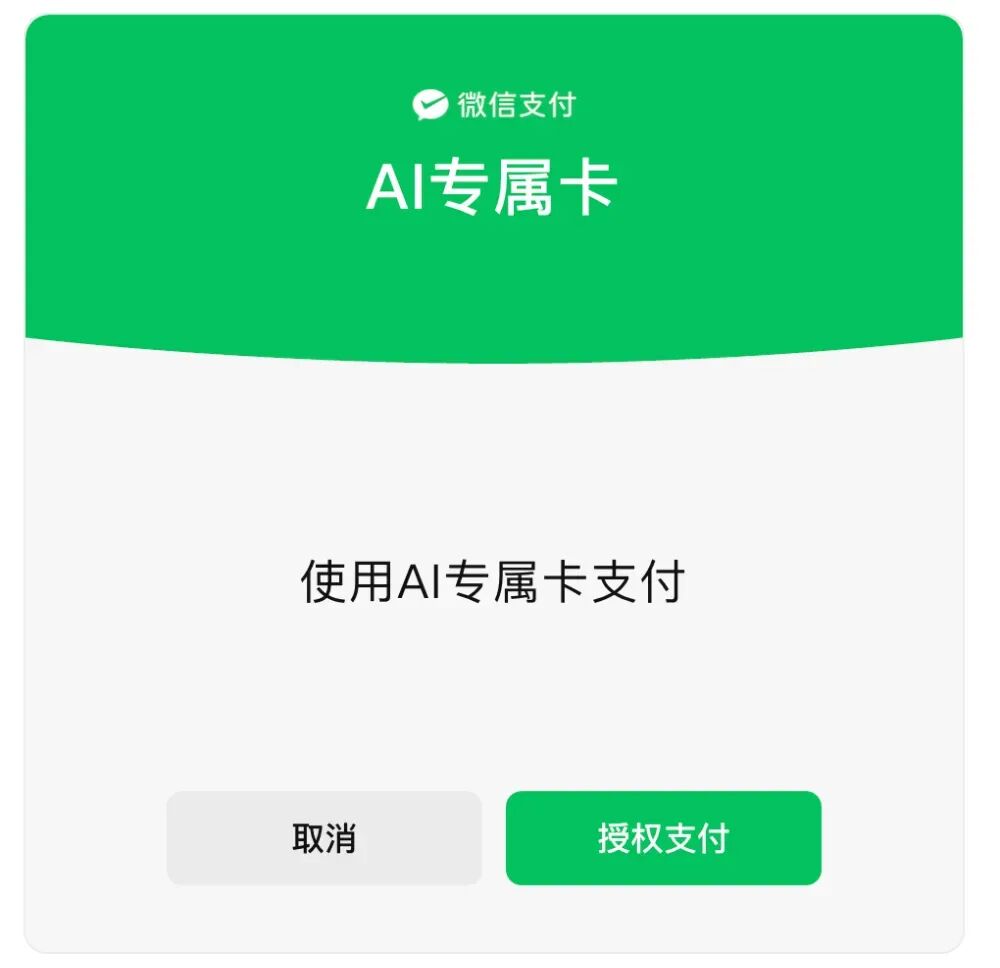
Meanwhile, WeChat is also laying out AI payment infrastructure. It is currently testing the AI payment function in cooperation with Tencent's agent product WorkBuddy and plans to launch an “AI exclusive card” in the WeChat wallet. While consolidating the existing ecosystem, it is also exploring new payment scenarios.
Genes determine: Low - frequency payment seeks change, high - frequency scenarios seek stability

Such different AI strategies are rooted in the genetic differences between WeChat and Alipay.
Alipay's challenge is “low - frequency”. Li Jun, the vice - president of Ant Group, once publicly stated that among the more than 8,000 services provided by Alipay, the vast majority are in a “sleeping” state, and the active usage rate is less than 10%.
As a payment tool, Alipay is mostly in an unlaunched state. In theory, AI dialogue - based interaction can significantly lower the threshold for service discovery, allowing users to avoid searching through layers of menus, thus effectively improving the efficiency of function usage.
WeChat's characteristic is “high - frequency”. As a national - level social app, WeChat ranks among the top in terms of daily opening times. When users have additional needs in scenarios such as chatting and browsing Moments, AI can be mobilized at any time. This means that the built - in AI in WeChat naturally has a higher invocation frequency and a lower usage threshold.
In this context, Alipay chooses to change its low - frequency status, while WeChat aims to consolidate its high - frequency foundation.
Alipay's AI transformation is an important self - innovation. In the past decade, Alipay has tried socialization, local life, and content - based strategies. Each strategic shift was logically flawless, but the implementation results were not satisfactory. This AI transformation is a deep summary of Alipay's past experience - trying to expand the user's path to access services through dialogue - based interaction and directly reach the user's service needs.
WeChat's AI transformation is an in - depth development of its ecosystem. It focuses more on allowing users to complete everything within WeChat and continue their existing usage habits.
WeChat wins in the breadth of entry, Alipay wins in the depth of trust

The two paths have different focuses, and in the specific implementation, their respective advantages and disadvantages are gradually emerging.
From the current situation, WeChat has a head - start in terms of entry.
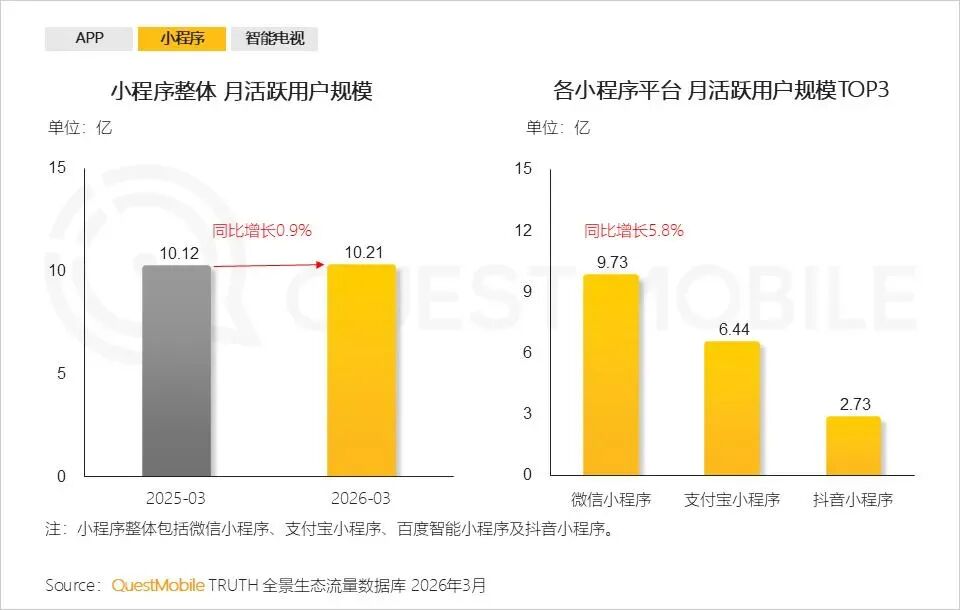
As the earliest platform to layout mini - programs, WeChat already has 8.4 million mini - programs, with a considerable ecosystem scale. When these mini - programs are fully connected to WeChat AI, the resulting closed - loop service experience has significant characteristics in terms of ecosystem integrity.
More importantly, it's about the usage scenarios. Most task triggers in daily life are already hidden in WeChat - invitations in group chats and product recommendations in Moments are all natural entry points for AI intervention. Users can dispatch AI by stating their needs in WeChat, while invoking A Bao requires actively opening another app.
But Alipay has built a differentiated ability in another dimension - financial trust.
Relying on payment accounts, fund accounts, and the investment system, Alipay AI can not only complete life services but also has the ability to deeply extend to the wealth management scenario. Searching for “which fund has a good return” in the AI version of Alipay, it can not only give suggestions but also directly retrieve the user's investment holdings for personalized comparison. WeChat's accumulation in this area is still in its infancy.
In addition, Alipay's early layout in AI payment infrastructure is also worthy of attention. In May this year, Alipay announced that its “AI payment” already supports 95% of the general agent framework. When AI agents become the mainstream interaction method, payment and settlement capabilities will become a key infrastructure.
The decisive factor in the final outcome is hidden in the agent's payment choice

From a longer - term perspective, the two paths of WeChat and Alipay may coexist for a long time.
Alipay takes the revolutionary route - changing the old interface and reshaping everything with AI. Its judgment is that in the AI era, users need an all - around AI financial butler.
WeChat takes the improvement route - not changing the overall structure and optimizing everything with AI. Its judgment is that even in the AI era, users still need to open WeChat every day.
And the real variable may come from further away. When AI agents can independently complete transactions and agents can settle accounts with each other, the entry logic of the traditional Internet will face new changes. By then, what Alipay and WeChat are competing for may no longer be “the user's first entry” but “the agent's first choice”.
The platform that first builds the payment infrastructure in the AI era will have a broader development space in the next stage.
The outcome of this competition remains to be seen.
This article is from the WeChat official account “New Entropy” (ID: baoliaohui). Author: Pineapple, Editor: Jiuli. Republished by 36Kr with permission.