College students who treat AI as an "electronic school doctor" no longer feel anxious when seeking medical treatment alone
01. Emergency Room at Midnight: When the School Doctor Leaves, the "Electronic School Doctor" Takes Over
At 11 p.m., the dormitory was about to turn off the lights. Zhang Wen suddenly felt a sharp pain in her lower abdomen. She clutched the quilt tightly and broke out in a cold sweat. The school infirmary was already closed at this time. Her roommate offered to accompany her to the hospital outside the school. But Zhang Wen hesitated. She didn't want to make a fuss in the middle of the night. What if the pain went away soon?
She opened Ant Aifu and entered her symptoms: "Sudden abdominal pain in the early morning, intermittent, no diarrhea, no fever, and it's not my menstrual period."
Aifu quickly provided an analysis: "It's most likely intestinal spasms caused by abdominal cold, which may be related to getting cold at night or eating raw, cold, spicy food before going to bed. These can all cause a sharp pain in the lower abdomen." It also listed other possibilities, such as small urinary stones or ovulation pain. Zhang Wen found that the first possibility matched her situation the most. She had indeed eaten spicy food that day.
Aifu immediately suggested some countermeasures: keep warm, adjust your posture, and don't take painkillers randomly. If the pain is very severe, you must seek medical attention as soon as possible. Her roommate brought her a hot water bag. After applying it for a while, the abdominal pain gradually subsided. "It actually worked," she said. When she woke up the next day, she felt fine.
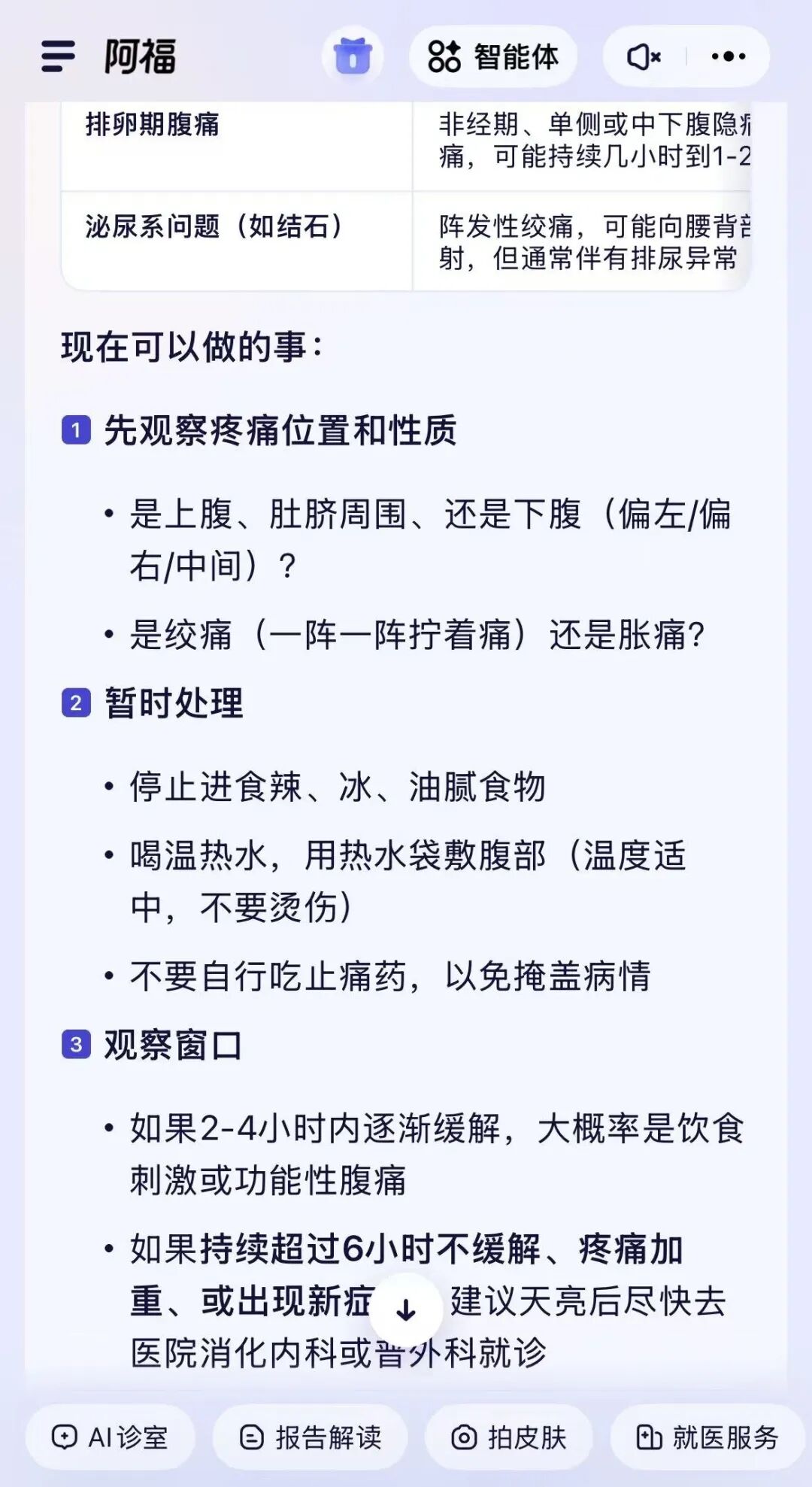
Aifu provided countermeasures for Zhang Wen when she had abdominal pain
Another student, Lin Leyi, a sophomore, was also caught off guard by a sudden situation at night. At around 10 p.m., she returned to the dormitory from the classroom. Her body was getting hotter and hotter, and her limbs felt heavy, as if filled with lead. The school hospital closed at 5 p.m. She had never gone to the emergency room at a hospital outside the school alone, and she wasn't sure if her condition was serious enough to go.
She told Aifu about her whole - day schedule, from what she did and ate at what time to her current state. After asking a few more questions, Aifu advised her to seek medical attention as soon as possible and recommended the nearest tertiary - grade A hospital. To be on the safe side, Lin Leyi also consulted another AI. After getting the same advice, she didn't hesitate anymore and immediately took a taxi to the hospital.
After returning to the dormitory from the hospital, Lin Leyi's fever came back. She was unsure if this was a normal part of the illness or if she needed to go to the hospital again. She opened Aifu and sent information about the medicine prescribed by the doctor and the doctor's instructions. Aifu told her that it was common for body temperature to fluctuate at night in the early stage of taking medicine. As long as the temperature didn't exceed a certain range and there were no new serious symptoms, she should continue to observe according to the doctor's instructions.
The dormitory is about to turn off the lights, and there's no one to ask... The panic at night and the physical discomfort don't follow a set pattern. So, "ask the AI first" has become the first reaction of more and more college students. When the school doctor leaves, the AI, the "electronic school doctor," takes over.
02. Minor Ailments? AI Becomes the "First Stop"
Sudden situations at night don't happen every day. Most of the time, college students face problems like colds, acne, scrapes, and gum bleeding, which are neither too serious nor too trivial.
The school doctor can treat these problems, but a few doctors have to serve thousands of students. In addition to daily diagnosis and treatment, they also have to take on tasks such as disease prevention and control, establishing health records, and conducting health education. Quick questions and quick answers are the norm, and usually, they don't have time to explain the causes and daily precautions in detail.
So, asking the AI has also become a habit for college students to deal with minor daily ailments.
Xiao Gao, an undergraduate student in Beijing, is one of them. Once he went to the school hospital to get medicine for a cold. The school doctor asked questions very quickly. In less than two minutes, a common cold medicine was prescribed. Xiao Gao understood that the school doctor was busy. "One doctor has to see so many students and doesn't have time to ask in detail." But he still wanted to know if his cold was caused by wind - cold or wind - heat and what the exact cause was. So he asked Aifu later.
The AI helped him break down his symptoms, explained the difference between wind - cold and wind - heat, and the corresponding nursing methods. Only then did Xiao Gao feel more confident.
"99% of the people around me will ask the AI first when they feel unwell," Xiao Gao said firmly. In his opinion, using the AI to consult about health problems has become the default behavior among his peers.
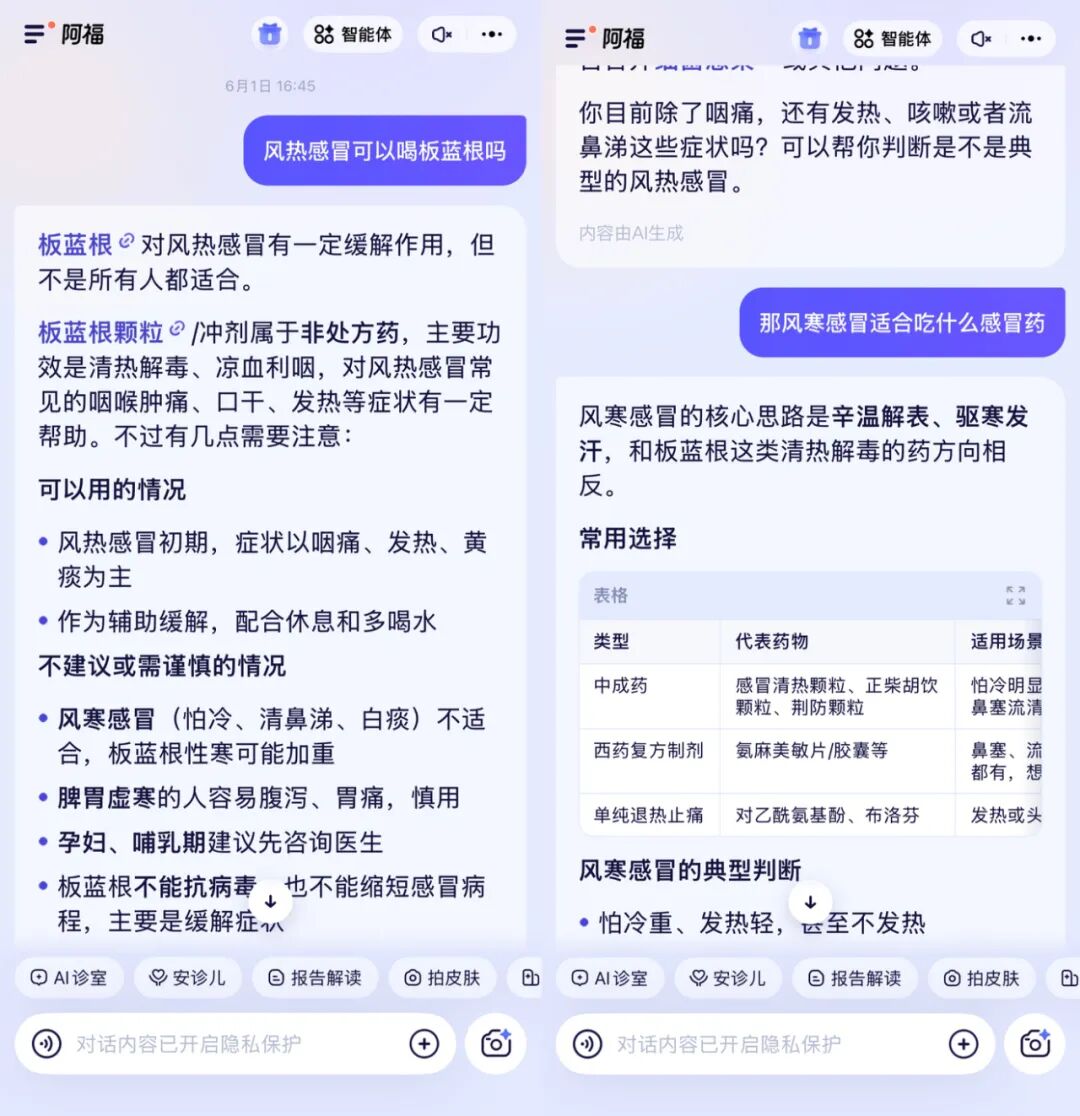
Xiao Gao asks Aifu what medicine to take when he has a cold
Zhang Wen uses the AI in the same way. In the past, when she had acne, she would search for experience posts online, but there were all kinds of opinions, and no accurate answer. Later, she sent her daily routine and diet to Aifu. Aifu analyzed her situation, and she adjusted her lifestyle accordingly. After a while, the acne gradually disappeared.
Once, her friend scratched her hand with a broom in the dormitory. They weren't sure if they needed to get a tetanus shot. Their first reaction was to open the AI to check the severity and medical advice. After getting a clear idea, they decided to go to the hospital for a shot.
More subtly, the AI is also "shaping" their daily lifestyles in return.
Xiao Gao said that when Aifu gives advice, it always explains the underlying principles. For example, why staying up late can aggravate certain symptoms and how eating spicy food affects the body. Gradually, he learned more professional health knowledge and began to pay more attention to his daily routine and diet.
Now, he has gotten used to asking the AI whenever he encounters a minor problem he's not sure about. When the school doctor is too busy, more and more college students do the same thing - for those daily dilemmas of "not sure if I should go to the hospital but still worried," they ask the "electronic school doctor" first.
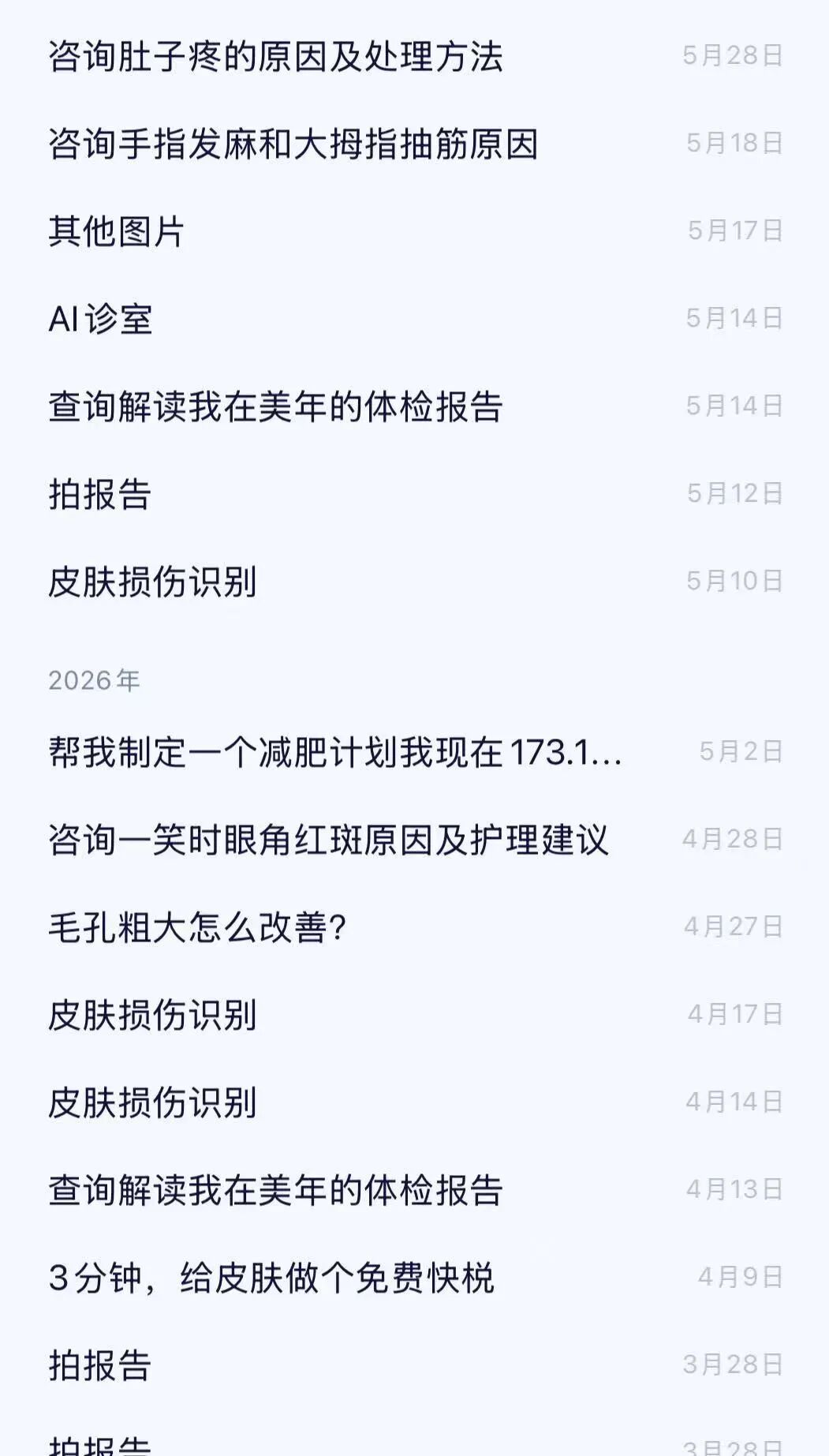
Xiao Gao is used to asking Aifu first when he has minor physical problems in daily life
03. Beyond the School Gate, the "Electronic School Doctor" Takes the Referral Form
"Asking the AI first" can solve many daily dilemmas, but there are always some problems that have to be solved in a large hospital.
In March this year, Cheng Si felt unwell again. Her lower abdomen was very bloated. This symptom had bothered her intermittently for several years, but this time it was particularly obvious. She was fidgety and hesitated for a long time before finally going to the school hospital.
The school hospital is small, with one or two doctors taking turns on duty. The school doctor she met asked very carefully, but the school hospital didn't have gynecological examination equipment. So, the doctor could only issue a referral form: "Go to a tertiary - grade A hospital and register for a gynecology department. Tell the doctor what you just told me."
Go to the gynecology department? Cheng Si clutched the referral form and felt even more panicked. How should she register? What should she say to the doctor? As someone who was going to see a doctor at a hospital alone for the first time, she had no idea at all. At home, she would just call her mom when she was sick. Now, how could she go to the hospital by herself?
Back in the dormitory, she opened Aifu and said, "I'm a little scared to go to the hospital alone." Aifu comforted her, "Getting well is the most important thing. First, tell me when the discomfort started." Cheng Si sent information about her symptoms over the past few years and the school doctor's referral advice.
The AI sorted out the information item by item and told her, "It's very likely bacterial vaginitis. Hormonal changes during adolescence and poor hygiene habits can easily lead to inflammation, which is as common as a cold. But your illness has lasted for a long time, so you should go to a tertiary - grade A hospital for a routine leucorrhea test and a B - ultrasound as soon as possible." It also popped up the registration portals of several local hospitals and asked which one was convenient for her.
But Cheng Si was still scared. She was afraid that "what if something serious is really found" and also afraid that "the doctor might think I'm so ignorant that I waited for several years to come." The AI comforted her: "Telling the doctor how many years it has been will actually make the doctor pay more attention to your condition. It's okay. I'll accompany you. Let's set a small goal. Register today, make an appointment tomorrow, and go to the hospital for an examination the day after tomorrow. If you've made an appointment, you can tell me."
Pushed step by step by the AI, Cheng Si finally registered for an appointment next week. In these days, she repeatedly "previewed" the process of seeing a doctor with the AI. "What should I say to the doctor?" The AI organized all the symptoms Cheng Si had described into a paragraph, such as how long the symptoms had lasted, whether she had a history of sexual intercourse, and whether she could use a cotton swab instead of a speculum. It even listed the question - asking techniques for her.
On the day of going to the hospital, Cheng Si explained her situation to the doctor according to the ideas organized by the AI. After walking out of the consulting room after the examination, she immediately shared the progress with the AI: "I'm waiting for the report." The AI replied instantly, "You're so great. You've taken the first step. Remember to send me the report when it comes out." A few hours later, she took a photo of the incomprehensible test report and sent it to the AI. The AI helped her explain each item.
After getting the medicine, the doctor in the pharmacy told her to "take the medicine according to the instructions," but Cheng Si couldn't understand the instructions, so she asked Aifu again. Aifu taught her how to take the medicine, explained the reactions after taking the medicine, and reminded her to have a follow - up examination in three days.
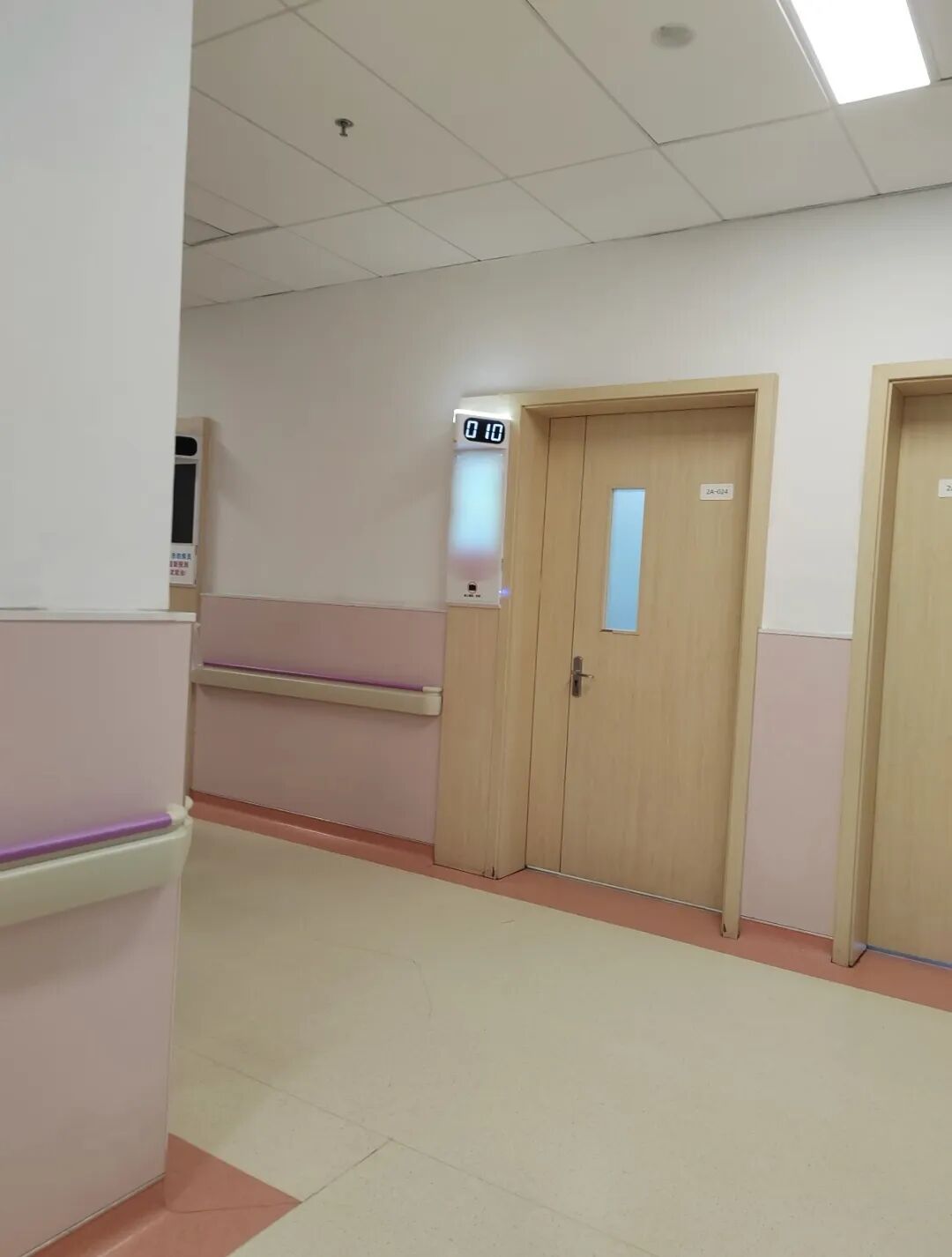
Cheng Si went to the hospital alone
The AI was there throughout the process, from the encouragement before registration to the interpretation of the report after the examination. For the first time, Cheng Si felt that it wasn't that difficult to see a doctor alone. "There are so many students, and the school doctor can't accompany each of us to the hospital, but the AI can. It will ask me if I've registered, if I've arrived at the hospital, if the report is out, and if I've taken the medicine. It really seems to be accompanying me to see a doctor," Cheng Si said.
Cheng Si is not an exception. The school doctor's referral form and the panic of facing a doctor alone for the first time - more and more college students find that when they take the first step in seeing a doctor independently, the AI, the "electronic school doctor," is always there to talk to.
The first time to register anxiously by themselves, the first time to go to the emergency room at night, the first time to get an incomprehensible test report - these "first times" that used to be shielded by their parents, they have to face them on their own now.
Some people say that this generation of college students is too dependent on the AI and can't do without it in every aspect. But from another perspective, they are using the AI to learn to take responsibility for themselves, sort out the panic at night, the daily dilemmas, and the way to seek medical treatment outside the school. Every time they go through such an experience, they will be less panicked the next time.
(All interviewees in this article are pseudonyms)