The market value returned to 145.4 billion in one day, this Huizhou lithium battery leader goes all-in on energy storage
Abstract:
An interim report forecast that exceeded expectations sent EVE Energy's stock price soaring by 13% in a single day. However, what really sparked a divergence was not the growth itself, but the profit structure: How much of it came from the real improvement in operations, and how much from the combined effect of the cycle and strategies? With the price war in the energy storage sector still ongoing and expansion continuing, the market is re - evaluating its profit quality.
01 An "Unexpected Profit" Quickly Priced by the Market
On the evening of June 15th, EVE Energy released a rather impactful interim report forecast: the net profit attributable to the parent company was between 3.13 billion and 3.371 billion yuan, a year - on - year increase of 95% to 110%.
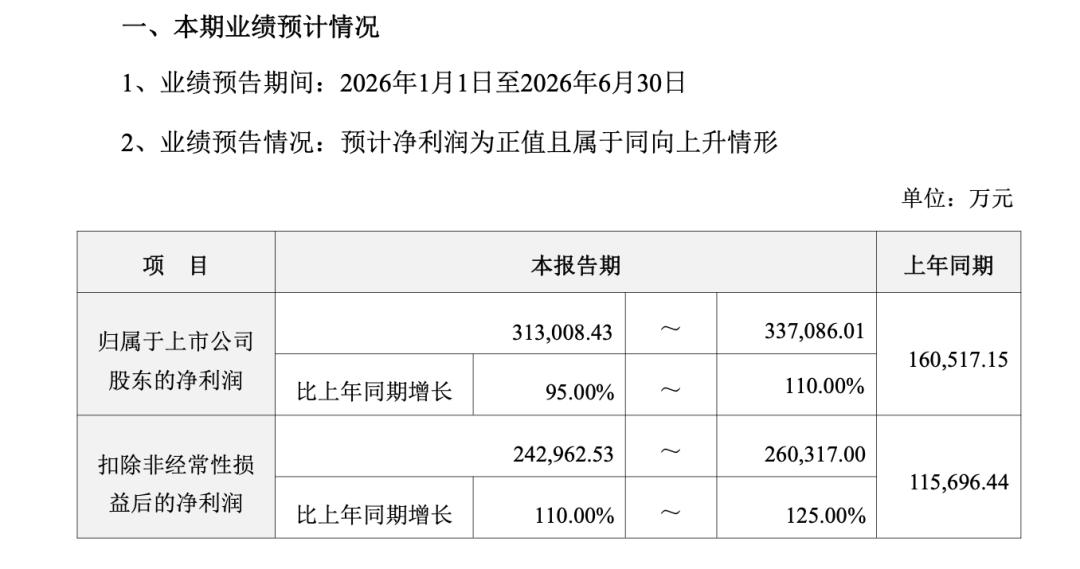
Image | From the company's announcement
The next day, the market quickly responded - on June 16th, the stock price rose by 13.8%, closing at 66.88 yuan per share, and the market value rebounded to 145.4 billion yuan.
In the past year, against the backdrop of the lithium - battery industry chain being deeply involved in a price war and companies' profits generally under pressure, such growth was even regarded by many as a clear signal of the industry's bottoming - out and rebound.
The question is, did this profit growth come from the restoration of operational quality or from the temporary resonance of the cycle and strategies?
Structurally, the net profit growth rate was nearly doubled, while the revenue growth rate disclosed by the company during the same period was about 60%. The profit elasticity was significantly higher than the revenue expansion. This gap usually does not simply come from the natural improvement at the manufacturing end.
The company's explanation in the announcement was: "By actively implementing pre - management, diversifying the supply chain layout, formulating strategic procurement plans, and prudently using financial instruments, we buffered the fluctuations in material cost increases and ensured the stability of the profitability of the main business."
In plain language, it means buying more in advance when raw materials are cheap to lock in prices, and at the same time using some financial instruments to hedge against price fluctuations. In this way, even if the prices rise later, the company's costs will not be passively increased, thus making the profits more stable.
This is related to the sharp fluctuations in the price of lithium carbonate in the past two years.
According to data from Shanghai Steel Union, the price of battery - grade lithium carbonate once fell below 100,000 yuan per ton at the beginning of 2024, a decline of more than 80% from the peak in 2022. Then it started to rebound after hitting the bottom in the second quarter of 2025. By the end of 2025, the spot price of battery - grade lithium carbonate rebounded to about 100,000 yuan per ton, and the main futures contract exceeded 120,000 - 130,000 yuan per ton, doubling from the mid - year low.
Against this background, mid - stream battery manufacturers generally adopted three strategies: locking in raw materials in advance at low - price stages, smoothing costs through long - term contracts, and using futures and derivatives for hedging.
EVE Energy's profit improvement is also related to this. For example, in the 2025 annual report, the company mentioned that by deploying upstream lithium resources and establishing a long - term cooperative procurement mechanism with upstream suppliers, it smoothed the risk of raw material price fluctuations; it carried out commodity futures hedging for the expected procurement of raw materials such as lithium carbonate and copper to hedge the impact of significant raw material price fluctuations on operations.
From this perspective, EVE Energy's high profit growth in the first half of the year did not entirely come from the restoration of the profitability of the current business. A large part of it came from the successful realization of the low - price inventory and hedging strategies. In other words, this part of the profit has a certain "financial attribute", and its sustainability depends on the trend of raw material prices rather than the continuous improvement of the company's own efficiency.
Further comparing the situation in the first quarter of this year also shows this characteristic. At that time, affected by factors such as the incomplete transmission of the rising lithium carbonate price to the downstream, the gross profit margin dropped to 14.0%, a 2.8% decline from the previous quarter. "But the company maintained the stability of the net profit margin through forward - looking hedging arrangements," CSC Securities mentioned in its research report.
This also leads to a more core question in the market: After stripping out the impact of raw material price fluctuations and financial instruments, to what extent has EVE Energy's real profitability recovered?
Therefore, instead of regarding this forecast as the starting point of the industry's full - scale reversal, it is better to focus on the performance itself. Wait until the official financial report is released to see how much money EVE Energy has actually earned from manufacturing after excluding the cycle and strategy factors.
02 A Second - Tier Player Betting It All
If we go back a few years, EVE Energy's story was relatively simple: a diversified battery company composed of power batteries, energy storage batteries, and consumer batteries.
Among them, power batteries are for new energy vehicles and commercial vehicles, which is a high - cycle and high - capital - expenditure track, comparable to CATL; energy storage batteries are the fastest - growing segment in recent years, but the price competition is fierce and the gross profit margin is continuously under pressure; consumer batteries are relatively stable, mainly providing cash flow and profit buffer.
However, in the past two years, there has been a turning point in this main line. From the perspective of the business structure, power and consumer batteries are still the company's basic business, but energy storage has become a prominent variable determining profit fluctuations.
In March this year, EVE Energy announced an investment plan of about 23 billion yuan in 11 days, planning to add up to 230GWh of energy storage and power battery production capacity.
What exactly is a second - tier player with a net profit attributable to the parent company of only 4.1 billion yuan last year betting on by suddenly announcing such a huge investment plan?
Chen Xiang, the senior vice - president of EVE Energy, said very straightforwardly in an interview with the Beijing News that the rapid iteration of AI has given rise to an extreme demand for computing power. The infrastructure of artificial intelligence computing centers (AIDC), which carry this demand, with its characteristics of high power density, high power supply reliability, and rapid iteration rhythm, has brought new development opportunities to the energy storage industry.
How much electricity do data centers consume? Wu Yongming said at the 2025 Yunqi Conference that the energy consumption of Alibaba Cloud's global data centers will increase tenfold by 2032.
However, this currently still relatively fragmented market is no longer a sweet spot with both high growth and high profits. Instead, it has quickly evolved into the most competitive battlefield in the lithium - battery industry. Price involution, capacity expansion, and the increasing bargaining power of customers have almost occurred simultaneously. In the process of seizing the market in the past three years, the unit price of energy storage batteries has been continuously decreasing. Even though EVE Energy's shipments have ranked second in the world, the scale has not been transformed into a profit moat.
Compared with CATL, the industry leader, which can still maintain a gross profit margin of more than 26% for its energy storage systems, EVE Energy's energy storage gross profit margin has been continuously declining in the past three years, reaching only about 12% in 2025.
It was also at this stage that EVE Energy actually began to accelerate its "cross - border" expansion: humanoid robots, electric robot dogs, and various embodied intelligent terminals - EVE Energy is deploying in almost all battery demands related to "future scenarios".
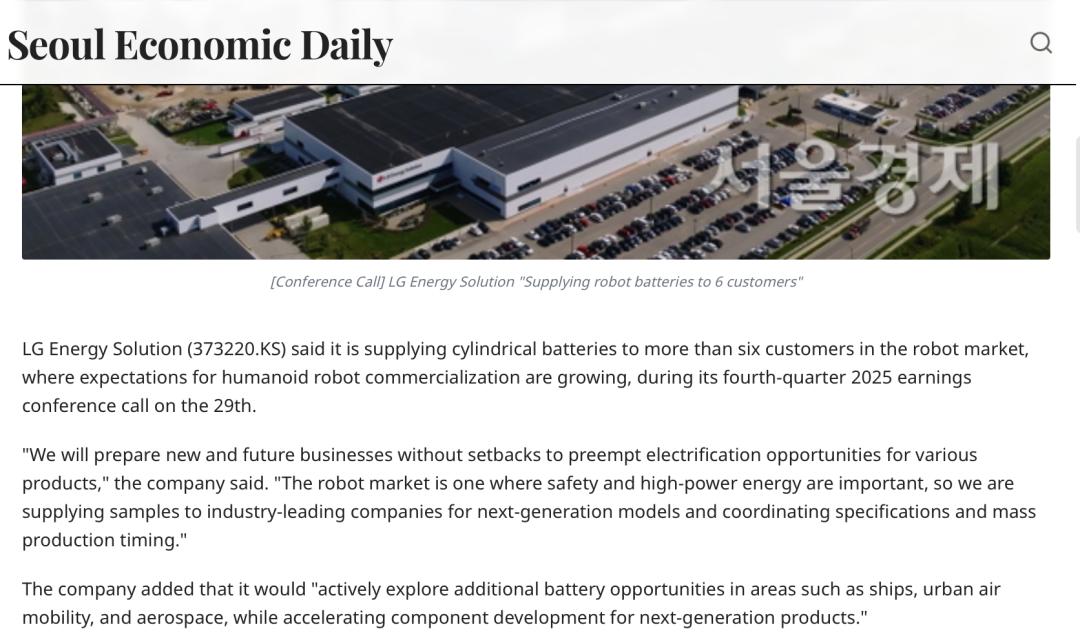
In this regard, EVE Energy seems to be following. LG Energy Solution of South Korea disclosed in a conference call at the beginning of this year that it has supplied battery samples to more than six robot customers and is coordinating the mass - production time with industry leaders. At the same time, its batteries have entered the Boston Dynamics' Atlas humanoid robot project.
From an industrial logic perspective, although the market for robots is much smaller than that for cars, the requirements for energy density and power output are higher, which are exactly the problems that battery companies are best at solving and the most likely direction to build barriers.
The problem is that as of 2026, both humanoid robots and robot dogs are still in the stages of sample verification, small - batch delivery, and joint development, and there is still a long way to go before large - scale production.
Back to EVE Energy, although its expansion is supported by orders. Public information shows that since the first quarter of 2025, its energy storage production capacity has been basically fully utilized. In 2025, the energy storage battery shipments were 71.05GWh, and the capacity utilization rate was about 87.82%. According to a research report from Huatai Securities, during the SNEC exhibition in June, EVE Energy obtained more than 67GWh of orders. Coupled with the previously disclosed four production capacities totaling 230GWh, "the company has sufficient orders to support future shipments," Huatai Securities said.
However, the financial pressure is also increasing. In 2025, although the company achieved a revenue of 61.47 billion yuan, the net profit attributable to the parent company only increased slightly by 1.44% to 4.134 billion yuan, and the non - recurring profit - adjusted net profit even decreased by 2.09%, falling into the dilemma of "increasing revenue but not profit". The core problem is that the energy storage business is deeply involved in the price war, and the gross profit margin has dropped to 12.28%.
Meanwhile, the huge capital expenditure has led to negative free cash flow for the company. By the end of 2025, the company's asset - liability ratio climbed to 64.18%, and the interest - bearing debt was approaching 33 billion yuan. With only 8.5 billion yuan in monetary funds, the annual capital expenditure in the tens of billions makes it highly dependent on external financing.
Against the backdrop of the continuously declining energy storage gross profit margin and intensifying industry competition, instead of controlling the pace by reducing capital expenditure like LG Energy Solution, the company is still promoting the expansion of its main business while simultaneously deploying in multiple immature new directions such as robots. This makes its second growth curve not an expansion on the basis of high profits, but more like an early investment when the profit of the main business is under pressure.
When the return on the main business declines and the new business is in the investment stage, the two businesses not only have not formed a relay but are also consuming resources simultaneously.
From this perspective, the robot battery may not be a wrong direction, but it is more like a long - term option rather than an immediate solution. The real variable is not whether it can succeed, but whether the time to realize its value can outpace the speed at which the main business is under pressure. Currently, EVE Energy is treading on thin ice.
This article is from the WeChat official account "Phoenix Tech", author: Phoenix Tech. Republished by 36Kr with permission.