Lost about 260 billion in a year, OpenAI's "money-burning machine" can't stop
In the past day, the loss figure of OpenAI has become the hottest topic in the global tech circle.
According to the audited financial documents disclosed by Ed Zitron and independently verified by the Financial Times, OpenAI's net loss attributable to the company in 2025 reached $38.53 billion (approximately RMB 260 billion), an expansion of about 7.6 times compared to the $5.09 billion in 2024.
Ed Zitron is one of the journalists described as "the angriest critics in the tech industry", and he holds a very pessimistic attitude towards AI.
For an AI company that is preparing for an IPO and whose valuation may be pushed to the trillion - dollar level, this figure is eye - catching. Therefore, discussions around this topic have been intense.
OpenAI Loses $38.5 Billion in a Year
However, the real complexity of this matter is that OpenAI didn't simply "burn through $38.5 billion in cash".
Regarding the company's financial situation in 2025, at least three figures hold true simultaneously: a net loss attributable of $38.53 billion, an operating loss of $20.92 billion, and an adjusted cash burn of approximately $8 billion.
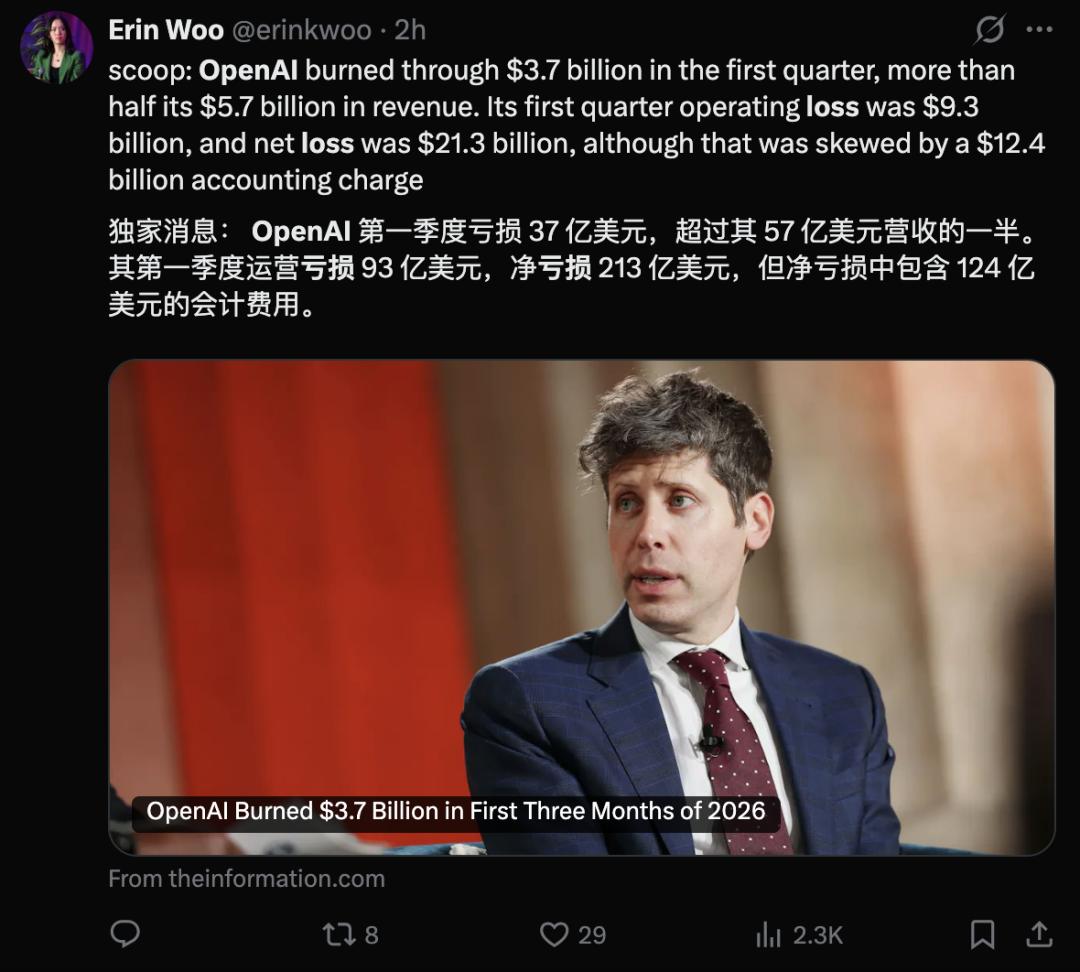
There are also reports that OpenAI lost $3.7 billion in the first quarter of this year alone, more than half of its $5.7 billion in revenue.
Judging from the caliber of the audited documents, OpenAI's revenue in 2025 was $13.07 billion, significantly higher than the $3.7 billion in 2024. From the data, it can't be said that OpenAI lacks commercialization capabilities: ChatGPT is still one of the most influential consumer - grade AI products globally. OpenAI also publicly stated this year that its monthly revenue has reached $2 billion, and ChatGPT has more than 900 million weekly active users and 50 million paying subscribers.
The problem is that the revenue growth hasn't changed OpenAI's cost structure.
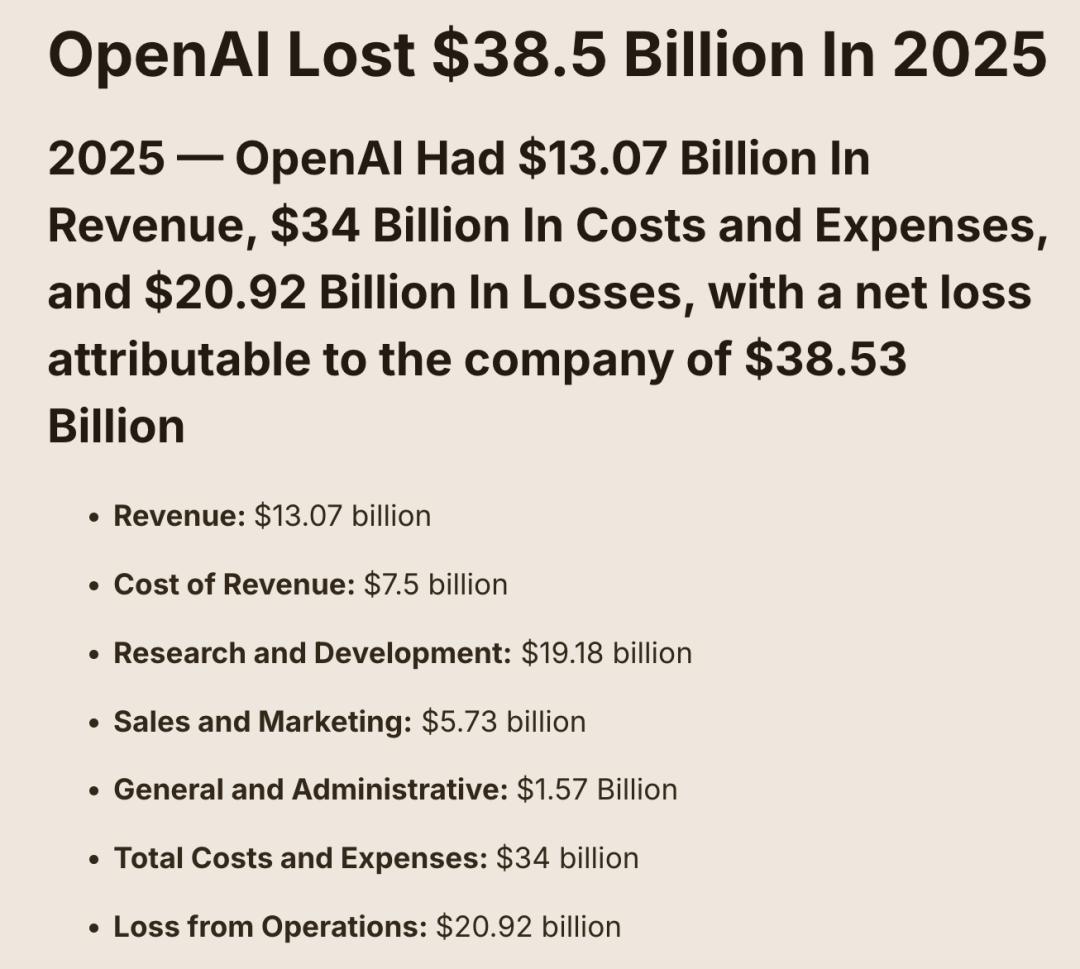
In 2025, OpenAI's total costs and expenses reached $34 billion.
Among them, R & D investment was as high as $19.18 billion, the largest expenditure item; the cost of revenue was $7.5 billion, mainly corresponding to costs related to model training, inference, cloud computing, and infrastructure; sales and marketing expenses were $5.73 billion; general and administrative expenses were $1.57 billion. After deducting these costs, OpenAI's operating loss for the year was $20.92 billion.
This is why looking at just the $38.5 billion figure is incomplete.
In 2025, OpenAI transitioned from a non - profit structure to a for - profit entity. The audited documents show that during this process, a loss of $41.55 billion was incurred due to changes in the fair value of convertible equity and warrant liabilities. Such items are non - cash accounting expenses and don't mean the company actually paid an additional $41.5 billion in cash in that year.
For this reason, after further excluding conversion fees, equity compensation, Microsoft's computing quota, and other items, the Financial Times estimated that OpenAI's basic cash burn was approximately $8 billion.
Conversely, using only $8 billion to describe OpenAI's losses can also easily underestimate the problem. Because $8 billion is the result of multiple adjustments, while the $20.92 billion operating loss better reflects the current state of OpenAI's business itself: a company with high - speed revenue growth still needs to invest more in R & D, computing power, and the market to maintain its lead.
Losses Stem from Massive R & D and Computing Power Investment
OpenAI's losses first come from R & D.
Cutting - edge large models are not traditional software businesses. Once a traditional SaaS product is developed, the marginal cost can be quickly spread; however, every time a large - model company improves its model capabilities, it requires a larger scale of data, computing power, training clusters, inference optimization, and security evaluation. OpenAI's R & D investment in 2025 reached $19.18 billion, far higher than its cost of revenue itself. In other words, OpenAI's current core expenditure is not "maintaining the operation of ChatGPT", but rather continuing to train the next - generation models, develop new products such as Codex, build enterprise - level capabilities, and secure the technological path to AGI.
Secondly, it is the computing power cost.
The audited documents also disclose that in 2025, OpenAI paid a total of approximately $17.2 billion in service fees to Microsoft, of which $10.59 billion was included in "R & D" - related expenses, and another $6.047 billion was included in the cost of revenue. This means that Microsoft is not only an early core investor in OpenAI but also one of its most important cloud infrastructure providers. The faster OpenAI grows, the deeper its dependence on underlying cloud and computing power resources.
This pressure is still increasing. Reuters previously reported that OpenAI plans to invest approximately $600 billion in computing power resources by 2030. OpenAI President Greg Brockman also stated in court testimony in May this year that the company's computing expenditure is expected to reach $50 billion in 2026. For OpenAI, the total cost of $34 billion in 2025 may only be the beginning of a larger - scale infrastructure investment cycle.
The third cost comes from competition.
In the past year, OpenAI's leading edge has been more directly challenged. Anthropic has rapidly expanded its influence among developers with Claude Code, while Google is catching up again with Gemini and its own infrastructure advantages. Reuters reported that OpenAI has adjusted its product roadmap twice in the past six months, first in response to Google's pressure and then accelerating investment in Codex and enterprise products due to Anthropic's Claude Code.
This shows that OpenAI is moving from the stage of "ChatGPT standing out alone" to a real stage of full - scale competition. It not only needs to continue to lead in model capabilities but also needs to invest simultaneously in code, enterprise services, multi - modality, agents, and super - application entrances. Each direction requires human, computing power, and market resources. In the past, OpenAI could attract users through the brand potential of ChatGPT. Now, it must prove that it can convert the user scale into more stable and higher - margin commercial revenue.
The cost of retaining talent cannot be ignored either.
Top - level researchers and engineering teams in the AI industry have become scarce assets. Reuters previously reported that companies such as OpenAI, Google, and xAI are in fierce competition for top - level AI talent. The annual salary packages of top - level researchers at OpenAI often exceed $10 million, and Google DeepMind has also offered annual salary packages of up to $20 million to top - level researchers. Meta has also joined this competition through high - salary offers and team poaching. For a cutting - edge laboratory like OpenAI, talent loss not only means salary pressure but may also affect the model iteration rhythm and product direction.
Therefore, OpenAI's losses are not just a financial figure but an epitome of the cutting - edge AI business model: user growth is extremely fast, revenue growth is extremely fast, but the R & D, computing power, talent, and market investment required to maintain the lead are also expanding simultaneously.
The capital market doesn't have only one attitude towards this.
The bullish side will emphasize that OpenAI already has a rare revenue growth rate and user scale. The company announced in March this year that it had completed a $122 billion committed capital financing, and its post - investment valuation reached $852 billion, indicating that top - level global capital is still willing to bet on OpenAI becoming a platform - type company in the AI era.
From this perspective, losses are a necessary cost to gain a leading position. As long as OpenAI can continue to expand enterprise revenue, improve the paid conversion rate, reduce inference costs, and integrate ChatGPT, Codex, API, and enterprise products into a stronger platform, its losses may be regarded as an investment in the high - growth stage.
However, the bearish side will ask another question: If the revenue has exceeded $13 billion and the company still incurs an operating loss in the tens of billions of dollars, when will growth bring operating leverage?
This is also the most core controversy before OpenAI's IPO.
Investors won't just look at how many users OpenAI has but will also look at how much computing power, how many R & D personnel, and how much cloud service expenditure are required for each dollar of revenue, and whether these costs can decrease as the scale expands. The story of traditional Internet platforms is that the larger the scale, the lower the marginal cost; however, the current state of cutting - edge AI is more complex - the more users there are, the higher the inference cost; the stronger the model, the higher the training and service costs.
In a broader context, the entire AI industry is facing a centralized test from the capital market.
Anthropic has secretly submitted an IPO application, and OpenAI subsequently confirmed the submission of a confidential S - 1. Meanwhile, large - scale technology companies are still increasing their investment in AI infrastructure. Reuters previously reported that the capital expenditure plans of major technology companies around AI in 2026 have raised concerns among investors, and the market has started to shift from simply believing in AI growth to questioning whether these investments can bring sustainable returns.
For OpenAI, the headline figure of $38.5 billion will attract attention, but what really matters is not "whether the loss is $38.5 billion, $20.9 billion, or $8 billion", but the structural problem pointed to by these three figures: OpenAI has proven that AI products can generate huge revenue, but it hasn't proven that a cutting - edge model company can form stable profits in a continuous competition.
What Do Netizens Think?
On Hacker News, the discussion around OpenAI's loss data isn't simply divided into "bearish" and "bullish" camps. Many netizens' debates focus on a more specific question: Are these losses an unsustainable structural problem or a normal phenomenon for cutting - edge AI companies in the high - investment R & D stage?
A user with the ID nstart believes that just looking at the cost of revenue, OpenAI's situation isn't that bad. He wrote that he was a bit confused because OpenAI's cost of revenue was lower than its revenue, "which is a good thing". In his view, the main factor causing the loss is R & D investment, and in an industry like AI, high R & D investment isn't abnormal.
The cost of revenue refers to the cost directly incurred to generate revenue.
The implication is that OpenAI's core services may have a gross profit because the revenue is actually higher than the cost, but the company as a whole still incurs huge losses because R & D, sales, management, and accounting expenses are too high.
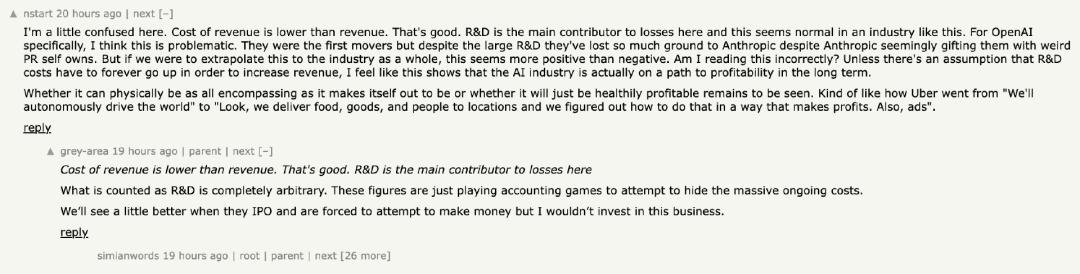
However, nstart also emphasizes that for OpenAI itself, this is still a problem. OpenAI is a pioneer, but even after investing huge R & D expenses, it has been caught up with or even left behind by Anthropic in the competition, and Anthropic itself also has some strange public relations blunders from time to time. But if we expand the perspective to the entire AI industry, he believes that these figures are actually more positive: Unless we assume that AI companies must always increase R & D investment to increase revenue, these figures seem to indicate that the AI industry is moving towards profitability in the long run.
He also made an analogy with Uber: It's still unclear whether AI can be all - encompassing as it claims or can only become a healthy and profitable industry. This is a bit like Uber changing from "We will change the world with self - driving cars" to "We can deliver food, goods, and people to their destinations, and we've found a way to make a profit, and there's also an advertising business".
A user with the ID grey - area doesn't agree with this optimistic interpretation.
grey - area believes that what is included in R & D is highly arbitrary. In his view, these figures are more like an accounting game, trying to cover up huge and persistent costs. He said that when OpenAI goes public and is forced to really try to make money, the outside world may see more clearly, but he personally won't invest in this company.

Netizen EmiDub also refuted the statement that "the cost of revenue is lower than the revenue, so it's positive".
He wrote:
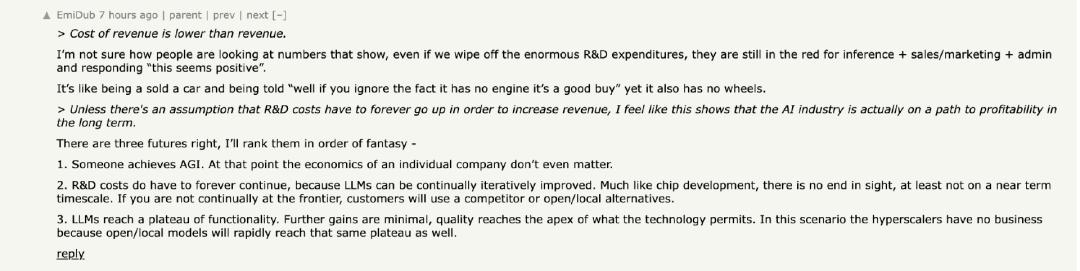
"I don't understand why some people can still be positive after seeing these figures: Even if we completely exclude the huge R & D expenditure, OpenAI is still in a loss state in terms of inference costs, sales and marketing, and administrative management."
He gave an analogy: It's like someone sells you a car and then tells you "If you ignore the fact that it doesn't have an engine, it's still a good deal", but in fact, the car doesn't even have wheels.
Regarding the view that "R & D costs can't keep rising forever, so the AI industry is expected to be profitable in the long run", EmiDub proposed three future scenarios and ranked them according to the "degree of fantasy".
The first is that someone truly achieves AGI. By then, the financial situation of individual companies may no longer matter.
The second is that R & D costs must continue to be invested because large - language models can be continuously iterated and improved. This is similar to chip development, with no clear end in sight, at least not in the short term. If a company can't stay at the forefront, customers will turn to competitors or choose open - source and locally deployed alternatives.
The third is that the capabilities of large - language models reach a plateau, with limited further improvement, and the model quality approaches the upper limit of the current technological path. In this case, the commercial space of large - scale cloud providers or cutting - edge model companies will be squeezed, because open - source models and local models will also quickly reach the same plateau.
User Certhas believes that comparing OpenAI with Uber isn't appropriate and is even the opposite. He said that Uber loses money in the ride - hailing business, while OpenAI may make money in the inference business. Uber used the R & D - type "moonshot project" of self - driving cars to explain why it wanted to enter a mature industry, but it didn't really significantly reduce costs; OpenAI's problem is that its core product is at risk of becoming a commodity because open - source models may only be six months behind.