Why did Jensen Huang skip Japan during his Asian trip?

From left: Lee Hae-jin, founder of NAVER; Koo Kwang-mo, chairman of LG Group; Choi Tae-won, chairman of SK Group; Jensen Huang, CEO of NVIDIA (at a restaurant in Seoul on June 5, Reuters)
Jensen Huang visited the Chinese mainland, Taiwan, and South Korea in succession from May to June, but did not visit Japan. In the semiconductor field, there are few Japanese enterprises directly related to NVIDIA...
Jensen Huang, the Chief Executive Officer (CEO) of NVIDIA in the United States, visited the Chinese mainland, Taiwan, and South Korea in succession from May to June, but did not visit Japan. This not only implies the decline in the competitiveness of the Japanese semiconductor industry but also suggests the risk that Japan may fall behind in the Artificial Intelligence (AI) revolution.
"Taiwan is the center of the AI revolution." "I'm here to thank our partners in South Korea." Jensen Huang praised highly during his visit to Taiwan and South Korea from late May to early June.
This is Jensen Huang's "high - level marketing" in his busy schedule. After arriving in Taiwan on May 23, he had a dinner with Wei Zhejia, the CEO of TSMC, his production partner, and then invited more than 40 leaders of Taiwanese enterprises led by Hon Hai Precision Industry to dinner, which attracted much attention.
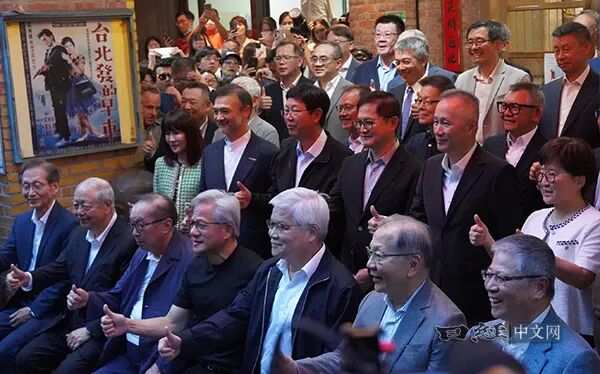
Leaders of Taiwanese enterprises that are important suppliers to NVIDIA, such as TSMC and Hon Hai, gathered together (in Taipei on May 28)
After arriving in South Korea on June 5, Jensen Huang had grilled pork belly and soju with leaders of representative enterprises such as Choi Tae - won, the chairman of SK Group, that night. On the 6th, he participated in the recording of a popular variety show, and on the 7th, he appeared at the opening pitch ceremony of a professional baseball game, extremely busy.
He also didn't forget to pay attention to the Chinese mainland, which is competing with the United States for dominance. In mid - May, Jensen Huang visited Beijing as a member of the corporate delegation accompanying President Trump to the China - US summit. He not only attended meetings with the Chinese side at places like the Great Hall of the People but also appeared on the streets to taste local food.
South Korea and Taiwan, Indispensable in the Supply Chain
The objects of his visits in South Korea and Taiwan are all indispensable members of NVIDIA's AI semiconductor supply chain. NVIDIA is a "fabless" enterprise without a factory, and most of its production depends on TSMC. The Graphics Processing Unit (GPU) can also only exert its computing power with the high - performance memory "HBM" of SK and Samsung Electronics.
The Chinese mainland is an important future sales market that cannot be ignored. Although the US government has banned the export of NVIDIA's most advanced semiconductors to China, it has allowed the export of the "H200", which is second only to the most advanced products, under certain conditions. It is said that due to the Chinese mainland government not allowing domestic enterprises to use it, there has been no export so far, but NVIDIA's real intention is to avoid being "shut out".
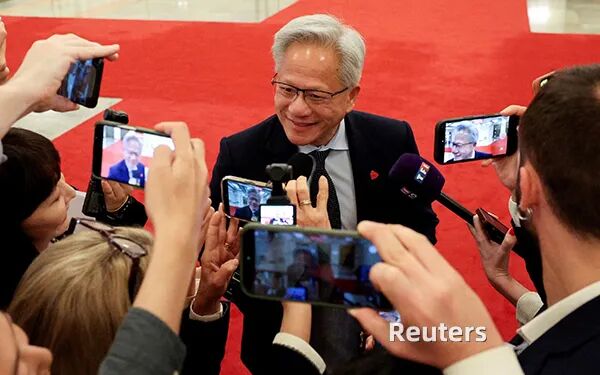
Jensen Huang, CEO of NVIDIA, participated in the corporate delegation visiting China for the China - US summit and visited the Great Hall of the People (in Beijing on May 14, Reuters)
From the perspective of Japan, which was skipped by Jensen Huang, in the semiconductor field, Japanese enterprises such as Tokyo Electron and Advantest have advantages in production equipment, and enterprises like Shin - Etsu Chemical have advantages in raw materials such as wafers, but there are few enterprises directly related to NVIDIA. An executive of a Japanese equipment manufacturer described NVIDIA as "the customer of (TSMC and other) customers".
Japan doesn't have enterprises like the AI development enterprises in the Chinese mainland, for which even NVIDIA competes to supply semiconductors and compete for global dominance. Tech giants in the United States such as Google and Microsoft are also investing heavily in data centers and competing to buy NVIDIA's semiconductors. Japanese enterprises cannot compete with those in China and the United States in terms of scale.
Promote the AI Revolution with Partners
Jensen Huang's skipping of Japan this time shows that the risks Japan faces are not limited to immediate transactions. This is because a careful look at Jensen Huang's visit itinerary shows his intention to upgrade Taiwanese and South Korean enterprises from the original "suppliers" to "partners" to jointly lead the AI revolution.
NVIDIA's total market value ranks first in the world, once exceeding $5 trillion. However, as investors turn their attention to memory enterprises, NVIDIA's stock price has relatively lacked upward momentum among semiconductor enterprises recently. Jensen Huang is reluctant to give up the leadership of the AI revolution and is trying to create a new AI growth story with his partners in South Korea and Taiwan.
When giving a speech in Taiwan, Jensen Huang repeatedly said that NVIDIA is an "AI infrastructure enterprise". It aims to participate in all scenarios from corporate activities to personal daily life by providing products such as servers for AI data centers and AI personal computers.
The growth vision he depicts is to get rid of the position of a supplier of components such as GPUs, enter the market with partners from the design stage of using AI, and obtain greater profits. It will also promote co - creation with partners.
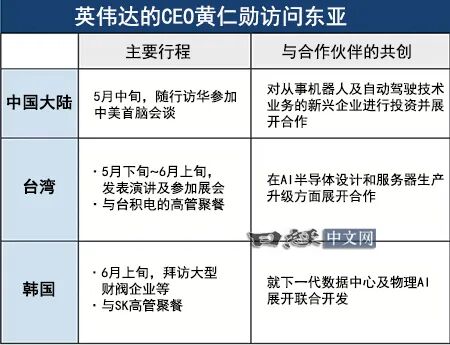
For example, the semiconductor for AI personal computers displayed at an NVIDIA event in Taiwan was co - designed with MediaTek in Taiwan. This is a key chip required for the efficient use of the "AI agent" that connects the GPU and CPU and automatically performs various processes.
The factory of Hon Hai in Taiwan, which manufactures servers for NVIDIA, has introduced a large number of new technologies to promote production upgrades. Using AI agents to operate robots, manage signals from sensors and machinery has improved production efficiency. It is said that the facility being built by Hon Hai will be equipped with up to 10,000 GPUs.
In South Korea, NVIDIA announced that it will join hands with the SK Group to launch a new - generation data center "AI Factory" in 2027. By combining GPUs and HBM, it can achieve efficient computing while reducing power consumption and improve the production efficiency of enterprises using it. SK will also promote the AI factory in Asian regions such as Japan.
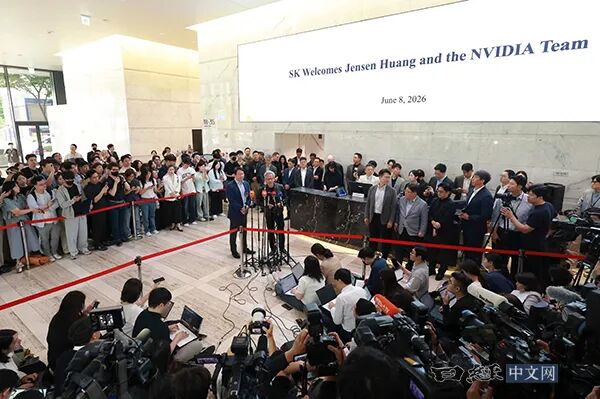
Jensen Huang, CEO of NVIDIA, was welcomed during his visit to the SK Group (in Seoul on June 8, photo provided by SK)
In addition to joining hands with SK, NVIDIA will also promote joint development with large chaebol enterprises such as LG, Hyundai Motor, and Doosan in the field of "physical AI" such as autonomous control robots.
In the Chinese mainland, NVIDIA has also cooperated with Unitree, an enterprise developing humanoid robots, and invested in WeRide, a startup in autonomous driving technology.
Can Japan Enter NVIDIA's Ecosystem?
What about Japanese enterprises? Jensen Huang visited Japan in 2025 and said that he would jointly develop AI semiconductors with Fujitsu. Fanuc, a giant in industrial robots, will cooperate with NVIDIA to develop robots equipped with AI. However, compared with South Korea and Taiwan, the scope of co - creation with Japan is limited.
NVIDIA has drawn enterprises related to semiconductor manufacturing, optical components, servers, AI development, etc. into its ecosystem through cooperation and investment. In today's Japan, how many attractive enterprises are there that can make Jensen Huang take time out of his busy schedule to visit and call for co - creation?
In the past, when Apple in the United States launched the smartphone revolution with the iPhone, electronic component enterprises such as Murata Manufacturing and TDK, and semiconductor enterprises such as Sony Group and Kioxia joined Apple's ecosystem. By becoming Apple's partners, Japan, which had failed in the field of digital home appliances, finally caught up with the wave of the new era.
Can Japan catch up with the wave of the new - round AI revolution? Well - known AI enterprises in the United States such as Anthropic and Palantir Technologies have recently visited Japan one after another. However, rather than being regarded as a partner in AI development, Japan is more like a "customer" in the sales system.
The "digital deficit" of paying for IT services of US enterprises has become an issue in Japan. The Ministry of Economy, Trade and Industry of Japan estimated in April 2025 that Japan's digital deficit will swell to 18 trillion yen by 2035. Whether Japan can become a partner of a leader like NVIDIA in the AI revolution will determine the country's future wealth.
This article is from the WeChat official account "Nikkei Chinese Net" (ID: rijingzhongwenwang), written by Kohei Yamada, Nami Matsuura, and Ryosuke Eguchi, and published by 36Kr with authorization.