ByteDance's Computing Power Under Pressure, Tencent Betting on Both Sides: Who Will Foot the Bill for 710 Million Monthly Active AI Users?
Yesterday, QuestMobile released the data on the top 10 AI-native apps in terms of monthly active users in May. Doubao, Qianwen, DeepSeek, and Yuanbao remained the top four, with a combined monthly active user count of over 710 million (without deduplication), accounting for nearly 90% of the market share in the top 10.
Doubao still led by a wide margin, with a monthly active user count of 368 million and a year-on-year growth rate of 182%. Qianwen, ranked second, soared 53 times, reaching a monthly active user count of 162 million. Together with DeepSeek, which had 127 million monthly active users, they formed a stable first camp of three AI-native apps with over 100 million monthly active users.
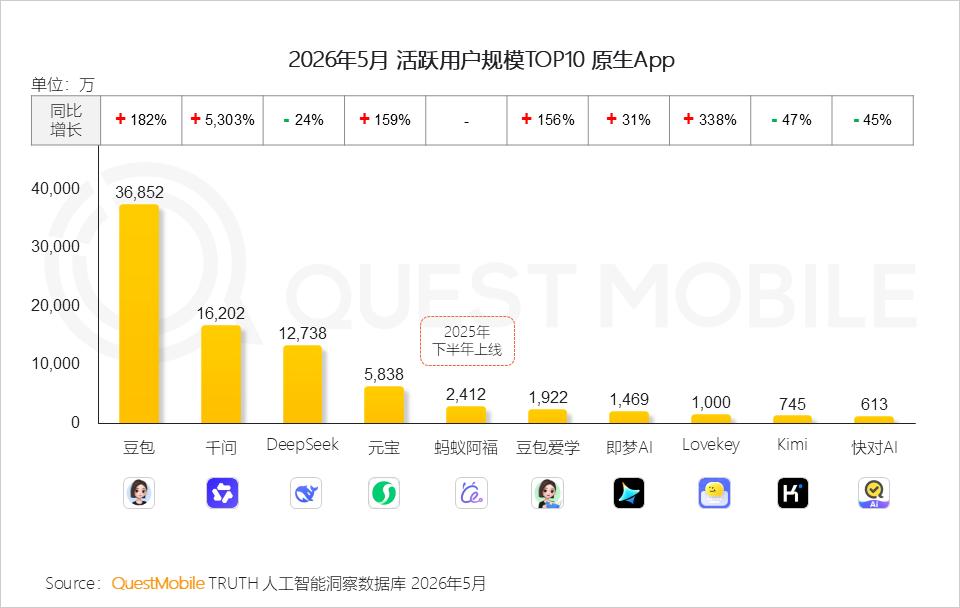
These numbers on the list seem to represent a competition among AI products on the surface, but in fact, they tell the stories of the past year about ecosystem, marketing, cost, and strategic choices. And each story is much more exciting than the numbers themselves.
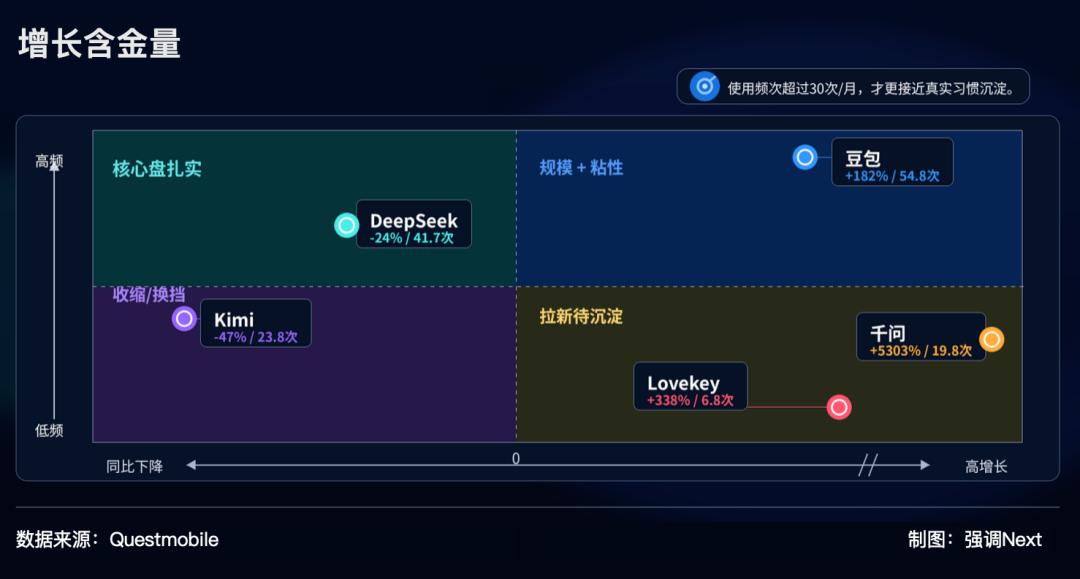
Today, let's take a look at what each company is betting on behind their growth through these two sets of data.
01. Doubao: The real challenges come after reaching 300 million users
On May 4th, Doubao quietly launched a paid subscription plan on the App Store: the standard version costs 68 yuan per month, the enhanced version costs 200 yuan per month, and the professional version costs 500 yuan per month. After the news came out, Doubao experienced user loss for the first time. According to third-party data, the number of monthly active users of Doubao decreased by about 6.1 million. In a vote participated by more than 90,000 people, 43% clearly stated that they would stop using it if it was charged.
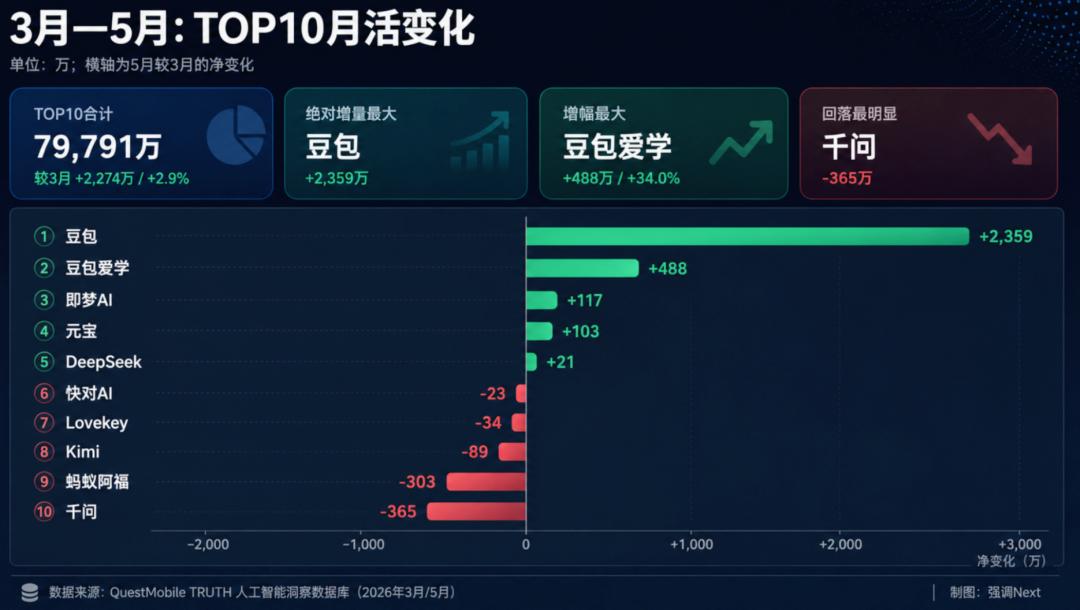
Questmobile data shows that Doubao still gained more than 20 million users in May compared to March. So, even though the decrease of 6.1 million users in May is not a significant fluctuation.
However, Doubao's cost pressure is real. ByteDance achieved a leading position through a free strategy in three years, but it also cultivated a group of users with almost zero migration costs. The cost of AI products is almost proportional to the user scale. As of March 2026, Doubao's daily average Token calls exceeded 120 trillion. It was reported that ByteDance's net profit in 2025 decreased by more than 70%, and AI computing power was one of the core reasons.
However, Doubao obviously doesn't expect to recover these costs directly from users. The large span of the three pricing tiers is more like a user segmentation test. First, screen out heavy users who are not sensitive to price and let them pay for AI first. The remaining free users will continue to stay in the ecosystem to generate data and usage habits. ByteDance's strategy is to first connect with Douyin e-commerce for traffic, and the real commercialization is bet on after 2027. In other words, the 68-yuan subscription is more like a mental education, and the real money will come from the Douyin e-commerce line after Q3.
The 6.1 million lost users are more likely to be marginal users who used Doubao lightly. The usage intensity of the remaining core users has actually increased.
Of course, there are also the recently emerging WeChat AI and AI version of Alipay. Whether these traditional super entrances accessing AI will divert some users is the key in the future. More notably, the "conversation to transaction" link that Doubao is betting on is becoming the same battlefield as what Qianwen and the AI version of Alipay want to do.
Whoever can enable users to make purchase and service decisions in one sentence will master the most realistic entrance for AI commercialization.
02. Qianwen: With a 5303% growth rate, how much of it is real growth?
Qianwen's year-on-year growth rate is the most eye-catching number on the entire list, but it is mainly concentrated in two months.
Qianwen was formerly known as "Tongyi" and was renamed and renovated in November 2025. The explosion point was the Spring Festival: on February 6th, 2026, it launched the "Spring Festival Treat Plan", connecting all Alibaba Group's businesses, with a total investment of 3 billion yuan. The gameplay was straightforward. Users sent shopping instructions to Qianwen, and Qianwen placed orders with free payment. The number of orders on the first day exceeded 10 million, and the DAU soared by 51 million in a single day, surpassing Doubao on the App Store and topping the list.
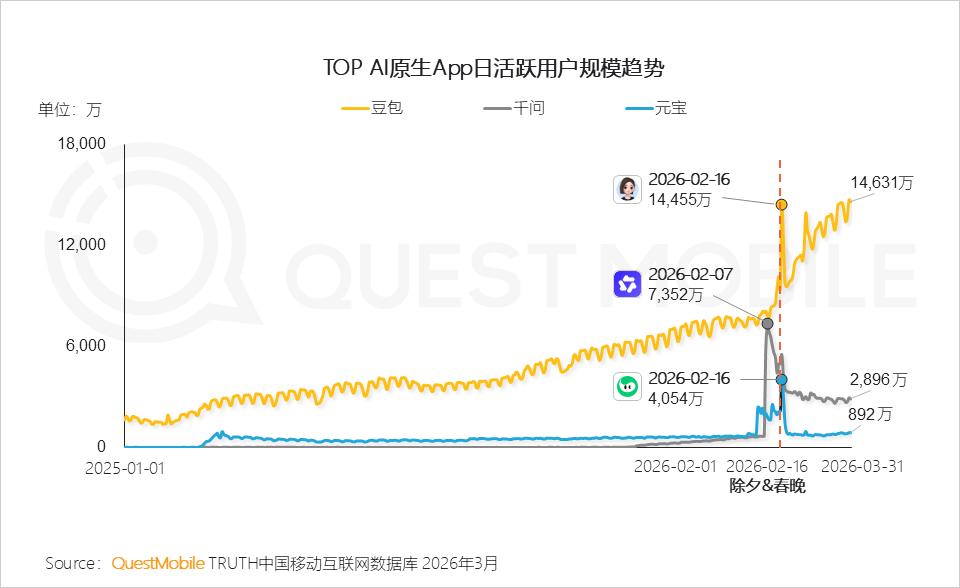
This was a strong marketing-driven explosion, not the result of the natural growth of product power. Qianwen's own analysis did not avoid this point. Among the 130 million users and 200 million orders, how many were for the sake of volume and how many were truly converted into daily active users? The long-term DAU after the event subsides is the real test.
We can see it more clearly by comparing the monthly active user data in March. From March to May, Qianwen's monthly active user count decreased the most. Although the absolute decrease is not large, it is at least a trend signal.
However, Alibaba's underlying logic is not entirely supported by marketing. Taobao's fulfillment system, Alipay's payment closed-loop, and Alibaba Cloud's computing power base make it possible to say to Qianwen, "Help me buy a box of mineral water and complete the delivery," and it can be truly realized. Alibaba has built Qianwen into a new entrance for AI purchase decisions, which is a barrier that startup companies cannot replicate in the short term. However, the increment contributed by this barrier is far less direct than the 3-billion-yuan subsidy.
During almost the same Spring Festival period, Tencent also invested 1 billion yuan in Yuanbao for a social fission experiment. After the red envelope event subsided, the DAU dropped significantly. Similarly, when it comes to spending money for growth, Qianwen's subsidy is integrated into a real transaction closed-loop, while Yuanbao's red envelopes are more like a one-time game. After the red envelopes are sent out, the users basically return to the pre-festival level.
03. DeepSeek: The battlefield is elsewhere
It is obviously inaccurate to evaluate DeepSeek based on a 24% decline in monthly active users. DeepSeek actually serves developers and enterprises accessing its API. The core indicators to measure it are the API call volume and the number of products around the world using its model. Questmobile data in March shows that the average monthly usage frequency of DeepSeek is 41.7 times, and it is still increasing year-on-year, indicating that the remaining core user base is more solid. The decline in monthly active users is more likely due to the loss of curious users who flocked in when R1 became popular.
In April, V4 was officially open-sourced. With 16 trillion parameters, it supports a context of one million tokens and has completed the full-chain migration from NVIDIA CUDA to Huawei Ascend. This is the first publicly released complete Ascend training plan that can be replicated among domestic cutting-edge models, and its engineering significance is no less than that of the model itself. In the same month, the API pricing of V4-Pro was permanently reduced to one-fourth of the original price. For the developer market, low price is a moat.
The bigger change is the financing. On June 16th, The Information reported, citing people familiar with the matter, that DeepSeek has completed a new round of financing, raising a total of more than 50 billion yuan, and its post-investment valuation exceeded 50 billion US dollars. Structurally, except for a national-level fund, all external funds did not directly enter DeepSeek. Instead, investors were required to invest in a limited partnership managed by Liang Wenfeng himself and could not obtain voting rights and could not withdraw within five years. Liang Wenfeng had previously locked his personal control ratio of the company at 84.29%. Money can come in, but the right to speak basically cannot.
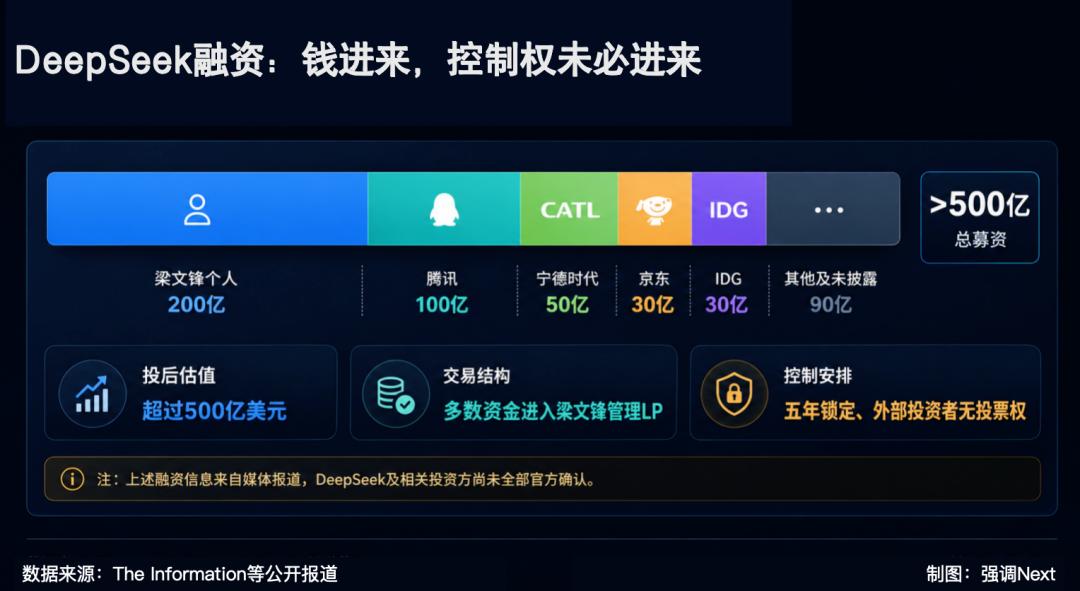
According to the disclosed investors, Liang Wenfeng himself invested 20 billion yuan, Tencent invested 10 billion yuan, CATL invested 5 billion yuan, and JD.com and IDG each invested 3 billion yuan. Alibaba, which was reported to be in talks in April, did not appear on the list in the end.
This 50-billion-yuan investment is not just about money. At the underlying level, it is a transformation of the company's form. DeepSeek is changing from a "technology laboratory that does not need external capital" to a Chinese AI company jointly bound by personal control rights, national strategic capital, and industrial capital.
04. Yuanbao: Tencent chooses to bet on two fronts
Yuanbao is the one among the top four that is most likely to be overlooked. After the 1-billion-yuan subsidy during the Spring Festival subsided, the monthly and daily active user counts of the independent app dropped significantly, and the usage depth was not really solidified. Tencent's internal judgment on this is clearer than the outside world imagines. Using Yuanbao to directly compete with Doubao and Qianwen did not meet the expectations.
Tencent's response is to bet on two fronts. On the one hand, it invested 10 billion yuan in DeepSeek to buy technology, talent, and ecosystem access rights. On the other hand, it is promoting the access of WeChat AI. On June 8th, it opened the interface to all mini-program developers, enabling AI capabilities to be directly integrated into the service network composed of 1.4 billion monthly active users of WeChat and millions of mini-programs. If this path succeeds, the outcome of Yuanbao may not matter at all, because the real entrance is still WeChat.
05. Kimi: Monthly active users halved, ARR soared
Kimi's monthly active user count is 7.45 million, a year-on-year decrease of 47%. This is not entirely because it was defeated; half of it is due to active abandonment.
Yang Zhilin clearly stated in the full-staff letter at the end of 2025 that in 2026, the company would not aim for the absolute number of users, and the commercialization would focus on Agent and paid subscriptions. Because a user who does not pay but consumes tokens every day may contribute negatively to the company's financial statements, which is difficult for a startup company to bear. The cost structure of AI products is completely different from that of traditional software, and Kimi has finally realized this reality.
The results were realized in January 2026. After the release of Kimi K2.5, the cumulative revenue within 20 days exceeded the total revenue of 2025. As of April, the ARR exceeded 200 million US dollars. In May, it completed a 2-billion-US-dollar Series D financing, and its valuation exceeded 20 billion US dollars, almost quadrupling compared to half a year ago. On the user side, the average monthly usage frequency in March was 23.8 times (QM data). After halving the monthly active users, the remaining users did not become more indifferent.
06. Ant and Lovekey: Two "outsiders"
Ant Aifu has 24.12 million monthly active users and ranks among the top five on the list, but this is not Ant's real trump card.
The AI version of Alipay, which started the invitation-only test yesterday (June 16th), is. Alipay integrates tens of thousands of life services into a unified dialog box. Users can directly access services such as provident fund inquiry, taxi-hailing, ordering food, and buying funds with one sentence. Almost at the same time, WeChat is also doing the same thing. Both are embedding AI capabilities into their existing and larger service networks, making the dialog box a scheduling entrance. This kind of entrance poses a threat to vertical apps such as ride-hailing, food delivery, and wealth management apps, as users may no longer need to open these vertical apps separately.
However, based on the current user experience in the test, the experience in some low-decision scenarios is better, such as taxi-hailing and paying electricity bills, while the experience in complex decision scenarios is still relatively poor, such as the food delivery scenario when users don't know what to eat.
Lovekey has 10 million monthly active users, a year-on-year increase of 338%. It provides emotional companionship, which is a demand scenario that has been skipped by mainstream AI products and is naturally growing. However, the average monthly usage frequency in the first quarter is 6.8 times, which is the lowest on the entire list and is still slightly declining year-on-year. A product that focuses on emotional companionship should theoretically be opened daily, but in reality, its usage depth ranks at the bottom of the list. The 338% growth mainly occurs at the level of "being seen" and "downloaded", and it is still far from "being indispensable".
07. The ultimate battle of AI applications
Looking beyond each company, this list points to a common question: In which dimension will the competition of AI applications ultimately be decided?
The path of large companies is to exchange ecological traffic for monthly active users and then convert monthly active users into commercial value. ByteDance's ecological advantage lies in attention, while Alibaba's lies in the wallet. Attention is more likely to drive monthly active users, while the wallet is more likely to drive ARR. There is also a third path quietly taking shape. The entry of the AI version of Alipay and WeChat AI does not follow the traffic logic but the service scheduling logic. Once this kind of entrance matures, the indicator of monthly active users will become invalid because the entrance itself will disappear in the underlying infrastructure.
Independent companies have different approaches. DeepSeek does not target the C-end market. It exchanges open-source infrastructure for the right to speak among global developers. The 5-billion-yuan financing is its first step towards the scale war. Kimi gave up monthly active users and bet on ARR, proving that a shift in commercialization is feasible, but whether it can be sustained remains to be verified.
The real issue approaching everyone is "When will AI start charging?" Doubao has proved that when competitors are generally free, charging alone, even for the AI application with the highest monthly active users globally, will first face the first wave of user loss. However, the pressure of computing power costs is rigid, and free is not the end. Whoever can first establish users' payment mentality and irreplaceable usage stickiness will truly turn this traffic war into a victory in the commercial war.