Another inter-provincial subway line is coming
According to Beijing Daily and Beijing News, on June 16th, at the press conference themed "Changes in the Sub - center", Zhou Bangda, the deputy director of the Transportation Commission of Tongzhou District, Beijing, revealed that by the end of this year, Beijing Subway Line 22 (Pinggu Line) will basically meet the opening conditions and will become the first cross - provincial subway in the Beijing - Tianjin - Hebei region.
In recent years, the construction of the road network in Beijing's Sub - center has been accelerating. The backbone road network of "eleven horizontal and nine vertical" has basically taken shape, and the total mileage of roads in the Sub - center has exceeded 660 kilometers. Currently, the rail transit lines in Tongzhou District include 5 subway lines and 2 suburban railways. Meanwhile, relying on the Beijing - Tangshan Intercity Railway, Beijing - Bincheng Intercity Railway, etc., Tongzhou District is building a "half - hour and one - hour" transportation circle with the central urban area, Tianjin, and major cities in Hebei.
This year's Beijing Municipal Government Work Report proposed to build a modern capital metropolitan area and promote the integrated development of the commuting circle. As the first urban rail transit line spanning Beijing and Hebei and constructed and operated uniformly, Beijing Subway Line 22 is a landmark project for high - quality construction of the "Beijing - Tianjin - Hebei on the Railways".
Public information shows that the line is 81.8 kilometers long, connecting key functional areas such as the core area of Beijing CBD, Beijing's Sub - center, Yanjiao Town in Sanhe City, Hebei, and the new town of Pinggu in Beijing. After the line is opened, Sanhe City in Hebei will be connected to the Beijing rail transit network for the first time, and the three northern counties in Hebei and Pinggu District in Beijing will enter the "one - hour transportation circle" of the central urban area of Beijing.
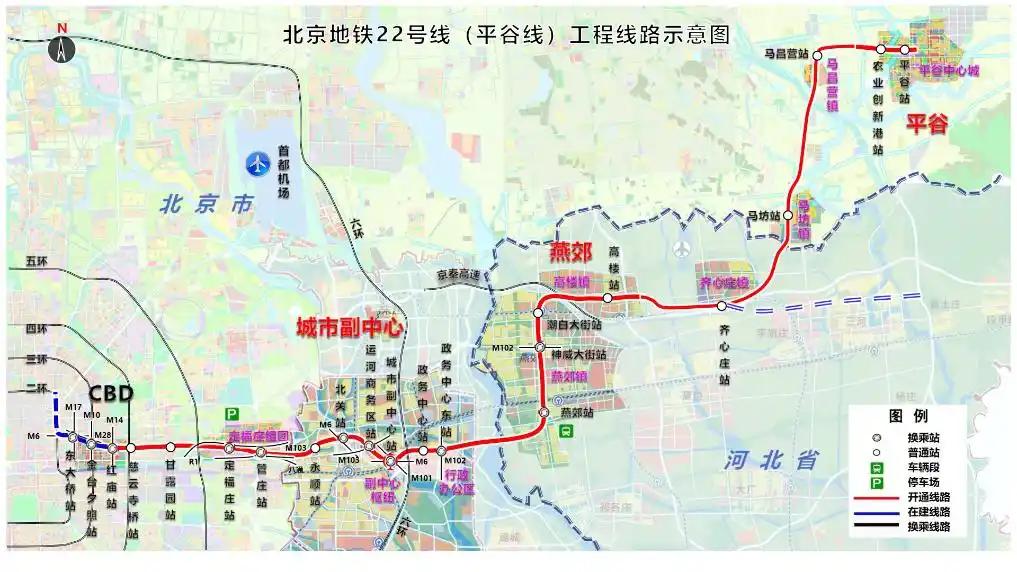
Image source: Beijing Daily
By then, it will take about 9 minutes at the fastest to travel from Yanjiao, Langfang, Hebei to Beijing's Sub - center, and about 28 minutes at the fastest to reach Hongmiao Station in Chaoyang, Beijing. It will play an important role in effectively solving the pain points of cross - provincial commuting, supporting the relocation of non - capital functions, and promoting regional coordinated development.
Looking across the country, driven by the integrated development of metropolitan areas, there are more and more cross - city and even cross - provincial "subways".
As early as 2013, the Yangtze River Delta welcomed the "first cross - provincial subway in the country" - the Huajiao section of Shanghai Subway Line 11 was opened for operation, with 3 stations located in Kunshan, Suzhou. In April this year, the Nanjing - Ma'anshan Intercity Railway connecting Nanjing, Jiangsu and Ma'anshan, Anhui was officially opened for operation. The line is incorporated into the Nanjing subway system, realizing unified management of dispatching, ticketing, and services, and is also regarded as the second "cross - provincial subway" in the country.
In a broader sense, in the Guangdong - Hong Kong - Macao Greater Bay Area, in 2024, with the opening of the Guangzhou - Foshan South Ring and Foshan - Dongguan Intercity Railways, the 258 - kilometer - long "super subway" was connected, linking 5 cities including Guangzhou, Foshan, Zhaoqing, Dongguan, and Huizhou.
In the Yangtze River Delta, Shanghai, Jiangsu, and Zhejiang are jointly promoting the construction of the Shanghai - Suzhou - Jiaxing Intercity Railway, which will become the first rapid commuter railway spanning two provinces and one municipality in the Yangtze River Delta.
According to the "Implementation Plan for the Project to Improve the Inter - city Commuting Efficiency in Metropolitan Areas (2026 - 2030)" jointly issued by multiple departments such as the Ministry of Transport, it is planned to increase the coverage rate of the population with one - hour commuting conditions in major metropolitan areas to about 73% in three years. The commuting conditions in metropolitan areas in regions such as the Beijing - Tianjin - Hebei, Yangtze River Delta, and Guangdong - Hong Kong - Macao Greater Bay Area will be significantly improved. By 2030, the coverage rate of the population with one - hour commuting conditions in major metropolitan areas will reach 75%, and the level of commuting services for urban integration will be significantly improved.
This article is from the WeChat official account "Urban Evolution Theory", author: Liu Yanmei. Republished by 36Kr with permission.