A major province in central China will continue to "regain" the provincial capital
The "strong provincial capital" strategy remains the mainstream choice for provinces in central and western China.
At a recent meeting of leading cadres in Changsha, Hunan Province put forward new requirements for Changsha again.
It was clearly emphasized that as the provincial capital, Changsha is the leader of high - quality development in Hunan. It should further raise the development benchmark, view itself from a national perspective beyond Hunan, strengthen its sense of responsibility, take on greater responsibilities, strive to improve the city's primacy, innovation driving force, development leadership, core competitiveness and radiation - driving force...
Among them, the expression of "striving to improve the city's primacy" is generally interpreted by the outside world as a clear signal that Hunan's official authorities continue to support Changsha in building a "strong provincial capital".
Facts have once again proved that the "strong provincial capital" concept has never gone out of date.
01
Previously, we have said many times that from public statements, it seems that the "strong provincial capital" model has shown signs of cooling down.
For example, Jiangxi has replaced the term "strong provincial capital" with "provincial capital leadership"; Hunan and Guangxi have not publicly emphasized the "strong provincial capital" or "strong provincial capital city" in recent years.
However, in fact, the "strong provincial capital" strategy has never really been diluted. Hunan's clear proposal to strive to improve Changsha's city primacy is a very direct signal.
Actually, whether to mention the term "strong provincial capital" is not important. For the vast majority of provinces, the core status of the provincial capital is beyond doubt. It's just that due to different provincial conditions, its importance is manifested differently.
For inland provinces, the provincial capital is often the all - around "big brother", the absolute center of a province's politics, economy, culture, transportation, etc.
But for some provinces with an obvious "twin - star" structure, this importance, or the resource and element agglomeration effect of the provincial capital, as well as the functions it plays, are not fully manifested.
Typical examples are Guangzhou and Shenzhen; Nanjing and Suzhou; Jinan and Qingdao. This is a very realistic and objective factor that differentiates the development models of different provinces. Of course, from the overall trend, in the vast majority of provinces, including those in the eastern region, the importance and presence of provincial capitals have been increasing rather than decreasing in recent years.
For example, cities such as Jinan, Hangzhou, and Fuzhou have been continuously strengthening the functions of provincial capitals in recent years.
Looking at the inland areas, although more and more provinces have proposed to build "sub - centers", it does not mean that the presence of provincial capital cities has been weakened.
For example, Sichuan has clearly proposed to support Chengdu in optimizing and strengthening its core functions. Hubei has also proposed to strengthen Wuhan's core functions and enhance the radiation and leading functions of the leading city.
The logic behind this is actually very realistic. That is, "strong provincial capitals" like Chengdu and Wuhan have long carried functions beyond their own provinces and occupy important positions in the national urban competition pattern, so they cannot be weakened.
In this case, the key lies in whether the "sub - center" cities can build new competitiveness in their respective regions.
02
Specifically for Changsha, Hunan's construction of a "strong provincial capital" indeed has many special features.
On the one hand, for a long time, Hunan has been one of the inland provinces that have suffered the most obvious siphon effect.
For example, the saying that "Shenzhen is the second provincial capital of Hunan" has even received "semi - official" recognition.
Under this reality, "striving to improve the city's primacy, innovation driving force, development leadership, core competitiveness and radiation - driving force" actually means to truly "get back" its provincial capital.
On the other hand, in recent years, Hunan has clearly proposed "to build Changsha, Zhuzhou and Xiangtan as one city". In fact, this is to take the three cities as a whole to build a Hunan - style "strong provincial capital". Judging from the current primacy of Changsha, it is second only to Wuhan among the six provincial capitals in central China.
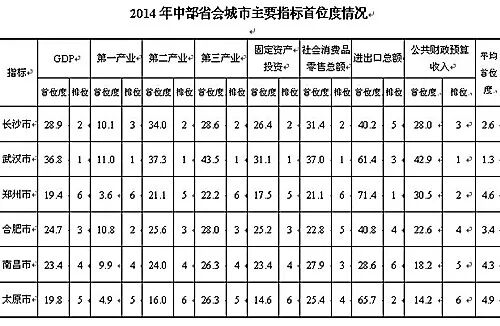
But in terms of the actual proportion, the proportion of less than 30% still has room for improvement. Of course, if we look at the three cities of Changsha, Zhuzhou and Xiangtan, this proportion is significantly larger. In 2025, the GDP of Changsha, Zhuzhou and Xiangtan accounted for 41% of Hunan's total. Among them, Changsha accounted for more than 68%. But from the perspective of the metropolitan area, there is still room for further expansion.
For reference, in 2025, the economic aggregate of the Chengdu metropolitan area accounted for 46.3% of the province's total. Among them, Chengdu accounted for 79.1%.
The economic aggregate of the Wuhan metropolitan area accounted for more than 60% of Hubei's total. Of course, this is directly related to the relatively large number of cities in the Wuhan metropolitan area.
But from the general trend that the provincial economy and population are mainly concentrated in the metropolitan area in the future, the current development scale of the Changsha - Zhuzhou - Xiangtan version of the "strong provincial capital" indeed has great potential to be tapped.
03
However, although the "strong provincial capital" strategy has never really been diluted, it should be noted that against the backdrop of the country's clear proposal to prevent "one - city dominance" and the increasingly tightened administrative division adjustments, the scope for strengthening the provincial capital simply by merging administrative divisions is getting smaller and smaller.
For this reason, the construction of metropolitan areas centered on provincial capitals has become the mainstream model for building "strong provincial capitals" at present.
However, for each provincial capital city or metropolitan area, to truly make the provincial capital "strong", we cannot rely on the integration of internal resources, but we should really strive for more external increments.
For example, both Wuhan and Chengdu have emphasized the need to improve their external radiation capabilities when strengthening their core functions.
To achieve this, the most important way is to seize the new opportunities of industrial and technological changes and truly establish industries that are competitive across the country. Only in this way can it bring real development increments to the whole province.
We usually say that if an inland province does not have a "strong provincial capital", it doesn't even have a chance to "sit at the table". And the so - called "sitting at the table" essentially means having the strength to compete with other cities across the country in key industrial fields.
In this way, on the one hand, it can resist the external siphon effect, and on the other hand, it can attract more external resources and elements to gather, rather than just "reshuffling" internally.
Whether it can achieve this is the most important criterion for judging whether a provincial capital is truly "strong".
This article is from the WeChat public account "Western City Affairs", author: Western Jun. It is published by 36Kr with authorization.