Revenue has more than doubled within half a year, Manus and Genspark have achieved profitable monetization amid intense competition from tech giants
In March 2025, "Manus" suddenly popularized the concept of Agent, and the invitation code was once resold for over $100,000. Immediately afterwards, "Genspark", an AI search product developed by Eric Jing, the former vice president of Baidu and the CEO of Xiaodu Technology, also announced its transformation into an Agent.
However, after the hype subsided, both products entered a relatively quiet phase, with their mobile - end revenues lingering around $500,000 for a long time. More commonly, most Agent projects are caught between ChatBots and vertical tools. General ChatBots encroach on lightweight tasks, while vertical tools (such as "Gamma" for making PPTs and "Otter" and "Granola" for transcription) siphon off users in single high - frequency scenarios.
We once thought that it would be difficult for general Agents other than the two giants to survive. But in 2026, both "Manus" and "Genspark" showed signs of a breakthrough, taking two completely different paths.
I. Finding the Neglected Long - Tail Users under Pressure
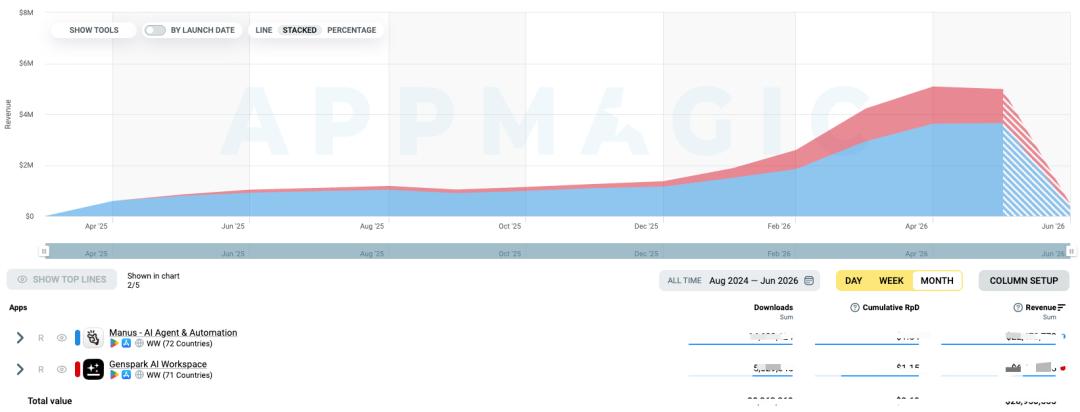
Monthly revenue data (after revenue sharing) of "Manus" and "Genspark" on both ends | Source: AppMagic
In 2026, when we thought that the vast majority of users had flocked to Codex and CC, "Manus" and "Genspark" began to grow rapidly on both the web and mobile ends. Most importantly, user payment increased significantly.
In terms of mobile - end revenue, compared with the level at the end of 2025, "Manus"'s revenue in May was three times that of before, reaching $3.6 million. "Genspark", with a smaller base, saw its revenue increase by more than six times, reaching over $1.3 million. (AppMagic)
The web - end also showed an upward trend. Although there is no third - party monitoring of revenue data, the traffic of "Manus" and "Genspark" increased from 15.27 million and 11.4 million in November last year to 30.3 million and 21.35 million in April this year respectively, doubling in five months. (AI Product Ranking)
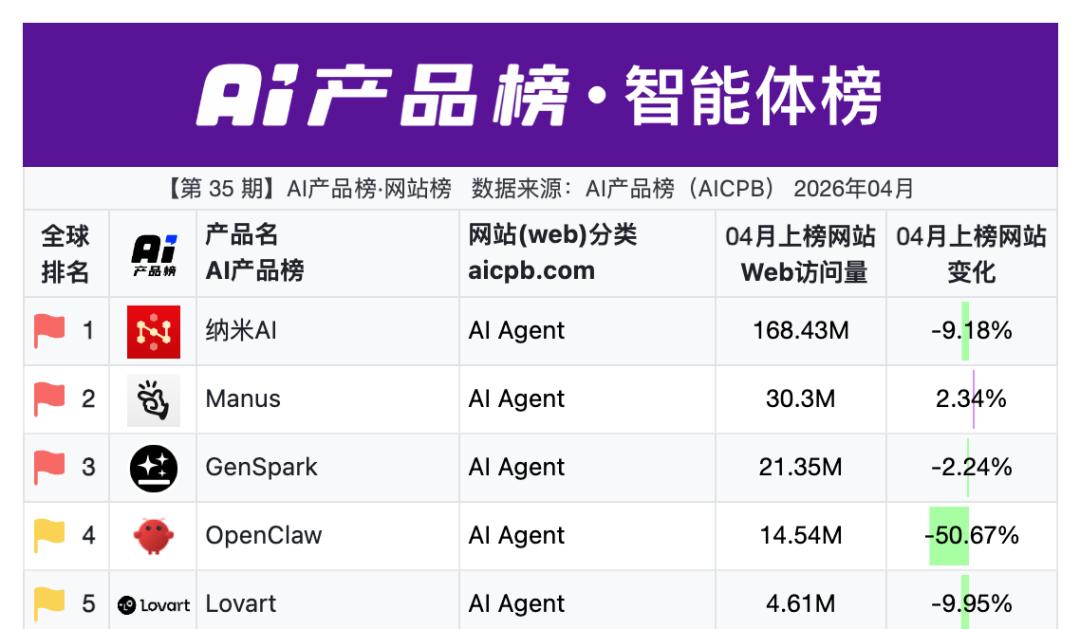
The two products ranked 2nd and 3rd in the AI agent website traffic ranking in April | Source: AI Product Ranking
The simultaneous growth of these two products with similar forms is probably not a coincidence.
Kay, the co - founder of "Genspark", wrote in the article "Why I Shut Down the AI Search Product with 5 Million Users" when announcing the transformation of "Genspark": "Users are no longer satisfied with 'Summarize this for me'. They now want pitch decks, video scripts, and follow - up emails." The underlying logic of Agent - type products entering the market is to change from "providing answers" to "delivering results". However, it is not easy to find paying users between the downward pressure of ChatBots and the interception of vertical tools.
Judging from user comments on app stores and Reddit, the breakthrough of "Genspark" and "Manus" in 2026 relies more on a group of people neglected by the giants, including designers, junior operators, lawyers, and independent small shop owners. Their common feature is a large variety of tasks with low frequency for each single task - they need to make promotional posters and process spreadsheets, write contract summaries and send follow - up emails.
We saw a representative comment on Reddit. A Japanese convenience store owner said, "I leave all the promotional posters and data processing in the store to 'Genspark', and it saves me two or three hours each time." Rather than having high - complexity professional tasks handled by AI, it's more like a series of fragmented tasks are taken over by a single entry.
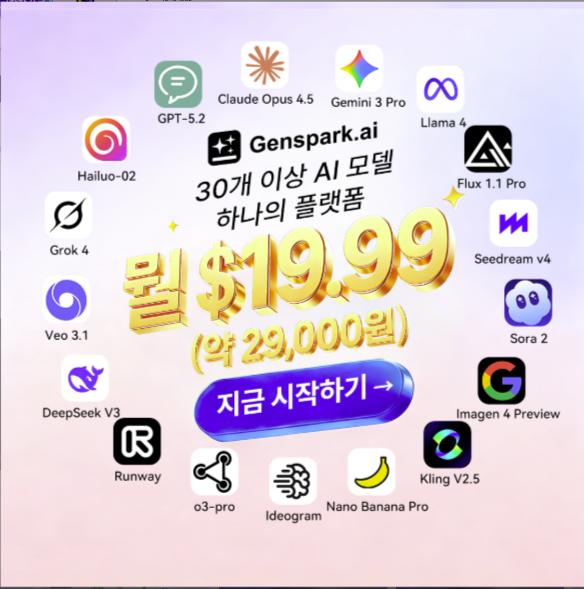
Advertising materials of "Genspark" in the South Korean market, featuring All - in - One | Source: Guangdada
For them, subscribing to a vertical tool for each type of task is not cost - effective in terms of subscription fees and learning costs. They need an all - in - one workflow entry.
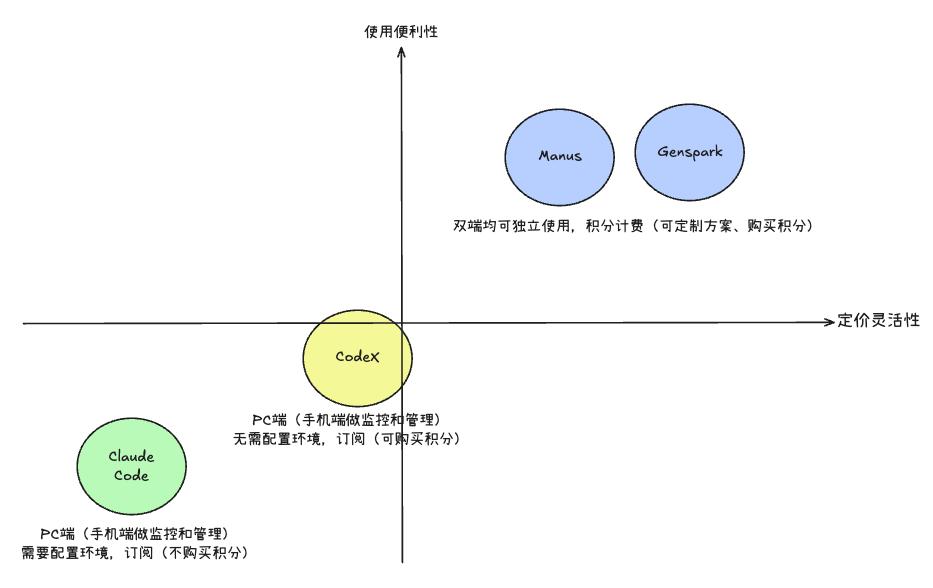
In the face of vertical tools, Agents differentiate themselves with All - in - One. When facing the general Agents of giants, they rely on low thresholds and flexible pricing.
Although all four products claim to complete tasks and deliver results, both CodeX and Claude Code, although having mobile versions, are mainly used for monitoring and management, and tasks still need to run on the PC desktop. Claude Code also requires a local development environment, with a higher learning cost than the directly usable "Genspark" and "Manus", which can also deliver results directly on the mobile end.
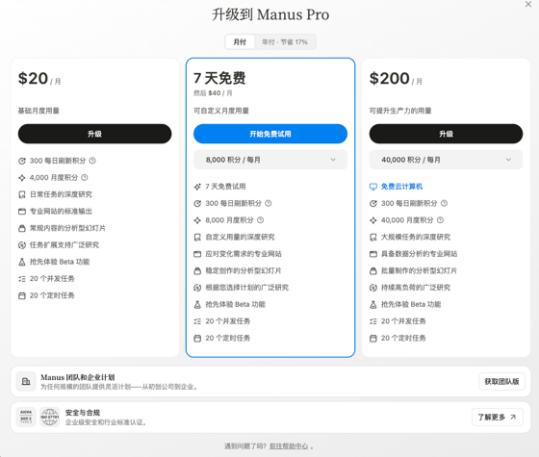
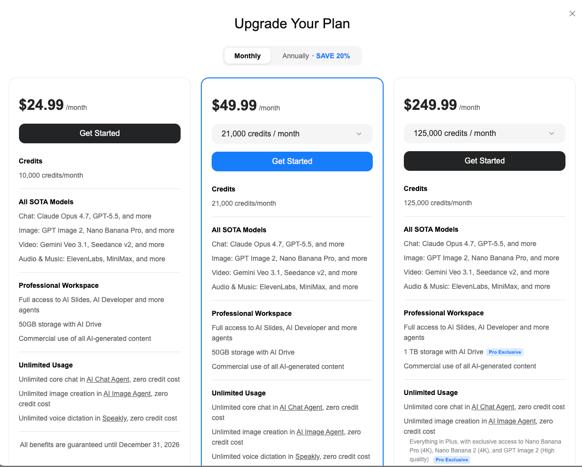
Note: Both "Genspark" and "Manus" are mainly subscription - based, but they are billed by Tokens and offer customizable point - based subscription plans, covering the range between $20 per month and $200 per month.
On the other hand, in terms of pricing, both "Genspark" and "Manus" are billed by Tokens and offer customizable subscription plans and options to purchase additional points. In contrast, using CodeX and Claude Code requires users to subscribe to ChatGPT and Claude, with only two levels of $20 and $200.
Although CodeX also allows users to purchase additional points, it is still not as flexible as "Genspark" and "Manus". Some users said that their budget could not reach the level of Claude Max, so they continued to use "Genspark".
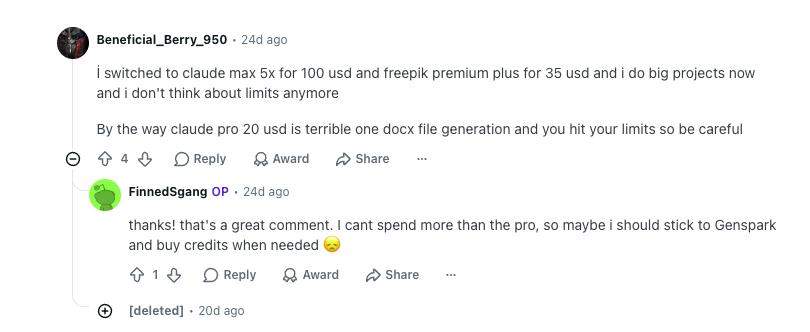
Translation 1: I switched to Claude Max and Freepik Premium Plus. Now I don't have to worry about quota limits when working on large - scale projects. By the way, Claude Pro really doesn't work well. Generating a Word (docx) file can consume a lot of quotas, and it's easy to trigger usage limits, so be careful.
Translation 2: Thank you! This comment is very helpful. My budget can't afford the Max package, so I'll probably continue to use "Genspark" and buy additional Credits when needed.
After finding similar users, both products' revenues increased exponentially. At the same time, the difference between them is that the main revenue of "Manus" comes from the United States, while Japan and South Korea contribute the vast majority of "Genspark"'s revenue.
II. "Genspark" Pursues Results, "Manus" Values the Process
The differences between the two products are evident from the home page.
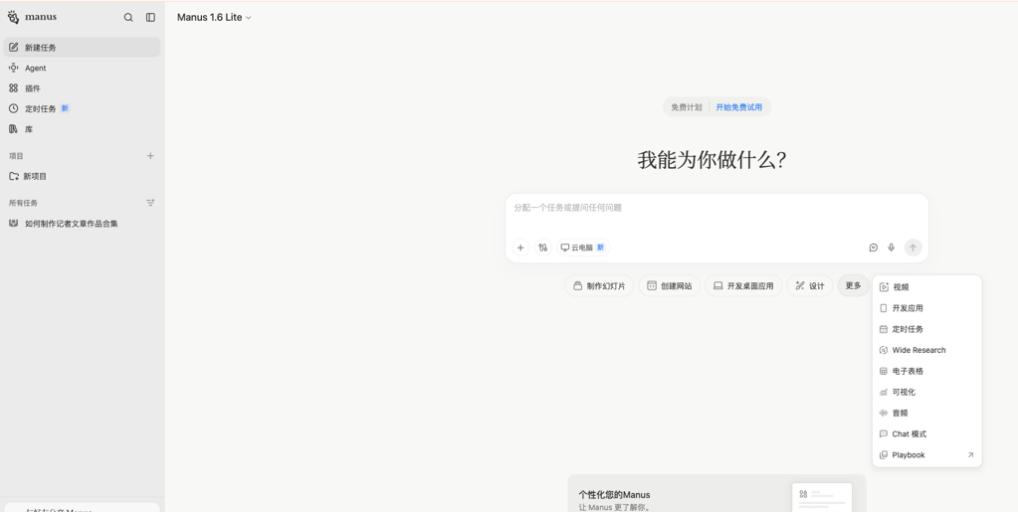
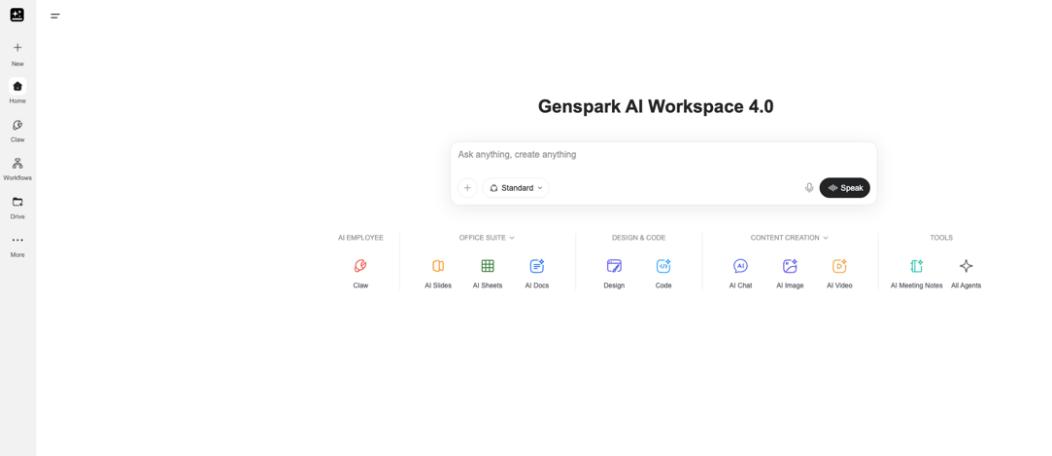
Home page of "Manus" (top), home page of "Genspark" (bottom)
The input box of "Manus" says "Assign a task", and its core entry focuses on execution capabilities such as Agent, plugins, cloud computers, and scheduled tasks, which is similar to Codex. The input box of "Genspark" says "Create anything", and the most prominent position on the home page directly displays specific results such as documents, PPTs, images, and videos.
Looking at the functions in more detail, the differences become clearer. "Manus" continuously strengthens process - oriented capabilities such as cloud computers, scheduled tasks, and in - depth research from multiple information sources, allowing users to see how tasks are disassembled, executed, and where they get stuck. "Genspark", on the other hand, continuously expands capabilities that can deliver results, such as making phone calls, playing music, automatic editing, translation, and downloading.
To some extent, "Manus" aims to be an Agent that allows users to see the process and intervene at any time; "Genspark" is more like an Agent that sets a goal and waits for the results. These two product philosophies are not absolutely opposed, and they also absorb each other's capabilities. However, the underlying "product personality" differences determine which type of users will pay for them.
Let's first look at "Genspark" in Japan and South Korea.
According to data from Podobas Global, the proportion of SaaS in the overall IT expenditure in Japan is only 4%, while in the United States, it is 15% - 18%. Although there are factors related to enterprise - level SaaS, for individual users such as convenience store owners and ordinary employees, the problem is more straightforward. There are almost no vertical tools in the Japanese market specifically targeting them.
"Genspark" is continuously filling this gap. The "Call for me" function launched this year allows the Agent to make phone calls on behalf of users to complete inquiries or appointments, and the AI returns the results without the user having to say a word. For Japanese users who are "socially anxious" but often need to make phone calls, this is a very specific and necessary feature. Some Japanese users have even shared scenarios of using AI to call their bosses to quit their jobs.
This function is hardly a selling point in the United States, but in Japan, it precisely meets the real needs of a group of real users.
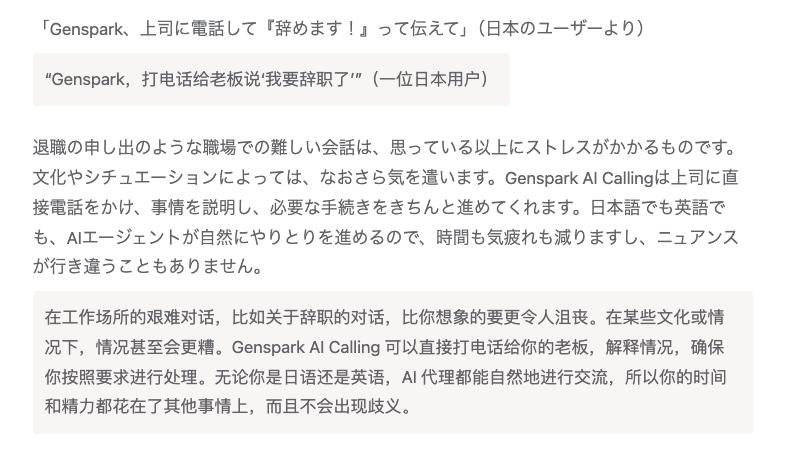
Japanese users sharing the usage scenario of calling to quit a job | "Genspark" official website
Now let's look at "Manus" and the United States.
Tools such as Gamma, Otter, and Notion mentioned earlier were almost all born in the United States and have a high penetration rate locally. The workflow of American users is composed of multiple SaaS tools - which means that "a super tool that directly delivers results" has limited appeal to them. Instead, the ability to be embedded in the existing workflow, with a visible process and the option to intervene at any time, is more valuable.

In user comments in the US market, "Manus" is more often embedded in a certain link of the existing workflow rather than replacing the original tools. Some users do a lot of preliminary brainstorming in ChatGPT and then take the first draft to "Manus" to integrate it into the final document. Other users connect "Manus" to GitHub and Vercel and write code with "Manus". Once satisfied, it can be directly pushed online. The common feature of these two usage methods is that users do not leave the original tools but let "Manus" undertake the execution and integration part.
In user comments in the US market, there are two typical usage methods. One is to switch between multiple tools and hand over the semi - finished products to "Manus" for modification and completion. The other is to polish a vague idea into a deliverable version through multiple rounds of interaction. The common feature of these two usage methods is "user presence", establishing a process that can be intervened throughout.
Previously, in the article "Manus, Trapped in the Sandbox", we discussed the limitations of "Manus" in the management consulting scenario - due to the lack of expert insights, enterprise internal data, and third - party benchmarks, "Manus" was trapped in the "McKinsey - style high - end" ambition at that time. Looking back, the market where "Manus" really succeeded in 2026 was not the consulting replacement scenario it initially imagined, but rather it lowered the "controllable process" advantage to ordinary American workers who handle a lot of scattered SaaS tasks every day, achieving "Product - Market Fit" by targeting a lower - level user group.
III. Multi - Model Routing vs. Main Model Context: Architecture as the Technical Expression of Product Philosophy
The differences in product concepts have helped them find different users. Looking deeper, they stem from the differences in technical architectures.
"Genspark" takes the multi - model routing path. The user