The lock-up period will end in less than a month, but the bubble of MiniMax has burst first.
No one could have imagined that the most eye - catching star technology stock in China's capital market in 2026 would stage a nerve - wracking drama in the capital market just before the approaching lock - up expiration.
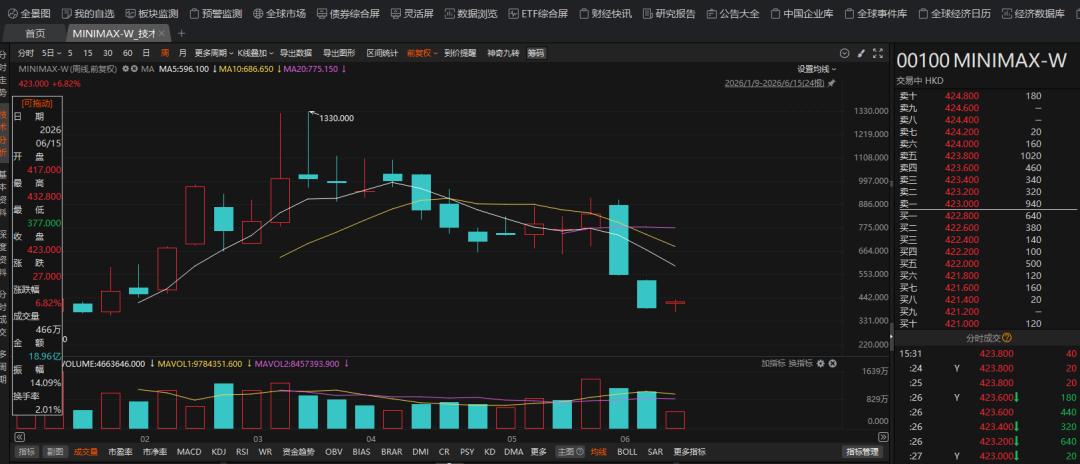
In the first two weeks of June, the share price of MiniMax on the Hong Kong stock market fell by 34.17% and 28.39% respectively. In just two weeks, the cumulative decline was about 53%. In economics, there is a widely - recognized view: If the asset price drops by more than 30% in a very short period, it can basically be regarded as a "burst bubble".
What has made the market so nervous might be the upcoming lock - up expiration pressure of MiniMax. MiniMax will face an important lock - up expiration on July 9, involving cornerstone investors and some existing shareholders. According to some market data calculations, the potential supply of tradable shares is expected to nearly increase tenfold.
The question is, which listed company doesn't face a lock - up expiration wave? Moreover, it's only approaching the lock - up expiration, not a large - scale sell - off yet, but the market has already panicked and the share price has tumbled. This shows that the reason for the market's premature panic may not just be the fear of someone selling stocks.
The real question is: After the share price has fallen from its pedestal, can MiniMax still prove that it deserves the previous valuation of nearly HK$400 billion?
From 2024 to 2025, MiniMax had a total loss of about US$2.337 billion. Roughly calculated at an exchange rate of 1:7, it lost about RMB 16 billion in two years. For a large - model company still in a high - investment stage like MiniMax, continuous financing has become an essential part of its survival logic.
Therefore, it's not difficult to understand either starting the guidance for A - share listing or seeking an "A + H" dual - capital platform.
However, when the share price of MiniMax on the Hong Kong stock market suddenly tumbled before the lock - up expiration, combined with the expanding losses, the user backlash caused by price hikes, and the doubts about its technological credibility, it's not so certain whether the capital market is still willing to pay for this AI story.
Share price drops by 53% in two weeks
On January 9 this year, MiniMax was listed on the Hong Kong stock market, with an IPO issue price of HK$165 per share. After the listing, the share price soared all the way. On March 18, it reached a maximum closing price of HK$1,238 per share. It was about 7.5 times the issue price, and the market value once reached HK$390 billion, almost being priced by the capital market as the "next AI giant".
Before the sharp decline in the share price, MiniMax had been sending signals to the market that its growth was accelerating.
In March, the founder, Yan Junjie, revealed at the performance communication meeting that the company's ARR (Annual Recurring Revenue) in February had exceeded US$150 million. On May 28, the co - founder and Chief Operating Officer, Yun Yeyi, publicly disclosed that as of then, MiniMax's user scale had exceeded 300 million, and the number of global corporate and developer customers it served had exceeded 1 million, a five - fold increase from half a year ago; the company's annualized ARR had doubled in the past two months.
However, the cruelest part of the capital market is that it can push a story to the pedestal at the fastest speed and re - evaluate it at the same speed. In the first two weeks of June, the share price of MiniMax on the Hong Kong stock market fell by 34.17% and 28.39% respectively. In just two weeks, the cumulative decline was about 53%.
On the one hand, there was an external shock.
On June 9, the technology think - tank SemiAnalysis released a research report titled "Power Off, Lights Out: 800V DC Propulsion Blocked and CPO Technology Delayed", which directly triggered market concerns about the AI chain. On that day, the technology sector of the US stock market adjusted first. Lumentum, a leading optical module company, fell by more than 8%, and Marvell, which was called the "next trillion - dollar enterprise" by Huang Renxun, also fell by more than 7% on the same day. Subsequently, the pressure was also transmitted to the technology sectors of the A - share and Hong Kong stock markets.
Although this report was about optical modules and CPO technology, since the technology stocks and large - model stocks have risen too much this year, the market has been in a highly sensitive state. Any sign of trouble in any part of the entire chain may lead the market to re - evaluate not only optical modules and CPO but also the value of the entire AI narrative chain. MiniMax is naturally hard to stay unscathed.
However, the more crucial factor contributing to the decline may still be the upcoming lock - up expiration pressure of MiniMax. Public information shows that MiniMax will face an important lock - up expiration on July 9, involving cornerstone investors and some existing shareholders.
For MiniMax, this is a real stress test of its previous high valuation. Currently, the actual tradable share ratio of MiniMax is only about 5%. It is precisely because of the small tradable share that the share price was able to have an extreme performance driven by funds in the early stage. However, after the lock - up expiration, according to some market data calculations, the potential tradable share ratio of MiniMax may rise to about 46%. In other words, the potential supply in the market will increase significantly, nearly tenfold.
More importantly, many early investors still have quite substantial floating profits. Even though the share price has fallen significantly from its high, for institutions that entered before the IPO, their holding costs are lower, and the book profits may be even more exaggerated. In this situation, the selling pressure of "taking profits" is imaginable.
Moreover, this sharp decline of MiniMax is also at a crucial node of its preparation to return to the A - share market.
Originally, the high market value, high attention, and high - growth narrative after the listing on the Hong Kong stock market could have been important chips for its return to the A - share capital market. However, the sharp decline in the share price within less than half a year after the listing also means that the capital market has begun to re - evaluate the real value of this company.
Loss of RMB 16 billion in two years
The reason why the capital market is so sensitive to MiniMax is ultimately the concern about whether its performance can hold up.
In 2024, MiniMax achieved a revenue of about US$30 million, but the loss was as high as US$465 million. In 2025, its revenue more than doubled to about US$79 million, but the loss more than quadrupled to US$1.872 billion. That is to say, from 2024 to 2025, MiniMax had a total loss of about US$2.337 billion. Roughly calculated at an exchange rate of 1:7, it lost about RMB 16 billion in two years.
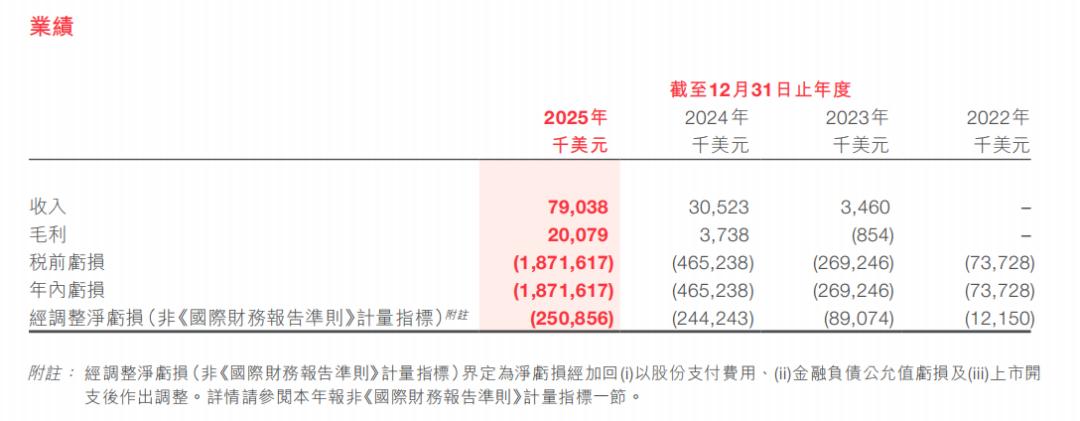
This may mean that MiniMax's business model is still in its early stage. Even though it has the status of a listed company, it is not the kind of company that can make the capital market see the hope of turning losses into profits, where "the scale has expanded, losses are starting to narrow, and the business model is about to succeed". It may still be far from achieving break - even.
For MiniMax, continued financing is almost not an option but a necessity. Starting the guidance for A - share listing and promoting an "A + H" capital platform naturally become a very reasonable next step.
A document released by the China Securities Regulatory Commission on May 29 shows that MiniMax signed a guidance agreement with CITIC Securities on May 29, 2026. On May 31, MiniMax issued an announcement on the Hong Kong Stock Exchange website, stating that its board of directors had resolved to explore a preliminary proposal for issuing RMB - denominated shares.
However, while the capital market can continue to listen to the story, the company itself must show some signs of improving its performance. Especially at the crucial node of preparing to return to the A - share market, MiniMax cannot just talk about technological imagination but also find ways to make its financial statements look better.
So, almost at the same time as sending the signal of preparing to return to the A - share market, MiniMax announced a price increase and changed the billing method from per - use to per - token.
From the company's perspective, this move is not difficult to understand. After all, it has lost more than RMB 10 billion in two years, and the R & D and computing power costs have been continuously high.
However, from the user's perspective, this price increase is not so easy to accept. Many developers only found out about the rule change after logging in. Online test data shows that the original quota of 1,500 calls in 5 hours can only support 300 to 500 calls under the new rule. Calculated based on the past consumption volume of the same business, the current cost increase can be up to 2.5 times.
Some users have also calculated: in the past, it only cost RMB 49 to consume 3 to 5 billion tokens per month, but now the same usage volume costs about RMB 175, a real increase of up to 257%. Another heavy - user said on the Black Cat Complaint platform that his development work requires high - frequency use of the 1M long - context function to process large - scale code libraries, and "the quota that used to last for a week is now used up in two or three days".
More importantly, many of its peers are currently reducing prices, and developers have more and more choices.
For example, on May 22, DeepSeek announced a permanent price cut for DeepSeek V4 Pro. The input (cache hit) price was adjusted to 0.025 yuan per million tokens, the input (cache miss) price was reduced to 3 yuan per million tokens, and the output price was 6 yuan per million tokens. On May 27, Xiaomi's MiMo - V2.5 series followed suit with a price cut, with a maximum reduction of 99%. Taking MiMo - V2.5 - Pro as an example, after the price cut, it is the same as DeepSeek V4 Pro.
In addition, according to an article in Caixin on June 1, on the weekly cumulative Token consumption ranking list of the world's largest API aggregation platform, OpenRouter, MiniMaxM2.7 ranked 18th with a Token consumption of 526B, significantly lagging behind many domestic competitors.
This reflects that MiniMax's market share is unstable, which also makes MiniMax's situation very awkward. It needs to increase prices to relieve financial pressure, but the price increase itself may weaken its market competitiveness.
Before returning to the A - share market, MiniMax needs to answer not only "whether it can continue to raise funds" but also a more realistic question: When losses are still expanding, peers are reducing prices, and users have more and more choices, what can it rely on to retain the market?
Shift to the B - to - B market
If it doesn't increase prices, its performance can't hold up; but if it does, it may drive users to its peers. So, is there a way to strike a balance between maintaining performance and retaining the market? Shifting to the B - to - B market may be a relatively realistic direction.
In 2025, MiniMax's B - to - B revenue accounted for more than 30%, and the growth rate of its B - to - B business began to exceed that of the C - to - C business. The strategic positioning of focusing on the B - to - B market has become increasingly clear.
The advantage of this path is that compared with C - end users, B - end customers are less sensitive to price. They care more about "whether it's worth it". When ordinary users see the price increase, they are likely to switch to other models immediately. However, enterprise customers are different. Especially for large - scale companies, what they really care about is not the token fee but whether the model can improve efficiency and reduce costs.
However, although the B - to - B market is less sensitive to price than the C - to - C market, MiniMax needs to answer a more challenging question: Does it have strong enough technological advantages and scenario implementation capabilities to make enterprise customers willing to continue to pay for it?
This is exactly the aspect where MiniMax is most likely to be questioned.
At the M3 product launch, what MiniMax was most proud of was its 59% score on the SWE - Bench Pro, a test benchmark close to real - world software engineering scenarios. According to MiniMax, this score of M3 has exceeded the 58.6% of GPT - 5.5 and the 54.2% of Gemini3.1 Pro, approaching that of Claude Opus 4.7.
However, doubts from the outside world soon emerged. Some overseas technology media pointed out that the benchmark results announced by MiniMax were from the company's self - testing, and some tests also used external Agent scaffolds such as Claude Code. This brings a very real question: How much of the final high score really comes from the M3 model itself?
If these disputes were spread in the C - to - C market, it might just be a marketing storm, and ordinary users might not even dig into the details. However, enterprise customers are different. When enterprises integrate the model into their business systems, they not only look at technological capabilities but also at technological credibility.
What makes MiniMax more passive is that this is not the first time it has faced the question of "technological credibility".
On February 23 this year, Anthropic accused three Chinese companies, including MiniMax, of launching an "industrial - scale distillation attack" on its Claude model. Anthropic said that these three companies had more than 16 million dialogue interactions with Claude through about 24,000 fake accounts, among which MiniMax had the largest interaction volume, exceeding 13 million times.
MiniMax did not publicly respond to Anthropic's accusation. However, market confidence has been affected. Wang Jie, an investor in Dark Side of the Moon and Moore Threads, once pointed out to Caixin: "MiniMax has a relatively mature business model, but after being accused of distilling the model by Anthropic, market confidence has declined."
It's worth noting that in addition to technology, when MiniMax focuses on the B - to - B market, it also needs to solve another equally important problem: whether to adjust its strategy.
In the past few years, one of the most criticized points of MiniMax in the industry is that its product line is too broad. From large - scale text models, voice synthesis, to large - scale video models, and then to natural language and multimodal capabilities, MiniMax wants to do almost everything. This approach is essentially a typical C - to - C thinking: to build itself into a model supermarket to cover various needs of ordinary users as much as possible.
However, the B - to - B market doesn't work this way.
Enterprise customers don't need you to do everything a little bit. They care more about whether you can really solve problems in a specific scenario. For example, improving customer service efficiency, increasing code development speed, or helping enterprises save some manpower.
Even if it only improves efficiency by 5% or saves 5% of costs in a certain vertical segment, as long as this value is stable and quantifiable, enterprises may be willing to pay for it.
This is exactly the awkward situation of MiniMax's current transformation to the B - to - B market. Advancing in all multimodal fields consumes astronomical amounts of computing power, R & D, and funds. Although