Alipay's AI Breakthrough and an Unfinished Organizational Test
In mid-June 2026, a group of invited users began testing a completely different version of Alipay on their mobile phones. The interface was reconstructed into two major sections: on the left is the assets section, which dynamically displays liquid assets, investment portfolios, and credit scores in the form of a cardholder; on the right is an AI assistant named "Abao". Users can issue instructions via text or voice, and the AI will call up lifestyle services on their behalf. According to a report by LatePost, this project, codenamed "Project Bao" internally, has been in preparation for over a year.
Alipay is not the only payment platform betting on AI. Almost at the same time, WeChat announced the opening of its AI ecosystem access capabilities, and platforms such as JD.com, Meituan, and Didi were among the first to conduct internal testing. Qianwen App has connected dozens of Alibaba-owned agents, including those for maps, ride-hailing, and shopping, and serves over a hundred million service-related conversations per day; ByteDance's Doubao has connected to Douyin e-commerce, supporting direct ordering and payment within the app. The competition in the mobile payment industry is shifting from the "QR code scanning war" to the "entry war".

For Alipay, the push towards AI is more urgent than for other platforms. Li Jun, the vice president of Ant Group and the general manager of the Alipay App Business Group, once publicly mentioned a statistic: "The utilization rate of various tools and services on Alipay by users is less than 10%." In a super app with over 8,000 services, the vast majority of functions remain dormant. In theory, conversational AI can significantly lower the threshold for service discovery. Users don't need to rummage through layers of menus; they just need to say a word to trigger the desired service.
However, if we look at a longer time frame, we'll notice a recurring pattern. Every strategic shift of Alipay in the past decade has been logically sound, but the execution has often deviated from the original intention. The push towards socialization was to counter WeChat's high-frequency advantage, the focus on local life services was to increase user engagement, the move towards content was to deal with the impact of Douyin, and now the AI transformation is to solve the problem of service discovery efficiency. Each direction makes sense on its own, but why does this organization keep changing directions?
A Decade of Searching: A History of Strategic Shifts
The Spring Festival in 2014 was the first turning point in Alipay's fate. That year, WeChat completed a "Pearl Harbor attack" on Alipay with its red envelope function, binding hundreds of millions of bank cards in just a few days. At that time, Alipay held over 80% of the mobile payment market, while WeChat Pay had less than 10%. However, once WeChat's social relationship network was integrated with payment, it demonstrated terrifying fission capabilities. Just two years later, Chen Liang, a former senior executive at Alipay, revealed during a review that the offline payment market share had reversed from 7:3 to 3:7.

In the face of WeChat's fierce offensive with its social relationship network, Alipay's first reaction was to fully embrace socialization. In 2015, Alipay pushed the "Life Circle" to the home page; in November 2016, it launched a gray-scale test of the "Circle" function, trying to boost user activity with content like "Campus Diary" and "White-collar Diary". The rules of these two circles were quite controversial: only female users could post, and male users could only comment if their Sesame Credit score was above 750; otherwise, they could only like or tip. This mechanism was quickly exploited, and a large number of revealing photos flooded in.
Amid the storm of public opinion, Peng Lei, the chairperson of Ant Financial, who was in the United States at the time, urgently issued an open letter titled "Wrong is Wrong" and closed all circles suspected of containing vulgar content. Jack Ma also spoke up on the internal network: "What's precious about Alibaba is the courage to correct mistakes." In 2017, Alipay officially announced the abandonment of its socialization strategy.
After the setback in socialization, Alipay turned its attention to local life services. In 2018, Alibaba acquired Ele.me for $9.5 billion and merged it with Koubei to form a local life service platform, directly competing with Meituan. However, this sky-high acquisition did not bring the expected market position. According to a recollection by a member of Ele.me's early founding team, as reported by 21st Century Business Herald, during the two most competitive years after 2015, Ele.me invested nearly 10 billion yuan in subsidies each year. "Even when you close your eyes and open them while sleeping at night, 30 million yuan is gone."
By the end of 2018, Ele.me (including the acquired Baidu Waimai) had a market share of 38.1%, while Meituan Takeaway had reached 58.6%. In 2019, Ele.me launched a subsidy war in lower-tier cities like Dali but failed, and its market share was further squeezed. By Q2 2019, Meituan's market share rose to 65.1%, while Ele.me's dropped to 32.8%. Koubei was also in a dismal situation, with its daily active users continuously declining, and it was transferred to Gaode in 2023.
In March 2020, when the COVID-19 pandemic swept the world, Alipay underwent another strategic shift. Hu Xiaoming, the CEO of Ant Financial, announced at a partners' conference that Alipay would be fully upgraded from a "financial payment platform" to a "digital life open platform", and the slogan changed from "Pay with Alipay" to "Live well with Alipay". According to Hu Xiaoming, the preparation for this upgrade started 18 months in advance, and the pandemic was the final push.
In the new version, the number of application display slots in the middle of the home page increased from 9 to 14, and local life services were pushed to an unprecedentedly important position. However, as revealed in a relevant report by the China Consumers Association, over 85% of users use less than 20% of Alipay's core functions in their daily lives, 68.2% of elderly users find the interface complicated, and 41.7% have been troubled by accidentally clicking on promotional content.
Behind each strategic shift lies the same anxiety: as a tool-based app, Alipay is naturally used infrequently.
According to a study by China International Capital Corporation in 2017, the average daily usage time of Alipay per user is about 6.4 minutes, while that of WeChat is 81.5 minutes. Facing the ironclad rule of "high-frequency beats low-frequency" in the Internet industry, Alipay has always been looking for a way to increase user retention and the frequency of app openings, but it has often gone too far in adding features.
The Structural Cost of Profit and Organizational Inertia
To understand the underlying motivation for these repeated strategic shifts, we need to look at Ant Group's financial statements. A little-known fact is that the payment business itself hardly makes any money. According to Ant Group's prospectus, Alipay's overall payment rate has long hovered between 0.04% and 0.05%. Considering bank channel fees and merchant subsidies, the payment segment has long been in a state of meager profit or even break-even. In 2019 and the first half of 2020, the net profits of Alipay Network Technology Co., Ltd. were only 120 million yuan and 310 million yuan respectively.
What really contributes to Ant's profits are the financial derivative businesses attached to the payment traffic.
Huabei and Jiebei, two consumer credit products, contributed 28.586 billion yuan in revenue in the first half of 2020, accounting for nearly 40% of Ant Group's total revenue and almost half of its profit. What's even more remarkable is its risk structure: about 98% of the credit balance facilitated by Ant is actually funded by partner financial institutions or securitized, and Ant bears less than 2% of the risk, yet it extracts most of the profit through technical service fees.
This "asset-light, high-interest margin" business model created astonishing profit growth from 2017 to 2020. The revenue of the micro-loan platform soared from 1.6187 billion yuan to 4.1885 billion yuan, with an average annual growth rate of over 60%.
This is the core of the problem. When an organization realizes that it can easily contribute half of its profit by simply adding financial products to the payment traffic, without having to deeply improve the product experience, patiently develop merchants one by one, or carefully polish the services, its tolerance threshold for "arduous tasks" undergoes a qualitative change.
The payment business requires a sales team to negotiate with merchants one by one, a customer service team to handle every dispute, and a technical team to ensure the stability of every transaction. The returns from these tasks are slow, linear, and unlikely to bring pleasant surprises in quarterly financial reports. In contrast, increasing the credit limit of Huabei or making the entry to Jiebei more prominent can lead to immediate revenue growth.
In June 2025, Yuan An, the former R & D leader of Alibaba's DingTalk, published a ten-thousand-word article when leaving the company. One paragraph accurately described how this mechanism operates at the organizational level. He recalled the experience of the Koubei business: "Our methods were extremely simple and crude: throwing money at operations and focusing on data indicators. As for the basic tasks such as developing merchants, providing services, and improving products, they are difficult, time-consuming, and require a large investment with slow results. Their impact on KPIs is far less direct and rapid than short-term investment in operations. So, either no one is willing to do these basic tasks, or those who do them don't get good performance evaluations." Jack Ma rarely replied to this post on the internal network: "Well written."
"It's not that the market is too competitive, nor that WeChat is too powerful. It's our assessment mechanism and corporate culture that are flawed. We've lost the perseverance of long-termism and prefer short-term stimulants."
——Yuan An, former R & D leader of DingTalk, June 2025
This organizational inertia is specifically reflected in every product decision. The addition of functions is not random but a reflection of the organizational power structure: every business department wants a place on the home page, and every strategic transformation means a new round of function addition. The final result is that when users open the app to find the payment code, they have to "navigate through a digital marketplace". This is not just a design issue but a deeper organizational question: when financial products can easily meet profit targets, is the user experience of the payment product itself still worth serious attention?
The "Baby" nickname incident in 2016 was a small but representative example of this mindset. On Children's Day, Alipay forcibly added the suffix "Baby" to all users' nicknames, and the system did not allow self-modification. In response to user protests, the team's first reaction was not to immediately withdraw the change but to gradually relax the restrictions: users could modify their nicknames after an hour, but the system still added the "Baby" suffix by default, and it wasn't until 1:30 am that users could fully customize their nicknames.
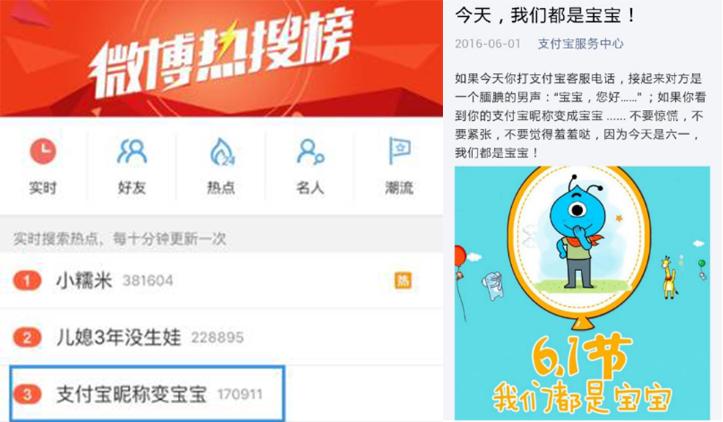
A platform with hundreds of millions of users actually believes that "users can't do without me, so I can do things that make them a little uncomfortable". Behind this mindset is the organizational inertia fed by excessive profits.
In the same business environment, WeChat Pay has taken a completely different path. Since its launch in 2014, the home page of WeChat Pay has always had only four tabs and has never changed. After payment, there are no recommendations for financial products, no guiding jumps, or pop-up windows to disturb users.
Zhang Xiaolong's product philosophy can be summarized in a few words: minimalism, restraint, and "use and leave". He has repeatedly emphasized in past WeChat Open Classes that "KPIs are the enemy of good products". The reason why WeChat can do this lies in Tencent's strategic emphasis on its social assets - any payment innovation that might damage the user experience could backfire on WeChat's social foundation. This determination to "do less" has enabled WeChat Pay to establish a strong user perception in the offline small - value payment scenario.
In the first quarter of 2025, the global monthly active users of WeChat Pay exceeded 1.47 billion, while that of Alipay was 1.04 billion. More importantly, in terms of usage frequency, a study by Tencent Research Institute in 2015 showed that 55% of WeChat users open the app more than 10 times a day, and 25% open it more than 30 times; most Alipay users only think of the app when they need to make a payment or check their bills.
One keeps adding features, while the other adheres to subtraction. The divergence of these two paths is ultimately reflected in the moment when users open the app.
Can AI Break the Cycle?
Let's return to Alipay's AI strategy. Logically, it is the right direction.
Conversational AI can indeed reduce the cost of service discovery and make the over 8,000 dormant services on Alipay truly useful to users. This is not a new judgment, and Alipay is clearly aware of it. The AI assistant is highly anticipated because it is expected to solve the long - standing service discovery problem that has troubled Alipay.
In terms of R & D, Ant is also increasing its investment.
According to calculations by Beijing Business Today based on Alibaba's financial reports, Ant's R & D investment in 2024 was about 23.45 billion yuan, exceeding 10% of its revenue for three consecutive years; in 2025, this figure further increased to about 28.98 billion yuan, accounting for over 15% of its revenue. During the same period, Ant's annual profit was about 15.3 billion yuan, a year - on - year decrease of about 60%. The official attributed the profit decline to "increased investment in new growth initiatives and technology", which to some extent addresses the outside world's doubts about its "seeking quick profits".
However, having the right direction and investment does not guarantee successful execution. The independent Alipay Smart Assistant app previously launched by Alipay can be regarded as a preview of the AI strategy. However, the feedback on the user experience is not optimistic: when asking "Where can I eat Cantonese cuisine?", it recommended a restaurant specializing in Shaoxing cuisine; when querying for the bus QR code, it replied "Temporarily not supported". The number of intelligent agents is only 26, far fewer than that of its competitors. Wang Yifei, the product manager of Alipay's intelligent assistant, admitted that there are still "a lot of details to polish" in terms of service integration and optimal presentation.
What's more worthy of attention is whether the mindset inertia has truly been broken. The AI strategy itself is impeccable, but if the organization still expects it to bring impressive KPI data in the short term, and if the team is still used to "throwing money at growth" rather than "patiently improving the user experience", then AI may become another case of "correct in concept but flawed in execution". The technical architecture can be upgraded, and the interaction interface can be reconstructed, but the renewal of organizational culture is much slower than code iteration.
At the 20th - anniversary celebration of Alipay in December 2024, Jack Ma made a rare appearance and called on Ant to "do truly valuable and distinctive things and soar with the power of AI". The subtext of this statement is that in the past few years, the things Alipay has done have been neither "distinctive" nor "valuable".