When it comes to the stories of chips and robots, has the "top player" of power banks, Anker Innovations, changed?
The founder of Anker Innovations, Yang Meng, is a typical "P-type" in MBTI personality.
When asked in an interview, "Where does your passion for entrepreneurship come from?", he would answer, "My early passion was very simple. I didn't want to go to work every day and toil. I wanted a bit more freedom and at the same time, not starve to death."
Of course, this kind of relaxation doesn't mean being lazy. The characteristic of "P-type" people is strong execution ability and fast error-correction speed. They can quickly sense and make judgments based on the surrounding environment.
Yang Meng is just like this.
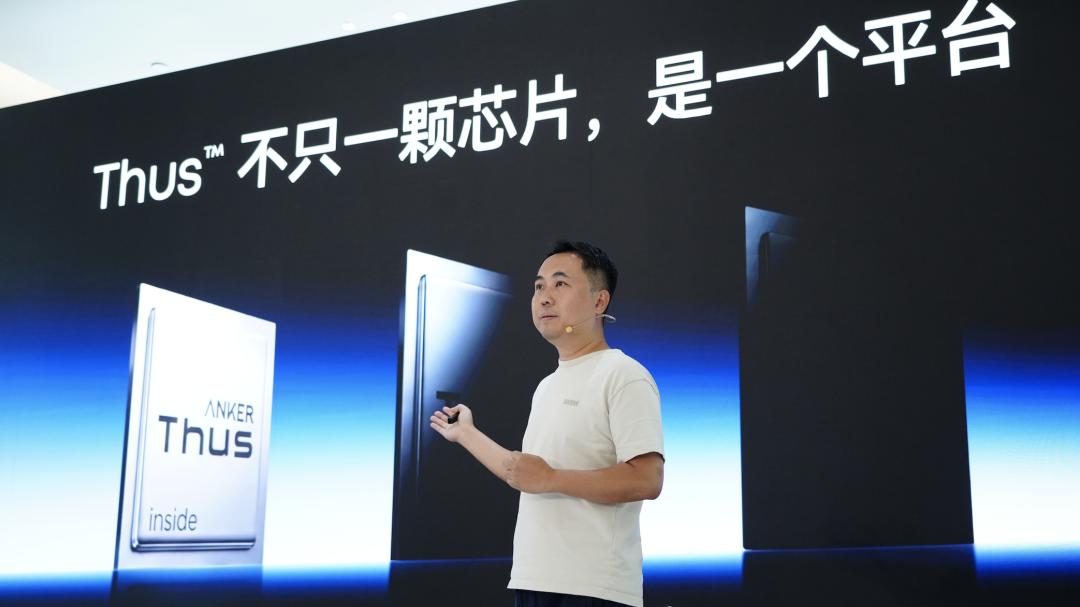
Yang Meng, the founder of Anker Innovations. Image source: Anker Innovations' official WeChat public account
The Anker Innovations he founded also presents such characteristics. At the beginning of its establishment, this company chose the right strategic directions many times, which to some extent depends on Yang Meng's strategic vision.
For example, in the process of purchasing a spare battery for a laptop, Yang Meng discovered a market gap and thus decided to start a business. After the product development was completed, Yang Meng saw the global e-commerce dividend represented by Amazon, so he chose to avoid the fierce competition in the domestic market and first build up his reputation in the European and American markets.
The "Shallow Sea Strategy" proposed by Yang Meng is a microcosm of this personality. For a long time, Anker Innovations has been following the Shallow Sea Strategy. It doesn't engage in super categories such as mobile phones, computers, and electric vehicles, but focuses on markets such as charging, energy storage, and home security with a single-category scale of less than $50 billion.
Under this thinking, Anker Innovations has also suffered from trial and error. It once tried to layout a category expansion route, but for a long time, the core product lines of Anker Innovations have still been shallow-sea categories such as charging and smart audio and video.
However, recently, the situation seems to be different.
After the power bank recall incident, Anker Innovations, which gradually calmed down the storm, began to frequently mention in public the deep-sea fields with large market scales such as embodied intelligence and chips. At the same time, it launched two attacks on the Hong Kong Stock Exchange and officially passed the listing hearing of the Hong Kong Stock Exchange on June 14th, seemingly telling good stories to attract the attention of the capital market.
Has Anker Innovations and Yang Meng really changed?
With a new story, Anker Innovations submits its listing application to the Hong Kong Stock Exchange again
Anker Innovations seems to have changed.
From April to June this year, Anker Innovations and Yang Meng have been very active. The company has successively launched multiple products and announced future strategic plans. However, these have nothing to do with its former image as the "number one power bank brand".
On April 22nd, Anker Innovations launched a self-developed AI audio chip with integrated storage and computing, Thus™. This new architecture that integrates storage units and computing units on the same chip breaks the "storage wall" and "power consumption wall" between traditional chip architectures, which is conducive to significantly reducing data transfer and improving computing efficiency.
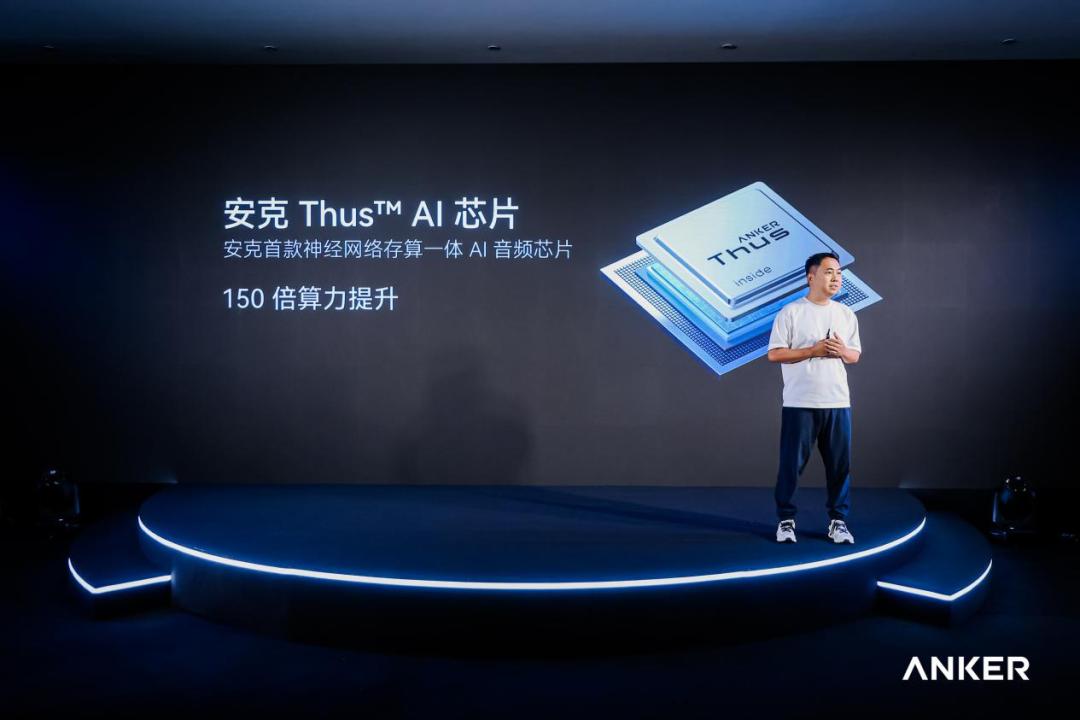
The next day, Anker Innovations announced that it would launch security robot dog products in the future and conduct preliminary research and development on household humanoid robots.
One month later, on May 22nd, Anker Innovations released two headphone products developed based on the AI audio chip with integrated storage and computing - Anker Noise Canceling Headphones Liberty 5 Pro Max and Liberty 5 Pro. As the key products of Anker Innovations' new story, these two products have also obtained the Guinness World Record certification for "the world's clearest wireless Bluetooth headphones for calls".
Beyond products and strategies, Anker Innovations' layout in the capital market is also proceeding simultaneously. It submitted a listing application to the Hong Kong Stock Exchange in December last year. The day after the first application failed, Anker Innovations submitted the application again, which shows its determination to list.
Anker Innovations, which is increasing the company's imagination in the AI era with one hand and promoting the process of getting the capital admission ticket with the other hand, has also become one of the companies most concerned by securities firms recently. According to a report by Securities China on June 8th, Anker Innovations has attracted research from 44 securities firms such as Orient Securities and CSC recently.
Now, its passing the listing hearing means that the listing process has passed the substantial review of the exchange or regulatory agency, and it is only one step away from the official listing.
Judging from its latest prospectus, this enterprise, which used to have intelligent charging and energy storage as its main business, shows new room for imagination.
In the past 2025, Anker Innovations experienced a power bank recall storm. The company recalled a total of 2.35 million to 2.38 million power banks.
In this process, Anker Innovations sent fire safety bags to users, helped consumers coordinate with airport authorities, and provided compensation plans for users who chose to destroy the power banks by themselves. Although it stabilized the brand image with a positive attitude, the market generally believes that the cost increase brought about by these remedial measures and the sales decline caused by the removal of some related products are likely to have a potential impact on its main business and even overall performance.
However, judging from the situation in the prospectus, Anker Innovations has stabilized the growth trend of revenue and net profit.
From 2023 to 2025, Anker Innovations' revenues were 17.507 billion yuan, 24.710 billion yuan, and 30.514 billion yuan respectively, with the revenue scale continuously expanding and a three-year compound growth rate of about 32%. During the same period, the company's net profit attributable to the parent company was 1.615 billion yuan, 2.114 billion yuan, and 2.545 billion yuan respectively.
The intelligent charging and energy storage segment remains the performance pillar of Anker Innovations, with revenues of 8.603 billion yuan, 12.667 billion yuan, and 15.401 billion yuan respectively from 2023 to 2025, showing continuous growth.
The storm last year had little impact on Anker Innovations' market position. According to data from Frost & Sullivan, in terms of revenue from 2020 to 2024, Anker Innovations ranked second in the global mobile charging product field and is also the world's largest independent mobile charging brand. In 2025, in terms of revenue, the company ranked first in the global mobile charging product field.
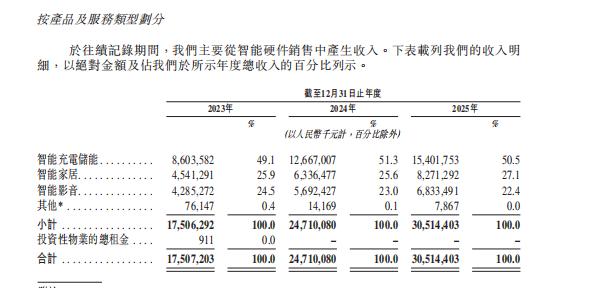
Revenues of Anker Innovations' various businesses divided by product service types. Image source: Anker Innovations' prospectus
In addition to the energy storage segment, the revenues and gross profit margins of Anker Innovations' other two main businesses, smart home and smart audio and video, are both increasing.
Among them, the smart home revenue increased from 4.541 billion yuan in 2023 to 8.271 billion yuan in 2025, and the gross profit margin continuously climbed from 45.5% to 47.7%. The smart audio and video revenue increased from 4.285 billion yuan to 6.833 billion yuan, and the gross profit margin increased from 43.2% to 48.4%.
The two businesses have also driven up the company's overall gross profit margin, increasing from 42.7% in 2023 to 43.9% in 2025.
More importantly, these two businesses are the carriers of Anker Innovations' new story: The integrated storage and computing chip is currently installed in AI headphones; the main function of the robot dog is for home security, which belongs to the category of smart home.
In addition, Anker Innovations' R & D investment increased from 1.414 billion yuan in 2023 to 2.893 billion yuan in 2025, doubling the growth.
The basic market of the story carriers is stable, the R & D intensity continues to increase, and the relevant achievements of the new story are frequently released... Anker Innovations' new story shows a certain degree of persuasion.
Anker Innovations is still in the "shallow sea"
Yang Meng has a Shallow Sea Strategy.
He once introduced in an interview, "The so - called shallow sea means that the scale of a single category is less than $50 billion. For example, the scale of the sweeping robot market is just over $10 billion. The small revenue scale of these categories also means that the technology stack is not that deep. If you are willing to invest a team of three to five hundred people and persist for three years, you will probably be able to launch a product."
This strategy was first proposed in 2020, but the motivation for proposing the strategy stemmed from the anxiety and crisis that Yang Meng felt around 2017.
During that time, power banks had become the performance pillar of Anker Innovations. The revenue of the company's charging products accounted for 72.58% of the total revenue in 2017.
Yang Meng said in an interview that when he was writing a paper for his MBA in 2017, he increasingly felt that consumer electronics categories really had a short life cycle. "When technology keeps changing, product forms will be replaced. The essential needs of users are stable, but the technologies and product forms to meet these needs are constantly evolving." He believes that the development of fast - charging technology and the increase in mobile phone battery capacity may make the power bank category disappear in the future.
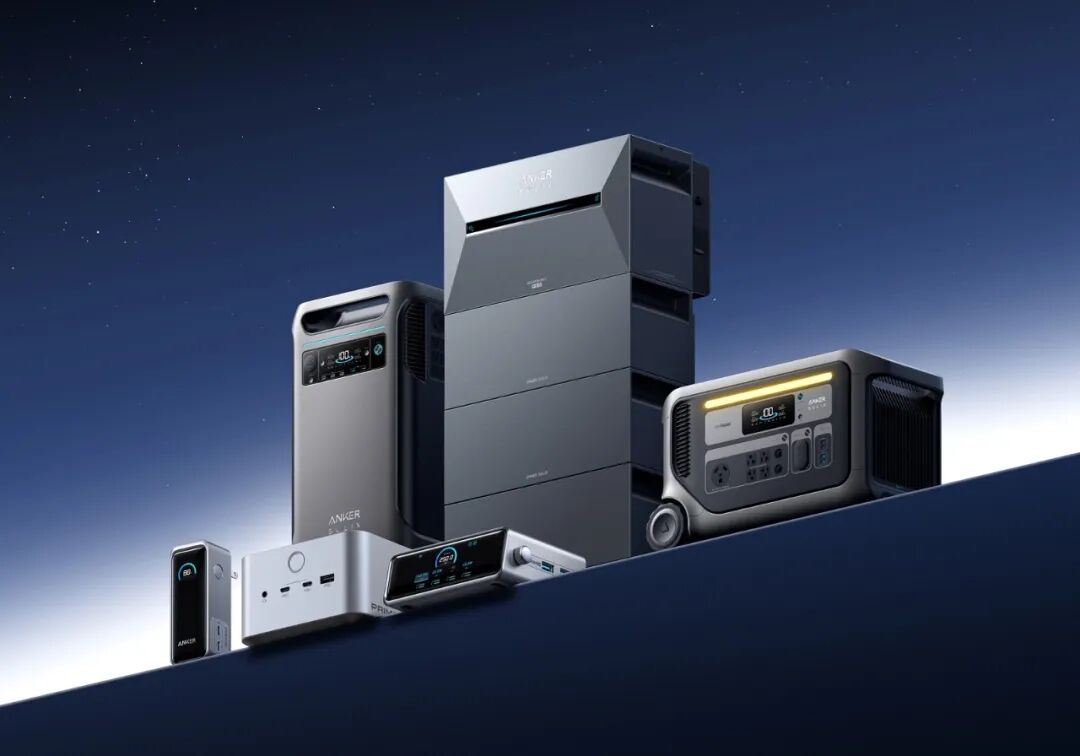
Image source: Anker Innovations' official website
Perhaps driven by this anxiety, Yang Meng began to lead Anker Innovations to try category expansion. From 2017 to 2020, Anker Innovations expanded to 5 business divisions and about 10 categories, mainly including smart hardware such as speakers, headphones, sweeping robots, and smart projectors.
It can also be seen in its previous prospectus that from 2017 to 2019, the company's products were divided into three major categories: charging, wireless audio, and smart innovation. These three types of businesses accounted for more than 90% of the total revenue, and the proportion of charging products in the revenue had begun to decline, from 72.58% in 2017 to 57.33% in 2019.
In 2020, Yang Meng summarized the previous experience of category expansion, proposed the Shallow Sea Strategy, and further put it into practice. By 2022, its product line had expanded to 27 categories.
In fact, Anker Innovations' thinking of focusing on the "shallow sea" has been reflected in the choice of the track at the beginning of its establishment.
Around 2011 when it was established, it was a period of rapid development of smartphones. According to statistics from Gartner, in 2011, a total of 1.77 billion mobile phones were sold globally, a 11% increase from 2010. The sales volume of smartphones increased by 58% year - on - year, reaching 472 million, accounting for 27% of the total mobile phone sales volume.
Anker Innovations didn't engage in mobile phone production but chose to make smartphone accessories, chargers, power banks, etc.
Even after realizing the hidden dangers brought by blind expansion later and completing the contraction, Anker Innovations still follows the Shallow Sea Strategy. In 2022, it cut some categories that were not on the main track and lacked technological synergy, and shrank the product line to 17, forming the company's three current business lines - energy (charging + energy storage), audio - video (audio + projection), and home automation (security + cleaning + robots).
Looking at Anker Innovations' recent planning and specific achievements in the new story, it seems to have stepped into the "deep - sea" areas such as chips, models, and robots, but in fact, it still reveals the "shallow - sea" background.
For example, after developing the integrated storage and computing chip, it didn't choose to directly make mobile phone chips or intelligent driving chips but made a headphone chip. After deciding to enter the robot field, it also delineated a progressive route from sweeping robots, intelligent lawn mowers, to security robot dogs and then to humanoid robots.
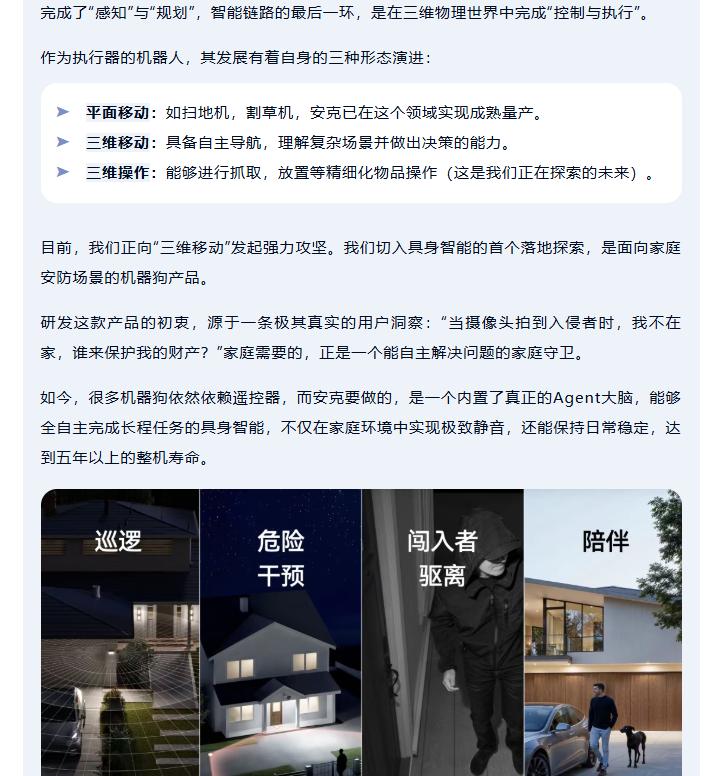
Anker Innovations' embodied intelligence strategic plan. Image source: Anker Innovations' official WeChat public account
Whether it's the integrated storage and computing chip or the security robot dog, they are all in the fields with a scale of tens of billions of dollars and where the core technologies have not been completely blocked by giants. In fact, they are still within the scope of Yang Meng's "Shallow Sea Strategy".
More importantly, there is no shortage of AI - related technology stories in the current market, but there is a lack of the feasibility of technology implementation.
Anker Innovations' integrated storage and computing chip has been launched on two products, and its technical level has been initially verified. The positioning of the robot dog is not a transition to humanoid robots, but it is planned to be first implemented in home security, which may be more conducive to generating revenue quickly in the future and then feeding back R & D.
In other words, Anker Innovations is actually still in the "shallow sea". It is still using its most proficient way to find new opportunities in the red ocean.
New tests for the "shallow - sea" approach
Anker Innovations' strategic thinking has not changed, but the external environment has.
In the past, the logic that "investing three to five hundred people and working for three years can launch a product" was valid on the premise of low traffic costs and many category gaps.
Nowadays, every sub - track in the consumer electronics field is full of players.
Brands that make power banks include not only Anker Innovations but also Baseus, Ugreen, Xiaomi, etc. The global mobile charging product market scale is close