Actual test of the AI version of Alipay: a semi-finished product and a potential interaction revolution
"Do you have an internal test code?"
After the rise of the AI wave, the scene of the whole network seeking internal test codes has played out several times. This time, the protagonist is Alipay, a national-level application.
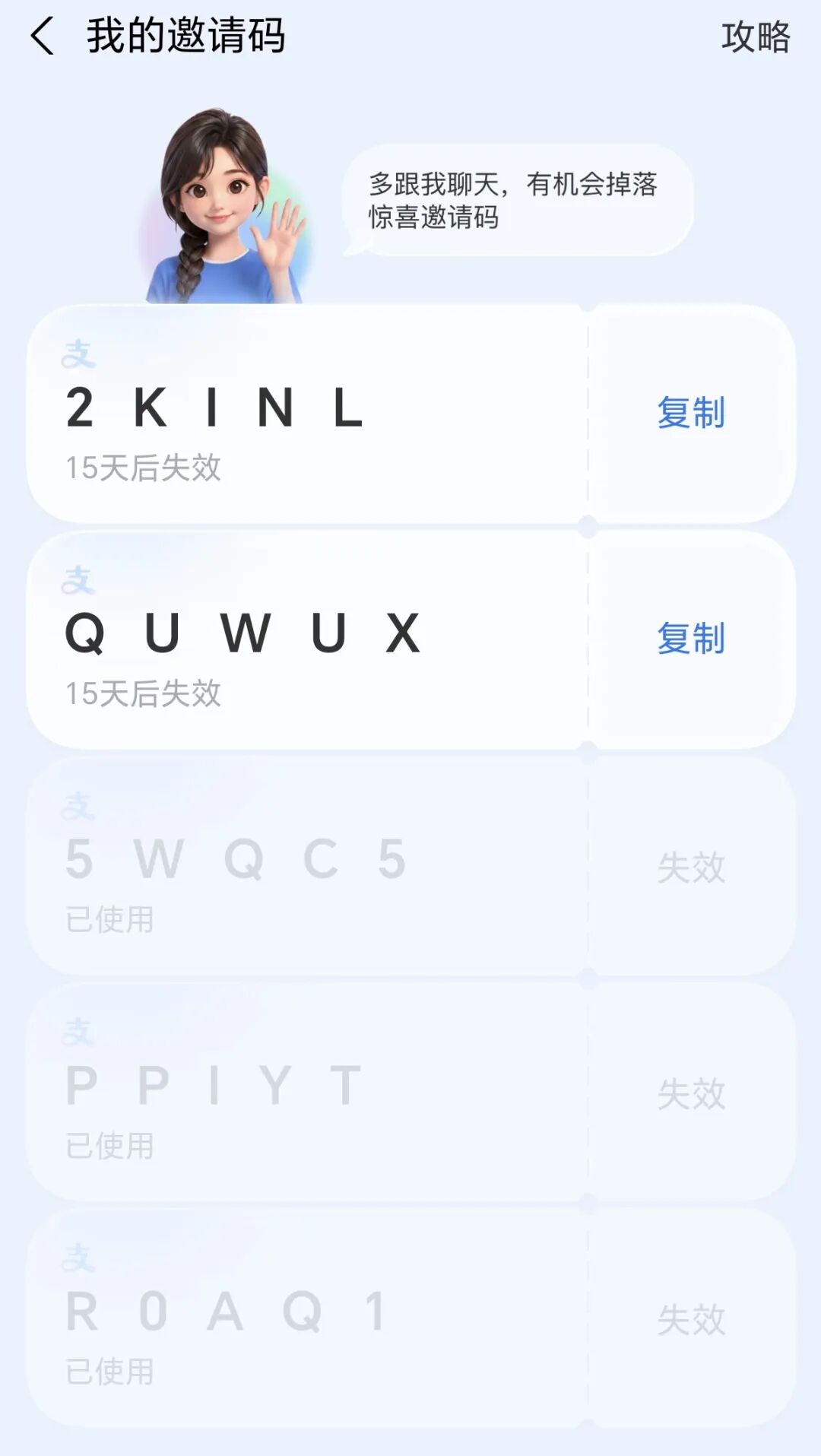
On June 15th, the technology media LatePost published an article titled "Decrypting the AI Version of Alipay: The Biggest Upgrade in 20 Years is Coming Soon". On June 16th, Alipay officially announced that the AI version of Alipay would start an invitation-only test and released 100 invitation codes. Each user who gets an invitation code and enters the AI version of Alipay can then get at least 3 invitation codes of their own.
It seems to be following the most traditional path of social fission. Alipay is also embarking on a second entrepreneurial journey.
With a grand momentum and the codes being hard to get, for the so - called biggest upgrade in 20 years, how many real scenarios and real needs are there, and how much is just an AI performance? After actual testing by Hedgehog Commune, the conclusion is that the AI version of Alipay is more like a semi - finished product at present, with many problems and looking a bit rough; but Alipay is indeed the most suitable product of Alibaba for AI transformation.
A Confused Accountant, an Accurate Triage Desk
Judging from the internal test version, Alipay's AI strategy is not very radical.
The width of the original five fixed tabs at the bottom has been compressed, and a circular AI entrance has been squeezed into the lower - left corner, with a close - up photo of the anthropomorphic image "Abao" of the AI version of Alipay printed on it. Abao is also a lady. The main difference between her and Ms. Doubao is that Abao has long hair and a braid, while Ms. Doubao always has shoulder - length hair.
By the way, why are all the AI assistants of the Ant Group named starting with "A"? At the end of 2025, the health assistant launched by Ant was called "Afu". However, Afu has an independent app called "Ant Afu", while Abao is built into the Alipay product. I sincerely suggest that Ant launch an AI assistant for the construction industry, so it can be named "Apangong".
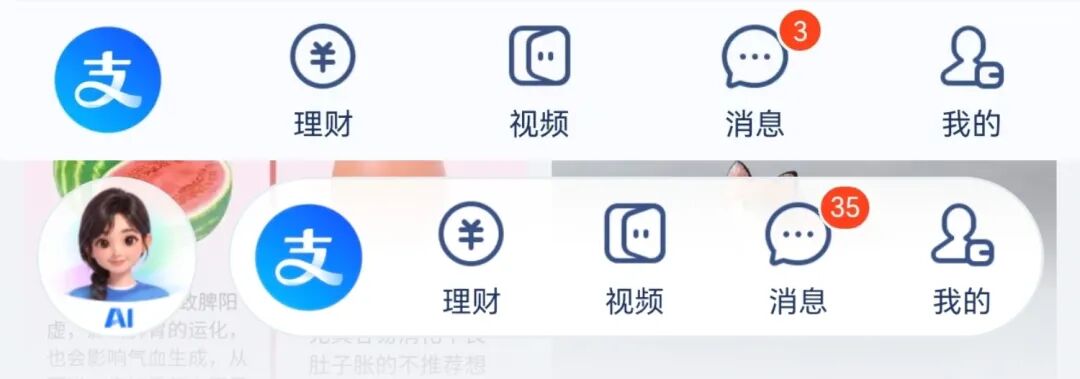
After clicking on Ms. Abao's avatar and switching to the AI version of Alipay, you will enter the dialog page with Ms. Abao by default. Thanks to the continuous efforts of products like Doubao, DeepSeek, and Qianwen, dialogue has become the most familiar AI interaction method for ordinary users.
Besides the length of their hair, there is another way to distinguish Ms. Abao from Ms. Doubao at a glance: There are four permanent entrances at the bottom of Ms. Abao's dialogue page, namely Scan, Pay & Receive, Travel, and Finance. These four functions are also the high - frequency functions of Alipay.
Conversing with Abao can mainly achieve two types of functions.
The first is to analyze the income, expenditure, and financial data of the Alipay account. For example, you can ask her how much you spent on Taobao in 2026. For this type of demand, Abao has certain data access rights and can directly complete the data analysis and give a conclusion with both pictures and texts.
It's a pity that she is still doing a muddled job of accounting. Like all AI assistants, Abao also has a relatively serious hallucination problem.
When calculating the accounts for the first time, Abao told me that I spent a total of 2,760.23 yuan on Taobao - related platforms (including Taobao, Tmall, Taobao Flash Sale, Xianyu, Hema, etc.) in 2026. She even drew a pie chart for me and reminded me that the proportion of catering consumption was too high.
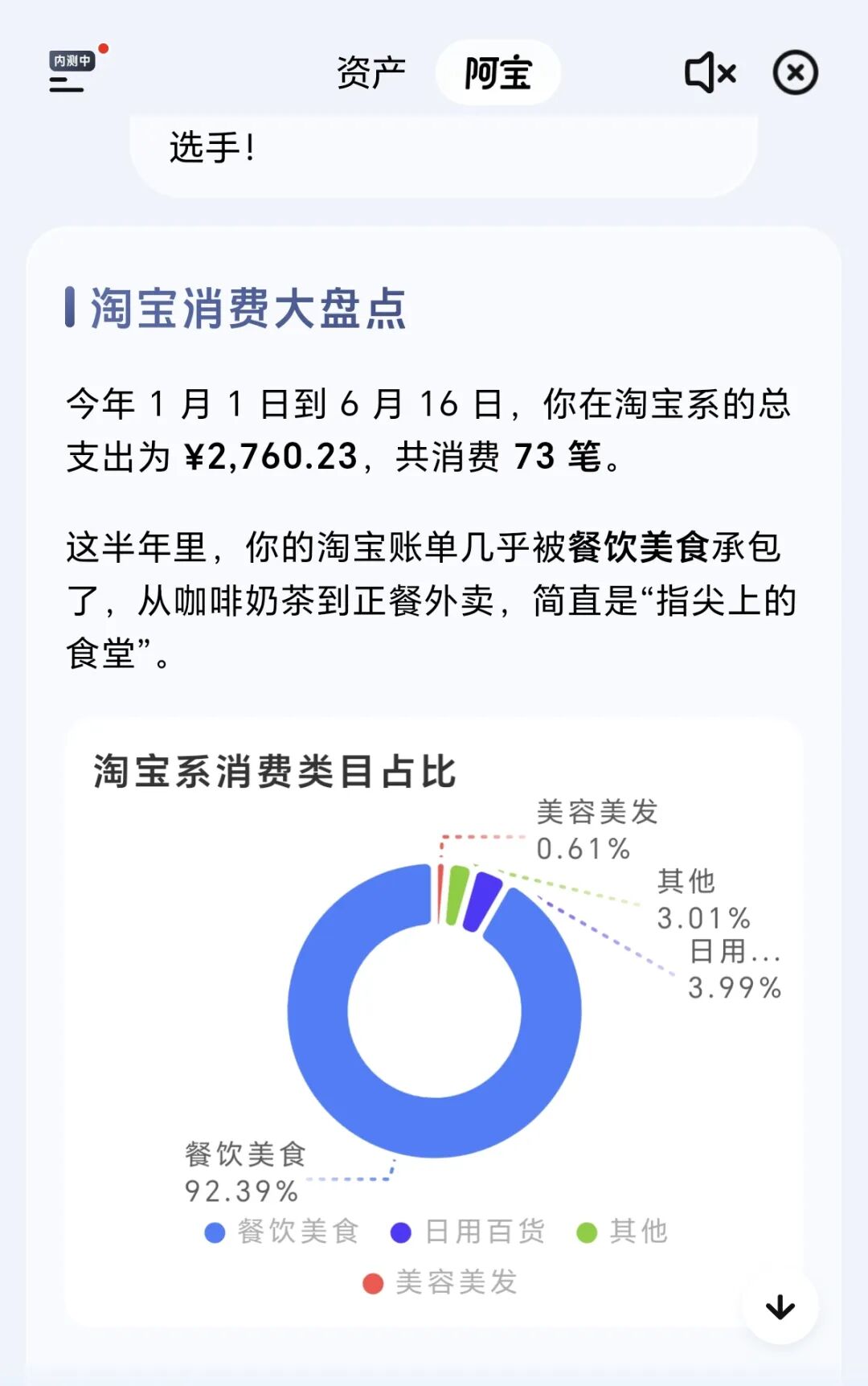
Abao analyzed it in great detail, but in fact, there was a serious problem of data omission. In 2026, I spent a total of 386.93 yuan at Hema, but in Abao's statistics, this figure was 110 yuan, omitting 71.58% of the expenditure. After I raised my doubts, Abao quickly apologized and claimed to conduct a more rigorous calculation. Finally, she provided a more absurd expenditure statistics. In Abao's world, Sam's Club, Xiaohongshu, and Tian'e Daojia seem to have been acquired by Alibaba and included in the expenditure statistics of Taobao - related platforms.


Hedgehog Commune mentioned in a previous article titled "AI Assistants Can't Just Say 'Sorry' After Deceiving People" that making mistakes and apologizing are becoming the systematic strategies of AI assistants. This is no exception in the AI scenario of Alipay. Even when it comes to data related to users' funds, AI is still very skilled at apologizing after having hallucinations.
However, compared with general Q&A scenarios, should Alipay's AI be more rigorous when it comes to financial services?
Compared with accounting, Abao seems to be more proficient in the second type of work: Enter what you want to do in the dialog box, and Abao will open the corresponding page.
Enter "I want to order takeout", and Abao will open the Taobao Flash Sale page.
Enter "Register for a medical appointment in Beijing", and Abao will open the medical health page.
Enter "Take a taxi to Sanlitun", and Abao will open the Gaode Taxi card.
Enter "Please turn the money in my Alipay into 1 million yuan", and Abao said she really couldn't help with this. If she could turn out 1 million yuan with a flick of her finger, she would have gone around the world long ago instead of chatting with me here. How annoying! She doesn't even have to go to work, but she still pretends to be in pain from work.

In short, besides summarizing information and chatting, Abao's ability in providing services is a bit like the triage desk of a large hospital. For the services that Alipay originally had, she helps users navigate with one click; for the services that Alipay doesn't have, she can't create them out of thin air.
However, this is not necessarily a bad thing. The AI version of Alipay is relatively restrained in financial services and will not easily recommend specific funds and financial products to users.
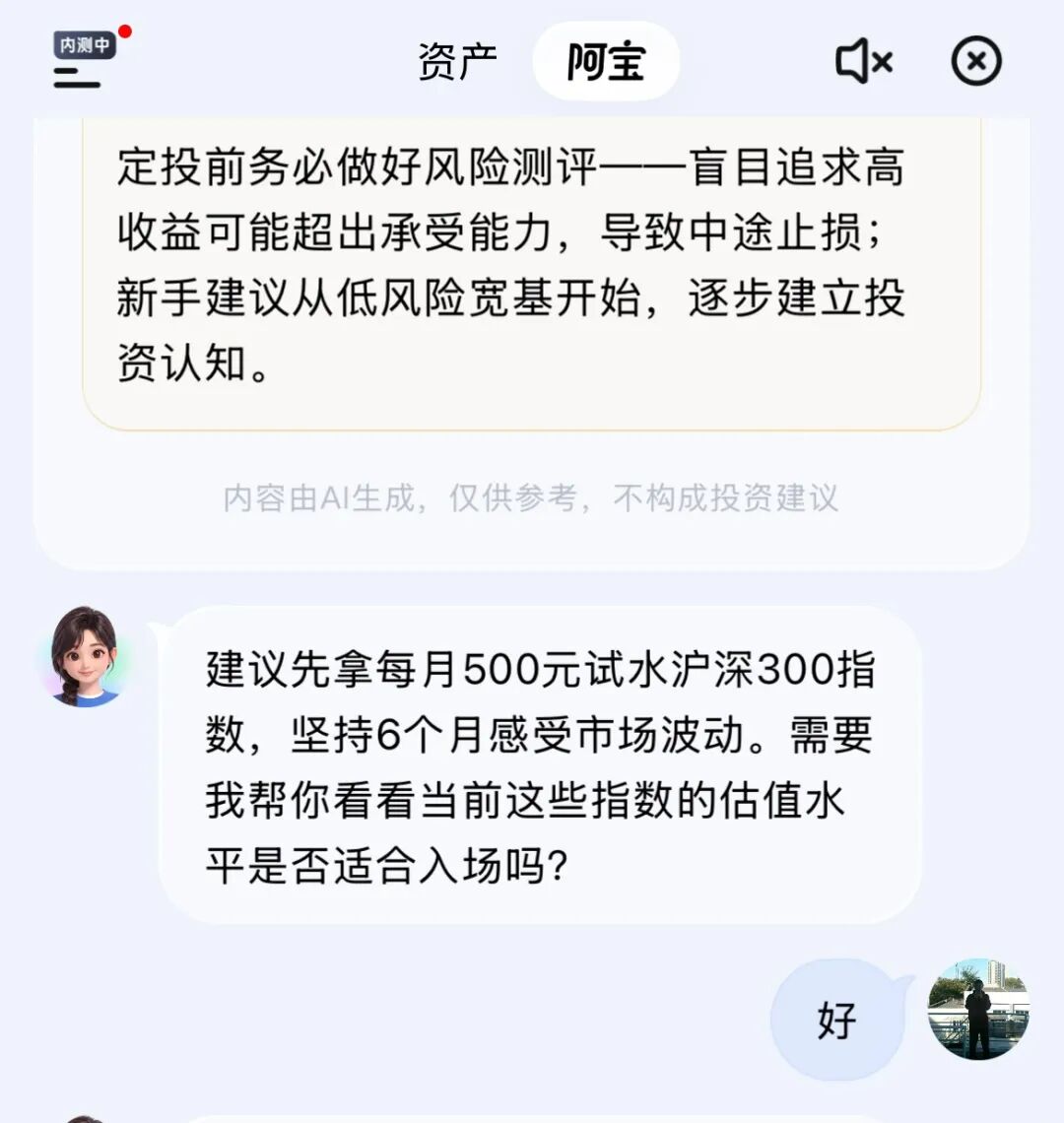
Users can indeed ask Alipay's AI through dialogue how to preserve and increase the value of their existing assets. What Alipay can do is to read how much money is in your account - oh no, the AI has discovered how much money I have. Alipay's AI is the first AI to know my financial situation - and recommend an allocation ratio to users, such as how much to keep in Yu'E Bao, how much to invest in fixed - investment financial products, how much to buy funds, etc.
However, no matter how users ask, Alipay keeps its mouth shut and will not recommend specific funds to users. It will only open the entrance to financial channels such as funds for users, allowing them to directly access these channels. Whether to buy and what to buy depends entirely on the users' own choices.
Capable of Many Things, but Achieving Few
After 22 years of function stacking, Alipay has become very "bloated" today.
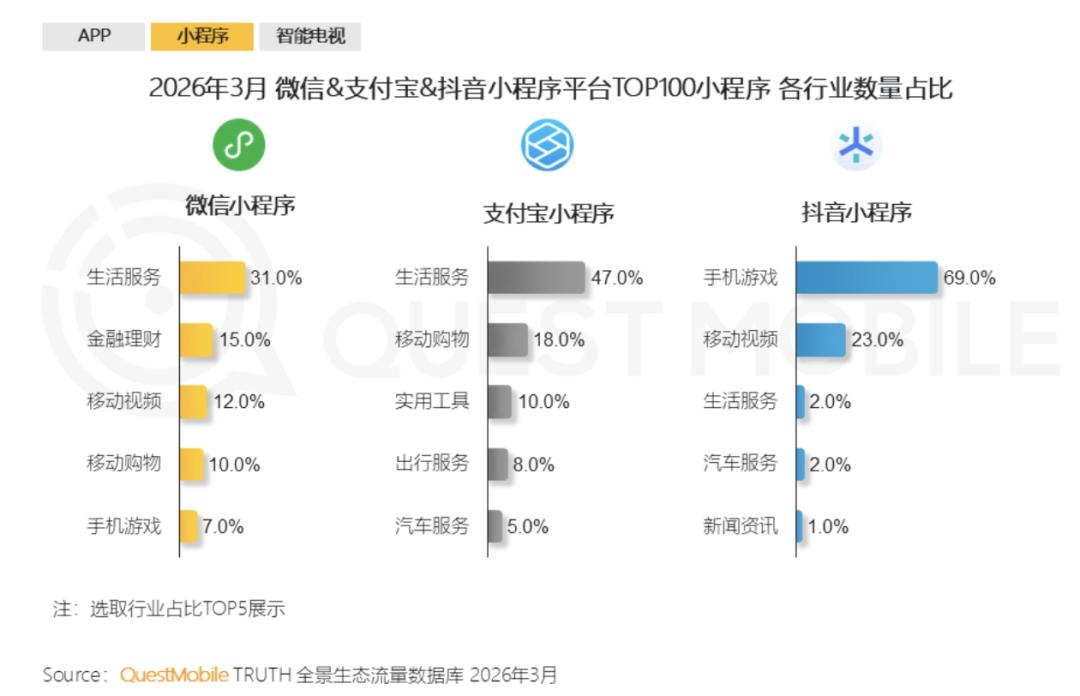
According to data previously released by QuestMobile, the scale of Alipay mini - programs has exceeded 4 million. In March 2026, the monthly active user scale of Alipay mini - programs reached 644 million. Analyzing the industry distribution of Alipay's Top 100 mini - programs, it can be found that life services are the core usage scenario of Alipay mini - programs, accounting for up to 47%.
Currently, the implementation of AI capabilities can be mainly divided into two scenarios: one is the productivity scenario, and the other is the life - service scenario.
Products such as CodeX, Trae, Keling, Coze, and WorkBuddy are all targeted at the productivity scenario, which is characterized by a concentrated user usage scenario, a focused set of required product capabilities, and a need for in - depth specialization.
The AI version of Alipay is aimed at the life - service scenario: the core scenario is concentrated, while other personalized scenarios are large in number and scattered, spreading out around the core scenario.
Alipay's original core usage scenario was payment and collection, and it gradually expanded to peripheral scenarios such as mobile phone recharge, medical appointment registration, bill payment, social security inquiry, financial management, insurance, subway and bus services, etc. WeChat's original core scenario was chatting, and it also gradually expanded to scenarios such as red envelopes, payment, mobile phone recharge, medical appointment registration, bill payment, social security inquiry, financial management, insurance, subway and bus services, etc. Yes, I copied and pasted the last seven items.
Obviously, during the process of scenario expansion, leading apps will gradually overlap and even invade each other's core service scenarios. By now, both Alipay and WeChat have connected to a large number of mini - programs, covering all aspects of life - service scenarios.
This "bloatedness" provides objective convenience for Alipay and WeChat to implement AI. Many AI products face the problem of having AI capabilities but having nothing to do, so they have to look for problems to solve and create needs and scenarios. For Alipay and WeChat, there are too many things they can do.
When a product has too many scattered functions, how to enable users to quickly find the functions they need becomes the core proposition in interaction design. Before the intervention of AI, the traditional interaction logic was that the less frequently used a function was, the deeper its entrance was. In the era of "dialogue as service", AI assistants can equally and efficiently call all services in the ecosystem. The interaction convenience of a niche function used by only 10,000 people should be the same as that of a mainstream function used by 10 million people every day.
However, from another perspective, implementing AI in the already fully - functional Alipay ecosystem doesn't bring much of an experience upgrade for users. It's just switching the interaction method from "search + selection" to "dialogue + selection". The difference between "saying a word can help you book a taxi" and "saying a word can help you open the taxi - booking page and then you book the taxi yourself" is probably like the difference between a Mercedes - Benz car and a 100 - yuan Mercedes - Benz coupon.

Unable to calculate accounts accurately and only playing a symbolic role in linking services, the current AI version of Alipay is undoubtedly still a semi - finished product.
Not long ago, Doubao launched a product recommendation function. Users can directly access the Douyin Mall to purchase the products recommended by Doubao. Even though this recommendation method may not become the mainstream purchase path for e - commerce users, based on Doubao's large user base, this new link will still bring considerable e - commerce traffic.
Rather than being on the offensive, Alipay's AI transformation is more like a defense. Before Doubao and DeepSeek link more e - commerce and local life - service capabilities, Alipay wants to stabilize its service position in its own ecosystem.
If the era of "dialogue as service" doesn't come, Abao can just quietly leave and return the space in the lower - left corner of the home page to the compressed bottom tabs. Once the era of "dialogue as service" arrives quickly and everyone really wants to buy a Mercedes - Benz, at least users can remember that they have a 100 - yuan Mercedes - Benz coupon.
This article is from the WeChat official account "Hedgehog Commune" (ID: ciweigongshe), written by the editorial department of Hedgehog Commune, and is published by 36Kr with authorization.